Sensex & Nifty Tumble on US-Iran Conflict, Rupee Slides to 95.70, NTPC Approves ₹20,457 Crore Lara Project
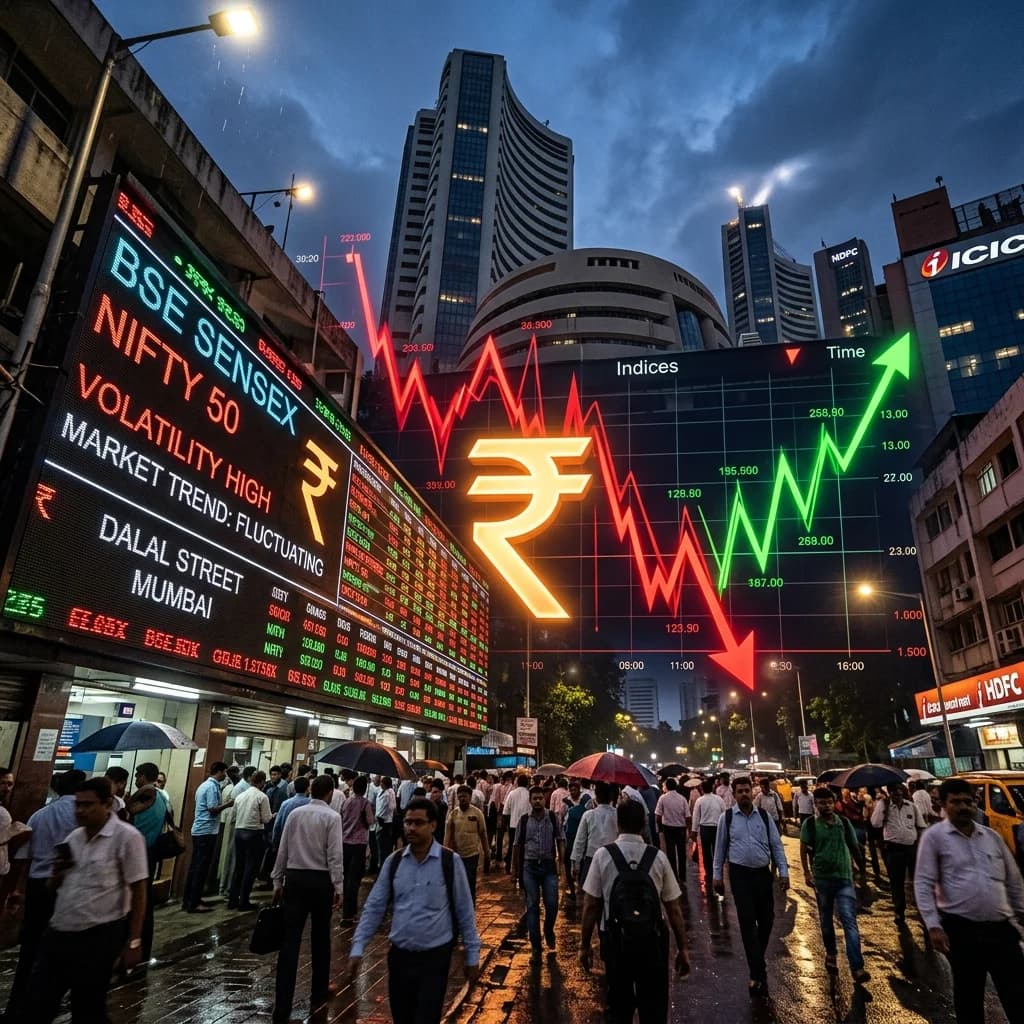
Sensex & Nifty Tumble on US-Iran Conflict, Rupee Slides to 95.70, NTPC Approves ₹20,457 Crore Lara Project
Indian financial markets faced a sharp sell-off on Monday, July 13, 2026, as escalating geopolitical tensions between the United States and Iran triggered a gap-down opening and sent crude prices soaring. The benchmark indices witnessed heavy volatility, with the NSE Nifty 50 testing the key 24,000 level and the BSE Sensex plunging over 600 points in early trade, before staging a partial recovery led by buying in the IT sector. Meanwhile, the Indian Rupee depreciated by 37 paise against the US Dollar to open at 95.70, and state-owned power giant NTPC captured headlines by approving a major ₹20,456.70 crore investment for Stage-III of its Lara Super Thermal Power Project.
📊 Dalal Street Tumbles as US-Iran Escalation Sparks Global Risk-Off Sentiment
Indian equity markets opened deep in the red on Monday, July 13, 2026, as geopolitical concerns in the Middle East rattled global investor confidence. A fresh round of military exchanges between the United States and Iran, coupled with threats of closure of the strategically critical Strait of Hormuz, sparked fears of a disruption in global energy supplies. The BSE Sensex opened 670 points lower, hitting an intraday low of 76,899.39, while the broader NSE Nifty 50 plummeted by over 200 points to test the critical psychological level of 24,000.20. Market volatility spiked, with the India VIX rising 9.8% to 14.50, reflecting heightened investor nervousness.
The morning sell-off was broad-based, with sectors like metal, banking, and automobiles bearing the brunt of the pressure. High-beta stocks and metal exporters fell sharply on fears of global demand slowing down. The market staged a partial recovery by mid-morning, led by a recovery in major technology names like TCS, Infosys, and HCLTech, as investors sought safety in export-oriented sectors that stand to benefit from a weaker rupee. Market breadth was sharply negative with approximately 1,900 stocks declining against 650 advancing — an advance-decline ratio of 0.34:1, signalling broad institutional selling rather than sectoral rotation.
FII provisional data indicated heavy net selling throughout the morning session. The total FII outflow for the session reached ₹3,062.27 crore — the highest single-session outflow in July 2026. Domestic Institutional Investors (DIIs) partially absorbed the selling pressure, providing net buying support of approximately ₹1,240 crore, but were insufficient to prevent the headline index from closing near its intraday lows.
🔬 Technical Analysis: Nifty Tests Critical 24,000 Support
Monday's intraday low of 24,000.20 on the Nifty 50 is one of the most significant technical moments of the July 2026 volatility cycle. The 24,000 level represents the confluence of:
- The 100-day exponential moving average (EMA)
- The lower boundary of the multi-month ascending channel
- The largest Put open interest concentration in NSE's near-month derivatives
The fact that the index bounced from exactly this zone — recovering intraday to close around 24,180 — suggests strong institutional support at these levels. Options writers who had sold 24,000 Puts at high premiums actively defend this strike by purchasing the underlying, creating a structural buying floor.
However, the risk is clear: if 24,000 breaks on a closing basis on high volume, the next meaningful support is only at 23,600–23,700 (200-day EMA), representing a further 2.5% downside from current levels. The key metric to watch is whether India VIX sustains above 15 — historically, Nifty corrections during periods of VIX above 15 tend to be more prolonged and deeper than those occurring at VIX below 14.
💸 Rupee Slides 37 Paise to 95.70 on Surging Brent Crude and Strong Dollar Index
The Indian Rupee (INR) faced significant downward pressure on Monday, July 13, 2026, opening 37 paise weaker against the US Dollar at 95.70. The sharp depreciation was driven by the global spike in crude oil prices, which saw Brent crude jump over 4% to trade above $79 per barrel. As India imports more than 85% of its crude oil requirements, rising energy prices put pressure on the country's current account deficit and fan concerns over imported inflation, leading traders to bid up the US Dollar.
Additionally, the US Dollar Index (DXY) strengthened toward 104.80 as international investors rushed to safe-haven assets amidst the geopolitical turmoil. Analysts noted that the Reserve Bank of India (RBI) likely intervened selectively through state-run banks in the non-deliverable forward (NDF) and spot markets to curb excessive volatility and prevent a runaway depreciation beyond the 95.80 mark.
The Strait of Hormuz dimension adds particular risk for India. Approximately 80% of India's imported crude oil transits the Strait of Hormuz — any prolonged closure or severe disruption would not only spike Brent crude prices but also create supply-chain delays for India's oil refineries, potentially causing fuel shortages and a sharp acceleration in pump-level petrol and diesel prices. The 1973 Arab oil embargo and the 1979 Iranian Revolution are historical precedents that show how energy shocks can cascade into broad economic slowdowns and inflationary spirals — scenarios that Indian policymakers are working urgently to prevent through diplomatic channels and strategic petroleum reserve management.
⚡ NTPC Board Approves ₹20,457 Crore for Lara Thermal Power Expansion in Chhattisgarh
On the corporate front, state-run power major NTPC Limited stood out positively after its Board of Directors approved a capital expenditure proposal of ₹20,456.70 crore. The investment is earmarked for the Lara Super Thermal Power Project Stage-III (2x800 MW) in Chhattisgarh, which will add 1,600 MW of ultra-supercritical thermal capacity to the national grid. NTPC stock stood resilient during the morning market sell-off, trading flat to marginally positive as investors cheered the company's capacity expansion ambitions.
This major capacity addition aligns with NTPC's target to secure India's baseline power demand, which has been growing at 7–8% annually due to rising industrial activity, urban air-conditioning loads, and data centre electricity consumption. The ultra-supercritical technology selected for Lara Stage-III is designed to improve fuel efficiency — the plant will achieve approximately 38–40% thermal efficiency compared to 32–34% for older subcritical plants — reducing both operational costs and carbon dioxide emissions per unit of electricity generated.
The ₹20,456.70 crore investment represents one of the largest single thermal power project approvals in India in FY27, and is aligned with the Union Government's power sector capital expenditure priorities. NTPC is simultaneously scaling up its renewable energy subsidiary with a 60 GW green capacity target by 2032, making this coal plant approval a strategic base-load investment designed to ensure grid reliability as India's intermittent renewable capacity grows.
For investors in NTPC, the approval supports a multi-year revenue growth runway — the new 1,600 MW capacity will add approximately ₹6,000–7,000 crore in annual regulated revenue once commissioned. NTPC's regulated return model (15.5% post-tax return on equity on regulated assets) makes these capacity additions highly predictable cash flow generators.
💡 Investor Takeaway: Geopolitics Creates Tactical Opportunities
Monday's sell-off, driven by external geopolitical factors rather than domestic fundamental deterioration, typically creates tactical buying opportunities for quality large-cap names once the initial panic subsides. Key considerations:
-
NTPC's resilience on a down day is a signal — companies with regulated earnings and strong government backing tend to outperform during market-wide risk-off events. NTPC, Power Grid, and similar regulated utilities are natural defensive positioning choices during geopolitical volatility.
-
IT sector's partial bounce is instructive — IT names like TCS and Infosys recovered intraday despite the broader market sell-off because a weaker rupee benefits rupee-revenue IT exporters. Every 1% depreciation in the rupee adds approximately 30–40 basis points to IT sector earnings margins.
-
24,000 is the line to watch on Nifty — If this level holds into the weekly close, the medium-term bull case remains intact. Investors should use dips toward 24,100–24,200 to gradually accumulate quality blue-chips in financials, FMCG, and IT.
📌 The Bottom Line
- market-selloff-geopolitics: The Nifty 50 fell to an intraday low of 24,000.20 and the Sensex plunged 670 points as US-Iran escalations triggered ₹3,062 crore in FII outflows. India VIX surged 9.8% to 14.50.
- rupee-depreciation: The Rupee depreciated 37 paise to 95.70 against the USD as Brent crude spiked 4% above $79. Hormuz closure risk remains the single biggest tail risk for India's energy import costs.
- ntpc-lara-expansion: NTPC's board approved ₹20,456.70 crore for Lara Stage-III (1,600 MW ultra-supercritical), adding ~₹6,000–7,000 crore in regulated annual revenue once commissioned.
📬 Stay Updated
Get India market analysis delivered to your inbox every trading day. Subscribe to our free newsletter →
Disclosure: This post contains affiliate links. If you purchase through our links, we earn a small commission at no extra cost to you. We only recommend products we believe in.
Enjoyed this post?
Get our weekly digest delivered free.
Share this post:
Knowelth is reader-supported. We may earn a commission from links in this article at no extra cost to you. Read our disclosure.
Related Posts
India Markets Daily: Sensex Rebounds to 78,080 as Nifty Drags, RBI Proposes Loan Reset Rules, FIIs Sell ₹1,006 Cr
India Markets Daily: Sensex Rebounds to 78,080 as Nifty Drags, RBI Proposes Loan Reset Rules, FIIs Sell ₹1,006 Cr Indian financial markets navigated a divergent trading session on August 13, 2026, as …
India Markets Update: Nifty Drops Below 24,450 Amid Oil Spike, RBI Holds Repo Rate at 5.25%, and FII Inflows Resume
India Markets Update: Nifty Drops Below 24,450 Amid Oil Spike, RBI Holds Repo Rate at 5.25%, and FII Inflows Resume Indian benchmark indices drifted lower for a second consecutive session as global en…
Nifty Snaps 4-Day Rally as Pre-RBI Policy Jitters & Crude Surge Trigger Profit Booking; Bharti Airtel Q1 Profit Soars 37%
Nifty Snaps 4-Day Rally as Pre-RBI Policy Jitters & Crude Surge Trigger Profit Booking; Bharti Airtel Q1 Profit Soars 37% Indian benchmark equity indices snapped their four-session winning streak on A…