Nifty Snaps 4-Day Rally as Pre-RBI Policy Jitters & Crude Surge Trigger Profit Booking; Bharti Airtel Q1 Profit Soars 37%
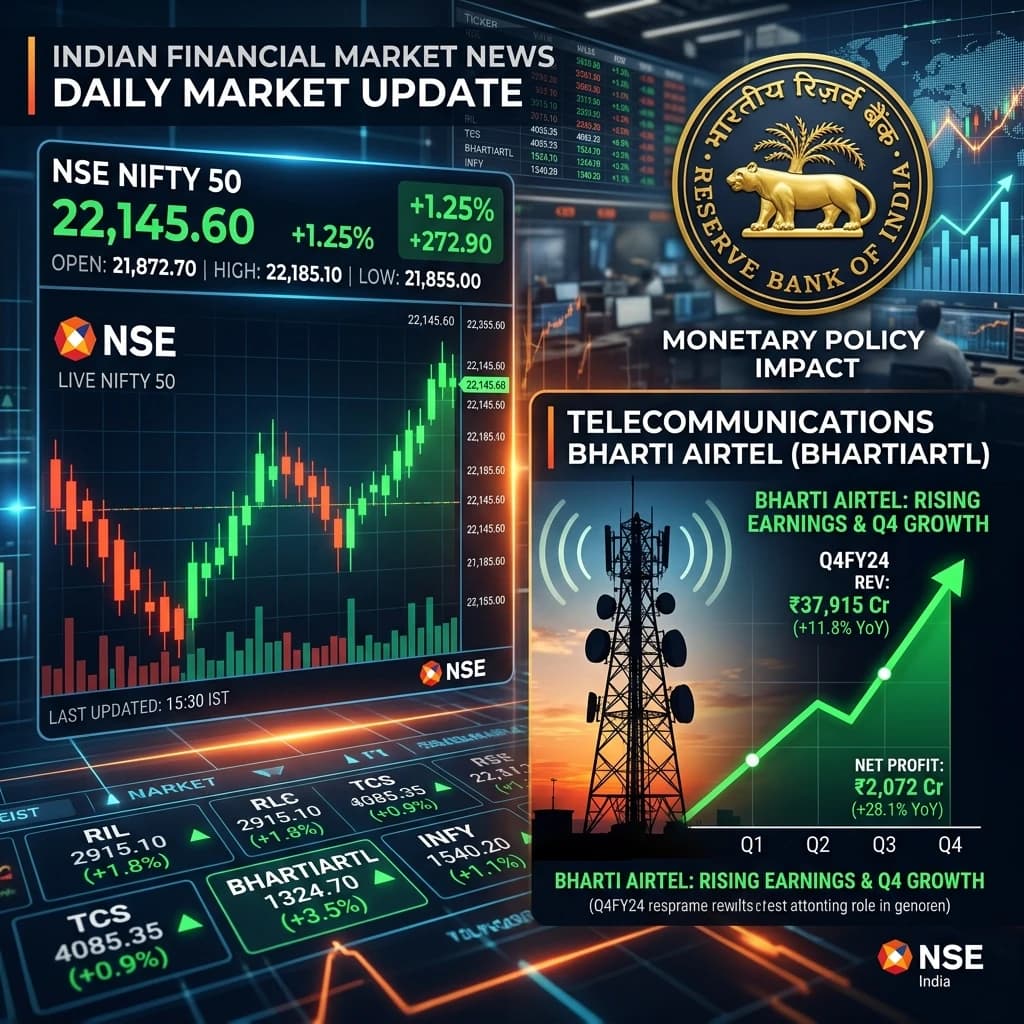
Nifty Snaps 4-Day Rally as Pre-RBI Policy Jitters & Crude Surge Trigger Profit Booking; Bharti Airtel Q1 Profit Soars 37%
Indian benchmark equity indices snapped their four-session winning streak on August 4, 2026, as investors locked in profits ahead of the Reserve Bank of India's (RBI) upcoming monetary policy announcement. Mounting pressure from rising global crude oil prices, regulatory scrutiny in the FMCG sector, and technical volatility stemming from newly implemented derivatives closing mechanisms led to broad-based distribution across Dalal Street.
📊 Nifty Slips 159 Points as Pre-RBI Caution and Crude Spikes Drag Sensex Lower
Dalal Street turned cautious on Tuesday, August 4, 2026, breaking its recent bullish momentum as market participants chose to reduce exposure ahead of the Reserve Bank of India's Monetary Policy Committee (MPC) resolution scheduled for August 5. The NSE Nifty 50 surrendered 159.40 points, or 0.64%, to close at 24,614.90, while the BSE Sensex declined 210.08 points, or 0.27%, to settle at 78,428.95.
Market breadth was heavily skewed toward decliners, with 15 out of the 16 major sectoral indices ending in negative territory. The sell-off was fueled by a nearly 3% spike in Brent crude oil prices, which crossed $86 per barrel due to renewed supply disruption concerns in key maritime transit zones. Given India's dependency on crude imports, elevated energy costs rekindled inflation apprehensions and weighed heavily on consumer-facing equities. The Nifty FMCG index suffered the steepest decline, dropping 1.5%, led by heavy losses in Hindustan Unilever, Colgate-Palmolive, and Dabur India. IT and financial heavyweights also acted as major drags on the benchmark indices, while only the Nifty Metal index managed modest gains on the back of firm global base metal pricing.
India VIX rose 4.6% to 14.80, reflecting increased pre-policy hedging demand. FII provisional data showed net outflows of ₹1,123 crore as foreign investors reduced risk positions ahead of the policy announcement, while DIIs bought ₹1,517 crore in equities, partially cushioning the decline.
📉 Technical Picture: Pre-Policy Consolidation Below 24,700
The Nifty 50's close at 24,614.90 keeps the index in technically positive territory — above all major moving averages (20-day EMA at ~24,200, 50-day EMA at ~23,950, 100-day EMA at ~23,700). However, the failure to sustain above the recent swing high of 24,780 on decreasing volume is a mild caution signal.
The RSI-14 at 58.2 is in the bullish zone but pulling back from near-overbought levels — consistent with a healthy consolidation rather than a trend reversal. MACD remains in positive crossover territory. The overall technical structure remains bullish; the current dip is pre-event positioning rather than structural deterioration.
Key levels around the RBI policy announcement:
- Immediate support: 24,500 (psychological level + short-term consolidation base)
- Key support: 24,200 (20-day EMA — break would signal near-term trend shift)
- Resistance on upside breakout: 24,780–25,000 (swing high + major round number)
- A rate cut from RBI would be bullish trigger toward: 25,200–25,500 (Bollinger Band upper and all-time high territory)
📉 Technical Derivatives Mechanics and FSSAI Scrutiny Impact Sectoral Trends
Beyond macroeconomic headwinds, trading activity on August 4 was significantly influenced by structural and regulatory developments. Market participants adjusted to the introduction of the new Closing Auction Session (CAS) mechanism for stocks in the Futures and Options (F&O) segment. The CAS — modelled on international best practices used in markets like Hong Kong and London — runs for a brief 15-minute window after regular trading hours and determines the official closing price through a blind auction, eliminating the ability for large participants to "mark the close" with last-minute directional trades.
Analysts noted that the updated pricing mechanism led to heightened volatility and brief price discovery aberrations during the final 30 minutes of trade as institutional desks realigned their hedging models to account for the new closing price methodology. The initial disruption is expected to settle within 2–4 weeks as market participants adapt their algorithms and position management frameworks to the new CAS environment.
Simultaneously, the Fast-Moving Consumer Goods (FMCG) basket encountered distinct regulatory turbulence. Sector major Dabur India faced selling pressure following regulatory communications from the Food Safety and Standards Authority of India (FSSAI) regarding marketing claims on product labeling — specifically around the nutritional claims made for certain herbal health products. The regulatory action triggered a broader repricing across packaged consumer goods manufacturers, amplifying the sell-off in defensive counters.
🏛️ RBI MPC Preview: What Markets Are Pricing In for August 5
The RBI's Monetary Policy Committee is meeting on August 4–5, 2026, with the policy resolution announcement scheduled for the morning of August 5. Market consensus is split between:
- Status quo (most likely — ~60% probability): The RBI holds the repo rate at 5.25% given that CPI inflation at 4.38% in June has breached the 4.0% target, and Brent crude at $86/barrel adds upside inflation risk. A rate hold would be mildly disappointing for equity markets but broadly expected.
- 25 bps rate cut (possible — ~35% probability): If the RBI focuses on growth support and emphasises that the inflation breach is temporary (food price driven), a 25 bps cut would be a meaningful positive surprise for equity markets — particularly rate-sensitive sectors like banking, real estate, and NBFCs.
- Rate hike (very unlikely — ~5% probability): Only warranted if June CPI were to print materially above 5.5%. Not the current scenario.
How to position for tomorrow's announcement:
- If rate cut: Overweight banking (NIM beneficiary), real estate, and NBFCs; reduce IT
- If rate hold with neutral tone: Markets likely range-bound; quality large-caps remain the play
- If rate hold with hawkish tone: Defensive names (FMCG, Pharma) outperform; reduce cyclicals
🏛️ Bharti Airtel Posts 37.3% Q1 Net Profit Jump; DII Flows Cushion FII Volatility
On the corporate earnings front, telecommunications leader Bharti Airtel delivered stellar Q1 FY27 financial results after market hours. The telecom operator posted a 37.3% year-on-year increase in consolidated net profit to ₹8,167 crore, driven by steady Average Revenue Per User (ARPU) expansion, strong subscriber additions in 5G premium tiers, and robust growth in its enterprise and African business units. Airtel's India wireless ARPU improved to ₹222 from ₹206 a year ago — a 7.8% increase reflecting the continuing shift of subscribers from feature phones to smartphones and from lower to higher-tier data plans.
Meanwhile, real estate major DLF reported a modest 4% YoY increase in net profit for the June quarter, reflecting steady residential booking execution despite higher input costs. DLF's pre-sales bookings for Q1 FY27 were in line with management guidance, suggesting that India's premium residential property market continues to demonstrate resilience even at elevated property prices.
Institutional flow dynamics provide underlying structural support. While FIIs maintained a selective stance, DIIs deployed ₹1,517 crore in equities — continuing their pattern of using pre-event dips as accumulation opportunities. The persistent inflow from domestic mutual funds via SIPs (estimated at ₹23,000+ crore monthly as of mid-2026) continues to absorb global liquidity shocks and prevent deep drawdowns in broader market valuations.
💡 Investor Takeaway: Pre-Policy Dips Are Typically Short-Lived
Historical analysis of Indian equity market behaviour around RBI MPC announcements shows a consistent pattern: markets tend to sell off in the 1–2 sessions immediately before the announcement (as observed today), and then rally on the day of the announcement regardless of the outcome, as uncertainty premium unwinds. The key exception is when the RBI delivers a strongly hawkish surprise — which appears unlikely given current economic conditions.
Strategy for August 4–5:
- Today's dip to 24,614 on the Nifty 50 is a tactical buying opportunity for medium-term investors, particularly in quality large-caps with strong earnings visibility (Airtel being a case in point with its 37% profit growth)
- Reduce exposure to FMCG names facing regulatory headwinds until the FSSAI situation clarifies
- Watch for the 9:15 AM reaction on August 5 post-policy announcement for directional cues
📌 The Bottom Line
- nifty-sensex-decline: Sensex declined 210.08 points (-0.27%) to 78,428.95 and Nifty 50 fell 159.40 points (-0.64%) to 24,614.90 amid pre-RBI policy profit-booking and Brent crude climbing past $86/bbl. VIX rose 4.6% to 14.80.
- rbi-mpc-preview: Markets assign ~60% probability to a rate hold at 5.25% and ~35% to a 25 bps cut. The new Closing Auction Session (CAS) for F&O contracts also induced end-of-day market volatility as institutions adjusted hedging models.
- bharti-airtel-q1-earnings: Bharti Airtel reported a 37.3% YoY jump in Q1 net profit to ₹8,167 crore, with India wireless ARPU rising to ₹222. Sustained DII buying of ₹1,517 crore provided key support against macro headwinds.
📬 Stay Updated
Get India market analysis delivered to your inbox every trading day. Subscribe to our free newsletter →
Disclosure: This post contains affiliate links. If you purchase through our links, we earn a small commission at no extra cost to you. We only recommend products we believe in.
Enjoyed this post?
Get our weekly digest delivered free.
Share this post:
Knowelth is reader-supported. We may earn a commission from links in this article at no extra cost to you. Read our disclosure.
Related Posts
India Markets Daily: Sensex Rebounds to 78,080 as Nifty Drags, RBI Proposes Loan Reset Rules, FIIs Sell ₹1,006 Cr
India Markets Daily: Sensex Rebounds to 78,080 as Nifty Drags, RBI Proposes Loan Reset Rules, FIIs Sell ₹1,006 Cr Indian financial markets navigated a divergent trading session on August 13, 2026, as …
India Markets Update: Nifty Drops Below 24,450 Amid Oil Spike, RBI Holds Repo Rate at 5.25%, and FII Inflows Resume
India Markets Update: Nifty Drops Below 24,450 Amid Oil Spike, RBI Holds Repo Rate at 5.25%, and FII Inflows Resume Indian benchmark indices drifted lower for a second consecutive session as global en…

Nifty Drops Below 24,000 as Oil Spikes; Rupee Slides to 96.59 Ahead of RBI FDI Reform Push
Nifty Drops Below 24,000 as Oil Spikes; Rupee Slides to 96.59 Ahead of RBI FDI Reform Push Indian equity benchmarks succumbed to acute global pressures on July 22, 2026, as geopolitical conflicts in t…