India Markets Update: Nifty Drops Below 24,450 Amid Oil Spike, RBI Holds Repo Rate at 5.25%, and FII Inflows Resume
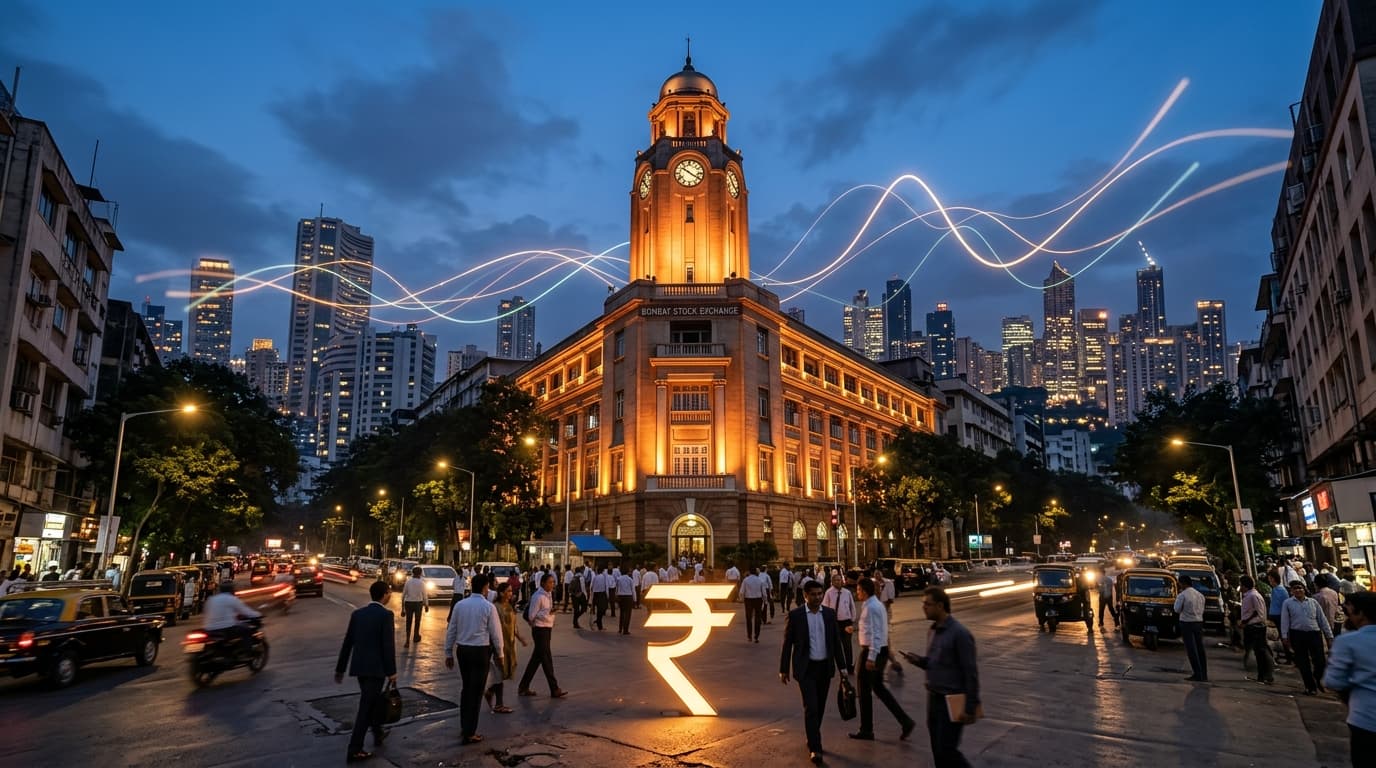
India Markets Update: Nifty Drops Below 24,450 Amid Oil Spike, RBI Holds Repo Rate at 5.25%, and FII Inflows Resume
Indian benchmark indices drifted lower for a second consecutive session as global energy price spikes and geopolitical tensions weighed on equity sentiment. Despite headline declines in major indices, strong domestic institutional flows and steady RBI policy signals provided structural resilience.
📌 Nifty 50 & Sensex Pullback Amid Geopolitical Friction and Brent Crude Surge
Indian benchmark equity indices closed in the red on August 12, 2026, reflecting cautious market sentiment triggered by escalating geopolitical uncertainty in the Middle East and a sharp spike in international energy prices. The 30-share BSE Sensex declined by 188.00 points, or 0.24%, to settle at 77,966.35, while the broader NSE Nifty 50 index lost 36.00 points, or 0.15%, ending the trading session at 24,435.95. Intraday volatility spiked as India VIX rose 3.40% to 14.85 points, signaling heightened short-term derivative hedging activity among institutional traders.
The primary macro catalyst driving market weakness was the sharp rally in Brent crude futures, which neared $90.00 per barrel following supply disturbance concerns surrounding maritime routes in the Strait of Hormuz. As one of the world's largest net importers of crude oil, India faces elevated current account deficit (CAD) pressures whenever energy benchmarks rise rapidly. Analysts estimate that every sustained $10.00 per barrel increase in Brent crude inflates India's annual import bill by approximately $13 billion to $15 billion and expands the CAD by nearly 40 basis points.
Sectoral performance reflected sharp divergence across themes. Heavyweight interest-rate-sensitive and export-oriented sectors faced notable selling pressure, with the Nifty IT index dropping 0.85%, led by corrections in Tata Consultancy Services (TCS) and Infosys. FMCG and Healthcare counters also receded by 0.62% and 0.45%, respectively. Adding to the negative momentum in blue-chip stocks was corporate leadership uncertainty within Tata Group counters following media confirmation that Tata Sons Chairman N. Chandrasekaran would not seek a second term extension beyond his current tenure ending in early FY27.
Conversely, public sector banks and basic metals demonstrated strong relative strength, keeping market losses capped. The Nifty PSU Bank index rallied 1.12%, spurred by robust quarterly asset quality metrics and attractive valuation buffers, while the Nifty Metal index surged 0.78% on firming global industrial commodity prices. Market breadth closed moderately negative, with 1,120 stocks advancing against 1,450 declining issues on the National Stock Exchange. From a technical perspective, market strategists highlight 24,350 (near the 50-day exponential moving average) as crucial immediate support for the Nifty 50, with overhead resistance pegged firmly at the 24,600 level.
📉 RBI Monetary Policy Committee Retains Repo Rate at 5.25% with Neutral Stance
In macro policy developments, the Reserve Bank of India’s (RBI) Monetary Policy Committee (MPC) concluded its bi-monthly review meeting by maintaining the benchmark repo rate at 5.25% for the fourth consecutive sitting. Consequently, the Standing Deposit Facility (SDF) rate remains unchanged at 5.00%, while the Marginal Standing Facility (MSF) rate and the Bank Rate stand at 5.50%. The six-member MPC voted unanimously to preserve a "neutral" monetary stance, signaling that central bankers remain committed to aligning inflation with targets while ensuring adequate liquidity for economic growth.
Significantly, the central bank adjusted its macroeconomic projections for Fiscal Year 2027 (FY27). Under the leadership of RBI Governor Sanjay Malhotra, the RBI revised India's real GDP growth forecast upward from 6.6% to 6.7%, citing strong private capital expenditure cycles, robust urban demand, and expanding services sector activity. Simultaneously, the CPI inflation forecast for FY27 was trimmed downward to 5.0% from 5.2%, reflecting optimistic expectations regarding domestic food supply management and stabilized supply chain logistics.
Governor Malhotra emphasized in his post-policy address that while headline inflation could experience temporary spikes due to seasonal food volatility and global crude swings, core inflation metrics show negligible signs of generalized price pressure. The policy tone was characterized by financial market participants as "balanced and calibrated," striking a pragmatic middle ground between aggressive easing and monetary tightening. The announcement helped anchor benchmark 10-year Indian Government Bond (IGB) yields near 6.82%, preventing yield curve inversion and stabilizing corporate borrowing costs.
Banking analysts view the RBI’s steady policy rate stance as a positive development for commercial lenders' Net Interest Margins (NIMs). By avoiding surprise rate changes, banks can maintain stable deposit pricing structures while preserving loan growth momentum, particularly across retail housing and industrial credit segments. Money market traders now project potential monetary easing to materialize toward the fourth quarter of FY27, contingent upon favorable monsoon distribution and global interest rate cuts by the US Federal Reserve.
📊 Institutional Capital Flows: FIIs and DIIs Turn Net Buyers Amid Market Dip
Despite intraday indices pullback, institutional capital metrics revealed healthy underlying liquidity conditions across Indian capital markets. Latest trading data from the BSE and NSE indicated that Foreign Institutional Investors (FIIs) returned as net buyers in the cash equity segment, acquiring shares worth ₹258.55 crore ($31 million). Simultaneously, Domestic Institutional Investors (DIIs) reinforced market sentiment by deploying net cash purchases of ₹24.77 crore ($3 million).
The synchronized net buying by both institutional categories underscores a persistent long-term asset allocation shift toward Indian equities. While global emerging market funds have engaged in tactical profit-booking over recent months, domestic retail capital flows managed via Systematic Investment Plans (SIPs) continue to set record high watermarks. Monthly SIP inflows into Indian equity mutual funds surpassed ₹23,500 crore, providing a resilient structural liquidity floor that absorbs foreign fund liquidations during global risk-off phases.
Foreign portfolio flows have also shown selective sector rotation rather than outright capital flight. Institutional trade logs show foreign asset managers reallocating funds out of high-valuation consumer discretionary stocks into cyclical value plays such as PSU banks, power utilities, and infrastructure equipment manufacturers. Furthermore, foreign investors have maintained steady inflows into Indian sovereign debt instruments following India's increased weighting in global emerging market bond indices, which has attracted passive fixed-income allocations exceeding $1.2 billion per month.
On the currency front, the Indian Rupee (INR) exhibited remarkable stability against the US Dollar, trading at 83.92 per USD despite a strengthening US Dollar Index (DXY), which advanced to 104.20 points. Strategic interventions by the Reserve Bank of India in the non-deliverable forward (NDF) and spot foreign exchange markets have kept currency volatility muted. Supported by foreign exchange reserves standing comfortably near $675 billion, India's financial system remains well-insulated against external exchange rate shocks, reinforcing foreign investor confidence in domestic equity and debt markets.
📌 The Bottom Line
- nifty-pullback: Nifty 50 slips 36 points to 24,435.95 as Brent crude touches $90/bbl, with crucial technical support holding firm at 24,350.
- rbi-rate-hold: RBI maintains repo rate at 5.25% with neutral stance, raising FY27 real GDP forecast to 6.7% while trimming CPI inflation target to 5.0%.
- fii-dii-flows: FIIs and DIIs log net cash purchases of ₹258.55 crore and ₹24.77 crore respectively, backed by ₹23,500+ crore monthly SIP structural inflows.
📫 Stay Updated
Get India market analysis delivered to your inbox every trading day. Subscribe to our free newsletter →
Disclosure: This post contains affiliate links. If you purchase through our links, we earn a small commission at no extra cost to you. We only recommend products we believe in.
Enjoyed this post?
Get our weekly digest delivered free.
Share this post:
Knowelth is reader-supported. We may earn a commission from links in this article at no extra cost to you. Read our disclosure.
Related Posts
India Markets Daily: Sensex Rebounds to 78,080 as Nifty Drags, RBI Proposes Loan Reset Rules, FIIs Sell ₹1,006 Cr
India Markets Daily: Sensex Rebounds to 78,080 as Nifty Drags, RBI Proposes Loan Reset Rules, FIIs Sell ₹1,006 Cr Indian financial markets navigated a divergent trading session on August 13, 2026, as …

Nifty Snaps 4-Day Rally as Pre-RBI Policy Jitters & Crude Surge Trigger Profit Booking; Bharti Airtel Q1 Profit Soars 37%
Nifty Snaps 4-Day Rally as Pre-RBI Policy Jitters & Crude Surge Trigger Profit Booking; Bharti Airtel Q1 Profit Soars 37% Indian benchmark equity indices snapped their four-session winning streak on A…

Nifty Drops Below 24,000 as Oil Spikes; Rupee Slides to 96.59 Ahead of RBI FDI Reform Push
Nifty Drops Below 24,000 as Oil Spikes; Rupee Slides to 96.59 Ahead of RBI FDI Reform Push Indian equity benchmarks succumbed to acute global pressures on July 22, 2026, as geopolitical conflicts in t…