Sacred Circles and Stone Blooms: The Architectural Wonders of Bhedaghat, Bhubaneswar, and Hangal
Sacred Circles and Stone Blooms: The Architectural Wonders of Bhedaghat, Bhubaneswar, and Hangal
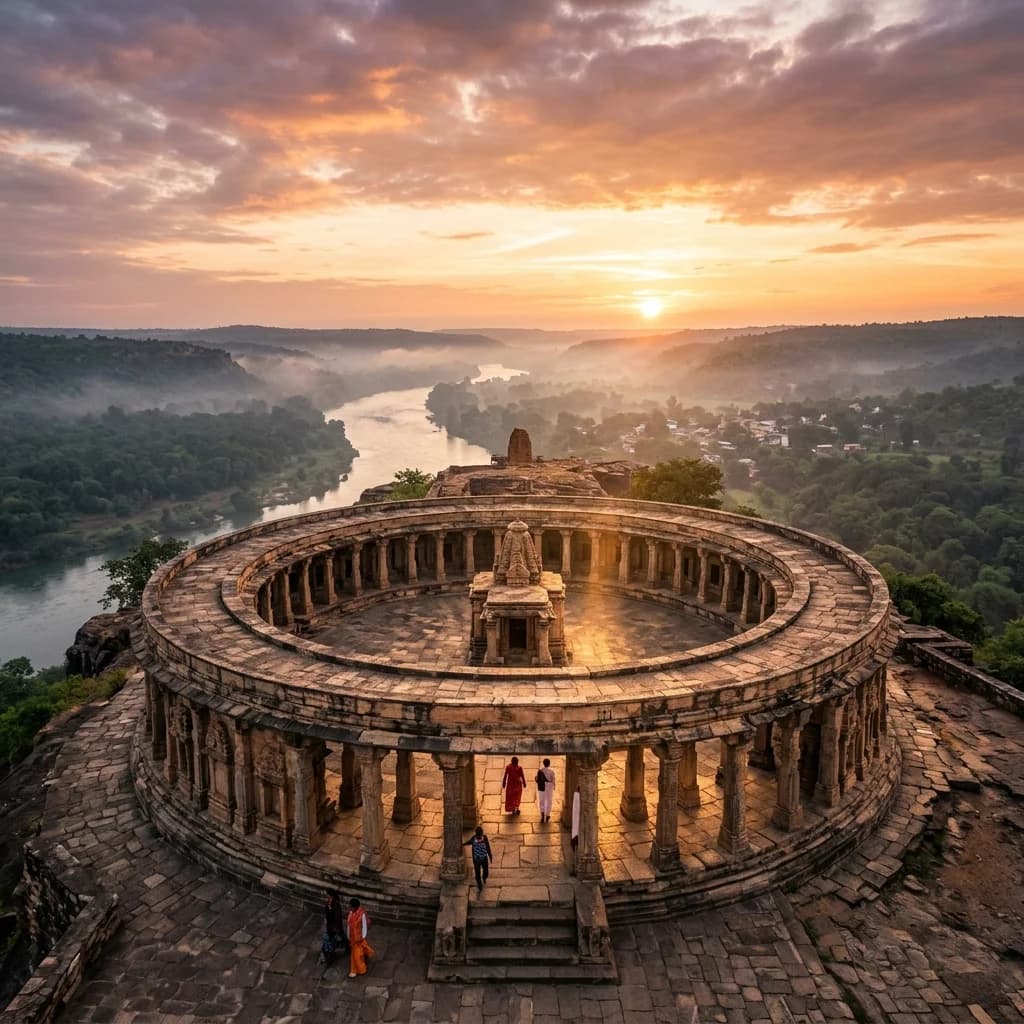
Three medieval temples across India's heartland reveal the full diversity of subcontinental architectural genius. The Chausath Yogini Temple at Bhedaghat (Kalachuri dynasty, c. 10th–11th century CE) is India's largest hypaethral circular temple — 81 open-sky Yogini niches in a 131-foot granite ring above the Narmada gorge, encoding Tantric cosmology where Khajuraho encodes devotional eroticism. The Rajarani Temple at Bhubaneswar (Somavamshi dynasty, c. 11th century CE) is Odisha's finest synthesis of Kalinga and central Indian clustered-spire architecture — its uniquely warm Rajarani sandstone shifting from honey-gold to rust under different sun angles. And the Tarakeshwara Temple at Hangal (Kalyani Chalukya, c. 1180 CE) achieves the impossible: a 6-metre monolithic hanging lotus ceiling carved from a single soapstone block, supported by eight lathe-turned pillars, that has not moved in 840 years.
🏛️ Chausath Yogini Temple, Bhedaghat — Open-Sky Tantric Circle
The Yogini Cult — What It Was and Why It Needed Open Temples
The Tantric Yogini tradition: The Yogini cult was a distinct Tantric tradition within Shaivism that flourished in central India between approximately 800–1200 CE. Yoginis were semi-divine feminine beings — part goddess, part siddha (accomplished practitioner) — associated with:
- Direct, embodied spiritual power (shakti)
- Dangerous, ecstatic, boundary-transgressing energy
- Transformative rituals that included offerings, possession states, and invocatory dance
Why Yogini temples are always hypaethral (open to the sky): The sky is not incidental — it is architecturally essential. Yogini rituals required:
- Moonlight (Yoginis were associated with lunar energies and nocturnal practice)
- Open air for fire rituals (homa)
- Direct elemental exposure — earth, water, wind, fire, sky as participants in the ritual
- Circular form to enact the mandala (cosmic diagram) in physical space
An enclosed roof would literallydefeat the purpose. No other major Hindu temple tradition consistently uses hypaethral design — this is unique to Yogini shrines.
The 81-Niche Layout at Bhedaghat
Temple specifications:
| Element | Detail |
|---|---|
| Dynasty | Kalachuri of Tripuri (central India) |
| Patron | King Yuvarajadeva II (c. 975–1000 CE) + Queen Alhanadevi (central shrine, 1155 CE) |
| Location | Hilltop above Narmada River, near Dhuandhar Falls, Jabalpur, Madhya Pradesh |
| External diameter | ~40m (131 feet) — largest circular hypaethral temple in India |
| Niche count | 81 (not the canonical 64 Yoginis) |
| Wall material | Granite + sandstone (composite) |
| Construction type | Circular perimeter wall with colonnaded niches; central open courtyard |
| UNESCO status | Not yet designated; under consideration |
Why 81 niches instead of the canonical 64: The Chausath (sixty-four) Yoginis represent the canonical tradition derived from Shaiva Agama texts. Bhedaghat's 81 shrines represent a royal expansion:
| Yogini count | Textual source | Temple examples |
|---|---|---|
| 42 | Rare — early regional traditions | Isolated Odisha sites |
| 64 | Primary Agama texts (Yoginihrydaya, Kulachudamani) | Most Yogini temples (Khajuraho, Hirapur, Ranipur-Jharial) |
| 81 | Royal modification (9 × 9 grid = 81) | Bhedaghat |
The number 81 = 9² — a mathematically auspicious expansion of the 9×9 Navayoni (nine-source) cosmic grid. By adding 17 extra Yogini shrines, Yuvarajadeva II was claiming the protection of an expanded cosmic feminine force, signalling supreme temporal authority.
The surviving sculptures: Of the 81 original Yogini figures, approximately 40 survive in recognisable form. The figures display:
- Kapalika iconography: Yoginis hold skull cups (kapala), severed heads, and tridents — imagery associated with cremation-ground Tantric practice
- Anatomical realism: musculature, facial expressions of raudra (fierce) emotion, dynamic postures mid-dance or mid-flight
- Animal vahanas (mounts): each Yogini stands on a distinct animal — lion, tiger, serpent, fish, owl — defining her specific power domain
The central Gauri-Shankar shrine (1155 CE): Queen Alhanadevi's addition — a small enclosed shrine at the courtyard's centre — contains a panel showing Shiva and Parvati mounted together on Nandi, in a posture of intimate royal partnership. This was a deliberate political statement: the reigning Kalachuri king identified himself with Shiva, the queen with Parvati, their sovereignty blessed by the entire ring of Yogini power surrounding them.
🗿 Rajarani Temple, Bhubaneswar — The Stone That Changes Colour
The "Temple City" of Bhubaneswar
Bhubaneswar (Odisha) is known as the "Temple City of India" — at its medieval peak, it contained over 7,000 temples. Today, approximately 500 survive. The Rajarani Temple is one of the finest surviving examples because it was never converted, damaged by iconoclasm, or structurally altered.
Bhubaneswar temple chronology (Kalinga school):
| Period | Architectural Characteristic | Key Example |
|---|---|---|
| Early (7th–8th c.) | Simple single-spire; minimal sculpture | Parasuramesvara (c. 650 CE) |
| Middle (9th–10th c.) | Larger spire; sculpture programme expanding | Mukteshvara (c. 950 CE) |
| Peak (10th–11th c.) | Clustered angashikharas; dense sculpture | Rajarani (c. 1000–1050 CE) |
| Late (12th–13th c.) | Massive scale; Lingaraja style | Lingaraja (c. 1090–1104 CE) |
Rajarani Stone — The Geology of Architecture
The Rajarani sandstone: The temple's name derives from the geological material used in construction. "Rajarani" (meaning "king-queen") refers to a specific ferruginous sandstone quarried from the Bhubaneswar region:
| Property | Detail | Architectural Effect |
|---|---|---|
| Composition | Silica sandstone with high iron oxide content | Warm rust, gold, and honey tones |
| Colour under morning sun | Deep amber-gold | Golden hour effect — temple appears lit from within |
| Colour at noon | Pale honey-yellow | High contrast against blue sky |
| Colour at sunset | Deep rust-red | Dramatic contrast with evening sky |
| Workability | Fine-grained; good for high-relief carving | Enables deep 3D relief sculpture |
| Durability | Moderate (less than granite, comparable to limestone) | Some surface erosion over 1,000 years |
This chromatic variability — a single material producing wildly different visual experiences depending on light angle — means the Rajarani Temple changes throughout the day, an intentional property exploited by the Somavamshi patron.
Architectural Analysis
The Pancharatha (five-projection) plan: The Rajarani Temple follows the Pancharatha layout — the outer wall has five projecting bays (rathas) on each face, creating a complex cross-section that increases carving surface while modulating light and shadow.
The angashikharas — Rajarani's Khajuraho connection: What distinguishes Rajarani from earlier Kalinga temples is its clustered subsidiary spires (angashikharas) arranged around the central gandi (curvilinear spire). These subsidiary spires are exactly the same design principle as the ushringas of Kandariya Mahadeva at Khajuraho — physical evidence of architectural exchange between Odisha and central India under the Somavamshi dynasty.
The exterior sculpture programme:
| Subject | Location | Count | Significance |
|---|---|---|---|
| Dikpalas (8 directional guardians) | Corner niches | 8 | Cosmic protection from all directions |
| Nayikas (women in daily activities) | Central band | ~60 | Auspiciousness, feminine beauty |
| Mithuna couples (amorous pairs) | Intermediate band | ~30 | Life force, Shiva-Shakti union |
| Lakulisa (Pashupata Shaiva founder) | Doorway | 1 | Confirms Pashupata sect patronage |
| Naga/Nagini (serpent deities) | Base + corners | ~20 | Underworld protection; fertility |
🔱 Tarakeshwara Temple, Hangal — The Monolithic Hanging Lotus
Kalyani Chalukya Architecture — The Western Chalukya Style
The Tarakeshwara Temple at Hangal (c. 1180 CE) represents the Late Kalyani Chalukya style — the culmination of the western Deccan's architectural tradition before it was superseded by Hoysala refinement.
| Aspect | Detail |
|---|---|
| Dynasty | Kadamba of Hangal (vassals of Kalyani Chalukyas) |
| Date | c. 1180 CE |
| Location | Hangal, Haveri district, Karnataka |
| Deity | Shiva as Tarakeshwara |
| Material | Chloritic schist (soapstone) |
| Architectural style | Late Kalyani Chalukya (transitional to Hoysala) |
The Lotus Ceiling — Engineering Analysis
The "Lotus of Hangal" specifications:
| Element | Specification |
|---|---|
| Location | Ceiling of the sabhamandapa (octagonal assembly hall) |
| Material | Single monolithic soapstone block |
| Diameter | ~6 metres (20 feet) |
| Depth of carving | Lotus bud drops ~2.75 metres (9 feet) below the ceiling plane |
| Supporting pillars | 8 highly polished lathe-turned columns |
| Pillar height | ~3 metres |
| Weight of ceiling block | Estimated 30–40 tonnes |
| Age | ~840 years (no structural movement detected) |
The engineering challenge: Carving a 6-metre, 30–40 tonne dome into a single stone block while:
- Maintaining structural integrity — removing material from the centre (the lotus bud hangs 2.75m below) while the remaining stone must support its own weight
- Creating uniform concentric petal rings — this requires the stone to be worked from a precisely calibrated centre point
- Achieving a smooth curved surface (the dome) + intricate petal detail simultaneously
- Lifting and placing a 30–40 tonne carved stone ceiling onto 8 columns without cracking it
The solution: soapstone's fresh-quarried softness allowed carving with iron chisels (not possible in granite). The dome was carved before hardening, placed while still relatively soft, and the atmospheric hardening process then locked it in position permanently. The 8 lathe-turned pillars were produced on rotating lathes — the only way to achieve the precise circular symmetry of their decorative columns visible today.
The "lathe-turned" pillars: Medieval Indian temple builders used horizontal stone lathes — a stone pillar held at both ends and rotated while a fixed chisel cuts circular profiles. This is identical in principle to a modern wood lathe. Evidence from Hangal (and Halebidu, Belur, and other Kalyani Chalukya sites) confirms that lathe-turning was a standard technique for soapstone column production in this tradition.
📌 The Bottom Line
- bhedaghat-chausath-yogini-kalachuri: Largest circular hypaethral temple in India: 40m diameter, 81 niches (not canonical 64: expanded to 81=9² by Yuvarajadeva II for supreme cosmic feminine protection); hypaethral mandatory for Yogini ritual (moonlight + fire + elemental exposure + mandala form); surviving sculptures: kapalika iconography (skull cups, severed heads, animal vahanas), fierce raudra expressions; central Gauri-Shankar 1155 CE: queen Alhanadevi's political Shiva-Parvati sovereignty statement.
- rajarani-bhubaneswar-somavamshi: Peak Kalinga style (10th-11th c.); ferruginous sandstone = Rajarani stone: amber-gold morning, honey noon, rust-red sunset (chromatic variability intentional); Pancharatha 5-projection plan; angashikharas = clustered subsidiary spires (same principle as Khajuraho Kandariya = physical evidence of Somavamshi-Chandela architectural exchange); exterior: 8 dikpalas (directional guardians) + 60 nayikas + 30 mithuna couples + Lakulisa (confirms Pashupata patronage).
- tarakeshwar-hangal-kalyani-chalukya: c. 1180 CE; chloritic schist soapstone; Lotus of Hangal: single monolithic block, 6m diameter, bud drops 2.75m below ceiling plane, 30-40 tonnes, 8 lathe-turned support pillars, ~840 years with zero structural movement; engineering sequence: carve while fresh-quarried soft (iron chisel) → place → atmospheric hardening permanently locks 30-40 tonne ceiling in position; lathe-turned pillars = horizontal stone lathe identical in principle to modern wood lathe.
📬 Stay Updated
Explore India's extraordinary architectural heritage with weekly deep dives. Subscribe to our free newsletter →
Disclosure: This post contains affiliate links. If you purchase through our links, we earn a small commission at no extra cost to you. We only recommend products we believe in.
Enjoyed this post?
Get our weekly digest delivered free.
Share this post:
Knowelth is reader-supported. We may earn a commission from links in this article at no extra cost to you. Read our disclosure.
Related Posts
Stone Chronicles of Sovereignty and Democracy: The Epigraphic Legacy of Aihole's Meguti Temple, Uttiramerur's Assembly Inscriptions, and the Royal Reliefs of Hampi's Hazara Rama
Stone Chronicles of Sovereignty and Democracy: The Epigraphic Legacy of Aihole's Meguti Temple, Uttiramerur's Assembly Inscriptions, and the Royal Reliefs of Hampi's Hazara Rama Across the diverse lan…
Monolithic Cliffs, Alpine Spires, and Chariots of Stone: The Architectural Feats of Dhamnar, Baijnath, and Melkadambur
Monolithic Cliffs, Alpine Spires, and Chariots of Stone: The Architectural Feats of Dhamnar, Baijnath, and Melkadambur Across the vast geographical expanse of the Indian subcontinent, ancient and medi…
Sacred Corridors, Interlocking Stone Chains, and Thousand-Pillar Sanctuaries: The Architectural Marvels of Rameswaram, Kanchipuram, and Moodabidri
Sacred Corridors, Interlocking Stone Chains, and Thousand-Pillar Sanctuaries: The Architectural Marvels of Rameswaram, Kanchipuram, and Moodabidri Across the Indian subcontinent, sacred architecture r…