Monuments of Eternal Granite and Sandstone: Unveiling Thanjavur, Khajuraho, and Badami
Monuments of Eternal Granite and Sandstone: Unveiling Thanjavur, Khajuraho, and Badami
Across the Indian subcontinent, ancient stone sanctuaries stand not merely as places of worship, but as living codices of imperial ambition, mathematical genius, and architectural innovation. From the fertile Kaveri delta of Tamil Nadu to the forested sandstone plateau of Madhya Pradesh and the red cliff canyons of Karnataka, medieval master builders transformed raw geology into immortal spiritual monuments. By examining the structural feats, regional design paradigms, and epigraphic archives of the Brihadeeswarar Temple, Kandariya Mahadeva Temple, and the Badami Cave Temples, we trace how three great dynasties carved their cultural legacy into stone.
🏛️ Brihadeeswarar Temple of Thanjavur: The Granite Apex of Imperial Chola Engineering
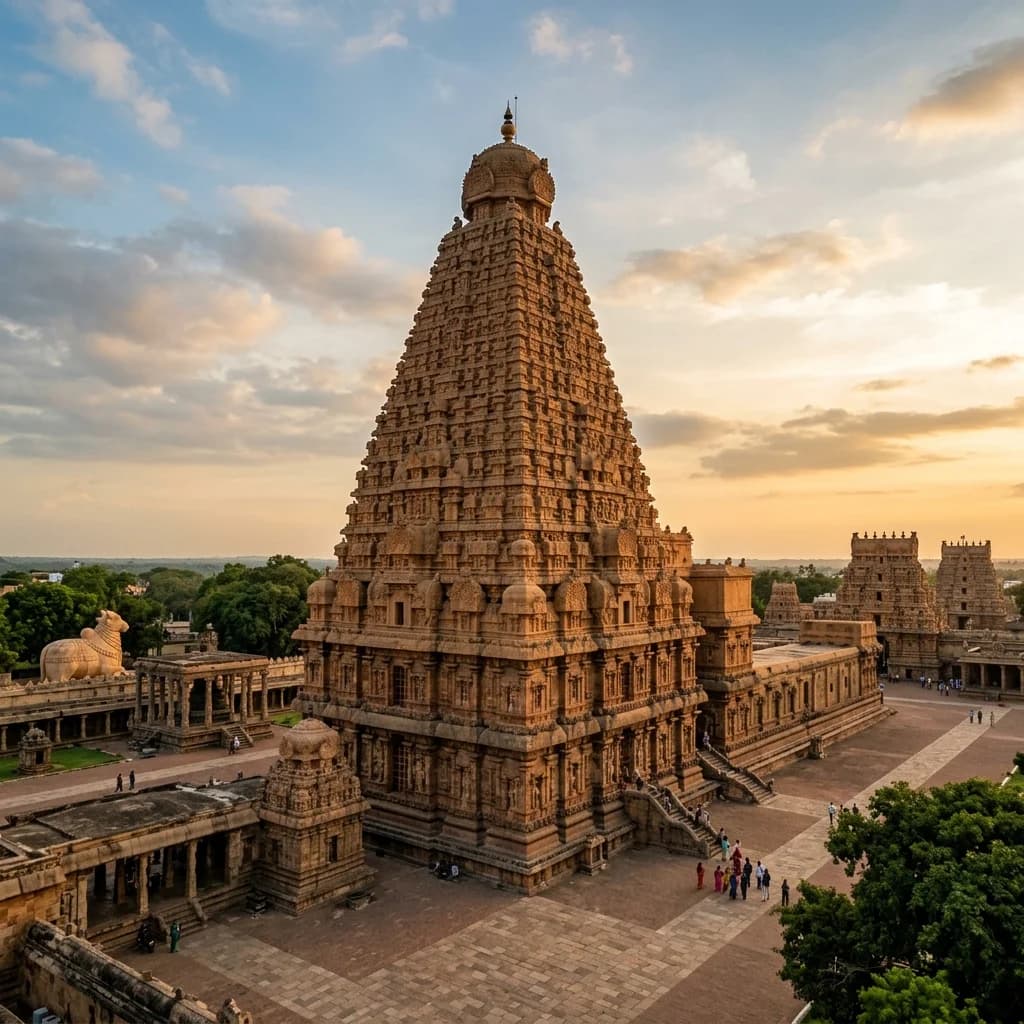
Rising majestically above the alluvial plains of Thanjavur, Tamil Nadu, the Brihadeeswarar Temple—originally consecrated as Rajarajeswaram—stands as the definitive supreme achievement of Dravidian temple architecture. Commissioned by Emperor Raja Raja Chola I and completed in 1010 CE to mark his 25th regnal year, the monument was designed to project the immense spiritual devotion and naval power of the Chola Empire at its zenith. Built entirely of hard granite—a rock non-native to the Thanjavur district that had to be quarried and transported from rock outcrops over 60 kilometers away—the complex spans a monumental 240-meter long courtyard enclosed by fortified walls and guarded by grand multi-tiered stone gateways (gopurams).
Architecturally, Brihadeeswarar reversed traditional Dravidian spatial proportions by erecting a soaring 216-foot (66-meter) central tower (vimana) over the main sanctum (garbhagriha), dwarfing its entrance gopurams. Known in inscriptions as Dakshina Meru (the Meru of the South), the 13-tiered pyramidal vimana is crowned by a colossal monolithic granite apex stone (kumbam or sikhara) weighing approximately 80 tons. Master masons assembled the entire 130,000-ton structure without a single drop of mortar, utilizing precision interlocking stone joinery and tenon slots. To hoist the massive 80-ton capping stone to a height exceeding 200 feet, Chola engineers constructed a miles-long earthen inclined ramp (sarvatobhadra inclined plane), demonstrating an extraordinary mastery of structural physics and logistics.
Beyond its engineering brilliance, Brihadeeswarar functions as an irreplaceable epigraphical archive. The smooth granite base mouldings of the sanctum are covered in pristine Old Tamil and Grantha inscriptions carved under the direct supervision of Raja Raja Chola I. Unlike typical donor records, these epigraphs document an exhaustive administrative blueprint of the Chola state: they record the precise names, duties, and land allotments for over 600 temple staff—including dancers, musicians, accountants, jewelers, and bronze sculptors—as well as detailed inventories of 66 gold and bronze icons donated by the King, his elder sister Princess Kundavai, and his royal queens. These records provide historians with an unparalleled window into medieval Indian economic organization, social stratification, and statecraft.
🗿 Kandariya Mahadeva Temple of Khajuraho: The Soaring Sandstone Peak of Chandela Artistry
Nestled in the Chhatarpur district of Madhya Pradesh, the Kandariya Mahadeva Temple represents the absolute pinnacle of Nagara style architecture in Central India. Built around 1030 CE during the golden age of the Chandela dynasty under King Vidyadhara—the sovereign who successfully defended his realm against Mahmud of Ghazni—the temple was dedicated to Lord Shiva as the "Great God of the Cave." Constructed entirely of fine-grained buff sandstone set upon a massive masonry platform (jagati), Kandariya Mahadeva was engineered to evoke the sacred, snow-capped contours of Mount Kailash soaring out of the earthly realm.
The structural composition of Kandariya Mahadeva is an exercise in complex architectural rhythm and mathematical symmetry. Arranged along an east-west central axis, the floor plan progresses sequentially through a stepped entrance porch (ardhamandapa), an outer hall (mandapa), a grand assembly hall (mahamandapa), a dark vestibule (antarala), and an inner sanctum encased by an ambulatory path (pradakshinapatha). Above this unified base rises a central spire (shikhara) reaching 117 feet (31 meters), surrounded by a cluster of 84 smaller miniature spires (urushringas). This fractal-like repetition of spires creates an ascending visual crescendo that guides the eye upward toward the main finial (amalaka and kalasha), symbolizing the soul's cosmic ascent to enlightenment.

Figure 1: Intricate stone craftsmanship and architectural elements at Kandariya Mahadeva Temple.
Every square inch of Kandariya Mahadeva's exterior facade is adorned with high-relief stone carvings carved with fluid grace and microscopic detail. Over 800 sculptures—ranging from celestial maidens (sursundaris) twisting in dance postures to multi-armed guardian deities, mythological beasts (yali), and erotic couples (mithunas)—cover the exterior friezes. Far from being purely decorative, these sculptures reflect the Tantric and Puranic worldview of the Chandela court, where non-dualistic philosophy integrated spiritual transcendence (moksha) with worldly vitality (kama). The precision of the stonework, joined by mortise-and-tenon grooves without binding mortar, has enabled the soaring sandstone spire to withstand centuries of environmental weathering.
🛕 Badami Cave Temples: The Red Sandstone Monolithic Rock-Cut Legacy of the Chalukyas
Enjoyed this post?
Get our weekly digest delivered free.
Perched along the dramatic red sandstone cliffs surrounding the sacred Agastya Lake in the Bagalkot district of Karnataka, the Badami Cave Temples stand as the foundational cradle of South Indian rock-cut architecture. Carved during the 6th and 7th centuries CE under the early Badami Chalukya dynasty—founded by Pulakeshin I and expanded by his sons Kirtivarman I and Mangalesha—these four cave shrines were excavated directly into the cliff face. Serving as the royal capital of Vatapi, Badami became an intellectual melting pot where master artisans experimented with both Northern (Nagara) and Southern (Dravida) stylistic elements, creating the precursor to the Vesara architectural synthesis.
The excavation of the Badami caves represents a monumental feat of manual quarrying and subterranean engineering. Rather than building up with masonry blocks, Chalukyan craftsmen cut inward into the living rock face using iron chisels and hammers. Cave 1, the oldest shrine dedicated to Shaivism, features a colonnaded porch, a pillared hall, and a small sanctum housing a Shiva Lingam. Its entrance is flanked by the world-famous 18-armed sculpture of Shiva as Nataraja performing the cosmic dance of creation and destruction, capable of forming 81 distinct dance postures (karanas). Caves 2 and 3 are dedicated to Vaishnavism, with Cave 3 being the largest and most ornate; an inscription dated to 578 CE (Saka 500) explicitly attributes its consecration to King Mangalesha during the reign of Kirtivarman I, documenting royal land grants to the shrine.
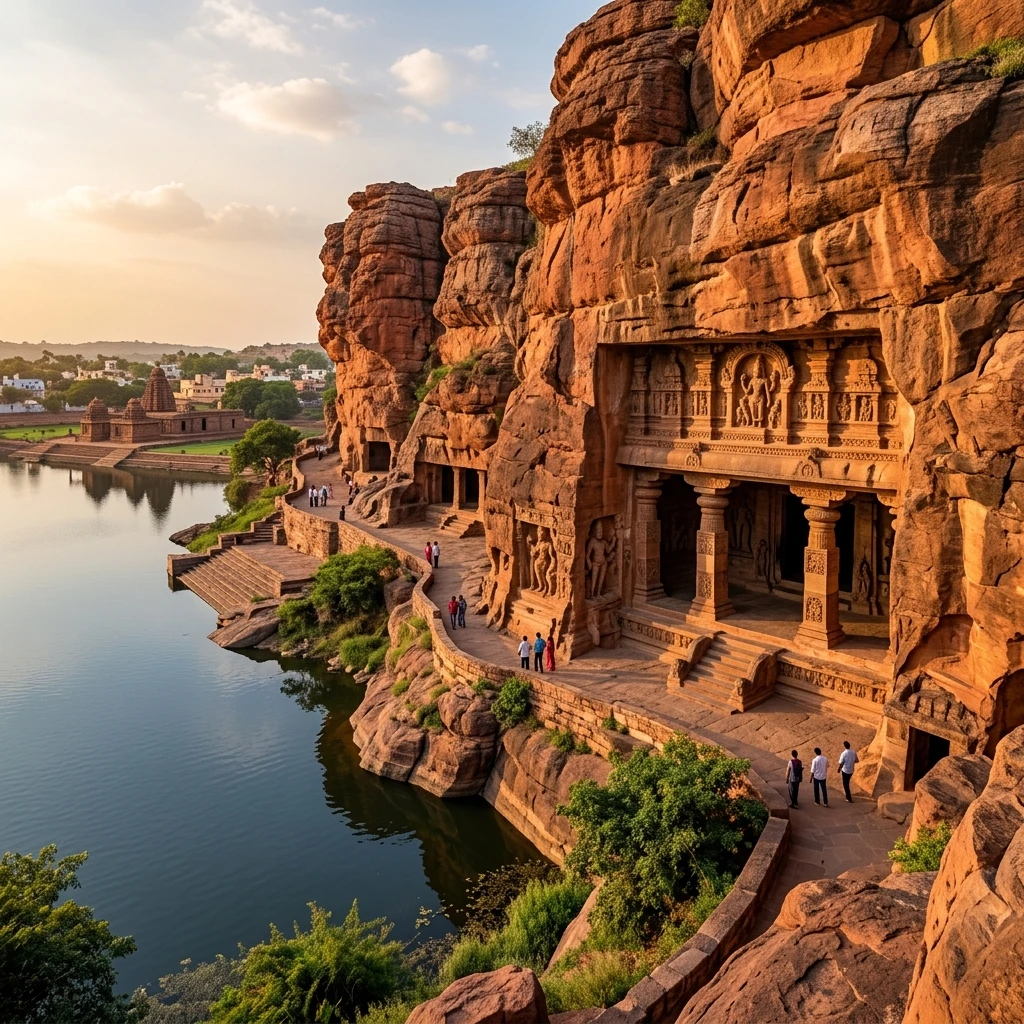
Figure 2: Architectural design and monumental structures at Badami Cave Temples.
Cave 4, carved high on the eastern cliff face, is dedicated to Jainism and features exquisite relief sculptures of Lord Mahavira seated on a lion throne and Tirthankara Parshvanatha sheltered by a multi-hooded serpent. The juxtaposition of Shaivite, Vaishnavite, and Jain shrines within a single royal rock-cut complex reflects the profound religious tolerance and syncretism fostered by the Chalukya kings. Inside the deep shadow of the caves, lathe-shaped columns support coffered stone ceilings carved with swirling lotus medallions, celestials (gandharvas), and narrative scenes. The fiery red hue of the natural iron-rich sandstone, combined with the enduring power of rock-cut carving, has preserved these 1,400-year-old subterranean sanctuaries as timeless symbols of early medieval Indian art.
📌 The Bottom Line
- thanjavur-brihadeeswarar: Celebrates Raja Raja Chola I's 11th-century mortarless granite masterpiece, soaring 216 feet with an 80-ton capping stone and unmatched administrative inscriptions.
- khajuraho-kandariya: Represents Chandela King Vidyadhara's 11th-century Nagara sandstone peak, renowned for its fractal spire geometry and over 800 detailed relief sculptures.
- badami-caves: Highlights the 6th-century Badami Chalukya rock-cut cliff sanctuaries, featuring the iconic 18-armed Nataraja and early Saka 500 royal epigraphs.
📫 Stay Updated
Get India's heritage and history stories delivered to your inbox every week. Subscribe to our free newsletter →
Disclosure: This post contains affiliate links. If you purchase through our links, we earn a small commission at no extra cost to you. We only recommend products we believe in.
Knowelth publishes independently researched analysis verified against primary documentation, academic journals, and official records. To report a factual inaccuracy or request a correction, please reach out via our Contact Page.
Enjoyed this post?
Get our weekly digest delivered free.
Share this post:
Knowelth is reader-supported. We may earn a commission from links in this article at no extra cost to you. Read our disclosure.
Related Posts
Stone Chronicles of Sovereignty and Democracy: The Epigraphic Legacy of Aihole's Meguti Temple, Uttiramerur's Assembly Inscriptions, and the Royal Reliefs of Hampi's Hazara Rama
Stone Chronicles of Sovereignty and Democracy: The Epigraphic Legacy of Aihole's Meguti Temple, Uttiramerur's Assembly Inscriptions, and the Royal Reliefs of Hampi's Hazara Rama Across the diverse lan…
Monolithic Cliffs, Alpine Spires, and Chariots of Stone: The Architectural Feats of Dhamnar, Baijnath, and Melkadambur
Monolithic Cliffs, Alpine Spires, and Chariots of Stone: The Architectural Feats of Dhamnar, Baijnath, and Melkadambur Across the vast geographical expanse of the Indian subcontinent, ancient and medi…
Sacred Corridors, Interlocking Stone Chains, and Thousand-Pillar Sanctuaries: The Architectural Marvels of Rameswaram, Kanchipuram, and Moodabidri
Sacred Corridors, Interlocking Stone Chains, and Thousand-Pillar Sanctuaries: The Architectural Marvels of Rameswaram, Kanchipuram, and Moodabidri Across the Indian subcontinent, sacred architecture r…