Nifty Reclaims 24,000 Milestone Amid Global Rally; RBI Warns of AI Cyber Risks; New NBFC Rules Kick In
Nifty Reclaims 24,000 Milestone Amid Global Rally; RBI Warns of AI Cyber Risks; New NBFC Rules Kick In
The Indian stock market snapped its two-day losing streak on July 1, 2026, as the benchmark Nifty 50 surged past the crucial 24,000 milestone to close at a new high. A strong rebound in blue-chip equities, falling crude prices, and positive global cues drove the rally, overriding immediate domestic regulatory concerns. However, the Reserve Bank of India (RBI) tempered market optimism with stark warnings in its June Financial Stability Report (FSR) regarding AI-enabled cyber threats, even as its new regulatory relief guidelines for smaller non-banking financial companies (NBFCs) came into effect.
📊 Nifty Reclaims 24,000 Milestone on FMCG and Financials Boost
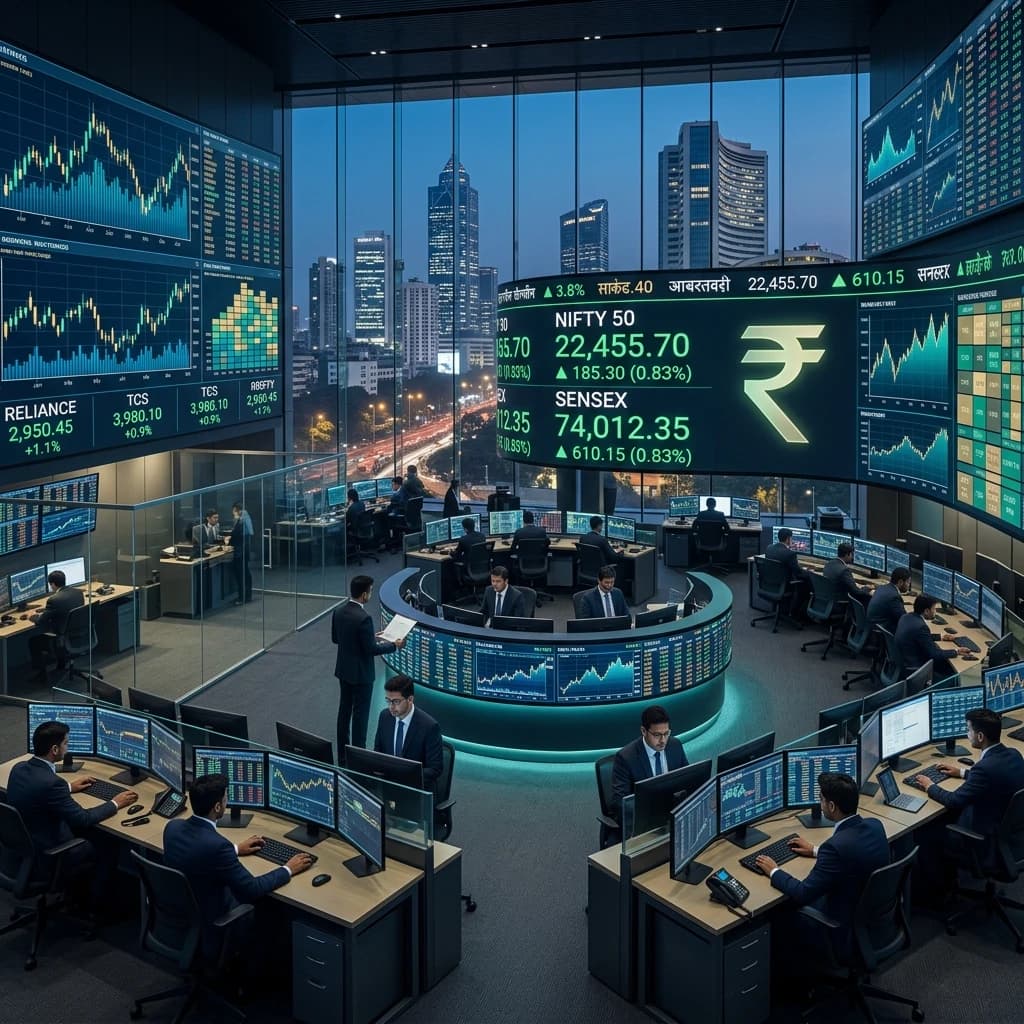
Following two consecutive sessions of losses, benchmark domestic indices witnessed a strong rebound on July 1, 2026. The NSE Nifty 50 reclaimed the psychological milestone of 24,000, gaining 140.10 points (0.59%) to close at 24,005.85. The BSE Sensex rose 443.97 points (0.58%) to settle at 76,922.64. The recovery was driven by robust buying interest in heavyweight FMCG, realty, and financial stocks, though IT equities remained under selling pressure, acting as a drag on indices.
Market participants attributed the upswing to positive global cues and a decline in crude oil prices, which alleviated inflation concerns. Despite the index surge, institutional activity remained mixed. Foreign Institutional Investors (FIIs) continued to be net sellers, offloading equities worth ₹2,556.75 crore in the previous session. However, sustained buying from Domestic Institutional Investors (DIIs) and retail participants provided the necessary support to push the Nifty 50 above the 24,000 threshold. DII purchases for the day totalled ₹1,897 crore, demonstrating the growing depth of domestic institutional capital as a counter-force to FII volatility.
Market breadth on the NSE was broadly positive with approximately 1,720 stocks advancing against 920 declining. India VIX fell 4.2% to 13.20, reflecting improving risk appetite. Notably, the Nifty MidCap 100 and SmallCap 100 indices outperformed the Nifty 50, gaining 0.84% and 1.12% respectively — a sign of broad confidence beyond blue-chip names.
🔬 Technical Picture: First Trading Day of July Opens Bullishly
The Nifty 50's reclamation of 24,000 on the first trading day of Q2 FY27 is significant from both a technical and psychological perspective. The index ended its two-day losing streak with a gap-up open and maintained gains throughout the session — indicative of genuine conviction buying rather than short-covering alone.
The RSI-14 moved from oversold territory at 38 in the prior session to 48.5 by Wednesday's close, approaching the neutral 50 mark from the bearish side. A sustained move above 50 on the RSI would confirm momentum recovery. The 20-day EMA at 23,850 continues to act as the dynamic support floor — as long as the index closes above this, the short-term trend remains constructively bullish.
Key technical levels for early July:
- Immediate resistance: 24,200 (50-day EMA; multiple prior failed attempts here)
- Strong resistance: 24,500–24,600 (previous swing highs and Bollinger Band upper)
- Key support: 23,850 (20-day EMA — critical bear/bull dividing line)
- Secondary support: 23,600 (100-day EMA)
🛡️ RBI Financial Stability Report: AI-Enabled Cyber Attacks Named Most Significant Emerging Risk
The Reserve Bank of India (RBI) released its June 2026 Financial Stability Report (FSR), raising concerns about rapid advancements in artificial intelligence and its implications for the financial ecosystem. The central bank categorized AI-enabled cyberattacks as the "most significant emerging risk" for banks, NBFCs, and other financial institutions over the next 12 months. According to surveyed financial entities, the deployment of AI by malicious actors has dramatically amplified the sophistication, speed, and scale of cyber incidents.
The specific AI-driven threats the RBI highlighted include:
- Deepfake fraud: AI-generated voice and video deepfakes used to impersonate executives and authorise fraudulent transactions — a growing threat that multiple Indian banks have already encountered in limited but costly instances.
- Automated spear-phishing: AI systems that can craft hyper-personalised phishing messages at scale, dramatically increasing the probability of successful social engineering attacks against bank employees and customers.
- AI-driven malware: Self-evolving malware capable of identifying and exploiting zero-day vulnerabilities in core banking systems faster than human security teams can respond.
Beyond operational cyber threats, the RBI also warned of systemic financial risks arising from AI investments. The central bank highlighted that excessive market enthusiasm has led to highly concentrated valuations in AI-linked firms and increased debt-financed capital expenditure, particularly on data centers. The FSR cautioned that a sharp correction in AI-related assets could trigger broader market spillovers, indirectly affecting exposed banking books. In response, the regulator urged financial institutions to ramp up their cybersecurity budgets and integrate AI risk management frameworks into their governance structures.
For investors, this regulatory spotlight on AI risk in banking has two implications: (1) it will increase compliance and cybersecurity spending by banks — a headwind to short-term margins but necessary for systemic safety, and (2) it creates opportunity in cybersecurity solution providers and AI risk management vendors that serve the financial sector.
⚙️ Regulatory Relief: New Rules for Unregistered Type I NBFCs Take Effect
A major structural shift in the NBFC sector came into effect on July 1, 2026, following the implementation of the RBI's updated scale-based regulation guidelines. The new framework introduces a formal category for "Unregistered Type I NBFCs," aimed at providing significant regulatory relief to smaller, non-public-facing financial entities. Under the revised norms, NBFCs are exempt from mandatory registration under Section 45IA of the RBI Act, 1934, provided they do not access public funds, have no customer interface, and maintain a group-level asset size below ₹1,000 crore.
These entities are now eligible to apply for deregistration through the RBI's PRAVAAH portal, with the deadline set for December 31, 2026. This regulatory relief is expected to reduce compliance costs for small investment and holding companies, allowing the central bank to focus its supervisory resources on systemically important financial intermediaries.
In tandem with these rules, the RBI's revamped Integrated Ombudsman Scheme also went live today, providing consumers with a unified, cost-free grievance redressal mechanism across banks, NBFCs, and digital payment issuers. The scheme consolidates previously separate ombudsman frameworks for banking, NBFCs, and digital payments into a single window — significantly simplifying the complaints process for consumers who often interact with multiple financial service providers simultaneously.
💡 Investor Takeaway: Q2 FY27 Opens on Cautiously Optimistic Note
July 1, 2026 marks the start of Q2 FY27 — and the positive open provides a constructive initial signal. However, investors should remain alert to three key risks that could disrupt the bull case over the coming weeks:
- FII flows — FIIs remain net sellers. A reversal to net buying would be a powerful positive catalyst; continued selling could cap upside despite strong DII support.
- Monsoon progress — The June-September monsoon season is critical for India's agriculture, food inflation, and rural consumption. Any significant rainfall deficit (below 95% of long-period average) would stoke food inflation and complicate the RBI's rate trajectory.
- Q1 FY27 earnings season — Beginning in mid-July 2026, corporate results for April-June 2026 will be the single biggest driver of market direction. Strong IT and FMCG earnings are expected to provide support; any negative surprises from banking (particularly on NIM compression) would be watched closely.
📌 The Bottom Line
- nifty-24000: The NSE Nifty 50 surged 0.59% to reclaim 24,000, closing at 24,005.85, driven by FMCG and financial buying. DII support of ₹1,897 crore countered continued FII selling.
- rbi-ai-warnings: The RBI's June 2026 FSR named AI-enabled cyberattacks the top threat to financial stability, citing deepfakes, automated phishing, and AI-driven malware as specific risks requiring urgent bank action.
- nbfc-regulatory-relief: The RBI's new registration exemption for Type I NBFCs with assets under ₹1,000 crore took effect on July 1, 2026, simplifying compliance alongside the launch of the unified Integrated Ombudsman Scheme.
📬 Stay Updated
Get India market analysis delivered to your inbox every trading day. Subscribe to our free newsletter →
Disclosure: This post contains affiliate links. If you purchase through our links, we earn a small commission at no extra cost to you. We only recommend products we believe in.
Enjoyed this post?
Get our weekly digest delivered free.
Share this post:
Knowelth is reader-supported. We may earn a commission from links in this article at no extra cost to you. Read our disclosure.
Related Posts
India Markets Daily: Sensex Rebounds to 78,080 as Nifty Drags, RBI Proposes Loan Reset Rules, FIIs Sell ₹1,006 Cr
India Markets Daily: Sensex Rebounds to 78,080 as Nifty Drags, RBI Proposes Loan Reset Rules, FIIs Sell ₹1,006 Cr Indian financial markets navigated a divergent trading session on August 13, 2026, as …
India Markets Update: Nifty Drops Below 24,450 Amid Oil Spike, RBI Holds Repo Rate at 5.25%, and FII Inflows Resume
India Markets Update: Nifty Drops Below 24,450 Amid Oil Spike, RBI Holds Repo Rate at 5.25%, and FII Inflows Resume Indian benchmark indices drifted lower for a second consecutive session as global en…
Nifty Snaps 4-Day Rally as Pre-RBI Policy Jitters & Crude Surge Trigger Profit Booking; Bharti Airtel Q1 Profit Soars 37%
Nifty Snaps 4-Day Rally as Pre-RBI Policy Jitters & Crude Surge Trigger Profit Booking; Bharti Airtel Q1 Profit Soars 37% Indian benchmark equity indices snapped their four-session winning streak on A…