Nifty and Sensex Extend Gains for Third Session, Forex Reserves Dip by $5.6B, and RBI Fines Bank of Baroda
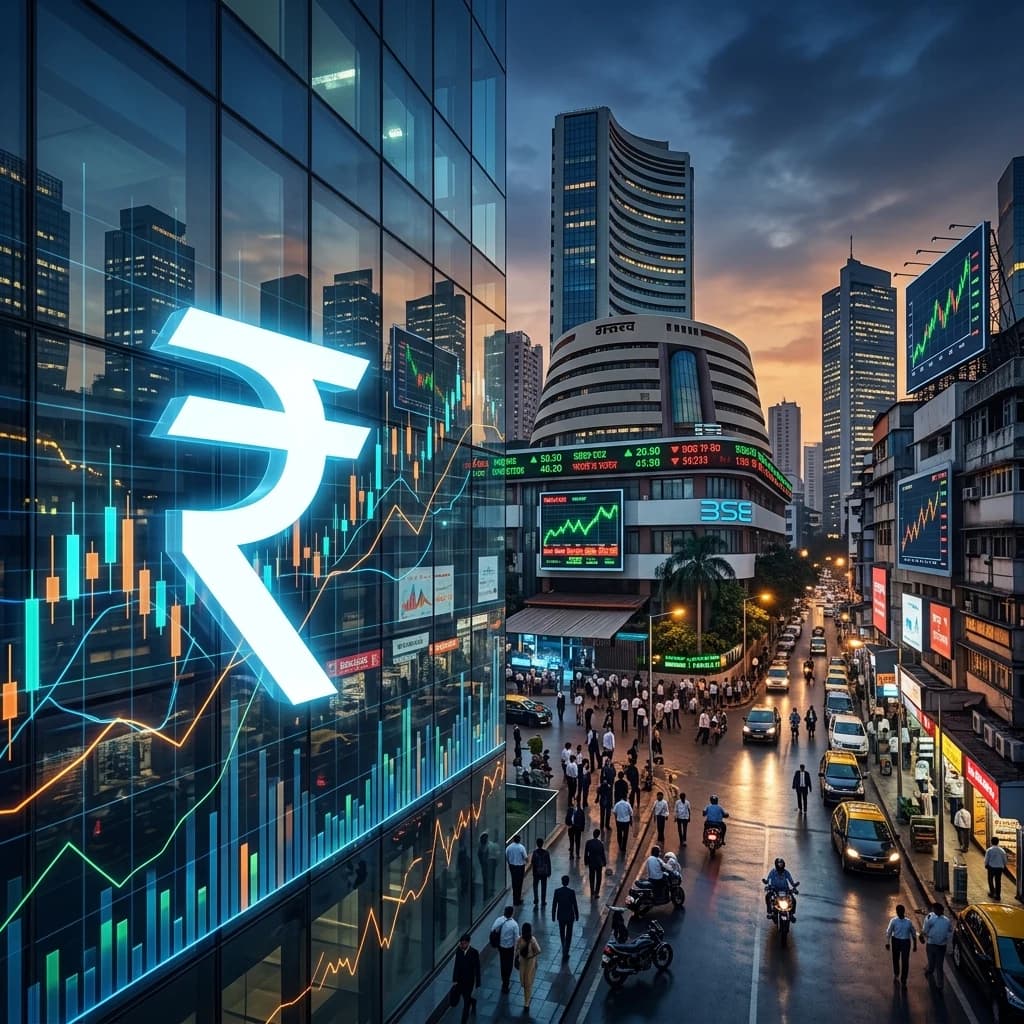
Nifty and Sensex Extend Gains for Third Session, Forex Reserves Dip by $5.6B, and RBI Fines Bank of Baroda
The Indian financial markets closed the week on a positive note on July 3, 2026, extending their winning streak to a third consecutive session amidst favorable global cues and strong sectoral buying. Positive domestic sentiment was further bolstered by institutional inflows and optimism surrounding a softer global interest rate environment, which offset a notable weekly drop in India's foreign exchange reserves. Concurrently, regulatory compliance remained in focus as the central bank penalised one of the nation's largest public sector lenders.
📊 Nifty and Sensex Log Third Successive Gain on IT and Pharma Strength
The domestic equity benchmark indices continued their upward trajectory on Friday, July 3, 2026, registering gains for the third straight trading day. The NSE Nifty 50 index rose 95.15 points, or 0.39%, to settle at a robust 24,270.85. Similarly, the 30-share BSE Sensex gained 261.79 points, or 0.34%, to close the session at 77,763.91. Market sentiment was strongly supported by overnight cues from Wall Street, where softer-than-expected U.S. employment data fueled expectations that the Federal Reserve might initiate interest rate cuts sooner than previously anticipated.
Sectoral action was highly pronounced, with IT, Pharma, Realty, and Metal indices leading the charge. Defensive sectors and high-growth technology shares found strong buyers, with market participants also reacting positively to bilateral trade optimism emerging from the ongoing India-Japan summit. The India-Japan summit's trade agenda centered on semiconductor supply chain collaboration and electronics manufacturing investment — areas where India is strategically positioning itself as a China-plus-one alternative for Japanese industrial relocations.
Gains were partially capped by profit-booking in the Energy, Auto, and Public Sector Undertaking (PSU) banking baskets. The Bank Nifty ended the session marginally in the red, down 0.16% at 57,938.50. Foreign Institutional Investors (FIIs) were net buyers, purchasing equities worth ₹1,355.33 crore, while Domestic Institutional Investors (DIIs) locked in profits, emerging as net sellers at ₹1,953.89 crore.
Market breadth was broadly positive with an advance-decline ratio of 1.65:1 on the NSE, confirming that the day's gains were distributed across multiple sectors rather than concentrated in a few heavyweights. India VIX remained contained at 13.10 — consistent with a stable, risk-on environment.
🔬 Technical Analysis: Three-Session Streak Places Nifty in Bullish Technical Territory
Friday's close at 24,270.85 represents the Nifty 50's highest settlement since the May 2026 correction. The three-session winning streak has pushed the index decisively above all major moving averages:
| Moving Average | Level | Distance |
|---|---|---|
| 20-day EMA | ~23,980 | +1.2% above |
| 50-day EMA | ~24,050 | +0.9% above |
| 100-day EMA | ~23,750 | +2.2% above |
| 200-day EMA | ~23,850 | +1.8% above |
The RSI-14 at 55.8 is in bullish territory without being overbought. MACD shows a positive histogram, confirming momentum. The key test is whether the Nifty 50 can close above the 24,500 upper Bollinger Band — a level that has capped the index on three separate attempts over the past six weeks. A close above 24,500 on strong volume would be a major technical breakout targeting 24,800–25,000.
📉 India's Foreign Exchange Reserves Decline by $5.65 Billion to $666.93 Billion
The Reserve Bank of India (RBI) released its weekly statistical supplement, showing that India's foreign exchange reserves decreased by $5.654 billion to stand at $666.933 billion for the week ended June 26, 2026. This contraction follows a period of steady accumulation that recently pushed reserves near historic highs. Despite the drop, the reserve cover remains highly comfortable — representing more than 11 months of projected import cover.
Breaking down the decline:
- Foreign Currency Assets (FCAs): The largest contributor to the decline. FCAs fell as the RBI likely intervened in the foreign exchange market to smooth out rupee volatility against a strengthening US Dollar.
- Valuation effects: When the US Dollar appreciates against other major currencies (Euro, Japanese Yen, British Pound, Swiss Franc), the dollar value of India's non-USD reserve holdings automatically declines, even without any actual selling. Analysts estimate approximately $2–3 billion of the $5.65 billion decline was due to valuation effects rather than actual reserve deployment.
- Gold reserves: Minor fluctuation reflecting London gold price changes.
The context matters: India's reserves had risen sharply in the preceding weeks due to the RBI's NRI special deposit mobilisation ($10 billion since June 5). A one-week $5.65 billion decline against this backdrop represents a temporary fluctuation rather than a trend reversal. India's reserves have oscillated within the $650–$680 billion range through May–June 2026, and the RBI's systematic reserve accumulation strategy remains intact.
For investors, the reserve level provides important signals:
- High reserves = strong rupee defence capacity: The RBI can absorb significant FII outflows without allowing disorderly rupee depreciation
- High reserves = lower sovereign credit risk: India's credit ratings from Moody's, S&P, and Fitch all benefit from strong reserve adequacy ratios
⚖️ RBI Imposes ₹63.60 Lakh Penalty on Bank of Baroda for Compliance Deficiencies
The Reserve Bank of India announced a monetary penalty of ₹63.60 lakh on state-owned Bank of Baroda (BoB). The enforcement action was taken under the Banking Regulation Act, 1949, following a statutory inspection of the bank's financial position and compliance records. The RBI clarified that the penalty addresses deficiencies in regulatory compliance and is not intended to pronounce upon the validity of any transaction with customers.
Specific violations identified:
- Overcharging on loan accounts: Bank of Baroda charged interest rates above the contracted rates in certain loan accounts — a direct violation of the RBI's Fair Practices Code and the Model Loan Policy framework that all scheduled commercial banks must adhere to. This category of violation directly harms retail and MSME borrowers who may not realise they are being charged above-agreed rates.
- KYC registry delays: The bank failed to upload customer Know Your Customer (KYC) records to the Central KYC Records Registry (CKYCR) within prescribed timelines. The CKYCR is India's unified KYC repository that eliminates duplication across financial institutions. Delayed uploads create gaps in the financial intelligence network and can facilitate identity fraud and money laundering.
Bank of Baroda responded that it has initiated corrective measures to address the gaps identified by the RBI and to ensure strict adherence to compliance timelines going forward. The ₹63.60 lakh penalty is modest relative to Bank of Baroda's total assets of over ₹12 lakh crore, but the reputational signal matters — the RBI's enforcement actions serve as deterrence across the entire banking system.
The broader compliance context: The RBI has significantly increased the frequency and quantum of bank penalties over FY26–27. Across scheduled commercial banks, total penalties imposed in FY26 exceeded ₹45 crore — nearly triple the FY24 level — signalling that the central bank is moving toward a zero-tolerance compliance culture. Banks that invest in robust compliance infrastructure now will avoid costly penalties, regulatory scrutiny, and potential reputational damage in the future.
💡 Investor Takeaway: A Week That Restores Confidence
July 3, 2026 closes a week that began with concerns (geopolitical tensions, FII outflows) and ended with restoration of confidence (IT-led rally, FII return to buying, stable rupee). Three things investors should take from this week:
-
India's domestically-driven market resilience is structural, not tactical. DII buying provided crucial support during Monday's FII selling. The SIP-driven monthly inflow of ₹23,000+ crore is not a short-term trend — it represents over 10 years of sustained financial inclusion growth.
-
Forex reserves at $666.9 billion still provide a formidable buffer. The $5.65 billion decline was largely technical; at this reserve level, the RBI can absorb 3–4 months of sustained FII outflows without depleting its currency defence capability.
-
Regulatory compliance enforcement is intensifying. The BoB fine is a reminder that banks and NBFCs face increasing scrutiny. This is ultimately positive for systemic health — but investors in banking stocks should prioritise institutions with proven compliance track records.
📌 The Bottom Line
- nifty-sensex-extend-gains: The Nifty 50 rose 0.39% to 24,270.85 (new monthly high) and the Sensex gained 0.34% to 77,763.91, securing a third straight gain amid FII net buying of ₹1,355.33 crore. All major EMAs are below the index — a textbook bullish alignment.
- forex-reserves-drop: India's foreign exchange reserves declined $5.654 billion to $666.933 billion for the week ended June 26. An estimated $2–3 billion was valuation-driven (USD appreciation vs. other reserve currencies); actual RBI market intervention accounted for the rest.
- rbi-penalises-bob: The RBI fined Bank of Baroda ₹63.60 lakh for charging above-contracted interest rates and delaying CKYCR KYC uploads. The action is part of the RBI's intensifying compliance enforcement, with FY26 total bank penalties triple FY24 levels.
📬 Stay Updated
Get India market analysis delivered to your inbox every trading day. Subscribe to our free newsletter →
Disclosure: This post contains affiliate links. If you purchase through our links, we earn a small commission at no extra cost to you. We only recommend products we believe in.
Enjoyed this post?
Get our weekly digest delivered free.
Share this post:
Knowelth is reader-supported. We may earn a commission from links in this article at no extra cost to you. Read our disclosure.
Related Posts
India Markets Daily: Sensex Rebounds to 78,080 as Nifty Drags, RBI Proposes Loan Reset Rules, FIIs Sell ₹1,006 Cr
India Markets Daily: Sensex Rebounds to 78,080 as Nifty Drags, RBI Proposes Loan Reset Rules, FIIs Sell ₹1,006 Cr Indian financial markets navigated a divergent trading session on August 13, 2026, as …
India Markets Update: Nifty Drops Below 24,450 Amid Oil Spike, RBI Holds Repo Rate at 5.25%, and FII Inflows Resume
India Markets Update: Nifty Drops Below 24,450 Amid Oil Spike, RBI Holds Repo Rate at 5.25%, and FII Inflows Resume Indian benchmark indices drifted lower for a second consecutive session as global en…

Nifty Snaps 4-Day Rally as Pre-RBI Policy Jitters & Crude Surge Trigger Profit Booking; Bharti Airtel Q1 Profit Soars 37%
Nifty Snaps 4-Day Rally as Pre-RBI Policy Jitters & Crude Surge Trigger Profit Booking; Bharti Airtel Q1 Profit Soars 37% Indian benchmark equity indices snapped their four-session winning streak on A…