Cosmological AI Models, Vyommitra Humanoid Milestones, and Chair Warsh's First Fed Decision
Cosmological AI Models, Vyommitra Humanoid Milestones, and Chair Warsh's First Fed Decision
Welcome to today's first digest, where we examine the integration of artificial intelligence in mapping the cosmos, the robotic frontiers of human spaceflight, and the landmark policy restructuring at the U.S. Federal Reserve. Today, we cover the deployment of transfer learning in cosmological mapping alongside the "overconfidence" challenge in AI, India's humanoid robot Vyommitra completing critical Gaganyaan simulations, and the conclusion of Chair Kevin Warsh's inaugural FOMC meeting. Here are the key stories you need to know today, June 17, 2026.
🔬 Science: Quantum Cosmology and AI-Driven Discovery
Transfer Learning and the Anomalous Limits of AI in Cosmological Mapping
As astronomical data volumes swell from deep-space instruments like the Euclid space telescope and the James Webb Space Telescope, researchers are turning to transfer learning models to accelerate cosmological mapping. Historically, cataloging dark matter distribution and identifying cosmic web filaments required months of supercomputing time to run detailed hydrodynamic simulations. By training convolutional neural networks and transformer architectures on high-fidelity synthetic simulations first, scientists can now transfer these pre-trained weights to analyze real-world observations in minutes. This approach has allowed teams to generate some of the most detailed 3D maps of local dark matter distribution to date, revealing subtle gravitational lensing patterns that were previously lost in background noise.
Despite these efficiency gains, astrophysicists are encountering a critical barrier known as the "overconfidence challenge" in generative and discriminative AI models. Because these systems are optimized to match patterns within their training distributions, they tend to classify rare cosmological anomalies into pre-existing, familiar categories with high statistical confidence. This behavior presents a significant risk of overlooking genuinely novel physical phenomena—the very anomalies that drive scientific revolutions. To safeguard serendipitous discovery, research consortiums are implementing hybrid, human-in-the-loop workflows. In these systems, AI models act as preliminary filters, but any data point exhibiting high uncertainty or matching outlier criteria is automatically flagged for manual analysis, ensuring that human intuition remains at the center of astronomical breakthroughs.
💻 Technology: Space Robotics and Edge Intelligence
India's Vyommitra Humanoid Robot Completes Pre-Flight Simulation Milestones
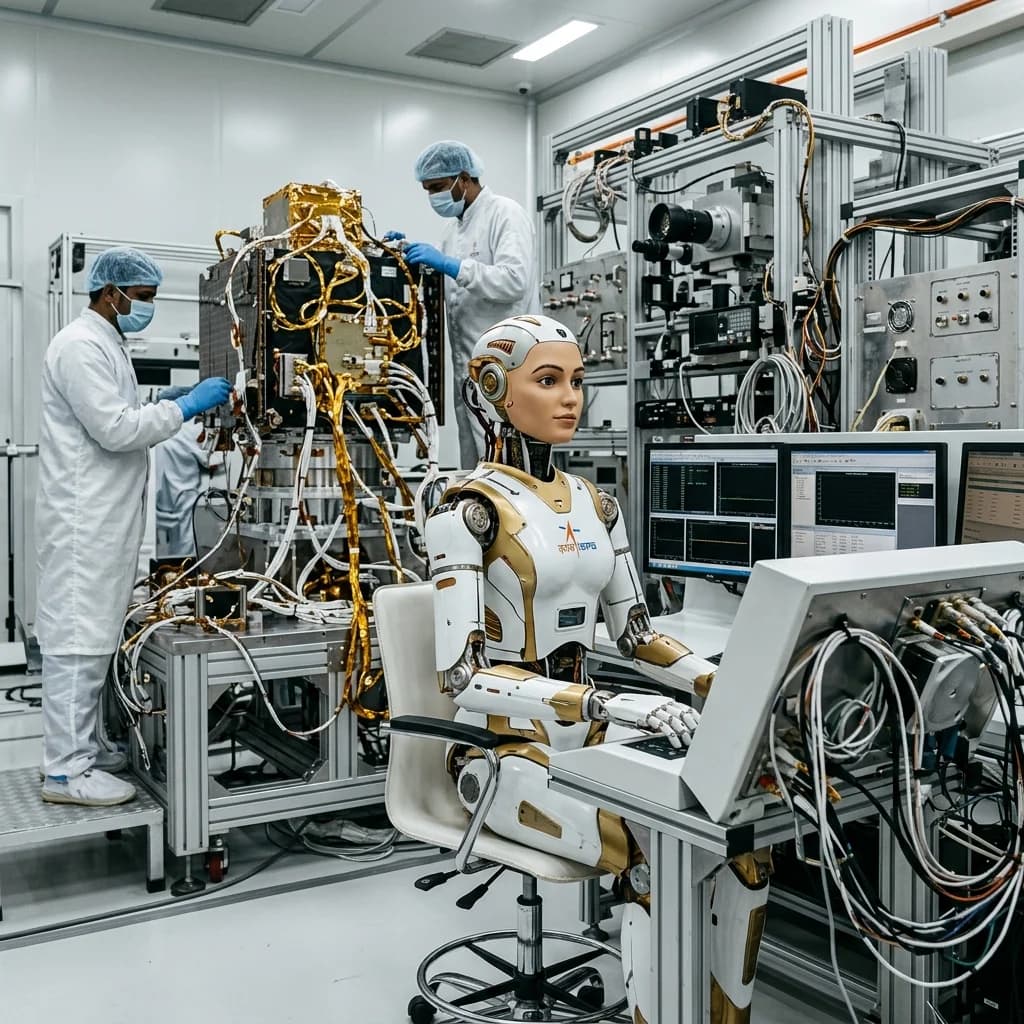
The Indian Space Research Organisation (ISRO) has achieved a key milestone in its crewed spaceflight ambitions, announcing the successful completion of simulation testing for its humanoid robot, Vyommitra. Developed at the Vikram Sarabhai Space Centre, the female-looking robot is designed to serve as an artificial crew member for the Gaganyaan programme. By integrating advanced actuators and a localized edge AI system, Vyommitra is capable of reading cockpit display panels, operating switchboards, and communicating with ground control using natural language. The recent simulations subjected the robot to extreme vibration, thermal stress, and microgravity postures, confirming its structural integrity and operational capacity in harsh space environments.
Vyommitra's primary mission will be on the upcoming uncrewed Gaganyaan-1 test flight, where it will monitor life-support systems, cabin pressure, and radiation levels inside the crew module. Unlike traditional passive test dummies, the humanoid can actively respond to simulated cabin emergencies, executing corrective procedures and transmitting real-time telemetry back to ISRO engineers. This active monitoring capability provides a critical safety layer, allowing mission controllers to assess the physical stresses of spaceflight on a human-like frame before committing human astronauts to orbital missions. The success of these robotic simulations marks a major step forward for India's domestic aerospace technology, establishing a template for humanoid deployment in deep-space exploration.
📈 Market: Macro Policy and Federal Reserve Decisions
Chair Kevin Warsh’s Fed Holds Rates Steady and Retires the Dot Plot
At the conclusion of a highly anticipated two-day meeting on June 17, 2026, the Federal Open Market Committee (FOMC) announced its decision to maintain the benchmark federal funds rate at its current range of 3.50%–3.75%. The policy hold, while widely expected by Wall Street following May’s hot 4.2% year-over-year Consumer Price Index (CPI) print, confirms that the central bank remains committed to a "higher-for-longer" monetary stance to cool persistent inflation. In his inaugural press conference as Chairman, Kevin Warsh delivered a hawkish but pragmatic message, emphasizing that while the threshold for further rate hikes remains high, the committee will not consider cutting rates until core inflation shows a sustained trajectory toward its 2% target.
In a surprise structural overhaul that sent shockwaves through the financial sector, Chair Warsh also announced the formal retirement of the quarterly "dot plot"—the Fed's traditional chart mapping individual governors' interest rate projections. Warsh criticized the dot plot as a source of market confusion and unnecessary volatility, arguing that it falsely projects a degree of policy certainty that does not exist. In its place, the Federal Reserve will transition to a qualitative, scenario-based policy framework, communicating potential actions through detailed economic narrative pathways. Markets responded to the double announcement with sharp initial volatility before stabilizing, as bond yields eased slightly with the 10-year U.S. Treasury yield settling at 4.15%, reflecting investor relief at the Fed's commitment to flexible, data-dependent transparency.
The Bottom Line
- Science: Cosmologists leverage transfer learning to accelerate dark matter mapping, but deploy hybrid human-AI workflows to prevent models from misclassifying rare cosmic anomalies.
- Technology: ISRO’s Vyommitra humanoid robot passes critical pre-flight simulation testing, preparing to monitor environment and life-support systems on the uncrewed Gaganyaan-1 mission.
- Market: The Federal Reserve under new Chair Kevin Warsh holds interest rates steady at 3.50%–3.75% and discontinues the quarterly "dot plot" in favor of a qualitative, scenario-based guidance framework.
Enjoyed this post?
Get our weekly digest delivered free.
Share this post:
📌 Disclosure: This post may contain affiliate links. If you make a purchase through our links, we may earn a commission at no extra cost to you. We only recommend products we believe in. See our Affiliate Disclosure.
Related Posts

U.S.-Iran Military Escalation, 3.2-Billion-Year-Old Enzymes Reconstructed, and Apple's $30 Billion U.S. Chip Deal
U.S.-Iran Military Escalation, 3.2-Billion-Year-Old Enzymes Reconstructed, and Apple's $30 Billion U.S. Chip Deal A dramatic military escalation in the Middle East has disrupted global energy markets,…

NATO Summit in Ankara, Saudi Arabia's Historic Crude Oil Price Slashes, and World's First Sub-1 GHz Massive MIMO 5G Network
NATO Summit in Ankara, Saudi Arabia's Historic Crude Oil Price Slashes, and World's First Sub-1 GHz Massive MIMO 5G Network July 7, 2026, represents a landmark day for international security allian…

UN AI Governance Summit, ISRO PSLV Resumption, and Norway's Historic World Cup Triumph
UN AI Governance Summit, ISRO PSLV Resumption, and Norway's Historic World Cup Triumph On July 6, 2026, the global landscape reflects a dynamic convergence of international policy, technological br…