Gravastar Mini-Universes, the Indian Army's Theater Reorganization, and the Consolidated Power Finance Merger
Gravastar Mini-Universes, the Indian Army's Theater Reorganization, and the Consolidated Power Finance Merger
Welcome to today's digest, where we cover the frontiers of theoretical astrophysics, systemic educational reforms, strategic military transitions, and massive green energy corporate consolidations. Today, we analyze a new mathematical model from Goethe University Frankfurt that proposes gravastars as singularity-free alternatives to black holes, the Supreme Court's interim report on student mental health, the appointment of Lieutenant General Dhiraj Seth as India's next Chief of Army Staff, and the presidential approval of the REC-PFC financial merger. Here are the key stories you need to know today, June 22, 2026.
🔬 Science: Astrophysical Models and Higher Education Welfare
Goethe University Frankfurt’s Gravastar Model Challenges the Singularity Concept
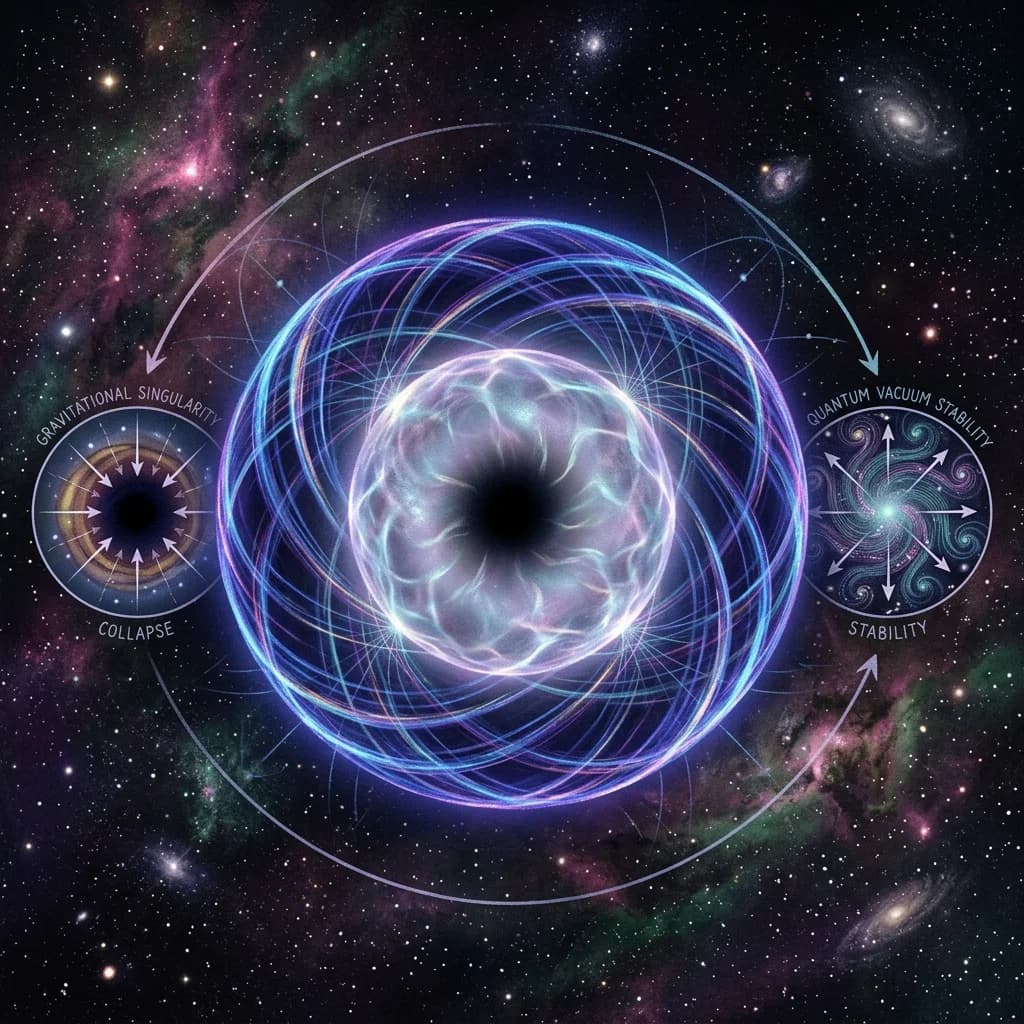
In a significant advancement for theoretical astrophysics, physicists Daniel Jampolski and Professor Luciano Rezzolla from Goethe University Frankfurt have published a pioneering study in Physical Review D outlining a new mechanism for the formation of gravastars. For decades, gravastars have been proposed as hypothetical alternatives to black holes, avoiding the problematic concept of singularities—infinitely dense points where the known laws of physics break down. The researchers' new model shows that when a massive star collapses under its own gravity, the collapse can trigger the nucleation of a tiny, expanding region of dark energy at the star's center. This internal dark energy expansion exerts an outward pressure that counterbalances the massive inward pull of gravity, stabilizing the object into a compact shell without a singularity or an event horizon.
The significance of this model lies in its ability to resolve the information paradox and physical inconsistencies associated with traditional black holes. By demonstrating that gravastars are a mathematically viable solution of Einstein's General Theory of Relativity, the study provides a scientifically grounded alternative to singularities. While the researchers emphasize that black holes remain the simplest explanation for astronomical observations, their gravastar model offers a paradox-free alternative that eliminates the problematic mathematical infinities. This theoretical breakthrough not only deepens our understanding of gravitational collapse but also opens new avenues for exploring the intersection of quantum mechanics, dark energy, and general relativity in the extreme environments of our universe.
Supreme Court Task Force Issues Interim Report on Student Mental Health Institutional Reform
Shifting the discourse from individual diagnostics to institutional responsibility, the National Task Force (NTF) on Student Mental Health and Suicide Prevention has released its interim report. Chaired by former Supreme Court Judge Justice S. Ravindra Bhat, the task force was established in response to rising student suicide rates in India. Based on site visits to 30 higher educational institutions (HEIs) across 10 states, the interim report argues that student suicides are deeply rooted in structural and institutional issues rather than being isolated mental health struggles. The panel's findings reveal that over 70% of HEIs lack full-time, professional mental health support networks, leaving students without accessible guidance during critical periods of academic and personal stress.
The report highlights how social exclusion and systemic academic pressures disproportionately impact students from underprivileged backgrounds, including Scheduled Caste (SC), Scheduled Tribe (ST), and Other Backward Class (OBC) communities. This systemic exclusion results in higher dropout rates and severe mental stress among marginalized students. To address these institutional deficits, the Supreme Court has extended the task force's tenure to October 31, 2026, allowing the panel to conduct broader consultations and draft actionable national regulations. This extension underscores the judiciary's commitment to transforming India's academic landscape, framing student mental health as a matter of civil rights, institutional accountability, and structural empathy.
💻 Technology: Strategic Command Restructuring and Grid-Forming Solar Infrastructures
Lieutenant General Dhiraj Seth to Spearhead Indian Army’s Joint Theater Reorganization
In a major transition for India's national security leadership, Lieutenant General Dhiraj Seth, the current Vice Chief of the Army Staff (VCOAS), has been officially appointed as the next Chief of the Army Staff (COAS). Lt. Gen. Seth will assume command on the afternoon of June 30, 2026, succeeding the retiring Chief, General Upendra Dwivedi. His upcoming tenure is expected to prioritize the transition of the Indian Army into a highly modernized, technology-enabled fighting force. Key operational priorities will include the integration of indigenous drone warfare systems, the enhancement of cyber-defense capabilities, and the deployment of agile, integrated battle groups (IBGs) to counter evolving threats along the nation's borders.
Beyond technological modernization, Lt. Gen. Seth's primary mandate will be coordinating with the Chief of Defence Staff (CDS) to implement India's historic joint theater command reforms. This structural overhaul aims to consolidate the currently separate operational commands of the Army, Navy, and Air Force into unified, theater-specific commands. The reorganization is designed to optimize resource allocation, enhance joint operational planning, and improve strategic response times in conflict scenarios. By leading this transition, the incoming COAS will play a central role in reshaping the Indian military's operational philosophy, shifting from service-specific silos to an integrated, unified command structure tailored for 21st-century warfare.
Grid-Forming Inverters and Smart Hybridization Dominate Intersolar Europe 2026
The global solar energy sector is undergoing a profound technological shift, as demonstrated at the Intersolar Europe 2026 conference in Munich. A central theme of this year's event is the rapid evolution of inverters from passive, frequency-following devices to active, "grid-forming" systems. Traditionally, solar installations relied on the existing utility grid to set the operating voltage and frequency, which created stability risks as renewable penetration increased. Grid-forming inverters, however, act as independent voltage sources that can actively stabilize and secure power grids. This breakthrough allows grids with high concentrations of solar power to maintain frequency stability, preventing widespread blackouts and enabling the safe integration of renewable energy on a massive scale.
Alongside grid-forming technology, the conference highlighted the rise of smart hybridization, combining solar PV with battery storage systems optimized by AI-driven energy management systems. These digitalized power plants utilize advanced machine learning algorithms and digital twins to predict generation capacity, perform predictive maintenance, and optimize power dispatch. This hybridization is becoming standard practice to mitigate the economic impact of "solar cannibalization"—where massive solar output drives electricity prices to zero or negative values during peak hours. By storing excess energy and discharging it during peak demand, hybrid systems ensure stable revenues and grid reliability, even during periods of low solar and wind resource availability.
📈 Market: Sovereign Energy Financing and Green Infrastructure Bonds
Presidential Assent Clears the Path for REC and PFC Corporate Amalgamation
In a landmark regulatory milestone for India's corporate and energy landscape, the government has granted presidential approval for the merger of REC Limited into its parent company, Power Finance Corporation (PFC). Executed under Sections 230–232 of the Companies Act, 2013, the amalgamation will see all of REC’s assets and liabilities transferred to PFC, after which REC will be dissolved as a separate legal entity. A critical clause in the Presidential assent mandates that the consolidated company must maintain its sovereign status as a "Government Company" both during and after the transaction, ensuring continued state oversight and shielding the entity from private market volatility.
The merger creates a colossal, consolidated non-banking financial company (NBFC) dedicated entirely to energy sector financing. By combining their balance sheets, the unified PFC will possess unprecedented capital leverage and reduced borrowing costs in international debt markets. This consolidated financial powerhouse is specifically positioned to fund India's ambitious clean energy transition, including green hydrogen initiatives, offshore wind corridors, and grid-scale storage systems. The merger represents a strategic consolidation of state-backed financial resources, streamlining the deployment of capital to meet the country's national decarbonization targets.
Hybridization and Commercial Demand Drive Solar Asset Valuation Shifts
The financial model of the global solar energy industry is experiencing a significant shift, as highlighted by market discussions at Intersolar Europe 2026. As renewable energy penetration reaches record levels across Europe, developers are increasingly exposed to "solar cannibalization," where high daytime generation depresses wholesale power prices. In response, project developers are shifting away from traditional power purchase agreements (PPAs) that rely solely on raw solar output. Instead, investments are flowing into multi-asset projects that integrate battery storage. This hybridization allows developers to engage in revenue stacking, capturing price spreads by storing cheap daytime electricity and selling it during high-priced evening peaks, thereby stabilizing project internal rates of return (IRRs).
Simultaneously, the Commercial & Industrial (C&I) solar sector has emerged as a major growth driver, insulated from utility-scale price volatility. Rising grid retail tariffs and corporate net-zero mandates are driving businesses to invest in onsite PV-plus-storage installations. These microgrid systems allow corporate energy consumers to lock in long-term electricity prices and bypass grid transmission charges. This growing demand has triggered a surge in secondary market transactions for C&I solar portfolios, with institutional investors viewing them as stable, high-yield infrastructure assets. As a result, the green finance market is seeing a rapid expansion of specialized debt instruments, such as green bonds and sustainability-linked loans, tailored specifically to fund decentralized corporate solar projects.
The Bottom Line
- Science: Theoretical physicists at Goethe University Frankfurt introduce a mathematically stable gravastar model that replaces black hole singularities with expanding dark energy, while India's National Task Force exposes critical mental health support deficits across 70% of higher educational institutions.
- Technology: Lieutenant General Dhiraj Seth is appointed as the next Chief of Army Staff to lead the Indian Army's joint theater command reforms, while Intersolar Europe 2026 highlights the transition to grid-forming inverters and smart hybrid solar-storage systems.
- Market: The presidential approval of the REC-PFC merger creates a consolidated state-backed financial powerhouse to fund India's clean energy transition, while solar asset markets shift toward hybridization and commercial-scale projects to mitigate price cannibalization.
Enjoyed this post?
Get our weekly digest delivered free.
Share this post:
📌 Disclosure: This post may contain affiliate links. If you make a purchase through our links, we may earn a commission at no extra cost to you. We only recommend products we believe in. See our Affiliate Disclosure.
Related Posts

U.S.-Iran Military Escalation, 3.2-Billion-Year-Old Enzymes Reconstructed, and Apple's $30 Billion U.S. Chip Deal
U.S.-Iran Military Escalation, 3.2-Billion-Year-Old Enzymes Reconstructed, and Apple's $30 Billion U.S. Chip Deal A dramatic military escalation in the Middle East has disrupted global energy markets,…
NATO Summit in Ankara, Saudi Arabia's Historic Crude Oil Price Slashes, and World's First Sub-1 GHz Massive MIMO 5G Network
NATO Summit in Ankara, Saudi Arabia's Historic Crude Oil Price Slashes, and World's First Sub-1 GHz Massive MIMO 5G Network July 7, 2026, represents a landmark day for international security allian…
UN AI Governance Summit, ISRO PSLV Resumption, and Norway's Historic World Cup Triumph
UN AI Governance Summit, ISRO PSLV Resumption, and Norway's Historic World Cup Triumph On July 6, 2026, the global landscape reflects a dynamic convergence of international policy, technological br…