The Hydrological Tax: Why Direct Lithium Extraction is an Ecological Mirage
The Hydrological Tax: Why Direct Lithium Extraction is an Ecological Mirage
Opinion | Editorial Desk | July 15, 2026
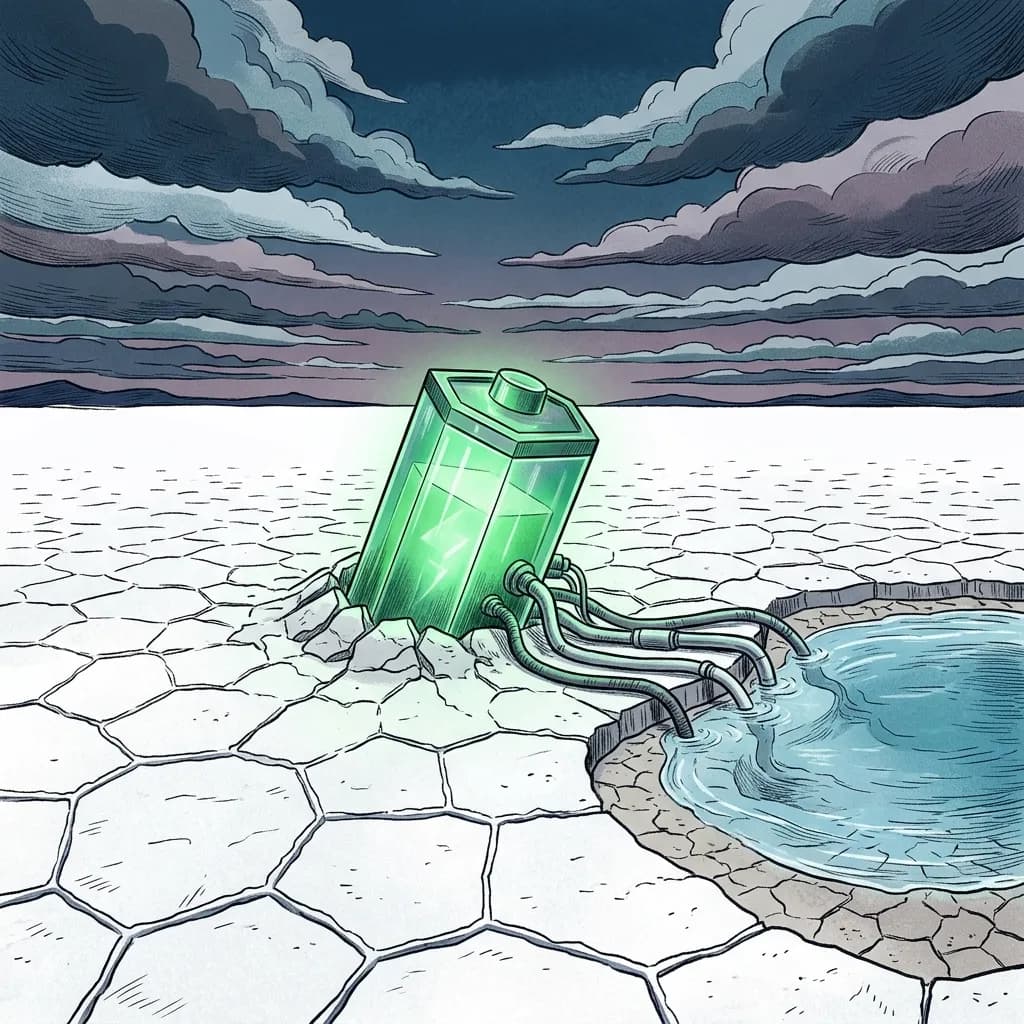
As global automakers race to meet ambitious electric vehicle targets, the search for "clean" battery materials has sparked a high-altitude gold rush in the salt flats of South America. For years, the environmental damage of lithium extraction was blamed on traditional evaporation ponds—massive, turquoise scars in the desert that slowly evaporate billions of liters of brine, leaving depleted water tables and parched communities in their wake. Enter Direct Lithium Extraction (DLE), a suite of technologies hailed by Western mining firms, venture capitalists, and eager governments as a green savior capable of extracting lithium in hours and cleanly reinjecting the remaining brine back into the earth. Yet, this promise of friction-free, water-neutral mining is a dangerous ecological illusion, one that risks desiccating some of the planet’s most fragile watersheds to clean up the tailpipes of the Global North.
The Core Argument
At the heart of the DLE sales pitch is the concept of closed-loop reinjection: by pumping the lithium-depleted brine back into the underground salar, companies claim they avoid the hydrological depletion of traditional ponds. But this marketing narrative ignores a stubborn chemical reality. DLE is not a dry process. To extract lithium from adsorption resins or ion-exchange membranes, the system requires massive quantities of freshwater. Depending on the specific technology and the chemistry of the brine, DLE plants can consume up to 140 cubic meters (140,000 liters) of freshwater for every single ton of lithium carbonate equivalent (LCE) produced. In hyper-arid regions like Chile's Salar de Atacama or Argentina's Salar de Hombre Muerto, where annual rainfall is measured in millimeters, diverting freshwater to wash industrial filters is a death sentence for local agriculture, ecosystems, and Indigenous communities.
Furthermore, the mechanics of reinjecting spent brine are far from a solved science. Salars are not simple, uniform underground tanks; they are highly complex, layered hydrogeological systems where fresh water floats precariously on top of dense, hyper-saline brine. Pumping millions of gallons of chemically altered, lithium-depleted brine back into these aquifers under high pressure is a massive gamble. The process risks fracturing the fragile barriers that separate freshwater tables from salt flats. If these barriers break, saltwater intrusion will contaminate the shallow freshwater aquifers that local communities rely on for drinking and farming. The long-term geological consequences of this subsurface disturbance remain completely unstudied at commercial scale.
Beyond water, DLE carries a hidden energy tax. To achieve the 90 percent recovery rates touted by developers, the brines must often be heated to temperatures between 50°C and 80°C to speed up chemical reactions. In the remote, off-grid heights of the Andes, generating this heat requires burning vast quantities of diesel or natural gas. This thermal requirement injects a heavy carbon debt into the very beginning of the EV supply chain, undermining the core environmental rationale of the electric transition. By the time the lithium reaches a gigafactory in Europe or North America, its "zero-emission" status has already been compromised by the fossil fuels burned to extract it.
The Counterargument (and Why It Falls Short)
Proponents of DLE, including industry leaders like EnergyX and Lilac Solutions, argue that the technology is a massive improvement over the status quo. They point to pilot projects demonstrating water recycling rates of up to 90 percent, arguing that any localized environmental footprint is a necessary and minor trade-off in the global fight against climate change. Without lithium, they contend, the transition away from fossil fuels will stall, lock-in global warming, and devastate ecosystems worldwide. From this utilitarian perspective, protecting a few remote desert watersheds is a small price to pay to secure the future of the biosphere.
While intellectually seducing, this "lesser of two evils" argument is a false dichotomy. It rests on the assumption that the only way to decarbonize transportation is to replace every combustion-engine passenger car with an electric equivalent of equal size and weight. More importantly, it relies on unproven corporate claims of high-efficiency water recycling at scale. In an industrial setting, even a highly optimized 90 percent recycling rate means a 10 percent net loss. When scaled up to meet the global demand of millions of tons of lithium, that 10 percent loss translates into billions of liters of freshwater permanently lost from some of the driest basins on Earth. The communities living in these salars are being asked to accept the destruction of their ancestral water resources so that wealthy drivers in California and Germany can feel virtuous in their three-ton electric SUVs. This is not environmental progress; it is green neocolonialism.
What Should Happen
To prevent DLE from turning South America’s salt flats into ecological sacrifice zones, governments must replace industry self-regulation with strict, binding environmental guardrails. First, regulatory bodies in the Lithium Triangle must establish a "hydrogeological net-zero" standard. No DLE project should be permitted to draw from local freshwater aquifers. If mining companies require freshwater, they must build, fund, and operate seawater desalination plants on the coast and pipe the water up the Andes at their own expense. This would raise the cost of extraction, but it is the only way to internalize the true environmental cost of the resource.
Second, the nations of the Lithium Triangle—Chile, Argentina, and Bolivia—should form a unified resource sovereign alliance. By coordinating regulatory standards, taxing structures, and technology requirements, they can resist the pressure of Western capital and prevent a "race to the bottom" where countries compete by lowering environmental standards. This alliance must demand that foreign developers provide full technology transfer and share local processing facilities, ensuring that the economic value of the lithium remains within the host nations rather than being exported raw.
Finally, the global community must decouple decarbonization from lithium dependency. The ultimate solution to the resource crisis is not finding cleaner ways to mine, but reducing the demand for mining itself. This requires a systemic shift in transport policy away from private-passenger EVs and toward public transit, high-speed rail, and walkable urban design. Expanding electric bus fleets and rail networks reduces the amount of lithium needed to move a person by over 90 percent compared to personal cars. By changing how we move, we can drastically lower the global demand for battery metals, taking the pressure off the fragile ecosystems of the Andes.
The Bottom Line
The green energy transition cannot be built on the same exploitative, extractive model that defined the fossil fuel era. If we dry up the watersheds of the Global South to clean the air of the Global North, we have not solved the climate crisis; we have merely relocated its victims. Direct Lithium Extraction is not a magic wand that makes mining harmless; it is a complex, resource-intensive industrial process that carries a heavy ecological cost. Until we enforce strict water-neutral standards, demand resource sovereignty for host nations, and shift our focus to public transit over personal EVs, DLE will remain what it is today: a green mirage in a thirsty desert.
The views expressed in this editorial represent an analytical position based on publicly available evidence and expert consensus, not personal or political affiliation.
Enjoyed this post?
Get our weekly digest delivered free.
Share this post:
Knowelth is reader-supported. We may earn a commission from links in this article at no extra cost to you. Read our disclosure.
Related Posts

The Capital-Compute Trap: Why the AI Stock Sell-Off and Data Center Moratoriums Expose the Limits of Centralized Scaling
The Capital-Compute Trap: Why the AI Stock Sell-Off and Data Center Moratoriums Expose the Limits of Centralized Scaling Opinion | Editorial Desk | July 17, 2026 The sharp market correction that wiped…

The Nobel Warning: Why AI’s Economic Disruption Demands Structural Action, Not Existential Dread
The Nobel Warning: Why AI’s Economic Disruption Demands Structural Action, Not Existential Dread Opinion | Editorial Desk | July 15, 2026 When sixteen Nobel laureates and more than two hundred leading…

The Freedom of Navigation Tax: Why the U.S. Hormuz Toll Threatens the Global Maritime Order
The Freedom of Navigation Tax: Why the U.S. Hormuz Toll Threatens the Global Maritime Order Opinion | Editorial Desk | July 14, 2026 As the U.S. Navy conducts its third consecutive night of missile st…