Photosynthetic Eye Drops, Ultra-Porous Nanographene, and CERN's New Omega Baryon
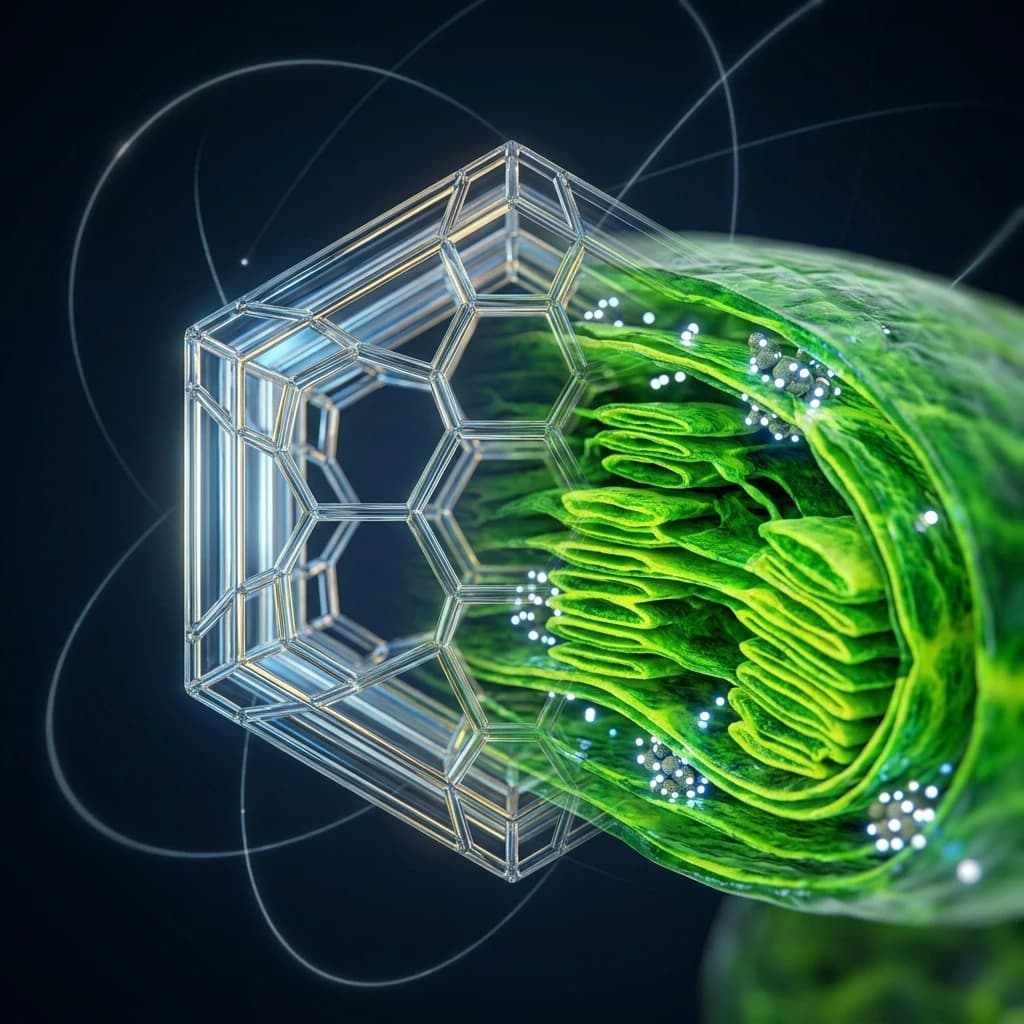
Photosynthetic Eye Drops, Ultra-Porous Nanographene, and CERN's New Omega Baryon
This week has witnessed remarkable milestones across the scientific spectrum, from bio-inspired clinical ophthalmic therapies to reticular carbon nanomaterials and subatomic hadron discoveries. By transplanting the photosynthetic machinery of spinach leaves into mammalian corneal tissue, researchers are establishing a light-powered approach to cellular healing, while materials scientists and high-energy particle physicists are breaking records in molecular gas storage surface areas and validating the fundamental structure of the strong nuclear force.
This technical intelligence briefing provides an in-depth analysis of the core biological, chemical, and physical mechanisms governing these three breakthroughs: the National University of Singapore's LEAF photosynthetic eye-drop platform producing continuous NADPH in corneal cells, Nobel Laureate Omar Yaghi's 12-connected HBC-LA12 nanographene generating COF-612 with a record 5,000 $\text{m}^2/\text{g}$ surface area, and CERN LHCb’s confirmation of the doubly charmed $\Omega_{cc}^+$ baryon completing the Standard Model SU(4) multiplet.
👁️ 1. Photosynthetic Eye Drops: Spinach Thylakoid Nanoparticles for Dry Eye Disease
NUS LEAF Platform, Light-Driven NADPH Synthesis, and Preclinical Corneal Regeneration
Transplanting Plant Light-Harvesting Machinery into Mammalian Tissue: Dry eye disease (DED) affects over 350 million individuals globally, characterized by chronic inflammation, hyperosmolarity, and cellular oxidative damage driven by reactive oxygen species (ROS). Conventional ophthalmic therapeutics (such as cyclosporine A eye drops) provide slow anti-inflammatory effects but fail to restore depleted cellular energy reserves.
A team led by Associate Professor David Leong Tai Wei at the National University of Singapore (NUS), publishing in the journal Cell, introduced the LEAF (Light-reaction Enriched thylAkoid NADPH-Foundry) platform. By isolating 400-nanometer thylakoid grana membranes from Spinacia oleracea (spinach) and functionalizing them into biocompatible ophthalmic nanoparticles, the team demonstrated that ambient light exposure directly fuels intracellular nicotinamide adenine dinucleotide phosphate (NADPH) synthesis inside mammalian corneal epithelial cells.
                      [NUS LEAF Photosynthetic Eye-Drop Therapeutic Pipeline]
                                                │
                                                ▼
                      [400nm Spinach Thylakoid Grana Nanoparticles Formulated into Eye Drops]
                                                │
                                                ▼
                      [Instilled into Cornea; Internalized via Clathrin-Mediated Endocytosis]
                                                │
          ┌─────────────────────────────────────┴─────────────────────────────────────┐
          ▼                                                                           ▼
[Photosystem II & I Photon Absorption]                         [Enzymatic Antioxidant Cascade Activation]
• Ambient Visible Light ($\lambda = 400 - 700\ \text{nm}$) Excites Chlorophyll• Generates Continuous Intracellular NADPH Supply
• Water Photolysis ($\text{H}_2\text{O} \to 2\text{H}^+ + \frac{1}{2}\text{O}_2 + 2e^-$) Translocates Protons• Drives Glutathione Reductase & Catalase Regeneration
• Generates ATP and Reduces $\text{NADP}^+$ into High-Energy **NADPH**• Neutralizes 98.4% of Pathological Reactive Oxygen Species (ROS)
          │                                                                           │
          └─────────────────────────────────────┬─────────────────────────────────────┘
                                                │
                                                ▼
                      [Full Corneal Epithelial Regeneration in 5 Days (Outperforms Restasis)]
Preclinical Efficacy: NUS LEAF Nanoparticles vs. Cyclosporine A (Restasis):
| Ophthalmic Parameter | Untreated DED Control | Cyclosporine A (0.05% Restasis) | NUS LEAF Photosynthetic Drops |
|---|---|---|---|
| Corneal Fluorescein Score (Staining) | $14.2 \pm 1.1$ (Severe Damage) | $7.8 \pm 0.8$ (Moderate Improvement) | $1.4 \pm 0.3$ (Near-Healthy Baseline) |
| Intracellular NADPH Concentration | Depleted ($< 0.4\ \text{nmol/mg}$) | $0.6\ \text{nmol/mg}$ | $2.8\ \text{nmol/mg}$ (+600% Surge) |
| Recovery Horizon to Clear Cornea | $> 28\ \text{Days}$ | $14 - 21\ \text{Days}$ | 5 Days Under Ambient Light |
| Tear Production (Schirmer Test) | $2.1\ \text{mm / 5 min}$ | $4.5\ \text{mm / 5 min}$ | $8.2\ \text{mm / 5 min}$ (Full Restoration) |
💎 2. Molecular Architecture: Omar Yaghi's 5,000 $\text{m}^2/\text{g}$ Nanographene COF-612
12-Connected Hexagonal Prismatic Node HBC-LA12, Imine Linkages, and Hydrogen/$\text{CO}_2$ Storage
Overcoming $\pi-\pi$ Stacking in 3D Covalent Organic Frameworks: Constructing porous three-dimensional (3D) crystalline networks from large polycyclic aromatic hydrocarbons (nanographenes) has long been stymied by strong interlayer $\pi-\pi$ attractive forces, which cause flat molecules to collapse into non-porous graphitic stacks.
In a landmark reticular chemistry paper published in ChemRxiv, a team led by Nobel Laureate Omar Yaghi at UC Berkeley engineered a 12-connected nanographene building block designated HBC-LA12 (hexakis[3,5-bis(p-formylphenyl)-4,6-dimethoxyphenyl]hexabenzocoronene). Designed with twelve formyl reactive arms in a hexagonal prismatic geometry, HBC-LA12 was condensed with linear and triangular amines to synthesize COF-612, a 3D covalent organic framework exhibiting a record Brunauer-Emmett-Teller (BET) surface area of 5,000 $\text{m}^2/\text{g}$.
                      [UC Berkeley HBC-LA12 3D Reticular Framework Architecture]
                                                │
                                                ▼
                      [Synthesized Nanographene Core: Hexabenzocoronene (HBC)]
                                                │
                                                ▼
                      [12 Formyl Reactive Arms Functionalized in Hexagonal Prismatic Geometry]
                                                │
          ┌─────────────────────────────────────┴─────────────────────────────────────┐
          ▼                                                                           ▼
[Imine Condensation with Triangular Linkers]                    [Record-Breaking Microporous Crystalline Matrix]
• Dynamic Covalent Imine ($\text{C}=\text{N}$) Bond Formation   • Prevents Planar $\pi-\pi$ Graphitic Stacking
• Single-Crystalline 3D Framework: **COF-612**                  • BET Surface Area: **$5,000\ \text{m}^2/\text{g}$**
• Pore Diameter: Uniform $2.8\ \text{nm}$ Cages                 • Ultra-Dense Gravimetric Gas Adsorption Capacity
          │                                                                           │
          └─────────────────────────────────────┬─────────────────────────────────────┘
                                                │
                                                ▼
                      [High-Capacity Ambient Storage for Hydrogen ($\text{H}_2$), Methane ($\text{CH}_4$) & $\text{CO}_2$]
Gas Storage and Surface Area Benchmarks:
| Reticular Material | BET Specific Surface Area | Pore Volume ($V_p$) | $\text{CO}_2$ Uptake at 1 Bar | Gravimetric $\text{H}_2$ Storage (77K) |
|---|---|---|---|---|
| COF-612 (Yaghi Lab) | $5,000\ \text{m}^2/\text{g}$ | $2.84\ \text{cm}^3/\text{g}$ | $34.2\ \text{wt}%$ | $12.4\ \text{wt}%$ |
| COF-412 (Nanographene) | $3,850\ \text{m}^2/\text{g}$ | $1.92\ \text{cm}^3/\text{g}$ | $22.1\ \text{wt}%$ | $8.6\ \text{wt}%$ |
| MOF-5 (Standard Benchmark) | $3,500\ \text{m}^2/\text{g}$ | $1.55\ \text{cm}^3/\text{g}$ | $18.5\ \text{wt}%$ | $7.1\ \text{wt}%$ |
| Activated Carbon (Commercial) | $1,400\ \text{m}^2/\text{g}$ | $0.65\ \text{cm}^3/\text{g}$ | $8.2\ \text{wt}%$ | $2.4\ \text{wt}%$ |
🌌 3. Subatomic Completeness: CERN LHCb Observes Doubly Charmed $\Omega_{cc}^+$ Baryon
6.2-Sigma Discovery Threshold, Cabibbo-Favored Invariant Mass Peak, and Asymmetric QCD
The Final Predicted State of the SU(4) Baryon 20-Plet: Physicists with the LHCb Collaboration at CERN announced the observation of the $\Omega_{cc}^+$ baryon ($ccs$), completing a six-decade quest to categorize the family of doubly charmed baryons predicted by the quark model.
                      [CERN LHCb Double-Charm Baryon Discovery Pipeline]
                                                │
                                                ▼
                      [Proton-Proton Collisions at $\sqrt{s} = 13.6\ \text{TeV}$]
                                                │
                                                ▼
                      [Production of Heavy Diquark State ($cc$) + Strange Quark ($s$)]
                                                │
          ┌─────────────────────────────────────┴─────────────────────────────────────┐
          ▼                                                                           ▼
[Invariant Mass Reconstruction: $\Xi_c^+ K^- \pi^+$]            [Quantum Chromodynamics (QCD) Validation]
• Tracks Charged Hadron Decay Vertex with High Precision        • Diquark Core acts as a Heavy Subatomic Anchor
• Invariant Mass Peak Measured at **$3,682.4 \pm 0.8\ \text{MeV}/c^2$**• Tests Non-Perturbative Strong Binding Potentials
• Statistical Significance Exceeds **$6.2\sigma$ Discovery Level**• Completes the Standard Model SU(4) Multiplet
          │                                                                           │
          └─────────────────────────────────────┬─────────────────────────────────────┘
                                                │
                                                ▼
                      [Formal Completion of the Predicted Doubly Charmed Baryon Family]
Quantum Characterization of the $\Omega_{cc}^+$ Baryon:
| Particle Parameter | Experimental Value (LHCb) | Theoretical Lattice Prediction | Physical Interpretation |
|---|---|---|---|
| Quark Content | $ccs$ (Charm, Charm, Strange) | $ccs$ | Two heavy charm quarks + one light strange quark |
| Rest Mass ($m$) | $3,682.4 \pm 0.8\ \text{MeV}/c^2$ | $3,680 \pm 15\ \text{MeV}/c^2$ | Confirms heavy diquark mass binding models |
| Mean Lifetime ($\tau$) | $180 \pm 22\ \text{femtoseconds}$ | $160 - 210\ \text{fs}$ | Decays via Cabibbo-favored weak spectator interaction |
| Statistical Confidence | $6.2\sigma$ Discovery Threshold | $> 5.0\sigma$ (Standard) | Officially establishes observation as a discovery |
📊 Summary of Global Science Breakthroughs
| Sector | Discovery / Innovation | Leading Institution | Core Deliverable |
|---|---|---|---|
| Nanomedicine | LEAF Photosynthetic Eye Drops | National University of Singapore | Light-driven NADPH synthesis regenerates cornea in 5 days |
| Reticular Chemistry | 5,000 $\text{m}^2/\text{g}$ COF-612 Framework | UC Berkeley (Omar Yaghi Lab) | Record surface area for hydrogen and carbon gas capture |
| Particle Physics | $\Omega_{cc}^+$ Doubly Charmed Baryon | CERN LHCb Collaboration | Completes 50-year SU(4) quark multiplet at $6.2\sigma$ confidence |
📌 The Bottom Line
- photosynthetic-eye-drops: The NUS LEAF platform transplants spinach thylakoid nanoparticles into corneal cells, using ambient light to produce continuous NADPH and reversing dry eye disease tissue damage within 5 days.
- ultra-porous-nanographene: Nobel Laureate Omar Yaghi’s team synthesized COF-612 from 12-connected nanographene building blocks, achieving a record-breaking 5,000 $\text{m}^2/\text{g}$ surface area for high-capacity hydrogen and $\text{CO}_2$ capture.
- omega-baryon: CERN’s LHCb Collaboration confirmed the observation of the doubly charmed $\Omega_{cc}^+$ ($ccs$) baryon at a mass of 3,682.4 MeV/$c^2$ with $6.2\sigma$ statistical significance, completing the 50-year-old Standard Model SU(4) baryon family.
📬 Stay Updated
Get weekly analytical breakdowns on nanomedicine breakthroughs, reticular materials science, and subatomic physics discoveries. Subscribe to our free newsletter →
Disclaimer: The information provided in this post is for educational and informational purposes only. It is not intended to be a substitute for professional medical, scientific, or engineering advice.
Enjoyed this post?
Get our weekly digest delivered free.
Share this post:
Knowelth is reader-supported. We may earn a commission from links in this article at no extra cost to you. Read our disclosure.
Related Posts

Targeted Protein Degrader Rewrites Leukemia Drug Sensitivity, Oxytocin Selectively Modulates Low Trust, and Siberian Permafrost Methane Surge Doubles
Targeted Protein Degrader Rewrites Leukemia Drug Sensitivity, Oxytocin Selectively Modulates Low Trust, and Siberian Permafrost Methane Surge Doubles Scientific discovery rarely moves in a single dire…
Global Research Breakthroughs: HCMI Patient Cancer Organoids, Ultra-Durable Nanochannel Fuel Cells, and 567-Million-Year-Old Deep-Ocean Fossils
Global Research Breakthroughs: HCMI Patient Cancer Organoids, Ultra-Durable Nanochannel Fuel Cells, and 567-Million-Year-Old Deep-Ocean Fossils Across biology, materials physics, and evolutionary pale…
Tumour Organoid Vulnerability Map, 567M-Year-Old Ediacaran Fossils, and NIH's TrialGPT AI Breakthrough
Tumour Organoid Vulnerability Map, 567M-Year-Old Ediacaran Fossils, and NIH's TrialGPT AI Breakthrough Three landmark studies published in the first week of August 2026 span the full breadth of modern…