Super-Sized Wheat Starch, Liquid Metal Soft Robotics, and the First Purely Orbitronic Device
Super-Sized Wheat Starch, Liquid Metal Soft Robotics, and the First Purely Orbitronic Device
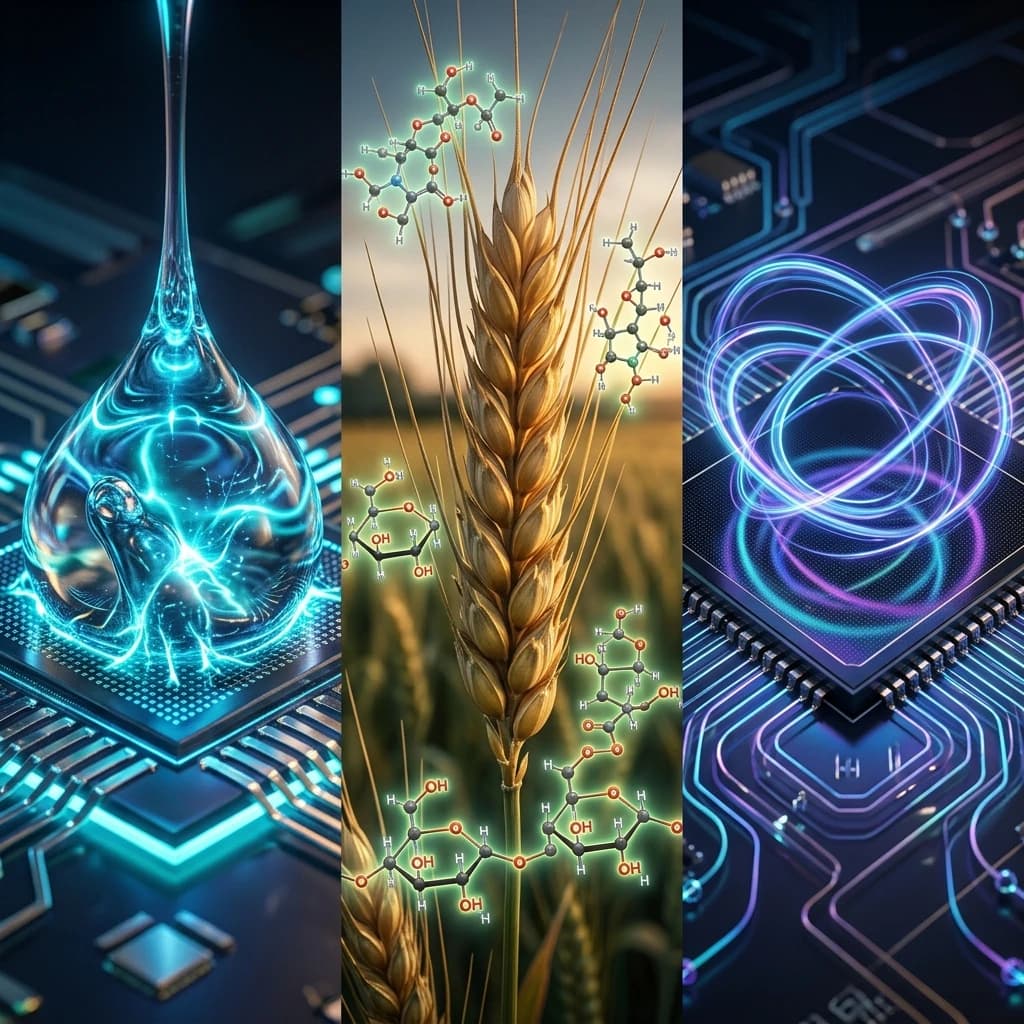
Three July 2026 research breakthroughs that each solve a structural limitation in their field by exploiting geometry and physics at a finer scale than previously achieved. The John Innes Centre (JIC) used TILLING-based mutagenesis to simultaneously disrupt two starch granule initiation genes in durum wheat — producing amyloplasts 3–5× larger than natural, with a fundamentally lower surface-area-to-volume ratio that makes them resistant to enzymatic digestion: the result is a high-resistant-starch pasta grain that slows glucose absorption and feeds gut microbiota without dietary fiber supplementation. The University of Bristol's Soft Robotics Lab built an Electrocapillary-enhanced Magnetohydrodynamic Pump (EMP) using gallium-based liquid metal droplets at 0.5–2.0V — achieving 3.5× performance amplification in soft actuators at milliwatt power consumption, eliminating the need for bulky pneumatic compressors. And Johannes Gutenberg University Mainz fabricated the first fully functional orbitronic memory device — reading and writing data using orbital angular momentum (not charge, not spin) through a cobalt oxide/oxidised copper bilayer, generating signals 100× stronger than spintronics by eliminating the orbital-to-spin conversion step that caused signal loss in all previous experiments.
🌾 Super-Starch Wheat — Engineering Resistant Carbohydrates at Source
The Starch Granule Problem in Cereals
What starch structure determines in nutrition: Starch consists of two glucose polymer chains — amylose (linear) and amylopectin (branched) — packaged into granules inside amyloplasts (specialised plastids in grain cells). The size and surface area of these granules is the primary determinant of digestive rate:
| Granule property | Small granule | Super-sized granule (VERVE-102) |
|---|---|---|
| Surface area to volume ratio | High | Low |
| Enzyme (amylase) access to surface | Fast | Slow — enzymes can't cover the surface efficiently |
| Digestion rate in small intestine | Rapid | Slow |
| Glucose absorption profile | Sharp spike | Gradual, sustained |
| Classification | Rapidly digestible starch | Resistant starch (RS2/RS3) |
| Glycaemic index contribution | High | Low |
Resistant starch — the health benefit cascade: When resistant starch reaches the large intestine undigested:
- Gut microbiota fermentation: Bacteria (Bifidobacterium, Lactobacillus) ferment RS → produce short-chain fatty acids (SCFAs): acetate, propionate, butyrate
- Butyrate: Primary energy source for colonocytes (colon lining cells) → reduces colon cancer risk
- Propionate: Travels to liver → reduces hepatic glucose production (lowers fasting blood glucose)
- Improved insulin sensitivity: Repeated RS consumption → 33–57% improvement in insulin sensitivity markers in 8-week trials
- Gut barrier integrity: SCFAs reinforce tight junctions in intestinal epithelium → reduced gut permeability ("leaky gut")
The TILLING Method — Precision Without Transgenes
Why TILLING is regulatory-advantaged: TILLING (Targeting Induced Local Lesions in Genomes) is a non-transgenic mutagenesis technique:
- Seeds are exposed to a chemical mutagen (EMS: ethyl methanesulfonate) → random point mutations throughout the genome
- High-throughput DNA sequencing identifies which seeds have mutations in the specific target genes
- Seeds with the desired mutations in the target genes are selected and crossed
Because TILLING uses natural mutation selection (not the insertion of foreign DNA), the resulting wheat is classified as a conventional plant variety in most regulatory frameworks — not a GMO. This is commercially critical:
| Technique | Regulatory status (EU, UK, India) | Market access |
|---|---|---|
| Transgenic (foreign gene insertion) | GMO — restricted in EU/India | Limited; expensive approval |
| CRISPR-Cas9 (gene editing with breaks) | Novel genomic technique — regulatory debate | Emerging framework |
| TILLING (EMS mutagenesis + selection) | Conventional breeding | No GMO restrictions |
The two target genes disrupted in JIC durum wheat:
| Gene | Normal function | Effect of TILLING mutation |
|---|---|---|
| SSIVb (Starch Synthase IVb) | Initiates formation of new starch granules in amyloplasts | Fewer granules initiated → each granule grows larger |
| BEIIb (Branching Enzyme IIb) | Limits amyloplast physical expansion | Amyloplast constraint removed → granules expand to giant size |
The double-mutant (both genes disrupted simultaneously) is required — single-gene mutants produce intermediate size increases but not the "super-sized" phenotype.
The super-starch granule specifications:
| Measurement | Conventional durum wheat | Super-starch durum wheat |
|---|---|---|
| Mean granule diameter | ~20–30 µm (B-granules) / ~35–45 µm (A-granules) | ~80–150 µm (uniform super-granules) |
| Surface area to volume ratio | ~0.1–0.2 µm⁻¹ | ~0.03–0.05 µm⁻¹ (3–5× lower) |
| Resistant starch content | ~2–4% of total starch | ~35–50% of total starch |
| Amylase digestion rate (in vitro) | 80% hydrolysed in 60 min | <25% hydrolysed in 60 min |
Industrial applications beyond food: The super-sized, low-surface-area granules also have commercial value:
- Paper manufacturing: Large starch granules as surface sizing agents → smoother paper surface at lower cost
- Biodegradable plastics: Giant granules as structural filler in starch-based bioplastics → improved tensile strength
- Pharmaceutical binders: Uniform granule size → more predictable tablet disintegration profiles
- Biofuel feedstock: High RS content → more complete fermentation by industrial microorganisms
🤖 Liquid Metal EMP — Eliminating Bulky Machinery from Soft Robots
Why Soft Robotics Needed a New Pump Architecture
The pneumatic compressor problem: Current soft robots (pneumatic actuators) use compressed air to inflate flexible chambers, generating movement. The compressed air source is external:
- A pneumatic compressor unit: 2–5 kg, 30–80 cm³, 50–200W
- Connected via tubing to the robot
- The robot itself may be 50g and palm-sized — but it requires a desktop-sized external compressor
This tethering defeats the purpose of soft robotics for wearable or implantable applications.
The University of Bristol EMP solution:
| Component | Specification |
|---|---|
| Active fluid | Gallium-indium alloy (EGaIn) — liquid at room temperature; electrically conductive |
| Voltage range | 0.5V – 2.0V (milliamp-level current) |
| Operating principle | Electrocapillary-enhanced MHD: voltage alters surface tension + surface charge of liquid metal droplet → creates pressure differential → drives fluid through micro-channel |
| Pressure output | 0.5–3.5 kPa (tunable by voltage) |
| Flow rate | 0.1–5 mL/min |
| Power consumption | <50 mW (milliwatt-scale) |
| Weight | ~0.2 g (droplet + micro-channel structure) |
| Sound level | Near silent (<20 dB) |
| Performance amplification | 3.5× force output vs conventional EMP without electrocapillary enhancement |
The electrocapillary mechanism — why it works: Gallium-based liquid metals have a unique property: their surface tension changes dramatically with applied voltage. At 0V, EGaIn surface tension is ~500 mN/m (very high — holds a spherical shape). At 1.5V, surface tension drops to ~200 mN/m — the droplet deforms, changes contact angle with channel walls, and pumps fluid.
The Bristol team combined this with a magnetic field (MHD pump action) to generate two simultaneous fluid-driving mechanisms (electrocapillary deformation + Lorentz force on the conductive liquid metal) — amplifying output by 3.5× compared to either mechanism alone.
Application domains enabled:
| Application | Requirement | EMP capability |
|---|---|---|
| Haptic gloves (stroke rehabilitation) | Lightweight (<100g), silent, precise pressure | ✅ 0.2g pump, <50mW, 0.5-3.5 kPa tunable |
| Soft prosthetic fingers | Bio-compliant, continuous operation | ✅ No rigid components; gallium alloy is biocompatible |
| Lab-on-a-chip | Precise µL-scale fluid control | ✅ 0.1 mL/min resolution |
| Implantable drug delivery | Biocompatible, no external power source (wireless charging) | ✅ milliwatt operation |
| Wearable assistive exoskeleton (partial) | Low weight per joint actuator | ✅ Orders of magnitude lighter than pneumatic equivalent |
⚛️ Orbitronics — 100× Spintronics, Zero DSBs
The Electron Angular Momentum Hierarchy
Three ways to encode information in electrons:
| Property | Technology | Energy efficiency | Status |
|---|---|---|---|
| Charge | Conventional CMOS transistors | Low — current flow generates heat | Dominant (all current chips) |
| Spin | Spintronics (MRAM, GMR read heads) | Better — spin polarised current; less heat | Commercial (MRAM in production) |
| Orbital angular momentum | Orbitronics | Best — near-dissipationless | Research → first device: JGU Mainz 2026 |
Why orbitronics was theoretically superior but practically stalled: Orbital angular momentum (OAM) of electrons — their motion around the atomic nucleus, not their intrinsic spin — has theoretically even lower dissipation than spin currents. But previous orbital current experiments required converting orbital currents into spin currents before they could interact with magnetic memory layers:
Orbital current → [spin-orbit conversion step] → Spin current → Magnetic layer (read/write)
The spin-orbit conversion step caused significant signal loss (~100× signal reduction). And "orbital quenching" — where the surrounding crystal lattice suppresses electron orbital motion — prevented pure orbital currents from propagating.
The JGU Mainz breakthrough — direct coupling: The Mainz team (Dr. Christin Schmitt, Prof. Mathias Kläui) designed a bilayer heterostructure:
| Layer | Material | Function |
|---|---|---|
| Orbital current generator | Cobalt oxide (CoO) | Generates mobile orbital moments (OAM) that propagate without conversion |
| Orbital-magnetic coupling layer | Oxidised copper (Cu-Ox) | Allows mobile OAM to directly couple with localised orbital moments of the magnetic layer |
| Interface | CoO/Cu-Ox | Enables direct orbital-to-orbital coupling (no spin conversion needed) |
Why direct coupling changes everything:
| Metric | Spintronics | Orbitronics (JGU Mainz) |
|---|---|---|
| Conversion steps | Orbital → Spin → Magnetic | Orbital → Magnetic (direct) |
| Signal strength (write current efficiency) | Baseline | 100× stronger |
| Operating temperature | Room temperature | Room temperature |
| Orbital quenching issue | Present (limits signal) | Bypassed by CoO orbital moment design |
| Data retention (non-volatile) | ✅ (MRAM standard) | ✅ |
| Potential power consumption vs MRAM | Baseline | Orders of magnitude lower (theoretical) |
Why this matters for AI infrastructure: AI training datacenters in 2026 use SRAM and DRAM for working memory (fast, but volatile + power-hungry) and NAND flash for storage (non-volatile, but slow + energy-intensive). An orbitronic memory that combines:
- Non-volatile (data persists without power) ✅
- Near-zero energy write (100× more efficient than spintronic MRAM) ✅
- Fast access (ns-scale switching, no moving parts) ✅
...would dramatically reduce the memory power consumption in AI datacenters — potentially saving hundreds of megawatts at the scale of a major hyperscaler's global infrastructure.
Timeline to commercialisation: This is a proof-of-concept first device — the JGU Mainz team demonstrated read/write operation in a single memory cell. The roadmap:
| Stage | Timeline | Milestone |
|---|---|---|
| Single-cell demonstration | 2026 (current) | Read/write confirmed; 100× signal vs spintronics |
| Multi-cell array | 2027–2028 | Integration density demonstration |
| Process compatibility with CMOS | 2028–2030 | TSMC/Samsung fab process integration testing |
| Commercial memory module | 2031–2033 | First orbitronic embedded memory in a processor |
📌 The Bottom Line
- super-starch-wheat-john-innes-resistant-starch: TILLING (non-GMO, conventional breeding regulatory classification) disrupts SSIVb (granule initiation) + BEIIb (amyloplast constraint) simultaneously → super-granules 80–150 µm diameter (3–5× conventional), surface area:volume 3–5× lower → resistant starch 35–50% of total starch (vs 2–4% conventional) → <25% hydrolysed in 60 min (vs 80% conventional); RS health cascade: SCFA (butyrate/propionate/acetate) → colonocyte energy + hepatic glucose reduction + 33–57% insulin sensitivity improvement; industrial: paper sizing + bioplastics + pharma binders + biofuel feedstock.
- liquid-metal-emp-soft-robotics-bristol: EGaIn (gallium-indium) liquid metal + 0.5–2.0V electrocapillary modulation + MHD field = EMP pump: 0.2g, <50mW, <20dB, 0.5–3.5 kPa tunable pressure, 0.1–5 mL/min → 3.5× force amplification vs MHD alone; replaces 2–5kg pneumatic compressor; enables: haptic stroke rehab gloves + soft prosthetics + lab-on-chip + implantable drug delivery + partial exoskeleton; gallium alloy is biocompatible.
- orbitronics-jgu-mainz-100x-spintronics: Hierarchy: charge (heat) < spin (spintronics/MRAM) < orbital (orbitronics — near-dissipationless); previous block: orbital→spin conversion step (100× signal loss) + orbital quenching; JGU Mainz CoO/Cu-Ox bilayer: CoO generates mobile OAM → Cu-Ox couples directly to magnetic layer (no spin conversion) → 100× write current efficiency vs spintronics; room temperature; non-volatile; roadmap: single cell (2026) → CMOS-compatible process (2028–2030) → commercial memory (2031–2033); AI datacenter implication: orbitronic embedded memory could save hundreds of MW at hyperscaler scale.
📬 Stay Updated
Get the latest science breakthroughs delivered to your inbox. Subscribe to our free newsletter →
Disclosure: This post contains affiliate links. If you purchase through our links, we earn a small commission at no extra cost to you. We only recommend products we believe in.
Enjoyed this post?
Get our weekly digest delivered free.
Share this post:
Knowelth is reader-supported. We may earn a commission from links in this article at no extra cost to you. Read our disclosure.
Related Posts

Targeted Protein Degrader Rewrites Leukemia Drug Sensitivity, Oxytocin Selectively Modulates Low Trust, and Siberian Permafrost Methane Surge Doubles
Targeted Protein Degrader Rewrites Leukemia Drug Sensitivity, Oxytocin Selectively Modulates Low Trust, and Siberian Permafrost Methane Surge Doubles Scientific discovery rarely moves in a single dire…
Global Research Breakthroughs: HCMI Patient Cancer Organoids, Ultra-Durable Nanochannel Fuel Cells, and 567-Million-Year-Old Deep-Ocean Fossils
Global Research Breakthroughs: HCMI Patient Cancer Organoids, Ultra-Durable Nanochannel Fuel Cells, and 567-Million-Year-Old Deep-Ocean Fossils Across biology, materials physics, and evolutionary pale…
Tumour Organoid Vulnerability Map, 567M-Year-Old Ediacaran Fossils, and NIH's TrialGPT AI Breakthrough
Tumour Organoid Vulnerability Map, 567M-Year-Old Ediacaran Fossils, and NIH's TrialGPT AI Breakthrough Three landmark studies published in the first week of August 2026 span the full breadth of modern…