Decoded Bacterial Drug Assembly, 3.2-Billion-Year-Old Enzymes, and Tabletop Black Holes
Decoded Bacterial Drug Assembly, 3.2-Billion-Year-Old Enzymes, and Tabletop Black Holes
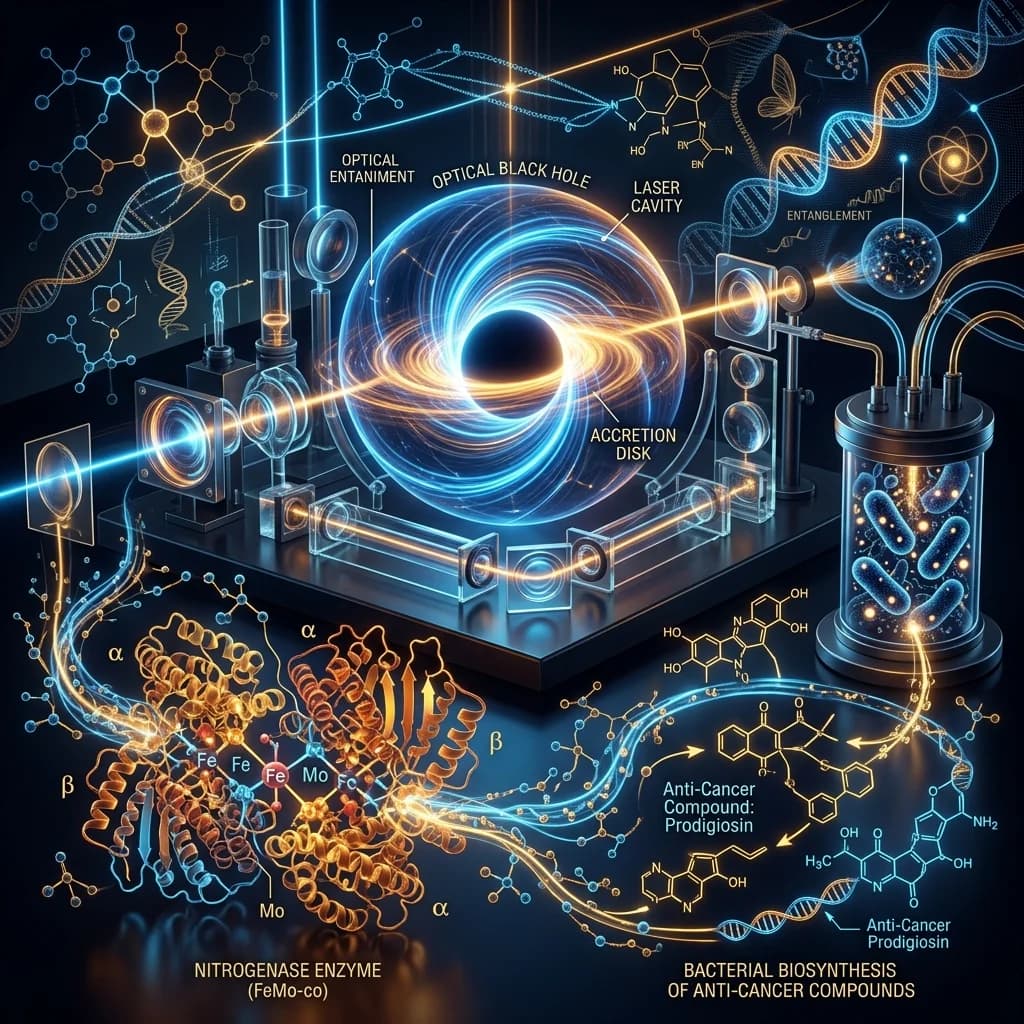
From re-engineering nature's microscopic pharmaceutical factories to peering back billions of years into the primordial soup, peer-reviewed scientific discovery continues to rewrite our understanding of reality. This week, landmark studies published in Nature and Nature Communications unveil how soil bacteria manufacture complex anti-cancer drugs, how Earth's ancient enzymes first catalyzed life's essential nutrients, and how laser pulses can simulate black hole evaporation inside an optical lab. Together, these breakthroughs push the outer boundaries of medicine, synthetic biology, and fundamental physics.
🔬 Cracking the Bacterial Code for Targeted Anti-Cancer Chemotherapies
For decades, natural product chemists have marveled at soil bacteria like Chromobacterium violaceum, which effortlessly synthesize intricate, highly targeted therapeutic compounds that synthetic chemistry struggles to replicate. Chief among these is Romidepsin, an FDA-approved potent anti-cancer agent capable of reactivating silenced tumor suppressor genes. However, modifying these complex molecules to reduce toxic side effects or boost efficacy has remained an immense biological puzzle. In a landmark study published in Nature Communications, an international collaboration of bio-engineers and chemical biologists announced they have successfully cracked the molecular docking code that bacteria use to assemble these potent medicinal compounds.
The research team focused on non-ribosomal peptide synthetases (NRPS)—massive multi-enzyme complexes that act like cellular assembly lines. Bacteria use these enzymatic assembly lines by passing chemical building blocks from one module to the next via specialized structural regions known as "docking domains." By isolating these docking domains and mapping their crystal structures at atomic resolution, researchers discovered that NRPS enzymes use a universal "mix-and-match" molecular interface. This modular architecture allows distinct enzyme sub-units to recognize, bind, and hand off chemical intermediates with exquisite precision.
To test their findings, the scientists engineered synthetic NRPS assembly lines in the laboratory. By swapping docking domains between completely different bacterial species, they directed microbes to manufacture entirely novel variants of Romidepsin and related HDAC inhibitors. The synthetic pathways operated with efficiency comparable to natural bacterial strains, yielding custom drug candidates designed to bypass common chemo-resistance mechanisms while sparing healthy human tissues.
The implications of this discovery extend far beyond a single cancer treatment. By transforming natural product synthesis into a programmable, modular engineering framework, researchers now possess a blueprint to bio-engineer custom antibiotics, anti-fungals, and targeted chemotherapies on demand. As synthetic biology merges with automated drug design, harnessing nature's enzymatic assembly lines could fundamentally accelerate how life-saving medicines are discovered and manufactured.
🌿 Resurrecting a 3.2-Billion-Year-Old Nitrogenase Enzyme
Long before oxygen enriched Earth's atmosphere, primitive single-celled organisms faced a fundamental challenge: converting inert atmospheric nitrogen ($N_2$) into bioavailable ammonia ($NH_3$), the vital building block for proteins and DNA. Today, all biological nitrogen fixation relies on nitrogenase, a complex metalloenzyme. However, how this metabolic engine evolved during the planet's violent early history has long been shrouded in mystery. In a groundbreaking study published in Nature Communications, researchers from Utah State University, the University of Wisconsin–Madison, and NASA's MUSE project successfully reconstructed and resurrected a functional 3.2-billion-year-old ancestral nitrogenase enzyme in modern living microbes.
Using advanced phylogenetic algorithms and ancestral sequence reconstruction, the interdisciplinary team analyzed thousands of modern bacterial and archaeal nitrogenase DNA sequences to map out their evolutionary tree. Working backward through deep geological time, they computationally deduced the probable amino acid sequence of the ancestral nitrogenase that existed during the Paleoarchean Era. The scientists then synthesized the ancient gene from scratch and inserted it into living host bacteria to observe its biochemical performance.
Remarkably, the resurrected 3.2-billion-year-old enzyme was not only active, but it also functioned with striking efficiency under environmental conditions simulating primeval Earth. Biochemical analysis revealed that the ancient enzyme produced an isotopic chemical signature identical to the nitrogen isotope ratios found in 3.2-billion-year-old rock formations. This discovery provides definitive proof that the geochemical traces preserved in Earth's oldest sedimentary rocks were indeed generated by biological nitrogen fixation rather than abiotic chemical reactions.
Beyond solving a core enigma of evolutionary biochemistry and astrobiology, this achievement holds profound promise for sustainable agriculture. Modern synthetic nitrogen fertilizers, produced via the energy-intensive industrial Haber-Bosch process, account for over 1% of global greenhouse gas emissions. By uncovering how primitive enzymes efficiently fixed nitrogen in harsh, low-nutrient environments, agricultural biotechnologists can use these ancestral blueprints to engineer crop plants or soil microbes that fix their own nitrogen, potentially eliminating humanity's reliance on chemical fertilizers.
🕳️ Tabletop Black Holes and the Observation of Hawking Radiation Backreaction
In 1974, theoretical physicist Stephen Hawking proposed a revolutionary theory: black holes are not completely black, but instead emit faint thermal radiation due to quantum fluctuations near their event horizons. Over time, this "Hawking radiation" should drain energy and mass from the black hole, causing it to shrink and eventually evaporate—a phenomenon known as backreaction. Because detecting Hawking radiation from astrophysical black holes in deep space is virtually impossible with current telescopes, scientists have sought to construct laboratory analogs. In a breakthrough published in Nature, physicists at Paderborn University demonstrated a tabletop black hole made entirely out of light, providing the first direct experimental measurement of Hawking radiation backreaction.
The researchers achieved this by firing ultrafast, high-intensity laser pulses through specialized photonic crystal fibers. As the intense laser pulse travels through the glass fiber, it alters the refractive index of the material, creating a localized optical disturbance that moves at the speed of light. For weaker "probe" light pulses trailing behind, this refractive barrier acts as an effective optical event horizon: probe light waves cannot overtake the moving pulse, mimicking the gravitational point of no return surrounding a cosmic black hole.
Using ultra-sensitive optical phase detectors, the team observed that quantum vacuum fluctuations near this light-based event horizon were amplified and emitted as thermal light quanta—displaying the exact mathematical spectrum predicted by Hawking's equations. More importantly, the researchers detected a minute, quantifiable recoil shift in the primary laser pulse. This energy loss confirmed that the emitted analog Hawking radiation directly siphoned energy from the artificial event horizon itself, providing concrete empirical proof of quantum backreaction in action.
This optical breakthrough marks a milestone in fundamental physics. By bringing black hole dynamics into a controllable laboratory environment, scientists now have an experimental platform to probe the intersection of Einstein's general relativity and quantum mechanics. Insights gained from these optical analogs may help resolve long-standing theoretical puzzles, such as the black hole information paradox, while driving new advances in quantum optics and photonic technology.
📌 The Bottom Line
- bacterial-cancer-drugs: Decoded bacterial enzymatic docking domains enable bio-engineers to custom-design targeted anti-cancer drugs with reduced toxicity and higher efficacy.
- ancient-nitrogenase: Resurrecting a 3.2-billion-year-old nitrogen-fixing enzyme confirms early Earth biosignatures and offers blueprints for zero-fertilizer sustainable agriculture.
- tabletop-black-hole: Creating an optical event horizon in photonic crystal fibers provides the first direct laboratory measurement of Hawking radiation backreaction.
📬 Stay Updated
Get the week's most important research breakthroughs delivered to your inbox. Subscribe to our free newsletter →
Disclosure: This post contains affiliate links. If you purchase through our links, we earn a small commission at no extra cost to you. We only recommend products we believe in.
Enjoyed this post?
Get our weekly digest delivered free.
Share this post:
Knowelth is reader-supported. We may earn a commission from links in this article at no extra cost to you. Read our disclosure.
Related Posts

Targeted Protein Degrader Rewrites Leukemia Drug Sensitivity, Oxytocin Selectively Modulates Low Trust, and Siberian Permafrost Methane Surge Doubles
Targeted Protein Degrader Rewrites Leukemia Drug Sensitivity, Oxytocin Selectively Modulates Low Trust, and Siberian Permafrost Methane Surge Doubles Scientific discovery rarely moves in a single dire…
Global Research Breakthroughs: HCMI Patient Cancer Organoids, Ultra-Durable Nanochannel Fuel Cells, and 567-Million-Year-Old Deep-Ocean Fossils
Global Research Breakthroughs: HCMI Patient Cancer Organoids, Ultra-Durable Nanochannel Fuel Cells, and 567-Million-Year-Old Deep-Ocean Fossils Across biology, materials physics, and evolutionary pale…
Tumour Organoid Vulnerability Map, 567M-Year-Old Ediacaran Fossils, and NIH's TrialGPT AI Breakthrough
Tumour Organoid Vulnerability Map, 567M-Year-Old Ediacaran Fossils, and NIH's TrialGPT AI Breakthrough Three landmark studies published in the first week of August 2026 span the full breadth of modern…