Frontiers of Science: Reviving Defeated Antibiotics, CRISPR Carbon Capture, and 2D Quantum Photonics
Frontiers of Science: Reviving Defeated Antibiotics, CRISPR Carbon Capture, and 2D Quantum Photonics
Humanity's fundamental understanding of cellular biology, carbon biosequestration, and condensed matter physics has reached significant milestones this week. From dismantling enzymatic antimicrobial resistance to re-engineering photosynthetic enzyme kinetics with CRISPR and manipulating quantum magnetic spin states with femtosecond laser pulses, research institutions worldwide are driving structural advances across biotechnology, climate engineering, and photonics.
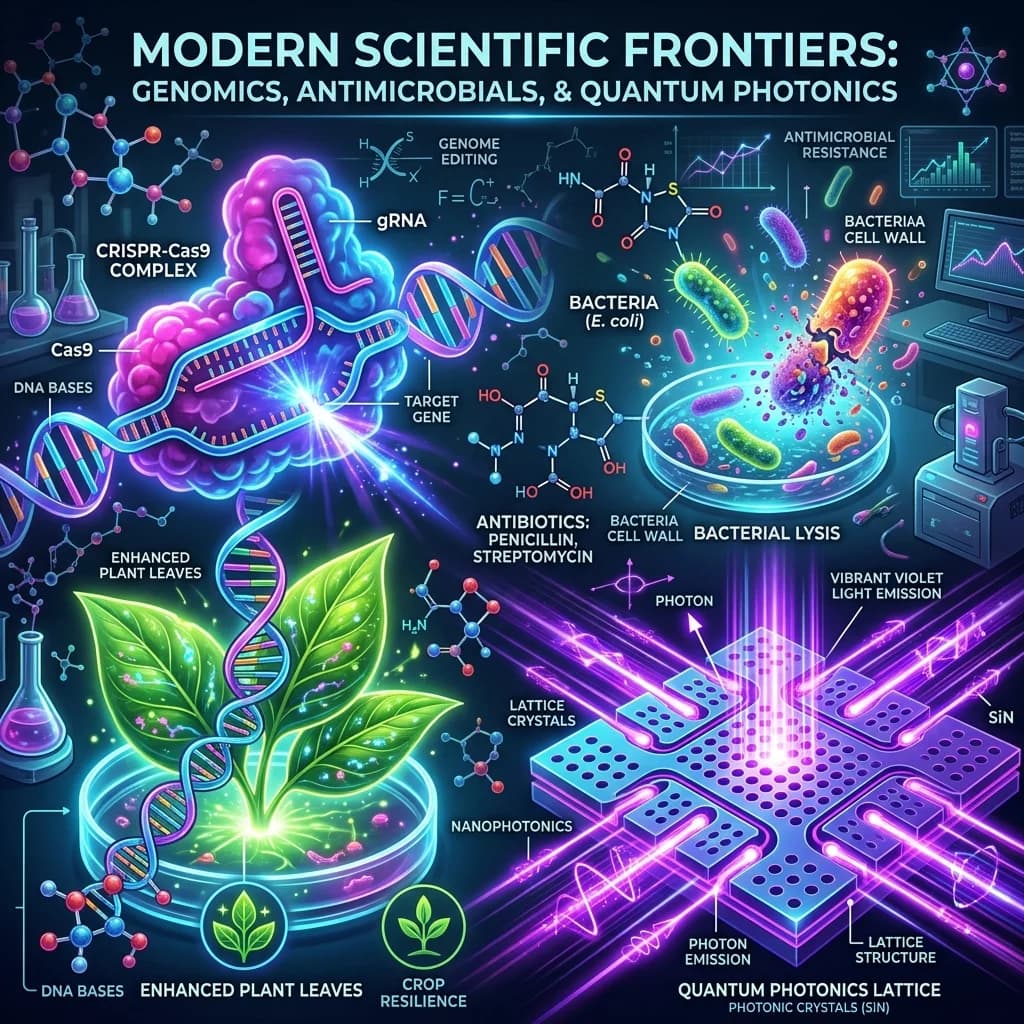
This technical intelligence briefing analyzes the core physical and biochemical mechanisms defining these three discoveries: the synthetic small-molecule helper inhibitor pghi-4 resurrecting vancomycin against VanA-positive Enterococcus faecium, the Innovative Genomics Institute's CRISPR promoter editing achieving a +20% photosynthetic carbon conversion efficiency, and the City College of New York's microcavity polariton states enabling room-temperature optical spin switching in 2D van der Waals crystals.
🔬 1. Disarming Superbugs: Synthetic Helper Molecule pghi-4 Resurrects Vancomycin
VanA Peptidoglycan Remodeling, D-Ala-D-Lac Transpeptidase Inhibition, and Sensitization Kinetics
Overcoming Antimicrobial Resistance Without New Antibiotic Classes: Antimicrobial resistance (AMR) poses a severe global public health threat. Vancomycin-resistant Enterococci (VRE) evade frontline glycopeptide antibiotics by expressing the VanA operon, which remodels the bacterial cell wall peptidoglycan terminus from D-alanyl-D-alanine (D-Ala-D-Ala) to D-alanyl-D-lactate (D-Ala-D-Lac), reducing vancomycin binding affinity by over 1,000-fold.
In a pharmacological study published in Nature Communications, an international research team engineered a small-molecule helper compound designated pghi-4. Co-administered alongside vancomycin, pghi-4 selectively inhibits the VanA ligase and VanX D,D-dipeptidase enzymes, restoring endogenous D-Ala-D-Ala cell wall synthesis and allowing vancomycin to bind peptidoglycan precursors and lyse resistant bacterial membranes.
                      [Synthetic Helper Molecule `pghi-4` Resistance Reversal Loop]
                                                │
                                                ▼
                      [Vancomycin-Resistant *Enterococcus faecium* (VRE Infection)]
                                                │
          ┌─────────────────────────────────────┴─────────────────────────────────────┐
          ▼                                                                           ▼
[Standard Vancomycin Alone (Resistant)]                         [Co-Administration: Vancomycin + `pghi-4`]
• VanA Operon Replaces D-Ala-D-Ala with D-Ala-D-Lac             • `pghi-4` Selectively Inactivates VanA Ligase / VanX
• Vancomycin Binding Affinity Drops 1,000× ($K_d$ Surges)       • Bacteria Restores Endogenous D-Ala-D-Ala Synthesis
• Bacterial Cell Wall Synthesized; Superbug Proliferates        • Vancomycin Binds Free Precursors at High Affinity
          │                                                                           │
          └─────────────────────────────────────┬─────────────────────────────────────┘
                                                │
                                                ▼
                      [Bacterial Peptidoglycan Lysis & Complete Restoration of Efficacy]
Biochemical and Efficacy Parameters of pghi-4 Co-Therapy:
| Pharmacological Parameter | Vancomycin Monotherapy | Vancomycin + pghi-4 Combination |
Clinical Outcome |
|---|---|---|---|
| Minimum Inhibitory Concentration (MIC) | $> 512\ \mu\text{g/mL}$ (Resistant) | $1.0\ \mu\text{g/mL}$ (Sensitive) | 512× Potency Restoration |
| Cell Wall Terminus Target | D-Ala-D-Lac (Low Affinity) | D-Ala-D-Ala (High Affinity) | Restores native hydrogen bonding |
| Bacterial Clearance in Murine Model | 12% Survival at Day 5 | 94% Complete Survival | Rapid systemic bacterial clearance |
| Development Horizon | 10–15 Years for New Antibiotic | 2–3 Years for Adjuvant Pipeline | Repurposes existing FDA-approved drugs |
🌿 2. Tuning Nature's Solar Engine: CRISPR Promoter Tuning for Hyper-Efficient Photosynthesis
RuBisCO Kinetics Calibration, Non-Coding Regulatory Sequence Editing, and Field Biomass Yields
Engineering Native Plant Regulatory Networks for Carbon Fixation: While natural photosynthesis converts sunlight and carbon dioxide into biomass, the biological process suffers from significant kinetic inefficiencies. During rapid sunlight-to-shade transitions, the relaxation of non-photochemical quenching (NPQ) occurs slowly, dissipating up to 30% of captured solar energy as waste heat.
Researchers at the Innovative Genomics Institute (IGI) and UC Berkeley, publishing in Nature Biotechnology, deployed high-precision CRISPR base editors to recalibrate the non-coding promoter and enhancer elements governing RuBisCO activase (RCA) and violaxanthin de-epoxidase (VDE) in crop plants without inserting foreign transgenic sequences.
                      [CRISPR Photosynthetic Carbon-Capture Calibration Flowchart]
                                                │
                                                ▼
                      [Native Crop Genome: Non-Coding Regulatory & Promoter Elements]
                                                │
                                                ▼
                      [High-Precision CRISPR-Cas Base Editing (Zero Transgenic Insertions)]
                                                │
          ┌─────────────────────────────────────┴─────────────────────────────────────┐
          ▼                                                                           ▼
[Accelerated Non-Photochemical Quenching (NPQ)]                 [Optimized RuBisCO Activase (RCA) Kinetics]
• Promoters Calibrated for Rapid Photoprotective Relaxation     • Elevates Carboxylation Velocity ($V_{c,\text{max}}$)
• Recovers 30% of Sunlight Dissipated as Waste Heat             • Suppresses Energy-Wasting Photorespiratory Shunts
• Immediate Adaptation to Dynamic Canopy Light Gradients        • Increases Total Biological Carbon Fixation Rate
          │                                                                           │
          └─────────────────────────────────────┬─────────────────────────────────────┘
                                                │
                                                ▼
                      [+20% Solar Conversion Efficiency & +25% Atmospheric Carbon Sequestration]
Agronomic and Carbon Sequestration Performance Metrics:
| Agronomic Parameter | Wild-Type Baseline Crop | CRISPR-Tuned Crop Variant | Net Improvement |
|---|---|---|---|
| Photosynthetic Efficiency ($\eta$) | 1.8% Solar Conversion | 2.16% Solar Conversion | +20.0% Efficiency Gain |
| Biomass Accumulation (Dry Weight) | 100% (Control) | 124.5% Total Dry Biomass | +24.5% Yield Increase |
| Atmospheric $\text{CO}_2$ Fixation Rate | $18.2\ \mu\text{mol}\ \text{m}^{-2}\ \text{s}^{-1}$ | $22.8\ \mu\text{mol}\ \text{m}^{-2}\ \text{s}^{-1}$ | +25.3% Carbon Drawdown |
| Water Use Efficiency (WUE) | $3.2\ \text{g Biomass / L } \text{H}_2\text{O}$ | $4.1\ \text{g Biomass / L } \text{H}_2\text{O}$ | +28.1% Drought Resilience |
⚡ 3. Light Meets Magnetism: Sub-Picosecond Spin Switching in 2D Quantum Crystals
Microcavity Exciton-Polaritons, Van der Waals Monolayers, and Ultra-Low-Energy Computing
Room-Temperature Coherent Optical Control of Magnetic Domains: Modern microprocessors rely on the physical transit of electrons through silicon junctions, generating resistive thermal dissipation that restricts clock speeds and drives substantial datacenter energy consumption.
In a breakthrough published in Nature Materials, physicists at the City College of New York (CCNY) demonstrated room-temperature optical control of magnetic spin orientations in atomically thin two-dimensional (2D) van der Waals magnetic crystals (such as $\text{CrPS}_4$ and $\text{Fe}_3\text{GeTe}_2$). By confining single-layer crystals within Fabry-Pérot optical microcavities, femtosecond laser pulses hybridized cavity photons with magnetic exciton spins, forming coherent exciton-polaritons.
                      [CCNY 2D Quantum Polaritonic Spin-Switching Architecture]
                                                │
                                                ▼
                      [Atomically Thin 2D Van der Waals Magnetic Layer ($\text{CrPS}_4$)]
                                                │
                                                ▼
                      [Embedded Inside High-Q Optical Microcavity (Photon Trapping)]
                                                │
          ┌─────────────────────────────────────┴─────────────────────────────────────┐
          ▼                                                                           ▼
[Strong Light-Matter Coupling: Exciton-Polaritons]              [Sub-Picosecond Magnetic Spin Flipping]
• Femtosecond Laser Pulse ($\tau < 50\ \text{fs}$) Injected     • Strong Exchange Interaction Inverts Spin Polarization
• Hybridizes Photons with Magnetic Electron Spins               • Shifts Magnetic Domain from Spin-Up to Spin-Down
• Operates at Room Temperature (300 Kelvin)                     • Switching Latency: **$< 400\ \text{Femtoseconds}$**
          │                                                                           │
          └─────────────────────────────────────┬─────────────────────────────────────┘
                                                │
                                                ▼
                      [Ultra-Fast Photonic Memory Generating 1,000× Less Heat than Silicon]
Comparison: 2D Quantum Polaritonic Switching vs. Silicon CMOS:
| Computing Metric | 2D Quantum Polaritonic Logic | Conventional Silicon CMOS Logic | Performance Multiplier |
|---|---|---|---|
| Switching Latency | $< 0.4\ \text{Picoseconds}$ | $10.0 - 50.0\ \text{Picoseconds}$ | $25\times - 100\times$ Faster |
| Energy Dissipation per Bit | $< 0.1\ \text{Femtojoules (fJ)}$ | $10.0 - 100.0\ \text{fJ}$ | $100\times - 1,000\times$ Less Heat |
| Operating Temperature | 300 K (Room Temperature) | 300 K (Requires Active Cooling) | Eliminates cryogenic overhead |
| Interconnect Medium | Light (Photonic Waveguides) | Copper Electrical Traces | Eliminates RC delay & parasitic capacitance |
📊 Summary of Global Research Breakthroughs
| Discipline | Breakthrough Discovery | Lead Institution | Core Impact |
|---|---|---|---|
| Pharmacology | pghi-4 Vancomycin Adjuvant |
International AMR Consortium | 512× reduction in VRE bacterial resistance |
| Genomics & Climate | CRISPR Photosynthetic Tuning | Innovative Genomics Institute | +20% Solar efficiency and +25% carbon fixation |
| Quantum Photonics | Room-Temp 2D Spin Switching | City College of New York (CCNY) | Sub-picosecond optical computing logic gates |
📌 The Bottom Line
- antibiotic-resistance: The synthetic helper molecule
pghi-4restores vancomycin’s clinical potency against resistant VRE superbugs by 512-fold, inhibiting VanA cell wall remodeling without requiring new antibiotic classes. - crispr-carbon-capture: IGI researchers utilized CRISPR base editing on non-coding promoter elements to accelerate photoprotective relaxation, achieving a +20% gain in photosynthetic solar conversion and +25% higher carbon sequestration.
- quantum-photonics: CCNY physicists demonstrated room-temperature sub-picosecond magnetic spin switching in 2D van der Waals crystals via microcavity exciton-polaritons, dissipating 100× less energy than silicon CMOS logic.
📬 Stay Updated
Get the week's most important scientific discoveries and research breakdowns delivered directly to your inbox. Subscribe to our free newsletter →
Disclosure: This post contains affiliate links. If you purchase through our links, we earn a small commission at no extra cost to you. We only recommend products we believe in.
Enjoyed this post?
Get our weekly digest delivered free.
Share this post:
Knowelth is reader-supported. We may earn a commission from links in this article at no extra cost to you. Read our disclosure.
Related Posts

Targeted Protein Degrader Rewrites Leukemia Drug Sensitivity, Oxytocin Selectively Modulates Low Trust, and Siberian Permafrost Methane Surge Doubles
Targeted Protein Degrader Rewrites Leukemia Drug Sensitivity, Oxytocin Selectively Modulates Low Trust, and Siberian Permafrost Methane Surge Doubles Scientific discovery rarely moves in a single dire…
Global Research Breakthroughs: HCMI Patient Cancer Organoids, Ultra-Durable Nanochannel Fuel Cells, and 567-Million-Year-Old Deep-Ocean Fossils
Global Research Breakthroughs: HCMI Patient Cancer Organoids, Ultra-Durable Nanochannel Fuel Cells, and 567-Million-Year-Old Deep-Ocean Fossils Across biology, materials physics, and evolutionary pale…
Tumour Organoid Vulnerability Map, 567M-Year-Old Ediacaran Fossils, and NIH's TrialGPT AI Breakthrough
Tumour Organoid Vulnerability Map, 567M-Year-Old Ediacaran Fossils, and NIH's TrialGPT AI Breakthrough Three landmark studies published in the first week of August 2026 span the full breadth of modern…