The Week in Research: Bacterial Anti-Cancer Blueprints, Ultrasound-Driven Brain Optogenetics, and Squeezed Ocean Carbon
The Week in Research: Bacterial Anti-Cancer Blueprints, Ultrasound-Driven Brain Optogenetics, and Squeezed Ocean Carbon
Scientific discovery reshapes human capability when researchers decipher nature's hidden mechanisms across radical scales—from the molecular assembly lines of soil bacteria to non-invasive deep-brain stimulation and abyssal ocean physics. This week, landmark studies in Nature Communications, Nature Materials, and Science Advances reveal how bacteria engineer complex anti-cancer drugs, how ultrasound-activated nanoparticles control brain circuits without surgery, and how deep-sea pressure squeezes bioavailable carbon from sinking marine snow.
🔬 Decoding Bacteria’s Modular "Blueprint" for Next-Generation Anti-Cancer Therapeutics
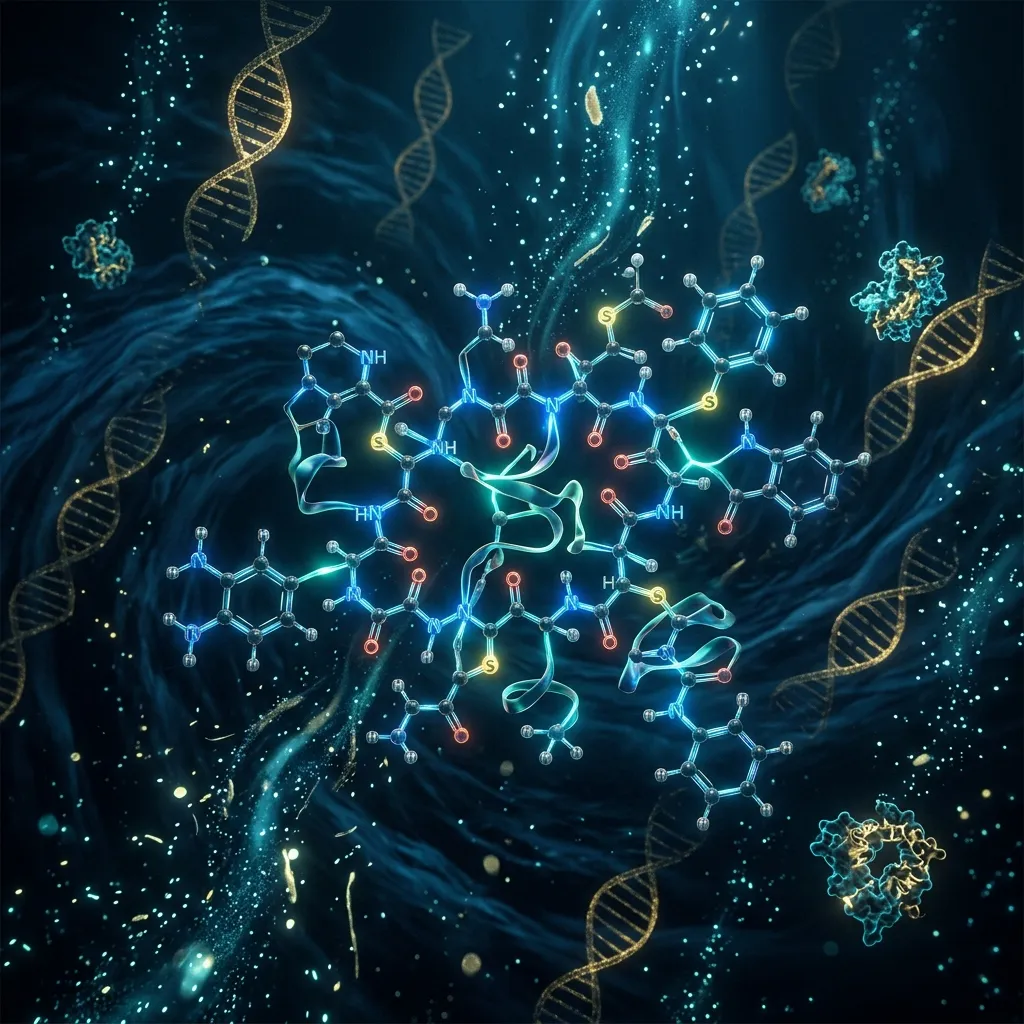
What was discovered: Soil bacteria have evolved over millions of years to synthesize extraordinary chemical arsenals, including potent anti-cancer compounds like Romidepsin used to treat cutaneous T-cell lymphoma. However, how these single-celled organisms reliably build diverse structural variations of these complex molecules without breaking their cellular machinery remained a mystery. A groundbreaking study published in Nature Communications has solved this enigma by discovering specialized molecular connectors dubbed "docking domains." These docking domains function like biochemical plug-and-play adapters, allowing bacterial enzymes to hand off building blocks along a modular assembly line, providing synthetic biologists with a universal blueprint to engineer custom oncology drugs.
Who did the work: The international research initiative was led by structural biologists and bioengineers at the University of Warwick in the UK and Monash University in Australia, with their findings published in Nature Communications (July 2026).
How it was done: Using high-resolution X-ray crystallography, cryo-electron microscopy (cryo-EM), and biochemical reconstitutions of non-ribosomal peptide synthetases and polyketide synthases, the team mapped the precise atomic interfaces where these docking domains operate. They observed how catalytic modules selectively align, interact, and exchange chemical precursors. By mutating specific amino acids at the docking interfaces, the researchers demonstrated that they could intentionally mix, match, and reroute the enzymatic assembly line to produce entirely novel structural variants of anti-cancer compounds.
Why it matters: Total chemical synthesis of complex natural products in laboratory settings is notoriously difficult, expensive, and environmentally taxing. By mastering nature's modular docking code, scientists can now re-engineer living bacterial factories to manufacture next-generation synthetic therapies. This enables the rapid design of novel drug candidates tailored to overcome chemo-resistance, reduce off-target toxicity, and treat aggressive hematological malignancies and solid tumors with unprecedented specificity.
🧠 Ultrasound-Activated Nanomaterials Enable Non-Invasive Deep-Brain Optogenetics
What was discovered: Optogenetics—the technique of using light to trigger or suppress electrical activity in genetically engineered neurons—has revolutionized neuroscience over the past two decades. However, its translation to human medicine has been hindered by a severe constraint: light cannot penetrate dense skull bone or deep brain tissue, requiring surgical craniotomies and implanted fiber-optic cables. Researchers have now shattered this limitation by developing intravenously injectable mechanoluminescent nanotransducers that emit localized visible light deep within the brain when activated by external focused ultrasound. Published in Nature Materials, this breakthrough enables precise optogenetic brain circuit control completely non-invasively.
Who did the work: The multidisciplinary team comprised material scientists, bioengineers, and neuroscientists, publishing their work in Nature Materials (July 10, 2026).
How it was done: The team synthesized biocompatible, non-toxic nanocrystals engineered with mechanoluminescent crystal structures that absorb acoustic energy from focused ultrasound transducers and convert it into focused photons. Once injected into the bloodstream, these nanoparticles circulate safely through brain microvasculature. When focused ultrasound waves—harmlessly targeted through the skull to millimeter-precise brain coordinates—interact with the circulating nanoparticles, they emit localized flashes of light. Neurons expressing light-sensitive Channelrhodopsin proteins immediately respond to these local photonic pulses, firing or calming as commanded.
Why it matters: This technology bridges the long-standing gap between high-precision animal neurobiology and clinical human neurotherapeutics. Eliminating the need for invasive brain implants opens revolutionary avenues for treating deep-seated neurological and psychiatric conditions, including Parkinson's disease, refractory epilepsy, major depressive disorder, and chronic neuropathic pain. Clinicians could soon modulate target brain circuits in outpatient settings using non-invasive ultrasound helmets paired with targeted nanotransducers.
🌊 Deep-Ocean Pressure Acts Like a "Giant Juicer" to Release Bioavailable Marine Carbon
What was discovered: Sinking organic debris—known as "marine snow"—transports vast quantities of carbon from the sunlit surface waters down into the abyssal ocean, acting as Earth’s primary biological carbon pump. A study published in Science Advances reveals that extreme hydrostatic pressure in the ocean depths acts like a molecular "juicer," physically compressing marine snow aggregates as they descend and extruding bioavailable dissolved organic carbon and nitrogen into the surrounding water. This discovery demonstrates that deep-sea microbes receive a continuous, pressure-released nutrient stream, fundamentally altering existing models of abyssal ocean food webs and global ocean carbon sequestration.
Who did the work: An international coalition of oceanographers, marine biogeochemists, and deep-sea ecologists conducted the research, publishing their findings in Science Advances (July 2026).
How it was done: The research team deployed specialized titanium high-pressure oceanographic sampling chambers to collect pristine marine snow aggregates at depths exceeding 4,000 meters. Back in high-pressure laboratories, they placed these delicate detrital clusters inside hyperbaric pressure vessels simulating hydrostatic gradients up to 500 atmospheres. Using real-time spectroscopic imaging and mass spectrometry, the scientists tracked the physical compaction of the marine snow matrix and quantified the accelerated dissolution rates of labile organic compounds under intense hydrostatic compression.
Why it matters: Global climate models previously treated sinking marine snow as relatively static particulate matter that slowly decomposed via microbial enzymatic action alone. Revealing that hydrostatic pressure mechanically squeezes out high concentrations of dissolved organic nutrients at depth explains why deep-ocean microbial communities thrive despite harsh abyssal conditions. Integrating this pressure-driven carbon extrusion mechanism into global Earth system models will dramatically improve our ability to predict ocean carbon storage capacity, evaluate ocean-based carbon dioxide removal strategies, and understand how ocean warming and acidification impact marine carbon sinks.
📌 The Bottom Line
- bacterial-docking-domains-cancer-drugs: Decoded bacterial enzymatic "docking domains" provide a modular bioengineering blueprint to synthesize custom, drug-resistant anti-cancer therapeutics.
- ultrasound-nanomaterials-deep-brain-optogenetics: Mechanoluminescent nanoparticles activated by focused ultrasound enable precise, non-invasive deep-brain optogenetic modulation without surgery.
- deep-ocean-pressure-marine-snow-carbon: Extreme hydrostatic pressure compresses sinking marine snow like a juicer, releasing vital carbon nutrients and reframing global ocean carbon sequestration models.
📬 Stay Updated
Get the week's most important research breakthroughs delivered to your inbox. Subscribe to our free newsletter →
Disclosure: This post contains affiliate links. If you purchase through our links, we earn a small commission at no extra cost to you. We only recommend products we believe in.
Enjoyed this post?
Get our weekly digest delivered free.
Share this post:
Knowelth is reader-supported. We may earn a commission from links in this article at no extra cost to you. Read our disclosure.
Related Posts
The Week in Research: Generalist Neurons, Solid-State Battery Breakthroughs, and Tripled Methanol Catalysis
The Week in Research: Generalist Neurons, Solid-State Battery Breakthroughs, and Tripled Methanol Catalysis Scientific discovery continuously redefines our understanding of nature across every scale, …
The Week in Research: mRNA Oncology, Ambient Direct Air Capture, and 'Flying Qubits'
The Week in Research: mRNA Oncology, Ambient Direct Air Capture, and 'Flying Qubits' This week’s breakthroughs remind us that the boundaries of human knowledge are continually expanding across vastly …
Bacterial Colon Cancer Lock, Molten Gallium Physics, and Ancient Triassic Firestorms
Bacterial Colon Cancer Lock, Molten Gallium Physics, and Ancient Triassic Firestorms From unmasking the molecular doorway gut bacteria exploit to initiate colon cancer to solving a 150-year-old physic…