The Week in Research: Generalist Neurons, Solid-State Battery Breakthroughs, and Tripled Methanol Catalysis
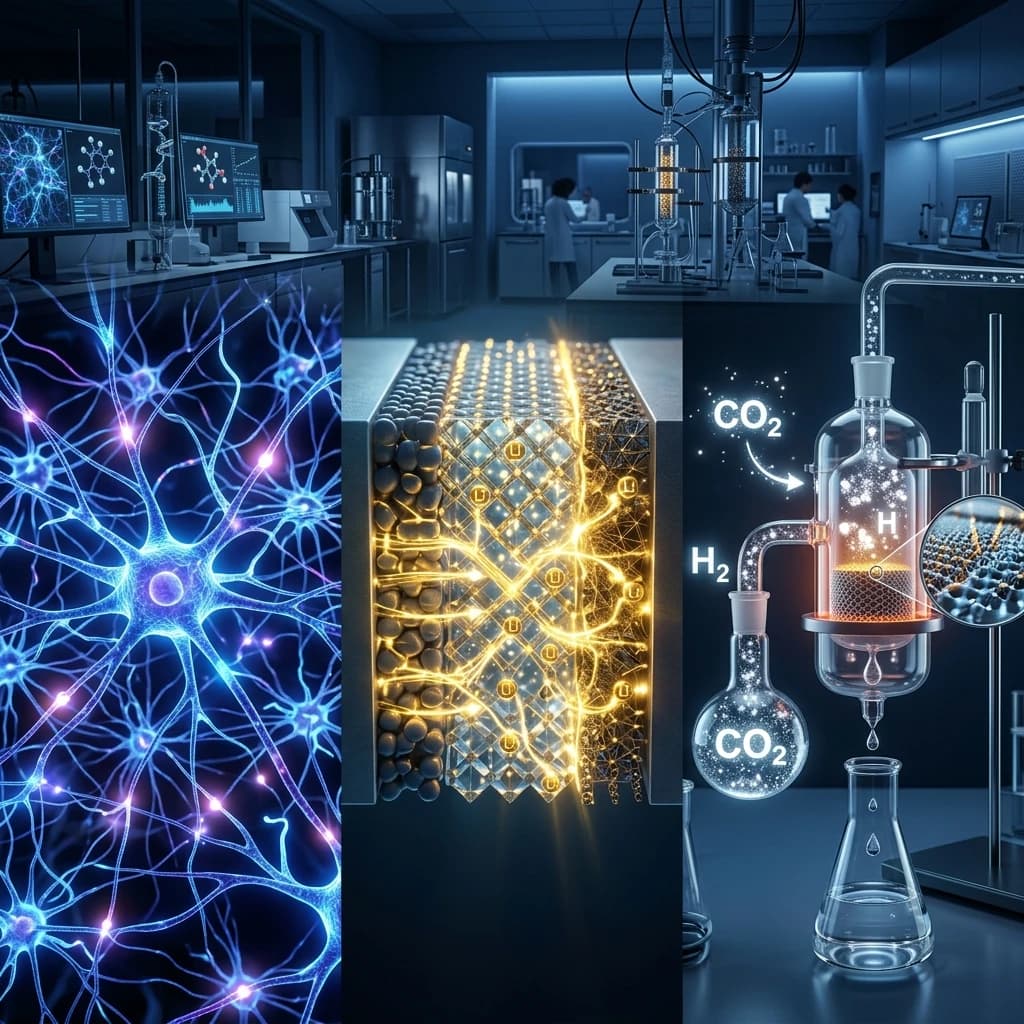
The Week in Research: Generalist Neurons, Solid-State Battery Breakthroughs, and Tripled Methanol Catalysis
Scientific discovery continuously redefines our understanding of nature across every scale, from single cells in the human brain to energy storage physics and molecular chemical synthesis. This week, landmark studies illuminate how flexible neural networks solve dynamic tasks, how microscopic stress mitigation unlocks next-generation solid-state batteries, and how novel tandem catalysts drastically boost sustainable fuel production from captured carbon dioxide.
🔬 Flexible 'Generalist' Neurons Power Complex Brain Computations
What was discovered: For decades, neuroscience operated under a foundational assumption: the brain relies primarily on specialized neurons tuned to dedicated tasks or sensory features. A groundbreaking study published in Nature has upended this paradigm, revealing that the vast majority of cortical neurons act as flexible "generalists." These versatile cells dynamically reconfigure their activity patterns to perform multiplexed computational roles, enabling the brain to process novel environments and solve complex decisions effortlessly.
Who did the work: The research was led by a team of neuroscientists at Columbia University's Zuckerman Institute, with results published in Nature (July 2026).
How it was done: Using high-density electrophysiological recording arrays and advanced calcium imaging, the team monitored thousands of individual neurons across multiple cortical regions in mice performing dynamic decision-making and pattern-recognition tasks. By analyzing population-level neural geometry, researchers separated classical specialist responses from multiplexed neural signals. They observed that while dedicated specialist cells handle rigid sensory baselines, generalist neurons alter their tuning properties depending on cognitive demand, contextual cues, and task history.
Why it matters: Understanding that generalist neurons drive brain flexibility offers vital insights into cognitive resilience, learning, and artificial intelligence design. Synthetic neural networks often suffer from "catastrophic forgetting" when switching between tasks; bio-inspired generalist architecture could yield far more adaptable AI systems. Crucially, in clinical neuroscience, identifying how generalist populations degrade in neurodegenerative conditions like Alzheimer's disease could unlock earlier diagnostic markers and targeted therapeutic interventions.
🔋 Cracking the Dendrite Code in Solid-State Lithium Batteries
What was discovered: Solid-state lithium-metal batteries promise to revolutionize clean energy storage by doubling energy density and eliminating the fire risks associated with flammable liquid electrolytes. However, commercialization has been stymied by metallic lithium "dendrites"—microscopic needle-like tendrils that pierce solid electrolyte separators and cause catastrophic short circuits. Researchers have now uncovered the precise chemo-mechanical stress mechanisms that trigger dendrite initiation, providing a definitive engineering blueprint to prevent solid-state battery failure.
Who did the work: The breakthrough was achieved by materials scientists at the Max Planck Institute for Sustainable Materials, with findings published in Nature Materials (July 2026).
How it was done: The team utilized in situ cryo-focused ion beam scanning electron microscopy combined with synchrotron X-ray nano-tomography to visualize the internal ceramic-lithium interface during ultra-high-rate battery cycling. They discovered that dendrites do not simply push through ceramic pores; rather, microscopic void collapse at high current densities creates extreme localized mechanical stress concentrations. These nanomechanical stress points induce intergranular shear fractures within solid ceramic electrolytes, allowing lithium metal to nucleate along grain boundaries.
Why it matters: Armed with this structural insight, the researchers developed an ultra-thin nanocomposite interlayer capable of dissipating localized mechanical stress and distributing lithium ions uniformly across the solid interface. In laboratory tests, modified solid-state cells achieved over 1,000 rapid charge-discharge cycles at ambient temperature without dendrite formation. This opens the door for commercially viable solid-state batteries in electric vehicles, promising longer ranges, faster charging times, and unprecedented safety.
🧪 Tripling Methanol Yields from Captured CO2 via Breakthrough Catalysts
What was discovered: Converting captured industrial carbon dioxide into liquid methanol offers a circular pathway for carbon-neutral transport fuels and chemical feedstocks. However, conventional catalytic synthesis suffers from low single-pass conversion efficiency due to thermodynamic equilibrium barriers and water byproduct accumulation that poisons catalytic active sites. Chemical engineers have demonstrated a novel tandem catalyst with integrated hydrophobic nano-capillaries that triples the production yield of green methanol from atmospheric CO2.
Who did the work: An international research collaboration led by chemical engineers and materials scientists published their findings in Nature Chemistry (June/July 2026).
How it was done: The research team engineered a multi-functional catalyst combining copper-zinc oxide nanoparticles with a specialized hydrophobic zeolitic framework containing sub-nanometer water-repelling capillaries. As CO2 and hydrogen react on the metallic active sites to produce methanol and water, the surrounding hydrophobic nano-channels rapidly evacuate water molecules from the reaction microenvironment. By continuously stripping away the water byproduct, the catalyst shifts the thermodynamic reaction equilibrium, allowing carbon conversion to proceed far beyond traditional thermodynamic limits at lower temperatures and pressures.
Why it matters: Methanol is a foundational industrial building block used to produce plastics, synthetic materials, and clean liquid fuels. Tripling single-pass catalytic yields while lowering required operating pressures significantly reduces the energy footprint and capital cost of Direct Air Capture (DAC) and point-source carbon utilization facilities. This milestone accelerates the transition toward a closed-loop carbon economy, turning airborne pollutants into valuable chemical resources.
📌 The Bottom Line
- generalist-neurons: Columbia University researchers discovered that flexible "generalist" neurons drive complex cognitive flexibility, challenging traditional neural specialization models (Nature).
- solid-state-dendrites: Max Planck Institute scientists identified the nanomechanical stress mechanisms behind solid-state battery dendrites, paving the way for safe, high-density batteries (Nature Materials).
- co2-methanol-catalysis: Engineers developed a hydrophobic tandem catalyst that continuously evacuates water byproducts, tripling green methanol yields from captured CO2 (Nature Chemistry).
📬 Stay Updated
Get the week's most important research breakthroughs delivered to your inbox. Subscribe to our free newsletter →
Disclosure: This post contains affiliate links. If you purchase through our links, we earn a small commission at no extra cost to you. We only recommend products we believe in.
Enjoyed this post?
Get our weekly digest delivered free.
Share this post:
Knowelth is reader-supported. We may earn a commission from links in this article at no extra cost to you. Read our disclosure.
Related Posts
The Week in Research: Bacterial Anti-Cancer Blueprints, Ultrasound-Driven Brain Optogenetics, and Squeezed Ocean Carbon
The Week in Research: Bacterial Anti-Cancer Blueprints, Ultrasound-Driven Brain Optogenetics, and Squeezed Ocean Carbon Scientific discovery reshapes human capability when researchers decipher nature'…
The Week in Research: mRNA Oncology, Ambient Direct Air Capture, and 'Flying Qubits'
The Week in Research: mRNA Oncology, Ambient Direct Air Capture, and 'Flying Qubits' This week’s breakthroughs remind us that the boundaries of human knowledge are continually expanding across vastly …
Bacterial Colon Cancer Lock, Molten Gallium Physics, and Ancient Triassic Firestorms
Bacterial Colon Cancer Lock, Molten Gallium Physics, and Ancient Triassic Firestorms From unmasking the molecular doorway gut bacteria exploit to initiate colon cancer to solving a 150-year-old physic…