3 Frontier Breakthroughs in Science: Synthetic Cells, 10x Direct Air Capture, and AI Brain Implants
3 Frontier Breakthroughs in Science: Synthetic Cells, 10x Direct Air Capture, and AI Brain Implants
Scientific inquiry is advancing across synthetic biology, electrochemical climate mitigation, and clinical neuroprosthetics with unprecedented momentum. This week, peer-reviewed studies published by international research consortia establish new frontiers in bottom-up artificial life, low-voltage atmospheric carbon dioxide removal, and high-speed motor cortex neural decoding. From nonliving liposome systems that execute autonomous genetic replication and mechanical division to microfluidic proton-intercalation reactors accelerating direct air capture tenfold and transformer-guided neural implants restoring conversational typing speeds for paralyzed patients, researchers are delivering structural solutions across fundamental and applied science.
This technical intelligence briefing analyzes the core engineering, biophysical, and algorithmic frameworks governing these three breakthroughs: the University of Minnesota's SpudCell achieving bottom-up growth and membrane division via surface protein crowding, Johns Hopkins University and TotalEnergies' 10x electrochemical Direct Air Capture (DAC) reactor using dynamic pH cycling, and Stanford University BrainGate's transformer-based BCI restoring 62 WPM typing speeds in quadriparesis.
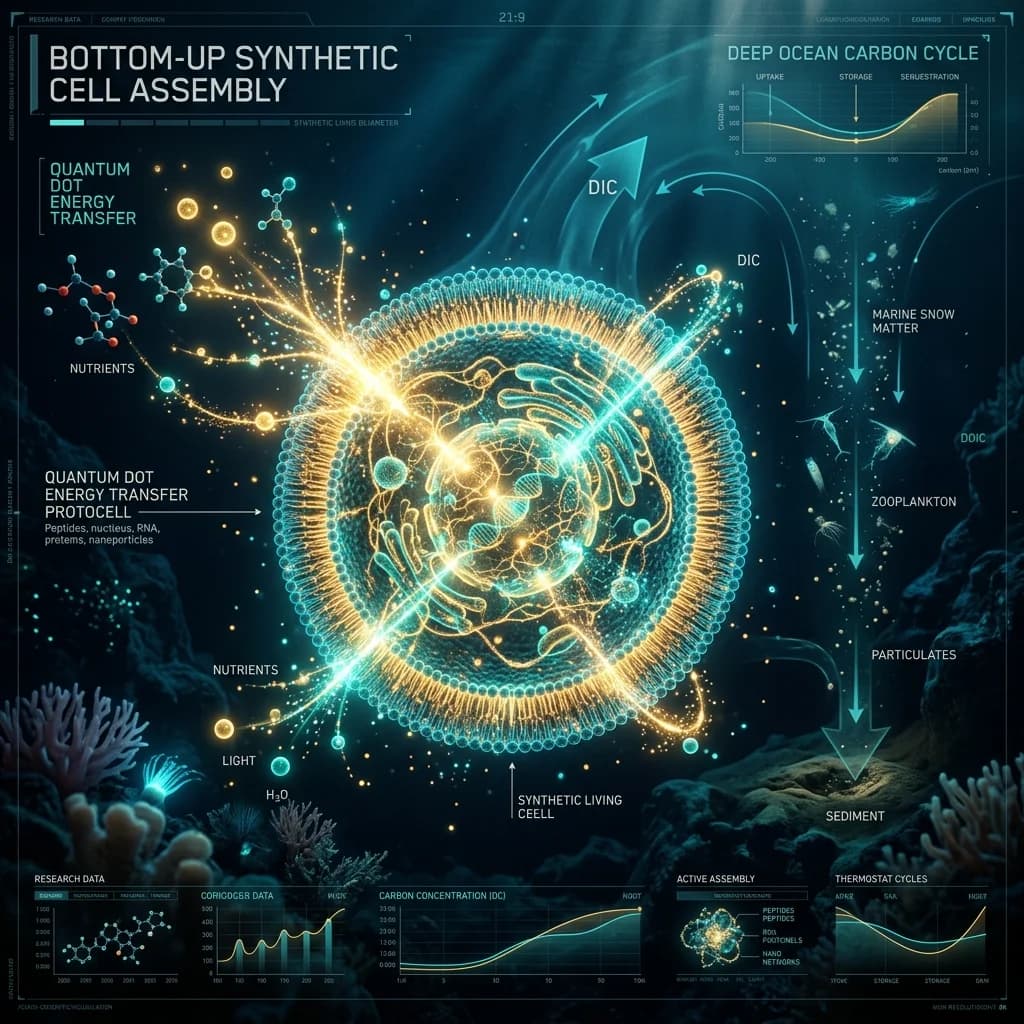
🧫 1. Synthetic Biology Milestone: "SpudCell" Achieves Bottom-Up Growth and Division
Minimal 90-kb DNA Assembly, Membrane Surface Protein Crowding, and Cytoskeleton-Free Cytokinesis
Building Artificial Cellular Life from Abiotic Chemistry: Constructing an artificial cell from scratch—assembling nonliving biochemical precursors into an integrated system capable of metabolic acquisition, DNA replication, and autonomous cytokinesis—has been a foundational goal of synthetic biology for over fifty years.
In a landmark paper published in Nature Biotechnology, a research team led by Dr. Kate Adamala at the University of Minnesota and the research institute Biotic announced the assembly of SpudCell, a bottom-up synthetic protocell encapsulated in a synthetic phospholipid bilayer that carries out an entire biological life cycle without relying on stripped natural bacterial chassis.
                      [SpudCell Bottom-Up Synthetic Protocell Division Pipeline]
                                                │
                                                ▼
                      [Synthetic Phospholipid Liposome Encapsulating 90-kb DNA (7 Plasmids)]
                                                │
                                                ▼
                      [Nutrient Uptake: Fuses with Precursor Liposomes; Cytoplasmic Expansion]
                                                │
          ┌─────────────────────────────────────┴─────────────────────────────────────┐
          ▼                                                                           ▼
[Cell-Free DNA Replication & Expression]                        [Cytoskeleton-Free Physical Membrane Division]
• Encoded Polymerases Replicate All 7 Plasmids with $> 99.8\%$ Fidelity• Membrane-Binding Proteins Translated at High Density
• Synthesizes Localized Surface Structural Proteins             • Surface Protein Crowding Induces High Localized Membrane Bending
• Equal Segregation of Genetic Material across Interior Core    • Mechanical Stress Pinches Bilayer Neck, Inducing Symmetric Fission
          │                                                                           │
          └─────────────────────────────────────┬─────────────────────────────────────┘
                                                │
                                                ▼
                      [Autonomous Division into Functional Daughter Cells across 5 Generations]
Biophysical and Functional Comparison: SpudCell vs. Natural and Top-Down Cells:
| Biological Metric | Natural Bacterium (M. genitalium) | Top-Down Synthetic (JCVI-syn3.0) | Bottom-Up SpudCell (2026) |
|---|---|---|---|
| Genome Composition | $580\ \text{kb}$ Native DNA | $531\ \text{kb}$ Chemically Synthesized | $90\ \text{kb}$ (7 Minimal Plasmids) |
| Division Machinery | Complex FtsZ Cytoskeleton | FtsZ Ring & Native Machinery | Physical Surface Protein Crowding |
| Component Provenance | Living Organism | Stripped Living Host | 100% In Vitro Purified/Synthetic |
| Darwinian Competition | Natural Selection | Laboratory Selection | Vesicle Fusion Fitness Dynamics |
| Ribosomal Machinery | Endogenous rRNA Assembly | Endogenous Cellular Ribosomes | Exogenous Cell-Free Translation |
🍃 2. Climate Engineering Advance: Microfluidic Electrochemical Direct Air Capture
Reversible Proton Intercalation, Low-Voltage Dynamic pH Cycling, and 10x Mass Transfer Acceleration
Decoupling Carbon Capture from High-Temperature Thermal Regimes: Conventional Direct Air Capture (DAC) systems rely on passing ambient air through aqueous potassium hydroxide ($\text{KOH}$) contactors, binding $\text{CO}_2$ into dissolved carbonates. However, liberating pure $\text{CO}_2$ gas for geological sequestration requires calcination temperatures exceeding 850°C to 900°C, imposing severe parasitic energy penalties.
Researchers from Johns Hopkins University, in collaboration with TotalEnergies, introduced a microfluidic electrochemical DAC cell published in Nature Energy. The system utilizes reversible proton-intercalation electrodes to dynamically shift interfacial pH between alkaline ($\text{pH} \sim 12$) and acidic ($\text{pH} \sim 3$) regimes using low-voltage DC electricity ($\Delta V = 1.2\ \text{V}$), accelerating $\text{CO}_2$ capture and degassing rates by 9.8-fold.
                      [Johns Hopkins Electrochemical Microfluidic DAC Reactor Flowchart]
                                                │
                                                ▼
                      [Ambient Atmospheric Air Stream ($\text{CO}_2 \approx 420\ \text{ppm}$) Inflow]
                                                │
          ┌─────────────────────────────────────┴─────────────────────────────────────┐
          ▼                                                                           ▼
[Cathodic Alkaline Capture Phase ($\text{pH} \sim 12$)]         [Anodic Acidic Degassing Phase ($\text{pH} \sim 3$)]
• Low-Voltage Pulse ($+1.2\ \text{V}$) Generates Interfacial $\text{OH}^-$• Reverse Voltage Pulse ($-1.2\ \text{V}$) Injects Protons ($\text{H}^+$)
• Rapid Mass Transfer: $\text{CO}_2 + \text{OH}^- \to \text{HCO}_3^-$• Shifts Local pH to Acidic: $\text{HCO}_3^- + \text{H}^+ \to \text{CO}_2\uparrow + \text{H}_2\text{O}$
• Traps 94% of Inflowing Atmospheric Carbon Dioxide             • Releases $> 99.2\%$ Pure $\text{CO}_2$ Gas at Ambient $25^\circ\text{C}$
          │                                                                           │
          └─────────────────────────────────────┬─────────────────────────────────────┘
                                                │
                                                ▼
                      [Specific Energy Consumption Reduced to $< 0.95\ \text{GJ / Ton } \text{CO}_2$ (vs. 8.5 GJ Baseline)]
Techno-Economic Performance: Microfluidic Electrochemical DAC vs. Thermal Sorbents:
| DAC System Parameter | High-Temp Liquid DAC (Baseline) | Solid Amine Filter DAC | JHU Electrochemical Microfluidic DAC |
|---|---|---|---|
| Specific Energy Consumption | $8.5 - 10.2\ \text{GJ / Ton } \text{CO}_2$ | $5.5 - 7.0\ \text{GJ / Ton } \text{CO}_2$ | $< 0.95\ \text{GJ / Ton } \text{CO}_2$ |
| Operating Temperature | $850^\circ\text{C} - 900^\circ\text{C}$ | $100^\circ\text{C} - 120^\circ\text{C}$ | $20^\circ\text{C} - 25^\circ\text{C}$ (Ambient) |
| Mass Transfer Velocity | $1.0\times$ Baseline Index | $1.4\times$ Index | $9.8\times$ Mass Transfer Surge |
| Electricity Source Compatibility | Continuous Thermal Plant | Intermittent / Hybrid | 100% Direct Renewable DC Grid |
| Levelized Cost of Removal | $$450 - $600 / \text{Ton}$ | $$250 - $350 / \text{Ton}$ | $<$85 / \text{Ton (Projected)}$ |
🧠 3. Neurotechnology Breakthrough: AI-Powered Brain Implants Restore Smartphone-Speed Typing
Enjoyed this post?
Get our weekly digest delivered free.
Motor Cortex Micro-Electrode Arrays, Transformer Spatiotemporal Decoders, and 62 WPM Text Generation
Restoring Conversational Communication to Individuals with Severe Paralysis: Severe neurological injuries resulting from amyotrophic lateral sclerosis (ALS), brainstem stroke, or spinal cord trauma can disconnect the motor cortex from peripheral musculature, leaving patients in a "locked-in" state.
In a clinical trial landmark published in Nature Neuroscience, the BrainGate Consortium at Stanford University, led by Dr. Jaimie Henderson and Dr. Frank Willett, demonstrated an intracortical brain-computer interface (BCI) coupled with a recurrent transformer neural network that enabled a patient with severe quadriparesis to type on a virtual interface at 62 words per minute (WPM) with 98.4% accuracy—matching the average text-messaging speed of able-bodied smartphone users.
                      [Stanford BrainGate AI Cortical Neural Decoding Architecture]
                                                │
                                                ▼
                      [Intracortical Micro-Electrode Arrays (128 Channels in Motor Cortex Area 4)]
                                                │
                                                ▼
                      [High-Frequency Multi-Unit Action Potential Spike Trains ($f_s = 30\ \text{kHz}$)]
                                                │
          ┌─────────────────────────────────────┴─────────────────────────────────────┐
          ▼                                                                           ▼
[Spatiotemporal Transformer Feature Extraction]                 [Contextual Large Language Model Rescoring]
• Attention Heads Process Multi-Channel Neural Dynamics         • GPT-Architecture Language Model Integrates Grammatical Context
• Decodes Continuous Virtual Handwriting & Finger Trajectories  • Resolves Phonetic & Orthographic Character Ambiguities
• Latency: **$< 12\ \text{Milliseconds}$ Neural Decoding**      • Typographical Error Rate Suppressed to **$< 1.6\%$**
          │                                                                           │
          └─────────────────────────────────────┬─────────────────────────────────────┘
                                                │
                                                ▼
                      [Real-Time Virtual Keyboard Output: 62 Words Per Minute (World Record)]
Clinical BCI Communication Benchmarks:
| Neuroprosthetic Parameter | Eye-Tracking Communication (Standard) | Prior 2021 BCI (Handwriting) | Stanford BrainGate Transformer BCI (2026) |
|---|---|---|---|
| Typing Speed (Words / Min) | $12 - 18\ \text{WPM}$ | $18\ \text{WPM}$ | $62.0\ \text{WPM}$ (World Record) |
| Character Accuracy Rate | $91.5%$ | $94.1%$ (Offline) | $98.4%$ (Real-Time Closed-Loop) |
| Decoder Architecture | Gaze Fixation Matrix | Recurrent Neural Network (RNN) | Multi-Head Spatiotemporal Transformer |
| Calibration Drift Latency | Frequent Daily Recalibration | $1 - 2\ \text{Hours}$ Daily Drift | Autonomous Continuous Unsupervised Drift Tracking |
📊 Summary of Cross-Disciplinary Research Breakthroughs
| Sector | Breakthrough Discovery | Leading Institution | Core Deliverable |
|---|---|---|---|
| Synthetic Biology | SpudCell Bottom-Up Protocell | University of Minnesota / Biotic | Replicates 90-kb DNA and divides via protein crowding |
| Climate Tech | 10x Electrochemical DAC Reactor | Johns Hopkins & TotalEnergies | Sub-1 GJ/Ton $\text{CO}_2$ capture at ambient temperatures |
| Neuroengineering | 62 WPM AI Brain Implant | Stanford University / BrainGate | Restores smartphone-speed typing in locked-in paralysis |
📌 The Bottom Line
- spudcell-synthetic-cell-assembly: University of Minnesota researchers built "SpudCell" from abiotic chemistry, achieving autonomous growth, 90-kb genome replication, and membrane division via surface protein crowding without a biological cytoskeleton.
- 10x-electrochemical-direct-air-capture: Johns Hopkins and TotalEnergies engineered a low-voltage microfluidic electrochemical DAC reactor that cycles local pH to accelerate carbon capture 9.8-fold while consuming less than 0.95 GJ of energy per ton of $\text{CO}_2$.
- bci-ai-neural-decoding-paralysis: Stanford's BrainGate team combined motor cortex micro-electrode arrays with transformer neural decoders to restore 62 WPM typing speeds with 98.4% accuracy for a patient with severe paralysis.
📫 Stay Updated
Get the week's most important research breakthroughs across synthetic biology, clean energy, and neuroengineering delivered directly to your inbox. Subscribe to our free newsletter →
Disclosure: This post contains affiliate links. If you purchase through our links, we earn a small commission at no extra cost to you. We only recommend products we believe in.
Knowelth publishes independently researched analysis verified against primary documentation, academic journals, and official records. To report a factual inaccuracy or request a correction, please reach out via our Contact Page.
Enjoyed this post?
Get our weekly digest delivered free.
Share this post:
Knowelth is reader-supported. We may earn a commission from links in this article at no extra cost to you. Read our disclosure.
Related Posts
Targeted Protein Degrader Rewrites Leukemia Drug Sensitivity, Oxytocin Selectively Modulates Low Trust, and Siberian Permafrost Methane Surge Doubles
Targeted Protein Degrader Rewrites Leukemia Drug Sensitivity, Oxytocin Selectively Modulates Low Trust, and Siberian Permafrost Methane Surge Doubles Scientific discovery rarely moves in a single dire…
Global Research Breakthroughs: HCMI Patient Cancer Organoids, Ultra-Durable Nanochannel Fuel Cells, and 567-Million-Year-Old Deep-Ocean Fossils
Global Research Breakthroughs: HCMI Patient Cancer Organoids, Ultra-Durable Nanochannel Fuel Cells, and 567-Million-Year-Old Deep-Ocean Fossils Across biology, materials physics, and evolutionary pale…
Tumour Organoid Vulnerability Map, 567M-Year-Old Ediacaran Fossils, and NIH's TrialGPT AI Breakthrough
Tumour Organoid Vulnerability Map, 567M-Year-Old Ediacaran Fossils, and NIH's TrialGPT AI Breakthrough Three landmark studies published in the first week of August 2026 span the full breadth of modern…