Bacterial Cancer-Drug Factories, Sky-River Heatwaves, and Dendrite-Free Solid-State Batteries
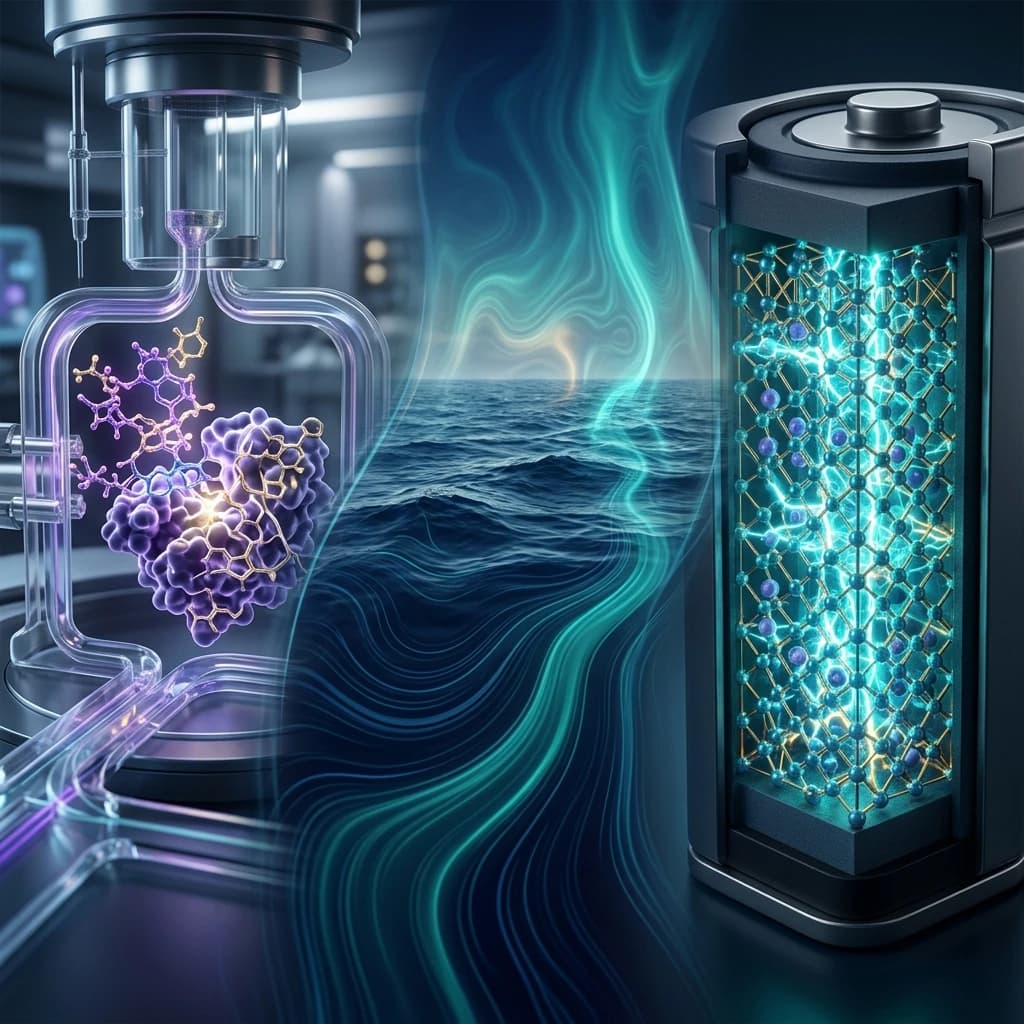
Bacterial Cancer-Drug Factories, Sky-River Heatwaves, and Dendrite-Free Solid-State Batteries
Scientific discovery moves forward not through isolated leaps, but through uncovering the subtle mechanisms that govern complex systems. From submicroscopic bacterial assembly lines to planetary atmospheric fluxes and solid-phase energy interfaces, understanding foundational rules allows researchers to engineer transformative solutions. This week's landmark studies highlight how mapping nature's intricate blueprints is accelerating targeted cancer therapies, refining global ocean-climate forecasts, and unlocking safe, ultra-fast energy storage.
🔬 Bacterial Molecular Docking Unlocks New Combinatorial Cancer Drugs
Nature has long been humanity’s most sophisticated medicinal chemist, synthesizing complex therapeutic molecules that synthetic laboratories struggle to replicate. Among these natural marvels is Romidepsin (marketed as Istodax), a potent histone deacetylase (HDAC) inhibitor derived from soil bacteria that selectively forces T-cell lymphoma cells into self-destruction. However, for decades, biochemists were puzzled by how bacterial enzyme networks manage to assemble an entire family of closely related drug variants without creating non-functional biological dead ends. In a groundbreaking study published in Nature Communications, an international team led by researchers from the University of Warwick and Monash University solved this biological mystery.
The researchers discovered that bacteria rely on specialized structural peptides termed "docking domains" that function like molecular puzzle pieces or universal couplers. In natural assembly lines known as non-ribosomal peptide synthetases (NRPS), one multi-enzyme cluster is dedicated to fabricating the core rigid scaffold of the drug molecule, while a separate, modular enzyme system crafts a variable chemical "cap." The newly identified docking domain acts as a precise physical interface, ensuring that the variable cap seamlessly snaps onto the core scaffold regardless of subtle structural modifications. By analyzing the biosynthetic gene cluster of FR-901375—a sister compound to Romidepsin—the team demonstrated how bacteria naturally execute "combinatorial biosynthesis" to generate diverse drug molecules engineered to target different cellular pathways.
To validate their model, the team reconstituted the enzyme docking interface in vitro and demonstrated that swapping docking domains between different bacterial species allowed custom assembly lines to produce entirely novel hybrid molecules. Think of it like a biological Lego set: instead of having to redesign an entire factory floor every time a minor drug alteration is needed, scientists can now use standardized docking snaps to swap in different active chemical heads onto a proven anticancer chassis.
This breakthrough opens unprecedented possibilities for synthetic biology and drug development. By harnessing these universal docking domains, bioengineers can design custom bacterial strains capable of churning out next-generation HDAC inhibitors tailored to overcome chemotherapy resistance. Beyond oncology, deciphering modular bacterial assembly lines provides a blueprint for sustainable, green-chemistry manufacturing of complex antibiotics, immunosuppressants, and antivirals directly from engineered microbial fermentations.
🌊 Atmospheric Rivers Exposed as Drivers of Severe Marine Heatwaves
Marine heatwaves—prolonged spells of abnormally high sea surface temperatures—have devastated coral reefs, disrupted global fisheries, and triggered massive die-offs of ocean wildlife over the past decade. While scientists have traditionally attributed these ocean warmings to persistent high-pressure atmospheric ridges and El Niño phenomena, the exact thermodynamic triggers causing rapid heat spikes have remained elusive. A landmark study published in Nature Communications by atmospheric scientists at Duke University's Nicholas School of the Environment has uncovered a critical, previously overlooked culprit: "rivers in the sky," officially known as atmospheric rivers.
Atmospheric rivers are massive, narrow corridors of concentrated water vapor that transport vast quantities of moisture from the tropics toward the poles—often carrying a water flow equivalent to 15 times the Mississippi River. Analyzing over 40 years of high-resolution satellite measurements and ocean-atmosphere reanalysis data from 1982 to 2023 across the North Pacific and North Atlantic, the Duke team evaluated the exact energy exchanges occurring when an atmospheric river passes over the ocean surface. They discovered that atmospheric rivers act as double-edged thermodynamic modifiers, pitting two opposing physical processes against each other.
On one hand, dense cloud decks accompanying atmospheric rivers reflect incoming solar radiation back into space, exerting a modest cooling effect on the water below. However, the study proved that this cooling is frequently overwhelmed by a powerful warming effect: the dense blanket of warm, humid air carried by the atmospheric river traps outgoing infrared heat like a thick thermal blanket. Crucially, the extreme air humidity severely suppresses surface evaporation—the ocean's primary natural cooling mechanism—effectively locking heat inside the upper marine boundary layer. In winter and early spring, this humidity-trapped heat drives basin-wide ocean surface warmings that trigger or amplify devastating marine heatwaves.
Unraveling this ocean-atmosphere coupling represents a major step forward for climate modeling. As global temperatures rise, atmospheric rivers are projected to become warmer, wetter, and more frequent. Incorporating atmospheric river moisture dynamics into predictive Earth system models will allow meteorologists and marine conservationists to forecast severe marine heatwaves months in advance, giving coastal communities and fisheries crucial lead time to mitigate ecological and economic impacts.
⚡ Cracking the Dendrite Code: Grain Boundary Engineering in Solid-State Batteries
Enjoyed this post?
Get our weekly digest delivered free.
Solid-state lithium metal batteries represent the holy grail of energy storage: by replacing flammable liquid electrolytes with solid ceramics, they promise double the energy density of modern EV batteries alongside near-zero fire risk. Yet, despite decades of intense industrial effort, commercialization has been stalled by a persistent physical failure mode. Under fast-charging conditions, microscopic needle-like lithium structures known as dendrites pierce through even the hardest ceramic electrolytes, creating internal short-circuits that destroy the cell. Now, joint research published in Nature and Nature Nanotechnology by scientists at the Max Planck Institute for Sustainable Materials (MPI-SusMat), MIT, and the Technical University of Munich (TUM) has finally resolved how dendrites penetrate hard solids and how to permanently prevent them.
Using advanced in situ transmission electron microscopy and nanoscale impedance spectroscopy, the interdisciplinary team investigated the mechanical and electrical behavior of solid ceramic electrolytes such as lithium lanthanum zirconium oxide (LLZO). Counter to the long-held assumption that dendrites simply force their way mechanically through microscopic cracks, the researchers discovered that the root cause is fundamentally electrical. At the microscopic interfaces where individual ceramic crystal grains meet—known as "grain boundaries"—local electrical imbalances build up. During rapid charging, these electrical potential variations cause metallic lithium ions to preferentially reduce and accumulate directly inside the grain boundary junctions, generating immense localized internal pressure that fractures the ceramic from within.
Armed with this diagnostic breakthrough, the team engineered a novel nanoscale processing technique to tailor the chemical composition and electronic bandgap of the grain boundaries. By introducing ultrathin atomic dopants along the grain boundary networks, they created an electronically resistive barrier that eliminates localized charge buildup. Tests of the grain-boundary-engineered ceramic electrolytes demonstrated an astonishing performance surge: critical current density—the maximum charging speed achievable before dendrites form—increased by over 300%. The modified solid-state cells survived thousands of rapid charge-discharge cycles without any trace of dendrite penetration.
This fundamental materials breakthrough transforms solid-state batteries from a fragile laboratory concept into a scalable manufacturing reality. By solving the dendrite bottleneck at the atomic level, the research paves the way for electric vehicles capable of charging fully in under ten minutes while extending driving ranges beyond 600 miles. Furthermore, dendrite-free solid-state architectures hold immense promise for aviation and grid-scale renewable energy storage, accelerating the global transition away from fossil fuels.
📌 The Bottom Line
- bacterial-cancer-drug-biosynthesis: Scientists decoded bacterial "docking domains" to custom-engineer versatile anti-cancer therapies like Romidepsin via combinatorial biosynthesis.
- atmospheric-rivers-marine-heatwaves: Researchers proved that atmospheric rivers drive intense ocean heatwaves by trapping heat and suppressing surface evaporation.
- solid-state-battery-dendrite-breakthrough: Engineering grain boundaries in ceramic electrolytes eliminates lithium dendrite short-circuits, enabling fast-charging solid-state batteries.
📫 Stay Updated
Get the week's most important research breakthroughs delivered to your inbox. Subscribe to our free newsletter →
Disclosure: This post contains affiliate links. If you purchase through our links, we earn a small commission at no extra cost to you. We only recommend products we believe in.
Knowelth publishes independently researched analysis verified against primary documentation, academic journals, and official records. To report a factual inaccuracy or request a correction, please reach out via our Contact Page.
Enjoyed this post?
Get our weekly digest delivered free.
Share this post:
Knowelth is reader-supported. We may earn a commission from links in this article at no extra cost to you. Read our disclosure.
Related Posts

Targeted Protein Degrader Rewrites Leukemia Drug Sensitivity, Oxytocin Selectively Modulates Low Trust, and Siberian Permafrost Methane Surge Doubles
Targeted Protein Degrader Rewrites Leukemia Drug Sensitivity, Oxytocin Selectively Modulates Low Trust, and Siberian Permafrost Methane Surge Doubles Scientific discovery rarely moves in a single dire…

Global Research Breakthroughs: HCMI Patient Cancer Organoids, Ultra-Durable Nanochannel Fuel Cells, and 567-Million-Year-Old Deep-Ocean Fossils
Global Research Breakthroughs: HCMI Patient Cancer Organoids, Ultra-Durable Nanochannel Fuel Cells, and 567-Million-Year-Old Deep-Ocean Fossils Across biology, materials physics, and evolutionary pale…
Tumour Organoid Vulnerability Map, 567M-Year-Old Ediacaran Fossils, and NIH's TrialGPT AI Breakthrough
Tumour Organoid Vulnerability Map, 567M-Year-Old Ediacaran Fossils, and NIH's TrialGPT AI Breakthrough Three landmark studies published in the first week of August 2026 span the full breadth of modern…