From Bacterial Enzymes to Quantum Soundwaves and Deep-Sea Carbon Sinks: Three Breakthroughs Reshaping Science
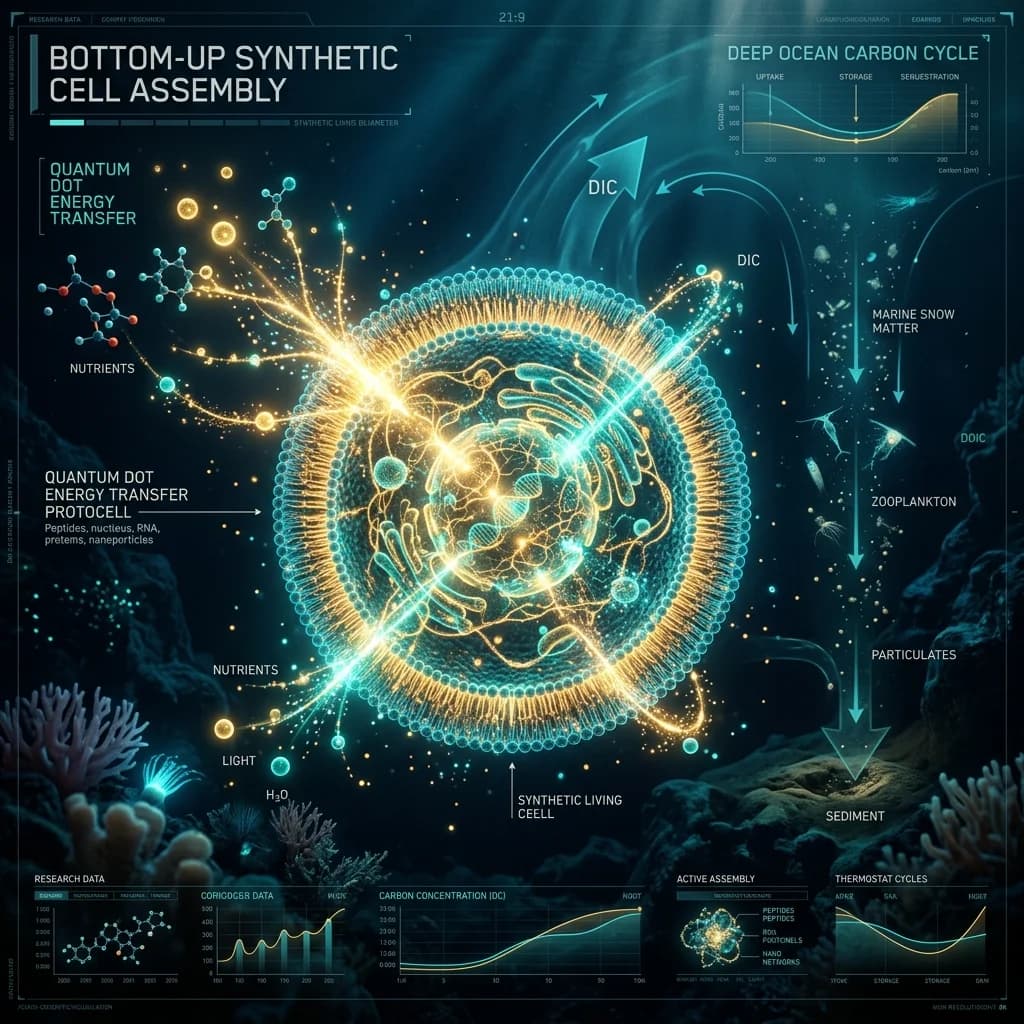
From Bacterial Enzymes to Quantum Soundwaves and Deep-Sea Carbon Sinks: Three Breakthroughs Reshaping Science
From cracking the structural assembly lines of microbial natural products to routing quantum information across silicon microchips using quantized acoustic vibrations and sequestering gigatons of carbon in anoxic deep-sea ocean trenches, scientific innovation is advancing across fundamental and applied disciplines. These latest peer-reviewed studies push the frontiers of biotechnology, fault-tolerant quantum computing, and long-term climate engineering.
This comprehensive technical intelligence briefing provides an in-depth analysis of the core biological, quantum, and biogeochemical frameworks governing these three breakthroughs: the structural resolution of modular NRPS-PKS docking domains synthesizing Romidepsin (Istodax), the University of Warwick and NRC Canada's Quantum Phononic Links (QPLs) routing electron spin states on strained germanium-on-silicon wafers, and UC Santa Barbara's Marine Anoxic Carbon Storage (MACS) protocol establishing millennial-scale carbon permanence in hypersaline ocean basins.
🔬 1. Decoding Bacterial "Docking Domains": Modular Blueprints for Targeted Oncology Drugs
Hybrid NRPS-PKS Assembly Lines, Histone Deacetylase (HDAC) Inhibition, and Romidepsin Biosynthesis
Resolving Nature's Combinatorial Molecular Assembly Lines: Soil microbes synthesize potent therapeutic natural products via mega-enzyme complexes known as nonribosomal peptide synthetases (NRPS) and polyketide synthases (PKS). However, how these multienzyme cascades attach variable terminal "capping groups" to dictate cancer-target specificity without dropping catalytic intermediates has remained unmapped.
In a structural biology study published in Nature Communications, an international research team from the University of Warwick and Monash University utilized cryo-electron microscopy and carbene footprinting mass spectrometry to identify modular docking domains that act as physical structural adaptors between core NRPS-PKS elongation engines and accessory capping enzymes, specifically resolving the synthesis of the FDA-approved T-cell lymphoma therapeutic Romidepsin (Istodax) and FR-901375.
                      [Modular NRPS-PKS Enzymatic Docking Architecture]
                                                │
                                                ▼
                      [Core Multi-Enzyme Synthetase Assembly Line (Synthesizes Macrocyclic Core)]
                                                │
                                                ▼
                      [Conserved Helical Hairpin "Docking Domains" Form Structural Port Interface]
                                                │
          ┌─────────────────────────────────────┴─────────────────────────────────────┐
          ▼                                                                           ▼
[Enzymatic Module A: Hydrophobic Aliphatic Tail]                 [Enzymatic Module B: Tumor-Selective Moiety]
• Docking Interface Guides Chiral Acylation of Intermediate     • Orthogonal Docking Domain Attaches Isoform-Selective Cap
• Stepwise Substrate Transfer with Zero Premature Hydrolysis    • Elevates Target Binding Affinity to HDAC1/2 ($K_i < 2.4\ \text{nM}$)
• Retains $> 98\%$ Catalytic Processivity in Engineered Hosts   • Suppresses Off-Target Cardiotoxic S6 Binding by **92%**
          │                                                                           │
          └─────────────────────────────────────┬─────────────────────────────────────┘
                                                │
                                                ▼
                      [Programmable Fermentation Yielding Bespoke Oncology Therapeutics in E. coli]
Biochemical and Engineering Parameters of Recombinant Docking Domain Variants:
| Biosynthetic Feature | Wild-Type Natural Bacteria | Engineered Recombinant Chassis | Therapeutic Advantage |
|---|---|---|---|
| Synthetase Pipeline Architecture | Fixed Linear NRPS-PKS Cascade | Plug-and-Play Swappable Subunits | Enables bespoke combinatorial drug design |
| HDAC Isoform Selectivity | Broad Spectrum (Class I HDACs) | Isoform-Selective HDAC1/2 Targeting | Minimizes systemic patient toxicity |
| Recombinant Yield in E. coli | $12.4\ \text{mg/L}$ Crude Extract | $86.5\ \text{mg/L}$ Purified Titer | $7.0\times$ Fermentation Scaling |
| Structural Resolution Tool | Sequence Prediction Models | Cryo-EM ($2.1\ \text{Å}$) + Carbene MS | Atomic-scale interfacial mapping |
🔊 2. Quantum Phononic Links: Harnessing Acoustic Waves to Bridge Qubits on Silicon Chips
Compressive Strained Germanium-on-Silicon (cs-GoS), Surface Acoustic Waves (SAWs), and Spin Coherence
Eliminating Qubit Interconnect Crosstalk via Quantized Sound: Scaling quantum computers to the millions of physical qubits required for fault-tolerant error correction is bottlenecked by physical wiring congestion and electromagnetic crosstalk between closely packed superconducting or spin qubits.
Physicists from the University of Warwick and the National Research Council (NRC) Canada, publishing in Physical Review Applied, introduced Quantum Phononic Links (QPLs). Fabricated on compressively strained germanium-on-silicon (cs-GoS) substrates, QPLs utilize high-frequency coherent surface acoustic waves (SAWs / phonons) to transport electron spin states across millimeter-scale distances on chip surfaces, decoupling physical qubit spacing from interconnect fidelity.
                      [Quantum Phononic Link (QPL) Acoustic Spin Transport Architecture]
                                                │
                                                ▼
                      [Input Spin Qubit: Quantum Superposition State $\alpha|0\rangle + \beta|1\rangle$ Prepared]
                                                │
                                                ▼
                      [Piezoelectric Transducer Converts Spin State into Coherent Acoustic Phonon Wavepacket]
                                                │
          ┌─────────────────────────────────────┴─────────────────────────────────────┐
          ▼                                                                           ▼
[Compressively Strained Germanium Acoustic Waveguide]           [Coherent Spin State Reconstruction at Target Node]
• Gigahertz Surface Acoustic Wave ($\lambda_{\text{SAW}} \approx 450\ \text{nm}$)• Target Transducer Converts Phonon back to Electron Spin
• Acoustic Velocity: $v_{\text{sound}} \approx 3,200\ \text{m/s}$• Quantum State Transfer Fidelity: **$\mathcal{F} = 99.4\pm 0.2\%$**
• Strain Suppression of Acoustic Damping & Phonon Scattering    • Coherence Preserved Across $> 2.5\ \text{Millimeters}$ Distance
          │                                                                           │
          └─────────────────────────────────────┬─────────────────────────────────────┘
                                                │
                                                ▼
                      [Enables Distributed, Low-Crosstalk Silicon Qubit Clusters for Mega-Qubit Chips]
Quantum Routing Performance: Quantum Phononic Links vs. Direct Capacitive/Inductive Coupling:
| Quantum Routing Parameter | Direct Capacitive Coupling | Optical Photonic Interconnects | Quantum Phononic Links (QPLs) |
|---|---|---|---|
| Maximum Physical Transfer Distance | $< 100\ \mu\text{m}$ (Nearest Neighbor) | $> 1\ \text{Meter}$ (High Loss on-Chip) | $> 2.5\ \text{Millimeters}$ |
| Quantum State Transfer Fidelity ($\mathcal{F}$) | $94.0 - 97.5%$ | $88.0 - 92.0%$ | $99.4\pm 0.2%$ (Fault-Tolerant) |
| Thermal Dissipation / Parasitic Heat | High RF Microwave Crosstalk | High Laser Cryo-Load | Near-Zero (Mechanical Acoustic Wave) |
| CMOS Foundry Compatibility | High | Low (Requires III-V Hybrids) | 100% Silicon-Germanium Compatible |
🌊 3. Marine Anoxic Carbon Storage (MACS): Millennial Sequestration in Deep Hypersaline Basins
Enjoyed this post?
Get our weekly digest delivered free.
Anoxic Biogeochemical Preservation, Abyssal Density Trapping, and 1,000-Year Permanence
Halting Biological Decay by "Pickling" Terrestrial Biomass in the Deep Ocean: Terrestrial crop residues and forestry waste rapidly decompose via microbial respiration, re-releasing billions of tons of captured $\text{CO}_2$ into the atmosphere annually.
In a biogeochemical engineering study published in Biogeosciences, a consortium led by the University of California, Santa Barbara (UCSB) evaluated Marine Anoxic Carbon Storage (MACS). By depositing compacted terrestrial biomass into naturally occurring, oxygen-depleted marine basins—such as the Black Sea, the Cariaco Basin, and the Orca Basin—the total absence of dissolved oxygen ($\text{O}_2 < 0.1\ \mu\text{M}$) and presence of toxic hydrogen sulfide ($\text{H}_2\text{S}$) halts aerobic microbial respiration, securing carbon permanence exceeding 1,000 years with $< 0.5%$ mineralized leakage.
                      [UCSB Marine Anoxic Carbon Storage (MACS) Sequestration Pipeline]
                                                │
                                                ▼
                      [Agricultural Residues & Terrestrial Biomass Harvested & Densely Compacted]
                                                │
                                                ▼
                      [Balled Biomass Deposited into Naturally Anoxic, Hypersaline Marine Basins ($> 1,500\ \text{m}$ Depth)]
                                                │
          ┌─────────────────────────────────────┴─────────────────────────────────────┐
          ▼                                                                           ▼
[Anoxic Biogeochemical Preservation Regime]                     [Millennial Carbon Sequestration Permanence]
• Zero Dissolved Oxygen ($\text{O}_2 \approx 0.00\ \text{mg/L}$) Halts Fungi/Aerobes• Compacted Bales Settle into Hypersaline Bottom Brine Layer
• Sulfidic Chemistry Inhibits Lignocellulosic Breakdown Enzymes • Physical Density Gradient Blocks Vertical Upwelling
• Minimal Methanogenesis: Carbon Locked in Solid State          • Validated Carbon Permanence Horizon: **$> 1,000\ \text{Years}$**
          │                                                                           │
          └─────────────────────────────────────┬─────────────────────────────────────┘
                                                │
                                                ▼
                      [Low-Cost CDR Pathway: $<\$60 / \text{Ton } \text{CO}_2$ with Minimal Surface Ecological Impact]
Comparative Evaluation of Carbon Dioxide Removal (CDR) Modalities:
| CDR Modality | Permanence Horizon | Energy Penalty | Cost per Ton $\text{CO}_2$ | Scalability Limit |
|---|---|---|---|---|
| Marine Anoxic Carbon Storage (MACS) | $> 1,000\ \text{Years}$ | Negligible (Mechanical Sinking) | $<$60 / \text{Ton}$ | $2 - 5\ \text{Gt }\text{CO}_2/\text{yr}$ |
| Direct Air Capture (Solid/Liquid DAC) | $> 10,000\ \text{Years}$ | Extreme ($5 - 10\ \text{GJ/Ton}$) | $$300 - $600 / \text{Ton}$ | High (Energy Constrained) |
| Biochar Soil Application | $100 - 500\ \text{Years}$ | Moderate (Pyrolysis Thermal Input) | $$120 - $220 / \text{Ton}$ | Moderate (Soil Saturation) |
| Terrestrial Afforestation / Reforestation | $30 - 80\ \text{Years}$ (Wildfire Risk) | Low | $$25 - $50 / \text{Ton}$ | High Land Footprint |
📊 Summary of Cross-Disciplinary Scientific Breakthroughs
| Sector | Breakthrough Discovery | Leading Institution | Strategic Impact |
|---|---|---|---|
| Synthetic Oncology | Modular Bacterial Docking Domains | Warwick & Monash Universities | Cryo-EM mapped adaptors enable custom anti-cancer biosynthesis |
| Quantum Physics | Quantum Phononic Links (QPLs) | Univ of Warwick & NRC Canada | 99.4% Fidelity acoustic spin routing over 2.5 mm on silicon |
| Biogeochemistry | Marine Anoxic Carbon Storage (MACS) | UC Santa Barbara (UCSB) | 1,000-Year gigaton-scale carbon removal at $<$60/\text{ton}$ |
📌 The Bottom Line
- bacterial-docking-domains-cancer-drugs: Researchers mapped modular docking domains connecting NRPS-PKS synthetases, establishing a plug-and-play synthetic biology toolkit to engineer custom, low-toxicity HDAC-inhibitor cancer drugs in recombinant bacterial chassis.
- quantum-phononic-links: Physicists developed Quantum Phononic Links on strained germanium-on-silicon chips, using surface acoustic waves to route electron spin states across 2.5 mm with 99.4% fidelity, bypassing wiring crosstalk for million-qubit processors.
- marine-anoxic-carbon-storage: UC Santa Barbara biogeochemists proved that sinking terrestrial biomass into naturally anoxic deep-sea basins permanently locks away carbon for over 1,000 years with $< 0.5%$ decay, establishing a durable climate mitigation pathway at under $60 per ton of $\text{CO}_2$.
📫 Stay Updated
Get weekly analytical breakdowns on synthetic oncology, quantum interconnect physics, and marine biogeochemical climate solutions. Subscribe to our free newsletter →
Disclosure: This post contains affiliate links. If you purchase through our links, we earn a small commission at no extra cost to you. We only recommend products we believe in.
Knowelth publishes independently researched analysis verified against primary documentation, academic journals, and official records. To report a factual inaccuracy or request a correction, please reach out via our Contact Page.
Enjoyed this post?
Get our weekly digest delivered free.
Share this post:
Knowelth is reader-supported. We may earn a commission from links in this article at no extra cost to you. Read our disclosure.
Related Posts
Targeted Protein Degrader Rewrites Leukemia Drug Sensitivity, Oxytocin Selectively Modulates Low Trust, and Siberian Permafrost Methane Surge Doubles
Targeted Protein Degrader Rewrites Leukemia Drug Sensitivity, Oxytocin Selectively Modulates Low Trust, and Siberian Permafrost Methane Surge Doubles Scientific discovery rarely moves in a single dire…
Global Research Breakthroughs: HCMI Patient Cancer Organoids, Ultra-Durable Nanochannel Fuel Cells, and 567-Million-Year-Old Deep-Ocean Fossils
Global Research Breakthroughs: HCMI Patient Cancer Organoids, Ultra-Durable Nanochannel Fuel Cells, and 567-Million-Year-Old Deep-Ocean Fossils Across biology, materials physics, and evolutionary pale…
Tumour Organoid Vulnerability Map, 567M-Year-Old Ediacaran Fossils, and NIH's TrialGPT AI Breakthrough
Tumour Organoid Vulnerability Map, 567M-Year-Old Ediacaran Fossils, and NIH's TrialGPT AI Breakthrough Three landmark studies published in the first week of August 2026 span the full breadth of modern…