CRISPR-dCas13 RNA Precision, Quantum 'Negative Time' Absorption, and Hydrated Sodium Batteries
CRISPR-dCas13 RNA Precision, Quantum 'Negative Time' Absorption, and Hydrated Sodium Batteries
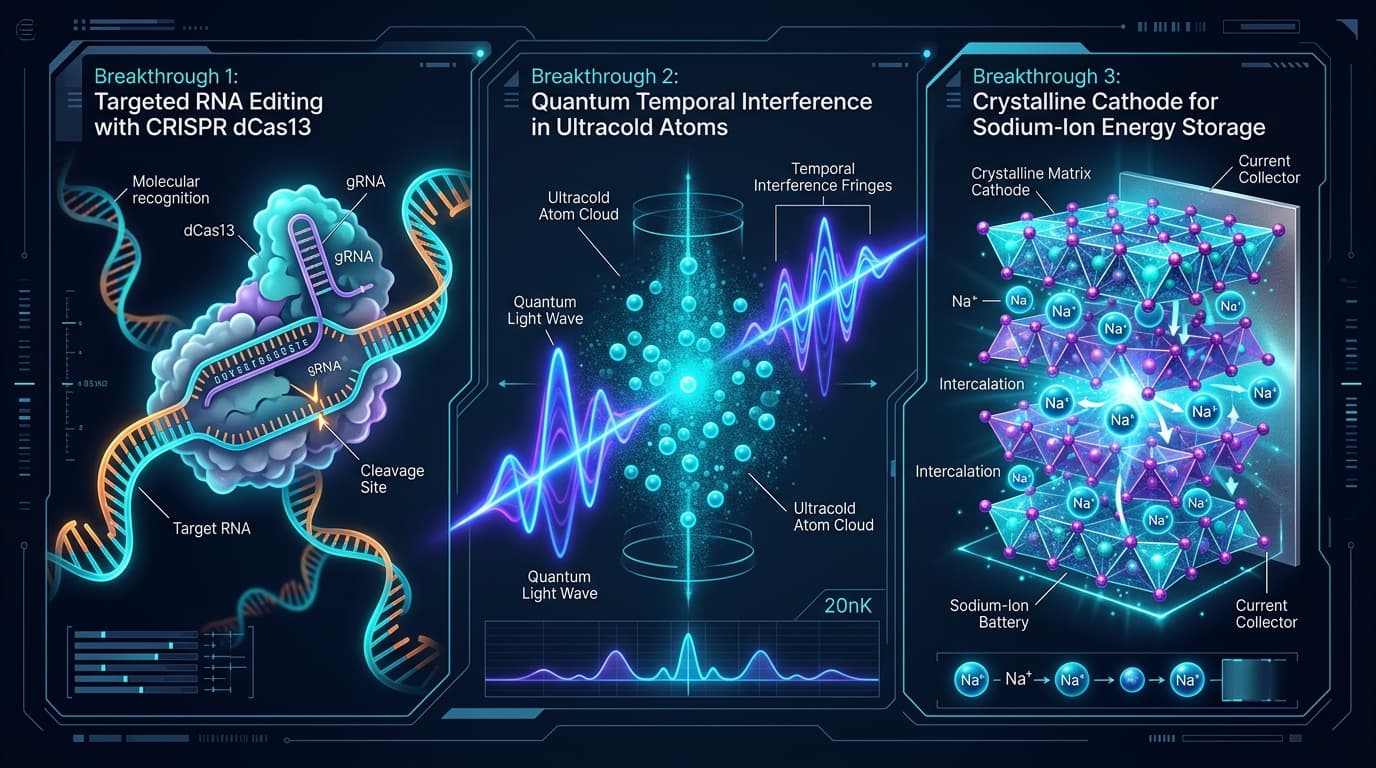
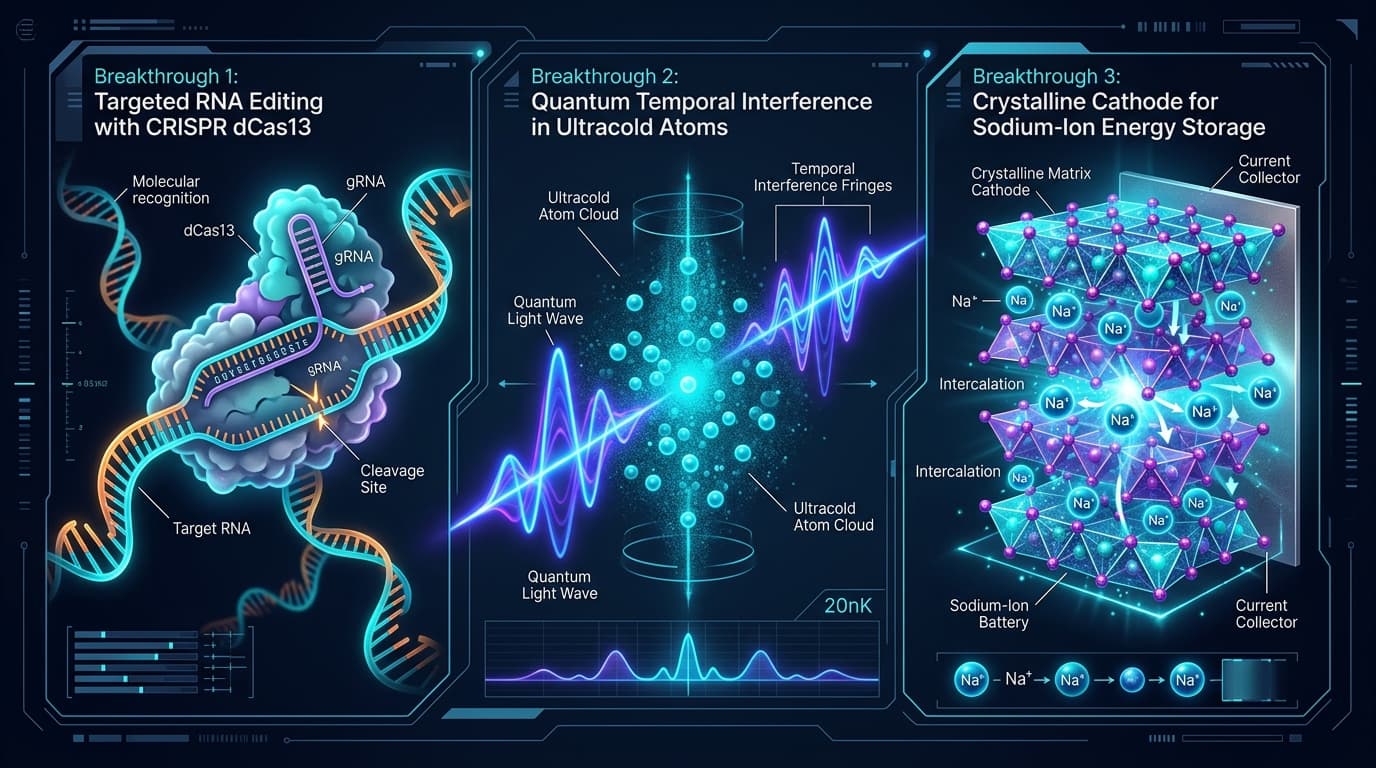
Scientific progress accelerates when researchers resolve fundamental mechanisms across distinct physical domains. From sub-genomic transcript manipulation in resistant malignancies to subatomic temporal mechanics of light-matter interactions and ion-transport physics in sustainable grid batteries, understanding foundational rules enables transformative engineering. Landmark peer-reviewed studies published across Nature Biomedical Engineering, Physical Review Letters, and Nature Energy present major scientific breakthroughs: a novel dCas13 system that reverses 3'UTR mRNA shortening to render "immune-cold" cancers targetable; direct weak-measurement evidence of quantum "negative time" during photon absorption in ultracold atomic clouds; and crystal-water engineering in sodium vanadium oxide cathodes that doubles sodium-ion battery power density for green energy storage.
🧬 CRISPR-dCas13 RNA System Sensitizes 'Immune-Cold' Prostate Cancers
Prostate cancer and many solid tumors have long presented a major challenge to clinical oncology because they are classified as "immune-cold." These tumors evade host immune surveillance by downregulating Major Histocompatibility Complex Class I (MHC-I) molecules—the critical surface "ID badges" that enable cytotoxic T cells to recognize and destroy malignant cells. Traditional immune checkpoint inhibitors (such as anti-PD-1 or anti-PD-L1 therapies) frequently fail in these patients because tumor-infiltrating lymphocytes cannot identify the hidden cancer cells. In a landmark study published in Nature Biomedical Engineering, an international research team introduced a non-DNA-altering gene therapy platform that successfully reactivates MHC-I presentation and turns treatment-resistant cold tumors hot.
The team developed a specialized system termed the 3′UTR CRISPR/dCas13 Engineering System (3′UTRCES). Unlike conventional CRISPR-Cas9, which cuts genomic DNA and risks off-target double-strand breaks, dCas13 utilizes a catalytic-dead RNA-guided endonuclease that targets and binds specific messenger RNA (mRNA) transcripts without altering the host genome. The researchers discovered that prostate cancer cells overproduce a protein called SPSB1, which specifically tags surface MHC-I molecules for degradation in the cell's proteasome. Crucially, excess SPSB1 production in cancer cells is driven by an abnormal post-transcriptional process: the shortening of the 3′ untranslated region (3′UTR) of the SPSB1 mRNA transcript, which strips away natural microRNA binding sites that normally keep SPSB1 in check.
To reverse this pathological mechanism, the 3′UTRCES platform was engineered to selectively bind the truncated 3′UTR sequence of SPSB1 pre-mRNA. By physically shielding the cleavage sites and directing endogenous splicing factors, the system forces the cell to produce full-length SPSB1 mRNA containing intact regulatory regions. In preclinical models, restoring full-length SPSB1 mRNA led to a sharp decline in SPSB1 protein levels, allowing MHC-I molecules to accumulate normally on the cancer cell surface.
When evaluated in vivo, treatment with 3′UTRCES triggered dramatic cytotoxic T-cell infiltration into previously "cold" prostate tumors. When combined with standard immune checkpoint inhibitors, the dual therapy achieved substantial tumor regression and long-term immunological memory. Because dCas13 operates strictly at the transient RNA level without modifying permanent genomic sequences, this approach offers a highly tunable, reversible therapeutic platform for sensitizing immune-evasive solid tumors.
⚛️ Quantum 'Negative Time' Observed in Light-Atom Absorption
In classical optics and everyday experience, interaction time is strictly non-negative: when a photon enters an absorbing medium, it excites an atom, spends a finite duration in that excited state, and is subsequently re-emitted or transmitted. However, at the quantum scale, where particles exist in superpositions of states and measurements interact non-trivially with system dynamics, physical intuition often breaks down. In a groundbreaking paper published in Physical Review Letters (building upon theoretical frameworks in Nature Physics), quantum physicists at the University of Toronto presented direct experimental evidence of quantum "negative time" during photon absorption.
The research team investigated a fundamental question: how long does an atom remain in an excited state when a photon passes through it without being permanently absorbed? To measure this elusive quantity, the physicists directed single photons through a dense cloud of ultracold rubidium atoms cooled to microkelvin temperatures. Because conventional direct measurement would collapse the delicate quantum superposition, the team employed weak measurement—a quantum diagnostic technique that extracts subtle statistical information by probing the atomic ensemble using an auxiliary cross-Kerr phase shift without disturbing the primary photon state.
Surprisingly, the data revealed that when transmitted photons were post-selected, the measured excitation time spent by the atomic cloud was negative. In effect, the atomic excitation clock recorded a hand moving backward, indicating that transmitted photons appeared to exit the atomic vapor cloud before the atomic excitation process had fully commenced.
The researchers emphasize that this counterintuitive result does not violate causality, special relativity, or Einstein's cosmic speed limit. Information cannot travel backward in time to alter past events. Instead, the "negative time" arises from the quantum interference of wave packets: when a photon's energy spectrum overlaps with an atomic resonance, the wave packet undergoes phase distortion such that the peak of the emerging photon pulse is shifted forward in time relative to its baseline expectation. This fundamental experiment resolves decades of debate regarding photon dwell time in resonant media and provides crucial insights for designing ultra-low-loss quantum photonic circuits, optical delays, and quantum memory architectures.
⚡ Hydrated Sodium Vanadium Oxide Cathodes Revolutionize Sodium-Ion Storage
Enjoyed this post?
Get our weekly digest delivered free.
As the global transition toward renewable energy gains momentum, grid-scale energy storage requires high-capacity, low-cost battery chemistries that avoid dependence on scarce elements like lithium and cobalt. Sodium-ion batteries have emerged as a prime candidate due to the vast global abundance and low cost of sodium. However, commercial adoption has been constrained by energy density and charge speed limitations: sodium ions ((\text{Na}^+)) possess a significantly larger ionic radius than lithium ions ((\text{Li}^+)), making them slower to diffuse through conventional solid crystal cathodes and causing severe mechanical strain during high-rate cycling. A landmark study published in Nature Energy by researchers at the University of Surrey and international collaborators has overcome this bottleneck through crystal-water engineering.
The researchers focused on sodium vanadium oxide ((\text{Na}_{x}\text{V}_2\text{O}_5)), a promising cathode material known for its high theoretical capacity. Traditionally, battery engineers attempt to remove all water molecules from electrode materials to prevent side reactions. However, the study demonstrated that deliberately retaining controlled, structural water molecules ((\text{H}2\text{O})) within the interstitial crystal lattice ((\text{Na}{x}\text{V}_2\text{O}_5\cdot n\text{H}_2\text{O})) dramatically improves electrochemical performance.
Using high-resolution synchrotron X-ray diffraction and atomic-scale molecular dynamics simulations, the team discovered that intercalated structural water acts as a electrostatic shield and physical spacer—termed "molecular pillaring." The polar water molecules coordinate around the large sodium ions, screening their positive charge and reducing electrostatic attraction between sodium ions and the host oxide framework. This expanded interlayer spacing allows sodium ions to glide through the crystal channels with ultra-low activation energy, nearly doubling ion diffusion rates.
Full-cell testing of the hydrated sodium vanadium oxide cathodes demonstrated an extraordinary leap in performance: the batteries achieved nearly twice the power density of standard anhydrous counterparts while retaining over 85% capacity after 3,000 rapid charge-discharge cycles. Furthermore, the robust crystal structure exhibited high stability during fast-charging conditions. Beyond grid storage, the researchers showed that the high ion selectivity of the hydrated lattice enables efficient capacitive seawater desalination, offering a dual-purpose technology for clean energy storage and freshwater production.
📌 The Bottom Line
- crispr-dcas13-prostate-cancer-rna-targeting: CRISPR-dCas13 RNA editing reverses 3'UTR transcript shortening of SPSB1, restoring MHC-I surface markers to convert "immune-cold" prostate tumors into responsive immunotherapy targets.
- quantum-negative-time-photon-absorption: Weak-measurement experiments in ultracold rubidium clouds demonstrated quantum "negative time" during photon absorption, offering fundamental insights for quantum optics and photonics.
- hydrated-sodium-vanadium-oxide-battery-breakthrough: Intercalating structural water into sodium vanadium oxide cathodes doubles sodium-ion battery power density and enables fast-charging, grid-scale energy storage.
📫 Stay Updated
Get the week's most important research breakthroughs delivered to your inbox. Subscribe to our free newsletter →
Disclosure: This post contains affiliate links. If you purchase through our links, we earn a small commission at no extra cost to you. We only recommend products we believe in.
Knowelth publishes independently researched analysis verified against primary documentation, academic journals, and official records. To report a factual inaccuracy or request a correction, please reach out via our Contact Page.
Enjoyed this post?
Get our weekly digest delivered free.
Share this post:
Knowelth is reader-supported. We may earn a commission from links in this article at no extra cost to you. Read our disclosure.
Related Posts

Targeted Protein Degrader Rewrites Leukemia Drug Sensitivity, Oxytocin Selectively Modulates Low Trust, and Siberian Permafrost Methane Surge Doubles
Targeted Protein Degrader Rewrites Leukemia Drug Sensitivity, Oxytocin Selectively Modulates Low Trust, and Siberian Permafrost Methane Surge Doubles Scientific discovery rarely moves in a single dire…
Global Research Breakthroughs: HCMI Patient Cancer Organoids, Ultra-Durable Nanochannel Fuel Cells, and 567-Million-Year-Old Deep-Ocean Fossils
Global Research Breakthroughs: HCMI Patient Cancer Organoids, Ultra-Durable Nanochannel Fuel Cells, and 567-Million-Year-Old Deep-Ocean Fossils Across biology, materials physics, and evolutionary pale…
Tumour Organoid Vulnerability Map, 567M-Year-Old Ediacaran Fossils, and NIH's TrialGPT AI Breakthrough
Tumour Organoid Vulnerability Map, 567M-Year-Old Ediacaran Fossils, and NIH's TrialGPT AI Breakthrough Three landmark studies published in the first week of August 2026 span the full breadth of modern…