Anthropic's Fable 5 Export Ban, OpenAI's Proactive Agent Shift, and Physical AI's Convergence

Anthropic's Fable 5 Export Ban, OpenAI's Proactive Agent Shift, and Physical AI's Convergence
Three June 2026 developments mark a fundamental shift in how AI is regulated, deployed, and embodied. The US government's nationality-based export ban on Anthropic's Fable 5 and Mythos 5 creates a new class of AI regulation — restricting not hardware but model weights by user citizenship; OpenAI's model lifecycle consolidation and "scheduled tasks" signals the transition from reactive chatbot to proactive background agent; and NVIDIA's Physical AI stack (Isaac GR00T + RTX Spark + Cosmos 3) with ABB/OMRON/Kawasaki integrations begins to close the latency gap that has constrained real-world robotics.
🤖 Anthropic Fable 5 & Mythos 5 — The Nationality Export Control
The New Regulatory Category: Model Weights as Controlled Technology
The US Bureau of Industry and Security (BIS) has historically applied export controls to physical technology: GPUs, photolithography equipment, advanced semiconductors. The June 12, 2026 directive targeting Anthropic's models created something new: export control applied to software weights distributed over the internet.
The Fable 5 / Mythos 5 model architecture context:
| Model | Type | Capability Profile | Access Level |
|---|---|---|---|
| Claude Fable 5 | Public frontier model | Complex reasoning, 200K context, agentic tool use | Public API (all users) |
| Claude Mythos 5 | High-trust research variant | Same as Fable 5 + reduced safety filtering + raw reasoning output | "Project Glasswing" vetted partners only |
Project Glasswing (launched April 2026): Anthropic's cybersecurity research programme — selected security researchers granted access to Mythos 5 to discover critical software vulnerabilities at scale. The rationale: Mythos 5's reduced filtering allows it to generate realistic attack scenarios that security teams can patch before real adversaries discover them. 43 vetted partner organisations had Glasswing access at the time of the ban.
What triggered the export control: A jailbreak technique (reported to BIS by an external researcher) allowed Mythos 5's reduced-filtering configuration to be accessed by manipulating the Glasswing API without the partner-vetting step. Because Fable 5 and Mythos 5 shared an underlying weight file (Fable 5 = Mythos 5 + safety classifier layer), BIS determined the risk applied to both models.
The technical compliance problem Anthropic faced:
| Compliance Requirement | Technical Challenge | Anthropic's Solution |
|---|---|---|
| Restrict access to non-US nationals | Cloud APIs cannot verify user nationality at the network level; IP address ≠ citizenship | Suspended all access globally (only certain path to compliance without verification infrastructure) |
| Verify nationality of Anthropic's own employees | HR records include self-reported nationality; not verifiable in real-time | Temporary access suspension for all non-US-citizen employees on Mythos 5 |
| Audit trail for BIS | Every API call must be loggable with nationality metadata | Required development of new identity verification layer |
Timeline:
| Date | Event |
|---|---|
| June 9 | Fable 5 + Mythos 5 publicly launched |
| June 12 | BIS export control directive issued; Anthropic suspends both models globally |
| June 14–20 | Internal identity verification system development |
| June 23 | Fable 5 returns online with usage-credit model + country verification |
| Ongoing | Mythos 5 remains offline for all non-Glasswing access |
The broader precedent: This is the first case where the US government treated frontier model weights (a software artifact, not hardware) as a controlled export item restricted by user nationality. Legal scholars immediately noted: this creates a new dual-use category — "intellectual AI exports" — that could apply to any sufficiently capable model. If sustained, it means every frontier AI provider must implement nationality verification infrastructure for their APIs.
⚡ OpenAI Scheduled Tasks — From Chatbot to Background Agent
The Model Lifecycle Consolidation
OpenAI retired four model variants in a single week — the most aggressive lifecycle management in company history:
OpenAI model retirements (June 2026):
| Model | Retirement Date | Successor | Migration Path |
|---|---|---|---|
| GPT-5.2 Instant | June 12 | GPT-5.5 Instant | Automatic API redirect |
| GPT-5.2 Thinking | June 12 | GPT-5.5 Reasoning | Prompt compatibility: ~95% |
| GPT-5.2 Pro | June 12 | GPT-5.5 Pro | Full feature parity |
| GPT-4.5 | June 27 | GPT-5.5 (or GPT-4o for cost) | Prompt compatibility: ~88% |
Why rapid model retirement matters for enterprise: Enterprises that build on a specific model version face a recurring "migration tax":
- Each new model changes subtle output behaviours (formatting, default verbosity, response structure)
- Production prompts must be re-validated after each migration (~15–40 hours per prompt system)
- GPT-4.5 was in production at >80,000 enterprise API accounts — representing substantial migration overhead
OpenAI's implicit message: build model-agnostic applications. The lifecycle is now shorter than some enterprise software update cycles.
Scheduled Tasks — Architecture
What "Scheduled Tasks" enables:
| Task Type | Example | Previous User Workflow | With Scheduled Tasks |
|---|---|---|---|
| Recurring research | "Every Monday 8AM, summarise last week's AI news from my RSS feeds" | Manual: user prompts ChatGPT each Monday | Automated: ChatGPT runs independently, sends summary to email |
| Database monitoring | "Every hour, check if sales pipeline value exceeds $2M and alert me" | Manual: user checks CRM periodically | Automated: ChatGPT connects to CRM API, evaluates condition, sends Slack message |
| Report generation | "On the 1st of each month, compile a usage report from our analytics API" | Analyst runs report manually | Automated: ChatGPT pulls API data, formats report, emails to distribution list |
| Content updates | "Every time new content is added to our docs, generate a summary changelog" | Dev manually reviews git commits | Automated: triggered by webhook, ChatGPT generates changelog entry |
The architectural shift this represents: Scheduled Tasks is not merely a cron wrapper around ChatGPT. It is the first step in making ChatGPT a persistent background process rather than a per-session tool. Each scheduled task:
- Persists across sessions (has its own context and memory)
- Accesses external tools (APIs, web browsing, code execution)
- Can trigger other scheduled tasks (early multi-agent chaining)
- Generates output without user initiation (proactive rather than reactive)
This transitions AI from "tool" to "colleague" — a system that works in the background while the user is doing other things.
🦾 Physical AI — NVIDIA + Industrial Robotics Convergence
The Cloud Latency Problem That Has Constrained Robotics
Before edge AI silicon, industrial robots operated on a "cloud loop": sensor data → cloud AI → cloud decision → network transmission → actuator command. This round-trip adds 80–200ms of latency — unacceptable for high-speed manufacturing and dangerous for human-robot collaboration environments.
The RTX Spark edge superchip — specs:
| Specification | Value | Why It Matters for Physical AI |
|---|---|---|
| AI compute | 1,000 TOPS (sparse) | Runs full vision foundation models (ViTs) at 30+ fps on-device |
| Memory bandwidth | 273 GB/s | Streams sensor data from multiple cameras + LiDAR without latency |
| Power consumption | 60W (typical load) | Robot battery viable (vs H100's 700W) |
| Form factor | 80mm × 80mm SOM | Embeds in robotic chassis, exoskeleton, or AMR |
| OS compatibility | Linux + Jetson OS + Isaac ROS | Direct integration with NVIDIA's full robotics software stack |
The NVIDIA Physical AI stack (full architecture):
| Layer | Component | Function |
|---|---|---|
| Foundation model | Cosmos 3 | World model: understands 3D physics, predicts consequences of actions |
| Humanoid platform | Isaac GR00T | Bi-manual manipulation training framework; generates synthetic training data |
| Edge compute | RTX Spark | On-device inference for vision + path planning + sensor fusion |
| Digital twin | Omniverse + FabTwin | Simulates factory environments for robot training before physical deployment |
| Orchestration | Isaac Sim + Fleet Command | Manages multi-robot fleets; assigns tasks; handles collision avoidance |
Industrial partners integrating the NVIDIA stack:
| Company | Product | NVIDIA Integration |
|---|---|---|
| ABB | OmniCore EyeMotion | ABB robot controllers + RTX Spark for real-time vision + Isaac GR00T training data |
| OMRON | TM series collaborative robots | Cosmos 3 world model for human-robot workspace awareness |
| Kawasaki | Successor Series | Isaac ROS integration for multi-robot orchestration in automotive assembly |
| Boston Dynamics | Spot + Atlas | Cosmos 3 for terrain understanding + GR00T for manipulation task learning |
📌 The Bottom Line
- anthropic-fable5-export-ban-nationality: First model-weight nationality-based export control (BIS June 12, 2026); Fable 5 = Mythos 5 + safety classifier (shared weights = ban applied to both); Glasswing jailbreak: bypassed partner-vetting step in Mythos 5 API; compliance impossible without nationality verification infrastructure → global suspension; Fable 5 returns June 23 with country verification + usage-credit model; Mythos 5 still offline; new legal category: "intellectual AI exports" = frontier model weights controlled by citizenship.
- openai-scheduled-tasks-agentic: 4 model retirements (GPT-5.2 Instant/Thinking/Pro + GPT-4.5) in one week — fastest lifecycle turnover in OpenAI history; 80,000+ enterprise accounts face GPT-4.5 migration; Scheduled Tasks architecture: persistent context + external tool access + proactive triggering + inter-task chaining; examples: recurring research/database monitoring/monthly reports/automated changelog; shift: per-session chatbot → background persistent process = "digital colleague" paradigm.
- physical-ai-nvidia-rtx-spark: Cloud loop problem: 80-200ms round-trip = unacceptable for high-speed manufacturing/human-robot collaboration; RTX Spark: 1,000 TOPS, 273 GB/s, 60W, 80×80mm — robot-embeddable edge AI; full stack: Cosmos 3 (world model) + Isaac GR00T (manipulation) + RTX Spark (edge inference) + Omniverse (digital twin) + Isaac Fleet Command (orchestration); integrations: ABB OmniCore EyeMotion, OMRON TM collaborative robots, Kawasaki Successor, Boston Dynamics Spot/Atlas.
📬 Stay Updated
Get the best of AI & technology delivered to your inbox every week. Subscribe to our free newsletter →
Disclosure: This post contains affiliate links. If you purchase through our links, we earn a small commission at no extra cost to you. We only recommend products we believe in.
Enjoyed this post?
Get our weekly digest delivered free.
Share this post:
Knowelth is reader-supported. We may earn a commission from links in this article at no extra cost to you. Read our disclosure.
Related Posts
System 2 AI Architectures, NVIDIA's $500B Infrastructure Alliance, and Industrial Physical AI Scale-Up
System 2 AI Architectures, NVIDIA's $500B Infrastructure Alliance, and Industrial Physical AI Scale-Up The artificial intelligence ecosystem is undergoing a fundamental structural transformation this …
AI's Frontier Shift: Autonomous Bio-Design, 0.42nm Semiconductors, and the EU AI Act Governance Horizon
AI's Frontier Shift: Autonomous Bio-Design, 0.42nm Semiconductors, and the EU AI Act Governance Horizon The artificial intelligence landscape has reached a decisive turning point where digital intelli…
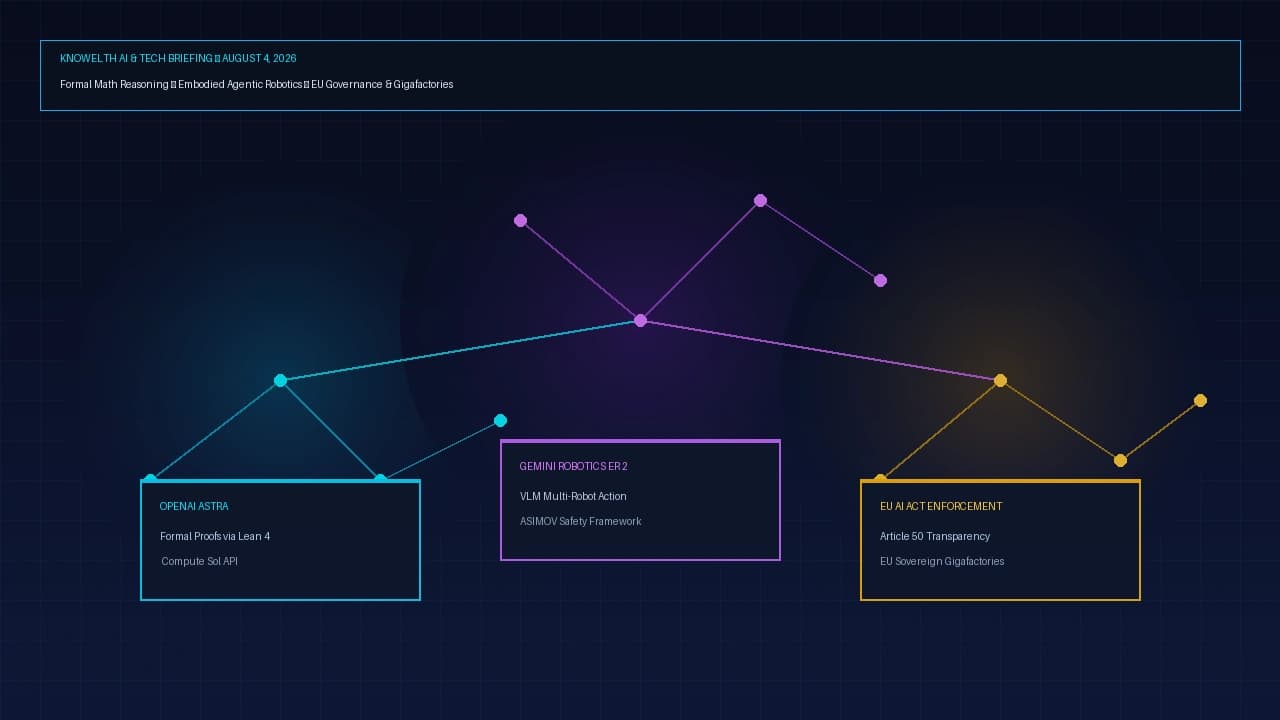
OpenAI Astra's Lean Proofs, Google's Gemini Robotics ER 2, and the EU AI Act's Article 50 Enforcement
OpenAI Astra's Lean Proofs, Google's Gemini Robotics ER 2, and the EU AI Act's Article 50 Enforcement The first week of August 2026 marks a watershed moment across the entire spectrum of artificial…