Noam Shazeer Joins OpenAI, Orbital AI Data Center Race, and Colorado's Landmark AI Act Repeal

Noam Shazeer Joins OpenAI, Orbital AI Data Center Race, and Colorado's Landmark AI Act Repeal
The third week of June 2026 marks a defining moment in the maturation of artificial intelligence across talent consolidation, computing infrastructure, and regulatory structures. From OpenAI's acquisition of legendary Google engineer Noam Shazeer to the emergence of orbital data center projects like SpaceX's AI1 and Google's Project Suncatcher, the hardware and software layers of AI are undergoing structural shifts. At the same time, Colorado's dramatic repeal of its landmark risk-based AI Act in favor of a targeted, transparency-focused framework signals a major pivot in how governments seek to govern automated decision-making without stifling innovation.
🤖 Noam Shazeer Joins OpenAI, Setting Up the Next Phase of AI Architecture Research
In one of the most significant talent acquisitions in the history of the artificial intelligence sector, Google AI pioneer and Gemini co-lead Noam Shazeer has left Google to join OpenAI. At OpenAI, Shazeer is slated to serve as the lead for AI architecture research, a critical role as the lab focuses on scaling its next-generation models and agentic reasoning frameworks. OpenAI CEO Sam Altman welcomed the move, noting publicly that Shazeer is someone he has wanted to work with since the very inception of OpenAI, cementing Shazeer's status as a foundational figure in modern machine learning.
Shazeer's departure is particularly striking given the complex history of his tenure at Google. He co-authored the seminal 2017 paper "Attention Is All You Need," which introduced the Transformer architecture that powers virtually all modern large language models. Shazeer left Google in 2021 to co-found Character.AI, only to return in August 2024 as part of a massive $2.7 billion deal in which Google licensed Character.AI's technology and brought Shazeer back to lead Gemini's core model architecture. His departure less than two years later highlights the intense rivalry and fluid talent dynamics among elite labs.
From a technical standpoint, Shazeer's move to OpenAI comes at a critical juncture. As OpenAI transitions from traditional large language models to complex, multi-step reasoning systems and planning-based architectures, Shazeer’s expertise in neural network efficiency, mixture-of-experts (MoE) models, and training optimization will be vital. His hiring signals that OpenAI is aggressively doubling down on fundamental architecture research to overcome the scaling bottlenecks that have begun to affect standard model architectures.
For Google, Shazeer's departure represents a notable loss of leadership and research prestige. While Google retains an exceptionally deep bench of research talent and possesses unmatched custom hardware through its TPU v6 and Blackwell infrastructure, losing the co-inventor of the Transformer to its primary competitor underscores the ongoing talent war. As labs race toward artificial general intelligence, securing the handful of researchers capable of designing novel architectures remains the industry's highest priority.
🚀 The Race to Orbit: SpaceX and Google Pioneer Space-Based AI Data Centers
Following its highly publicized initial public offering, SpaceX has officially entered the AI infrastructure arena by unveiling its "AI1" orbital data-center satellite concept. The craft is designed to host interchangeable high-density compute payloads in low Earth orbit, leveraging the vacuum of space for passive cooling and continuous solar radiation for power. Almost simultaneously, details have emerged regarding Google's "Project Suncatcher," a parallel initiative aimed at deploying specialized TPU-based compute nodes in orbit to bypass Earth's worsening energy and environmental constraints.
The driver behind space-based computing is the growing crisis of terrestrial power grids. In major tech hubs, data centers face severe grid bottlenecks, with power connection queues stretching up to seven years. Furthermore, cooling these massive facilities requires millions of gallons of water daily, drawing intense environmental and regulatory scrutiny. By launching compute infrastructure into orbit, companies can tap into 24/7 solar energy—completely unaffected by weather or day-night cycles—and radiate waste heat directly into the thermal sink of space, decoupling AI workloads from terrestrial utility limits.
Despite the promise, the engineering challenges of orbital compute are immense. Modern accelerators like GPUs and TPUs are highly sensitive to radiation, meaning space-based data centers require advanced radiation-hardening and error-correcting architectures to prevent cosmic ray bit-flips. Additionally, passive heat dissipation in a vacuum requires massive, high-efficiency thermal conductors rather than traditional fans or liquid cooling. While launch costs have plummeted, they must fall even further to achieve cost parity with land-based facilities, not to mention the rising concerns over orbital debris and light pollution.
Ultimately, analysts project that the future of orbital computing is one of functional specialization. Space-based data centers are unlikely to handle latency-sensitive, real-time consumer queries; instead, they will be utilized for energy-intensive, asynchronous training runs, long-horizon scientific simulations, and offline model alignment. By moving these bulk compute processes off the terrestrial grid, the technology industry is establishing a two-tiered infrastructure model that balances Earth's latency advantages with space's energy abundance.
⚖️ Regulatory Pivot: Colorado Repeals Landmark AI Act in Favor of Targeted Transparency
In a sudden and unexpected shift in the United States regulatory landscape, Colorado Governor Jared Polis signed SB 26-189 into law, officially repealing the state's landmark Colorado Artificial Intelligence Act (SB 24-205). The original legislation, enacted in 2024 and scheduled to take effect on June 30, 2026, was widely regarded as the nation's most comprehensive state-level AI safety law. The new bill completely replaces this risk-based auditing framework with a streamlined, transparency-focused model that shifts compliance requirements toward disclosure and consumer recourse.
The repealed SB 24-205 faced significant pushback from the business and technology communities due to its heavy compliance requirements. Under the original law, developers and deployers of "high-risk" AI systems were required to implement extensive risk-management programs, conduct regular algorithmic impact assessments, and maintain detailed documentation for state audits. The newly enacted SB 26-189 narrows the state's focus to "Automated Decision-Making Technology" (ADMT) that "materially influences" consequential decisions in critical sectors such as housing, employment, lending, education, and healthcare.
Under the new SB 26-189 framework, which takes effect on January 1, 2027, the focus shifts from preemptive auditing to active consumer transparency. Businesses utilizing ADMT must provide clear notice to consumers, explain the technology's role in any adverse outcome (such as a denied loan or rejected job application), and offer a meaningful path for human review and appeal. This pivot significantly reduces the administrative and compliance overhead for startups and mid-sized businesses while preserving core protections against algorithmic discrimination.
Colorado's regulatory course correction comes at a pivotal time for global AI governance. With the European Union's AI Act set to become fully applicable on August 2, 2026, and other US states drafting their own safety bills, Colorado's move suggests a growing consensus that heavy-handed, European-style risk management may stifle domestic innovation. By prioritizing transparency and consumer rights over proactive corporate audits, Colorado has established a pragmatic middle ground that could serve as a template for future federal and state-level AI legislation in the United States.
📌 The Bottom Line
- noam-shazeer-openai-hire: Google AI pioneer and Gemini co-lead Noam Shazeer has left Google to join OpenAI as lead for AI architecture research, intensifying the talent war between the industry's top labs.
- orbital-ai-data-centers: SpaceX and Google are pioneering space-based AI data centers to bypass terrestrial power and cooling bottlenecks, establishing a specialized tier for energy-intensive, asynchronous compute.
- colorado-ai-act-repeal: Colorado has repealed its landmark risk-based AI Act (SB 24-205) and replaced it with SB 26-189, a streamlined law focused on consumer transparency and human review for automated decision-making.
Enjoyed this post?
Get our weekly digest delivered free.
Share this post:
Knowelth is reader-supported. We may earn a commission from links in this article at no extra cost to you. Read our disclosure.
Related Posts

System 2 AI Architectures, NVIDIA's $500B Infrastructure Alliance, and Industrial Physical AI Scale-Up
System 2 AI Architectures, NVIDIA's $500B Infrastructure Alliance, and Industrial Physical AI Scale-Up The artificial intelligence ecosystem is undergoing a fundamental structural transformation this …

AI's Frontier Shift: Autonomous Bio-Design, 0.42nm Semiconductors, and the EU AI Act Governance Horizon
AI's Frontier Shift: Autonomous Bio-Design, 0.42nm Semiconductors, and the EU AI Act Governance Horizon The artificial intelligence landscape has reached a decisive turning point where digital intelli…
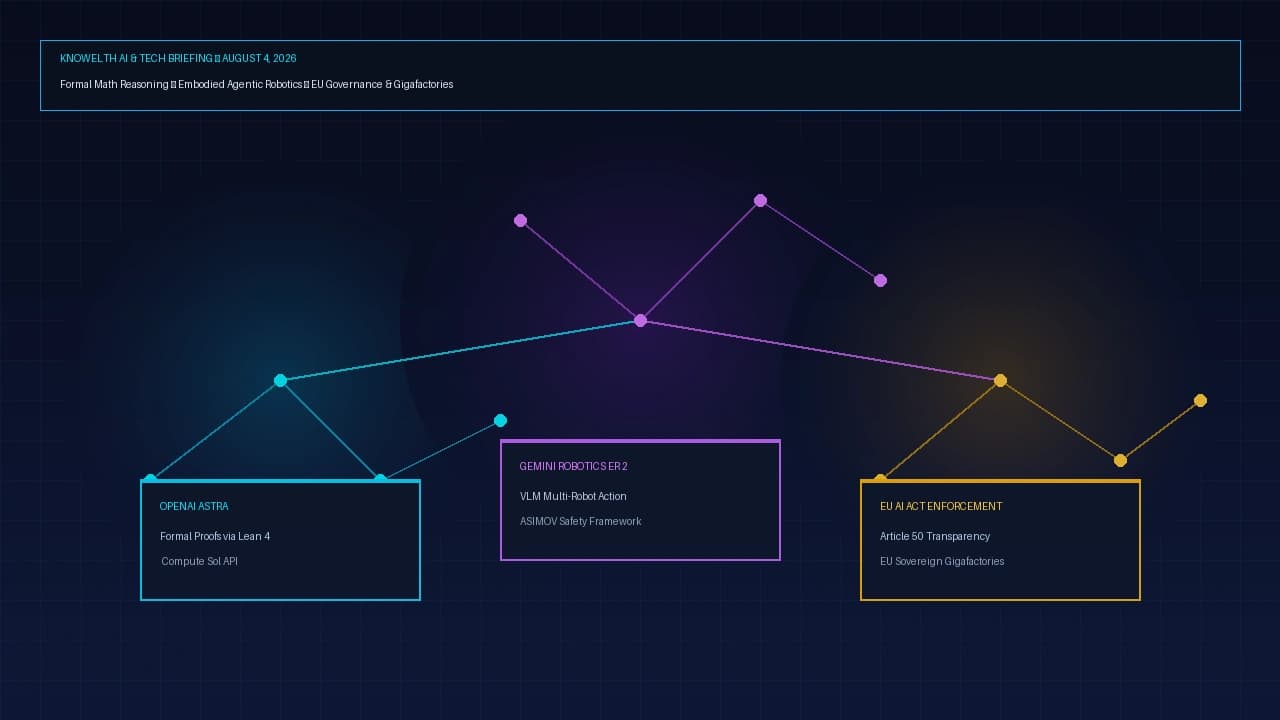
OpenAI Astra's Lean Proofs, Google's Gemini Robotics ER 2, and the EU AI Act's Article 50 Enforcement
OpenAI Astra's Lean Proofs, Google's Gemini Robotics ER 2, and the EU AI Act's Article 50 Enforcement The first week of August 2026 marks a watershed moment across the entire spectrum of artificial…