Reliance Jio vs Airtel 5G: ARPU & FWA Battle
Reliance Jio vs Bharti Airtel 5G Monetization: ARPU Expansion, FWA & The Data Monopoly
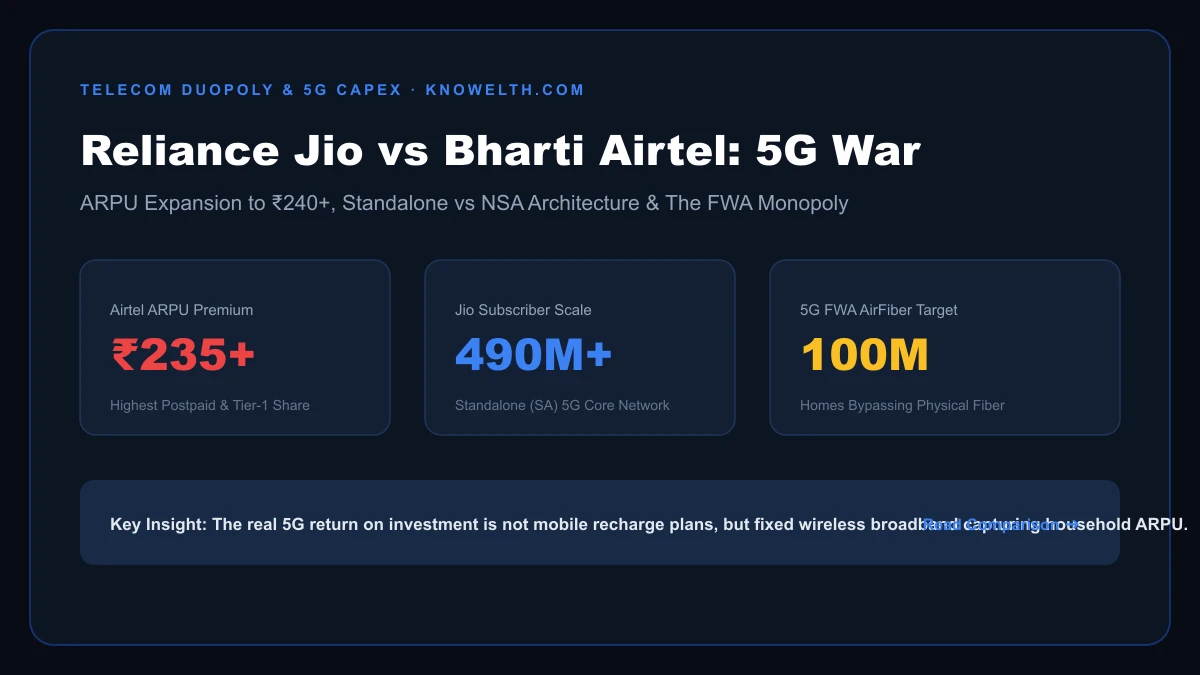
Quick Summary: Following a cumulative capital expenditure barrage exceeding ₹2,00,000 Crore ($24 Billion) to blanket the Indian subcontinent in fifth-generation wireless connectivity, the brutal price-war era of Indian telecom is decisively over. India has consolidated into an unassailable telecom duopoly where Reliance Jio Infocomm (commanding 490+ million subscribers) and Bharti Airtel (commanding 390+ million subscribers) capture over 88% of total industry revenue and virtually 100% of sector free cash flow. As both telecom giants execute coordinated tariff increases to drive industry Average Revenue Per User (ARPU) toward the holy grail of ₹300 ($3.60), the battleground has shifted from mobile data consumption to high-margin 5G Fixed Wireless Access (FWA), enterprise private networks, and cloud data center ecosystems.
The Fixed Wireless Access (FWA) Capex Breakthrough: Digging physical optical fiber trenches to connect individual Indian standalone homes costs between ₹10,000 to ₹15,000 per home pass, with last-mile municipal permissions creating multi-month delays. With 5G Fixed Wireless Access (JioAirFiber and Airtel Xstream AirFiber), the telcos install an outdoor receiver unit in 45 minutes at a capital expenditure under ₹4,000 per home, tapping into existing 5G cell towers. This allows Jio and Airtel to address India's 100 million television-owning households at triple the mobile ARPU (₹600–₹1,000/month).
+---------------------------------------------------------------------------------------------------+
|                        THE INDIAN TELECOM DUOPOLY CASH GENERATION ENGINE                          |
+---------------------------------------------------------------------------------------------------+
                                                  │
         ┌────────────────────────────────────────┼────────────────────────────────────────┐
         ▼                                        ▼                                        ▼
+──────────────────────────+             +──────────────────────────+             +──────────────────────────+
| SUBSCRIBER TARIFF HIKES  |             | FIXED WIRELESS (FWA)     |             | ENTERPRISE CLOUD & AI    |
| • Coordinated 15%–20% Up |             | • Bypassing Trench Cable |             | • Airtel Nxtra 400MW     |
| • ARPU Target: ₹250–₹300 |             | • ₹600–₹1,000 Monthly Fee|             | • Jio-Nvidia GPU Fabric  |
| • Churn Rate Sub-1.5%    |             | • TV & OTT App Bundling  |             | • 5G Private Factory Nets|
| • High Operating Leverage|             | • Low Churn Household Lock|             | • B2B Recurring Annuity  |
+──────────────────────────+             +──────────────────────────+             +──────────────────────────+
         │                                        │                                        │
         └────────────────────────────────────────┼────────────────────────────────────────┘
                                                  ▼
+---------------------------------------------------------------------------------------------------+
| SYNTHESIS: Massive Free Cash Flow (FCF) Transition Following 5G Capex Peak (FY26–FY28)            |
+---------------------------------------------------------------------------------------------------+
🏗️ 1. Architectural Divergence: Standalone (SA) vs Non-Standalone (NSA)
When the Department of Telecommunications (DoT) auctioned 5G spectrum in 2022, Jio and Airtel selected diametrically opposed engineering architectures:
1. Reliance Jio: Pure Standalone (SA) 5G
- The Architecture: Jio deployed a greenfield 5G Core network completely decoupled from 4G infrastructure.
- The Secret Weapon: Jio acquired premium 700 MHz sub-GHz low-band spectrum across all 22 circles for ₹39,279 Crore. Because low-band frequencies penetrate deep into multi-story concrete buildings and cover massive rural surface areas, Jio achieved indoor 5G coverage with half the tower density required by competitors.
- The Cost Penalty: SA deployment required immense upfront capital expenditure (over ₹1,30,000 Crore) and native optical fiber backhaul to every site.
2. Bharti Airtel: Pragmatic Non-Standalone (NSA) 5G
- The Architecture: Airtel anchored its 5G radios to its existing high-performing 4G Evolved Packet Core (EPC), operating primarily on 1800 MHz and 3300 MHz mid-band spectrum.
- The Strategic Benefit: By utilizing NSA, Airtel reduced immediate 5G capex by nearly 35%, deployed coverage faster in dense tier-1 cities, and maintained industry-leading Return on Capital Employed (ROCE).
- The Handset Compatibility Advantage: NSA 5G drained less battery on early 5G smartphones and suffered zero handover drops when transitioning between 4G and 5G base stations.
+---------------------------------------------------------------------------------------------------+
|                        5G SPECTRUM & NETWORK ARCHITECTURE COMPARISON                              |
+---------------------------------------------------------------------------------------------------+
| Architectural Metric          | Reliance Jio Infocomm            | Bharti Airtel                  |
+-------------------------------+----------------------------------+--------------------------------+
| 5G Core Architecture          | 🏆 Standalone (SA 5G)            | Non-Standalone (NSA 5G)        |
| Low-Band Coverage Anchor      | 🏆 700 MHz (Dedicated ₹39K Cr)  | Refarmed 900 MHz / 1800 MHz    |
| Mid-Band Capacity Layer       | 3300 MHz (100 MHz contiguous)    | 3300 MHz (100 MHz contiguous)  |
| High-Band mmWave Layer        | 26 GHz (1000 MHz bandwidth)      | 26 GHz (800 MHz bandwidth)     |
| Fiberized Cell Site %         | 🏆 ~88% Tower Sites on Fiber     | ~72% Tower Sites on Fiber      |
| Capital Expenditure Intensity | High Upfront Capex (~₹1.3L Cr)   | 🏆 Capital-Efficient (~₹75K Cr)|
+-------------------------------+----------------------------------+--------------------------------+
📈 2. The ARPU Expansion Mechanics: From Price War to Oligopolistic Pricing
The central driver of equity valuation for both telecommunications operators is Average Revenue Per User (ARPU). In 2018, at the height of Jio's predatory pricing campaign, Indian ARPU plummeted to a catastrophic ₹100 ($1.20) per month.
By mid-2024, Jio and Airtel enacted their first major post-5G coordinated tariff hike of 11% to 21%, removing unlimited free 5G data from low-tier prepaid plans and restricting unlimited data only to premium recharges of 2GB/day and above.
+---------------------------------------------------------------------------------------------------+
|                         TELECOM ARPU TRAJECTORY & OPERATING LEVERAGE (2020–2027)                  |
+---------------------------------------------------------------------------------------------------+
| Operator               | FY 2020 (Trough) | FY 2024 (Post-5G) | FY 2026 (Current) | Target (FY 2027–28)|
+------------------------+------------------+-------------------+-------------------+--------------------+
| Bharti Airtel (India)  | ₹135 / Month     | ₹209 / Month      | 🏆 ₹236 / Month   | ₹300 / Month       |
| Reliance Jio           | ₹130 / Month     | ₹182 / Month      | ₹208 / Month      | ₹260 / Month       |
+------------------------+------------------+-------------------+-------------------+--------------------+
| Premium Quality Gap    | Airtel +₹5       | Airtel +₹27       | 🏆 Airtel +₹28    | Airtel +₹40        |
+------------------------+------------------+-------------------+-------------------+--------------------+
Why Airtel Commands a Persistent ₹28 ARPU Premium:
- High Postpaid Market Share: Airtel commands over 54% of India's corporate and enterprise postpaid smartphone user base, where monthly bills range between ₹499 to ₹1,499 with near-zero voluntary churn.
- Quality-Seeking Urban Demographics: Airtel's customer base is concentrated in top-tier metro pin codes, high-income gated communities, and business executives who prioritize voice handover quality over cheap data vouchers.
- Family Pooling Plans: Airtel's "Airtel Black" bundles home fiber broadband, DTH satellite television, and multiple mobile SIM cards into a single recurring monthly invoice of ₹1,800 to ₹3,500.
📺 3. The 5G FWA War: The Battle for 100 Million Living Rooms
Enjoyed this post?
Get our weekly digest delivered free.
While smartphone data consumption in India has reached a staggering 30 GB per user per month (the highest in the world), mobile data yields low incremental profit once unlimited quotas are reached.
The true growth frontier is Fixed Wireless Access (FWA):
+---------------------------------------------------------------------------------------------------+
|                        5G FWA (AIRFIBER) VS PHYSICAL FIBER-TO-THE-HOME (FTTH)                     |
+---------------------------------------------------------------------------------------------------+
| Operational Parameter         | 5G AirFiber (FWA)                | Traditional FTTH (Fiber-to-Home) |
+-------------------------------+----------------------------------+--------------------------------+
| Installation Time             | 🏆 45 Minutes (Plug & Play)      | 3 to 14 Days (Digging Cables)  |
| Customer Acquisition Capex    | 🏆 <₹4,000 per Customer Premise  | ₹12,000 – ₹16,000 per Home Pass|
| Municipal RoW Approvals       | Zero Digging Approvals Needed    | Severe Municipal Permission Drag|
| Monthly Realized ARPU         | ₹599 – ₹1,199 (4x Mobile ARPU)   | ₹499 – ₹999                    |
| Content Bundling Leverage     | Free Set-Top Box + 16 OTT Apps   | Broadband Only / Router Basic  |
| 2026–2028 Scale Target        | 50 Million Connected Households  | 30 Million Physical Connections|
+-------------------------------+----------------------------------+--------------------------------+
Reliance Jio has mobilized its massive franchise network across 6,000+ towns to scale JioAirFiber, adding over 1 million FWA households per quarter. By converting a non-monetized television into an interactive digital entertainment hub carrying JioCinema, live cricket broadcasting, and high-speed broadband, Jio creates an unbreakable household switching barrier.
☁️ 4. Enterprise B2B Moats: Data Centers, Subsea Cables & AI Compute
Beyond consumer connectivity, both conglomerates are executing multi-billion-dollar enterprise diversification strategies:
Bharti Airtel: The Nxtra Data Center & Cloud Interconnect Moat
- Through its data center subsidiary Nxtra by Airtel (backed by Carlyle Group), Airtel operates 12 large hyperscale data centers and over 120 edge data facilities totaling over 400 MW of planned capacity.
- Airtel partners with Amazon Web Services (AWS) and Google Cloud to provide direct, low-latency private cloud interconnects for over 1,200 large Indian enterprises and banking institutions.
Reliance Jio: The Sovereign AI & Cloud Compute Grid
- Reliance Industries has entered an expansive sovereign computing alliance with Nvidia, deploying tens of thousands of Blackwell and Hopper GPUs across green-energy-powered data centers in Jamnagar.
- Jio provides enterprise AI-as-a-Service to Indian businesses, offering localized foundation models, enterprise copilots, and end-to-end telecom 5G private slice networks for smart manufacturing and ports.
📌 Strategic Investment Takeaways: Valuation & Capex Cycle Shift
+---------------------------------------------------------------------------------------------------+
|                                  INVESTMENT & STRATEGIC TAKEAWAYS                                 |
+---------------------------------------------------------------------------------------------------+
| Vector                         | Investment & Corporate Implications                              |
+--------------------------------+------------------------------------------------------------------+
| The 5G Capex Peak              | Infrastructure build-out is complete; FCF conversion accelerates.|
| Structural Pricing Power       | Vodafone Idea's weakness removes any risk of a destructive price war.|
| FWA Unit Economics             | AirFiber transforms 5G spectrum into high-yield household cash flows.|
| Jio IPO Catalyst               | Anticipated standalone Jio listing in 2026 unlocks conglomerate value.|
+--------------------------------+------------------------------------------------------------------+
📫 Corporate Equity Analysis & Macro Telecom Intelligence
Get rigorous corporate finance teardowns, balance sheet audits, and regulatory analyses delivered directly to your inbox with Knowelth.
Subscribe to Knowelth Executive Intelligence →
Disclaimer: This research note is prepared strictly for educational and financial benchmarking purposes. It does not constitute investment advice or a recommendation to purchase equities in Reliance Industries or Bharti Airtel.
The insights, business case studies, and financial data presented on Knowelth are strictly for educational and strategic research purposes only. Knowelth and its authors are not SEBI-registered investment advisors or research analysts. Nothing published herein should be construed as personalized investment advice or a recommendation to buy or sell securities. Investments in the securities market are subject to market risks. Please conduct your own due diligence or consult a SEBI-registered financial planner before making investment decisions. Read our Editorial Policy.
Enjoyed this post?
Get our weekly digest delivered free.
Share this post:
Knowelth is reader-supported. We may earn a commission from links in this article at no extra cost to you. Read our disclosure.
Related Posts

Reliance Industries Business Model: Moats & Scale
Reliance Industries Business Model: Moats, Scale & Future Cash Flows Quick Summary: Reliance Industries Limited (RIL) is India's most valuable corporate enterprise, generating nearly ₹10 lakh crore…

ITC Business Model: Cigarettes, FMCG & Demerger
ITC Business Model: The Cigarette Cash Machine, FMCG Scale & The Hotels Demerger Quick Summary: For decades, Indian retail investors debated whether ITC Limited was an unassailable cash machine or …

Infosys Business Model: The Global Delivery Moat
Infosys Business Model: The Global Delivery Moat, Margins & Generative AI Quick Summary: In 1981, seven software engineers led by N.R. Narayana Murthy pooled ₹10,000 to launch Infosys. Today, Infos…