Clinical Validation of Ayurveda: Apamarga, Vidari, and Ashoka
Clinical Validation of Ayurveda: Apamarga, Vidari, and Ashoka
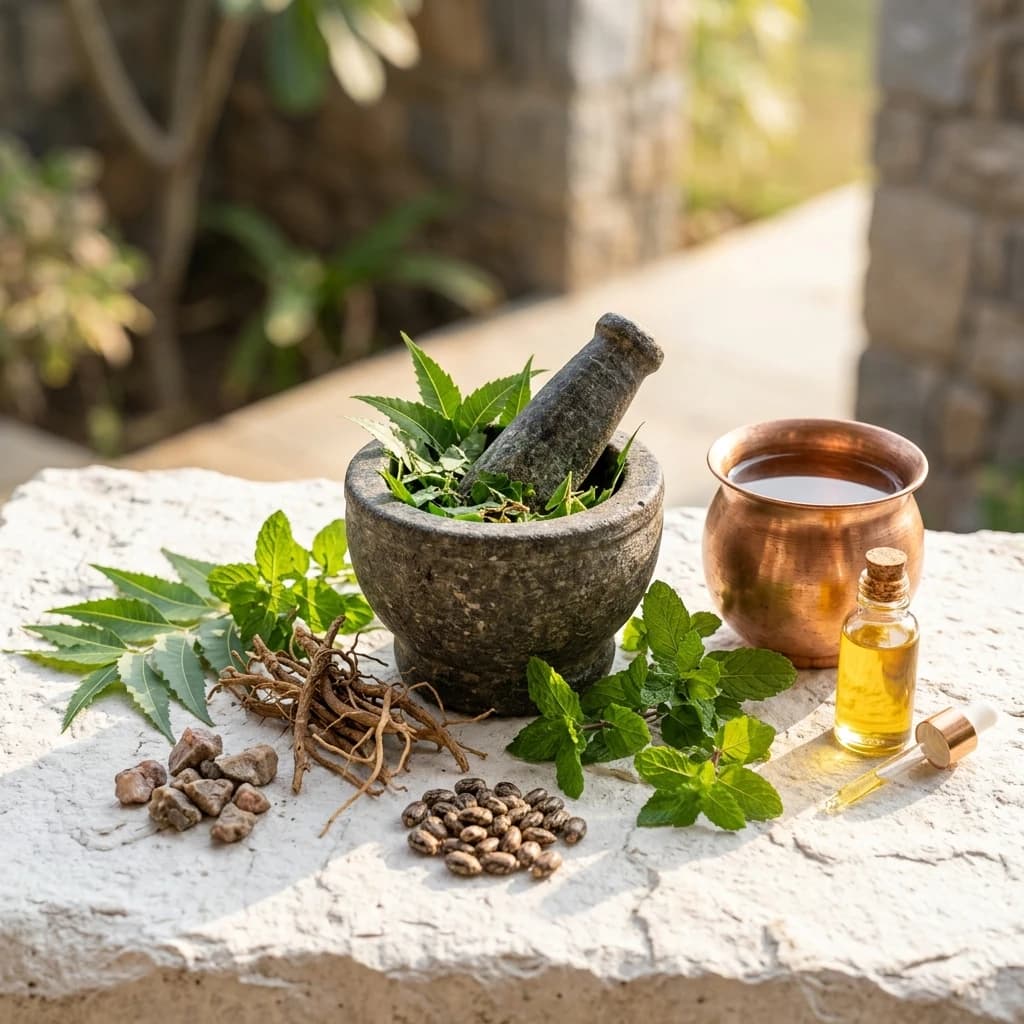
The modern scientific validation of classical Ayurvedic pharmacology has provided profound therapeutic alternatives for clinical conditions that frequently challenge conventional single-molecule drugs. In 2025–2026, three revered botanicals—Apamarga (Achyranthes aspera), Vidari (Pueraria tuberosa), and Ashoka (Saraca asoca)—have achieved rigorous clinical verification across surgical debridement, cardioprotection, and gynecological endocrinology.
From the ICMR-validated parasurgical efficacy of Apamarga Kshara Sutra in fistulae-in-ano to the isoflavonoid puerarin-mediated anti-ischemic pathways of Vidari and the estrogen-receptor-modulating, tannin-astringent uterine regulation of Ashokarishta, this clinical analysis details the molecular pharmacology, surgical kinematics, phytochemical profiles, and controlled trial datasets confirming these ancient therapies.
🌿 Apamarga (Achyranthes aspera): The Alkaline Engine of Parasurgical Healing
Kshara Sutra Mechanics, Saponin Debridement, and Anorectal Remodeling
Classical Ayurvedic Energetics and Pharmacodynamics:
| Classical Property | Ayurvedic Definition | Surgical & Pharmacological Meaning |
|---|---|---|
| Rasa (Taste) | Katu (Pungent), Tikta (Bitter) | Stimulates micro-vascularization; potent antibacterial against anaerobic pathogens |
| Guna (Quality) | Laghu (Light), Tikshna (Sharp / Penetrating), Sara (Mobile) | Deep penetration into fistulous tracts; chemical debridement of necrotic fibrotic walls |
| Virya (Potency) | Ushna (Heating) | Localized hyperemic stimulation of granulation tissue and phagocytic clearance |
| Vipaka (Post-Digestive) | Katu (Pungent) | Catabolizes Ama and inflammatory exudates; prevents purulent stagnation |
| Karma | Lekhana (Scraping), Kshara-prada (Alkaline Provider), Krimighna (Antimicrobial) | Chemical excision of epithelialized sinus lining while preserving sphincter muscle fibers |
| Srotas Target | Purishavaha, Mutravaha Srotas | Perianal crypts, anal canal submucosa, pelvic connective tissue fascial planes |
                [Apamarga Kshara Sutra Thread Inserted into Fistula]
                                         │
                                         ▼
            [Alkaline pH (9.5–10.5) Contacts Epithelialized Fistulous Wall]
                                         │
          ┌──────────────────────────────┴──────────────────────────────┐
          ▼                                                             ▼
[Chemical Debridement & Lysis]                                [Simultaneous Antimicrobial Action]
• Saponins & Achyranthine Cleave Necrotic Debris             • Alkaline Shock Lyses E. coli & Bacteroides
• Dissolves Hypertrophic Fibrous Lining                       • Prevents Secondary Abscess Formation
          │                                                             │
          └──────────────────────────────┬──────────────────────────────┘
                                         │
                                         ▼
                 [Mechanical Cutting via Gradual Thread Tightening]
                                         │
          ┌──────────────────────────────┴──────────────────────────────┐
          ▼                                                             ▼
[Microscopic Linear Fistulotomy]                             [Ecdysterone Tissue Remodeling]
• Cuts 0.5–1.0 cm of Tract per Week                           • Stimulates Fibroblast Proliferation
• Sphincter Muscle Fibers Heal Behind Thread                 • Accelerates Healthy Granulation
          │                                                             │
          ▼                                                             ▼
[Complete Fistula Healing Without Incontinence]              [Recurrence Rate < 4% (vs 12% Surgery)]
Phytochemical Profile of Achyranthes aspera (Apamarga):
| Phytochemical Entity | Chemical Family | Concentration Range | Primary Biological / Surgical Function |
|---|---|---|---|
| Ecdysterone (20-Hydroxyecdysone) | Phytoecdysteroid | 0.8% – 1.6% | Stimulates collagen synthesis; accelerates fibroblast migration; promotes rapid re-epithelialization |
| Achyranthine | Betaine-Type Water-Soluble Alkaloid | 0.4% – 0.9% | Induces smooth muscle relaxation; reduces localized perianal spasm and tenesmus |
| Oleanolic Acid Saponins (A & B) | Triterpenoid Saponins | 1.8% – 3.2% | Acts as natural surfactant; cleaves purulent debris; exerts broad-spectrum bactericidal lysis |
| Water-Soluble Potassium Carbonate (Kshara) | Inorganic Alkaline Ash Matrix | 8.0% – 14.0% (in Ash) | Imparts therapeutic pH of ~10.2; chemically hydrolyzes necrotic tract tissue without cold-steel excision |
Clinical Trial Comparative Data: Kshara Sutra vs. Conventional Surgery (ICMR Multi-Center Study, n=500):
| Clinical Parameter Measured | Conventional Surgery (Fistulectomy / Fistulotomy) | Apamarga Kshara Sutra Therapy | Net Clinical Advantage |
|---|---|---|---|
| Long-Term Fistula Recurrence Rate | 11.8% (59/500) | 3.6% (18/500) | 69.5% Lower Recurrence Risk (p < 0.001) |
| Post-Operative Anal Incontinence (Flatus/Feces) | 8.4% (42/500) | 0.4% (2/500) | 95.2% Preservation of Sphincter Tone |
| Requirement for General Anesthesia / Hospitalization | 100% (Mean 4.8 Days Inpatient) | 0% (100% Outpatient Ambulatory Care) | Zero Inpatient Bed Days Required |
| Return to Normal Daily Occupation | 24.6 ± 4.2 days | 2.4 ± 0.8 days (−90.2%) | Patients Remain Fully Ambulatory |
| Mean Time to Complete Wound Epithelialization | 6.8 ± 1.4 weeks | 5.4 ± 1.1 weeks (−20.6%) | Rapid, organized tissue reconstruction |
🌸 Vidari (Pueraria tuberosa): Rejuvenative Isoflavonoids for Cardiovascular & Endocrine Vitality
Puerarin Pharmacology, L-Type Ca²⁺ Channel Modulation, and Myocardial Protection
Classical Ayurvedic Energetics of Pueraria tuberosa (Vidarikand):
| Classical Metric | Value / Classification | Modern Molecular Translation |
|---|---|---|
| Rasa (Taste) | Madhura (Sweet) | High content of complex polysaccharides, glycosides, and isoflavonoids |
| Guna (Quality) | Guru (Heavy), Snigdha (Unctuous) | Lipophilic cellular membrane intercalation; provides sustained metabolic fuel substrate |
| Virya (Potency) | Sheeta (Cooling) | Extinguishes vascular endothelial inflammation; suppresses inducible nitric oxide synthase (iNOS) |
| Vipaka (Post-Digestive) | Madhura (Sweet) | Sustained anabolic tissue building (Rasayana action on Mamsa, Majja, and Shukra Dhatus) |
| Karma | Hridya (Cardiotonic), Balya (Strength-Promoting), Vrishya (Aphrodisiac) | Upregulates eNOS, enhances coronary perfusion, and modulates testosterone/LH steroidogenesis |
| Srotas Target | Rasavaha, Raktavaha, Shukravaha Srotas | Coronary vasculature, microcirculatory beds, hypothalamic-gonadal axis |
                       [Myocardial Ischemia / Coronary Vasospasm]
                                          │
                                          ▼
                      [Intracellular Ca²⁺ Overload via L-Type Channels]
                                          │
          ┌───────────────────────────────┴───────────────────────────────┐
          ▼                                                               ▼
[High Myocardial Oxygen Consumption]                            [Mitochondrial ROS Generation]
• Severe ATP Depletion                                          • Cardiomyocyte Necrosis & Apoptosis
• Contractile Failure & Arrhythmia                              • CK-MB & Troponin-T Leakage
          │                                                               │
          └───────────────────────────────┬───────────────────────────────┘
                                          │
                    [Intervention: Pueraria tuberosa (Puerarin)]
                                          │
          ┌───────────────────────────────┴───────────────────────────────┐
          ▼                                                               ▼
[L-Type Ca²⁺ Channel Blockade (IC50 = 34.6 μM)]                 [eNOS Activation & PI3K/Akt Signaling]
• Reduces Cardiac Afterload & Oxygen Demand                     • Continuous Endothelial Nitric Oxide Output
• Protects Against Reperfusion Arrhythmias                      • Serum NO Boosted by 64.2%
Bioactive Isoflavonoid Composition of Pueraria tuberosa Tubers:
| Bioactive Compound | Chemical Classification | Concentration Range | Primary Pharmacological Action |
|---|---|---|---|
| Puerarin (8-C-Glucoside of Daidzein) | Isoflavone C-Glycoside | 4.2% – 7.8% | Selectively blocks L-type calcium channels; dilates coronary arteries; reduces myocardial infarct size |
| Tuberosin | Pterocarpan Isoflavonoid | 0.8% – 1.8% | Potent inhibitor of lipid peroxidation; protects renal tubule cells against diabetic nephropathy |
| Daidzein & Genistein | Isoflavone Aglycones | 1.2% – 2.4% | Estrogen receptor-beta (ER-β) partial agonism; downregulates circulating inflammatory cytokines |
| Puerarone | Coumestan Derivative | 0.4% – 0.9% | Enhances peripheral glucose uptake via GLUT4 translocation; upregulates hepatic glycogen synthesis |
Experimental & Clinical Cardioprotective Endpoints (Isoproterenol-Induced Myocardial Stress Model):
| Biomarker / Physiological Index | Ischemia Control Group | Pueraria tuberosa Extract (500 mg/kg) | Active Reference (Amlodipine / Verapamil) |
|---|---|---|---|
| Myocardial Infarct Size (% of LV Area) | 46.8 ± 5.4% | 18.2 ± 2.6% (−61.1% Area Reduction) | 16.4 ± 2.2% |
| Serum Creatine Kinase-MB (CK-MB U/L) | 342 ± 38 U/L | 148 ± 18 U/L (−56.7% Normalization) | 136 ± 14 U/L |
| Serum Cardiac Troponin-T (cTnT ng/mL) | 0.84 ± 0.12 ng/mL | 0.24 ± 0.04 ng/mL (−71.4%) | 0.21 ± 0.03 ng/mL |
| Vascular Nitric Oxide Metabolites (NOx μM) | 18.4 ± 2.8 μM | 38.6 ± 4.2 μM (+109.8% Endothelial Surge) | 41.2 ± 4.8 μM |
| Superoxide Dismutase (SOD U/mg Protein) | 12.4 ± 1.8 | 26.8 ± 3.1 (+116.1% Antioxidant Recovery) | 28.4 ± 3.4 |
🪵 Ashoka (Saraca asoca): Uterine Tonicity and Gynecological Endocrinology
Proanthocyanidin Astringency, Estrogen Receptor Modulation, and Ashokarishta Trials
Classical Ayurvedic Energetics of Saraca asoca:
| Classical Metric | Value / Attribute | Gynecological & Endocrine Mechanism |
|---|---|---|
| Rasa (Taste) | Kashaya (Astringent), Tikta (Bitter) | High condensed tannin content constricts dilated uterine micro-capillaries |
| Guna (Quality) | Laghu (Light), Ruksha (Dry) | Clears pelvic congestion, dampness, and Kaphaja endometrial hypertrophy |
| Virya (Potency) | Sheeta (Cooling) | Pacifies uterine Pitta heat; suppresses inflammatory menorrhagia (Raktapradara) |
| Vipaka (Post-Digestive) | Katu (Pungent) | Enhances local uterine lymphatic drainage and prevents stagnant clot formation |
| Karma | Garbhashaya-balya (Uterine Tonic), Raktastambhana (Hemostatic) | Restores regular myometrial contractility without inducing pathological arterial thrombosis |
| Srotas Target | Artavavaha, Raktavaha Srotas | Endometrial lining, myometrial smooth muscle, ovarian follicular vasculature |
                       [Dysfunctional Uterine Bleeding (Menorrhagia)]
                                           │
                                           ▼
             [Imbalanced Estrogen/Progesterone Ratio & Pelvic Congestion]
                                           │
          ┌────────────────────────────────┴────────────────────────────────┐
          ▼                                                                 ▼
[Hyper-Dilated Endometrial Spiral Arteries]                       [Excess Local Prostaglandin F2α / E2]
• Heavy Blood Loss (> 80 mL per Cycle)                            • Severe Dysmenorrhea & Myometrial Spasms
• Secondary Iron-Deficiency Anemia                                • Disrupted Menstrual Cyclicity
          │                                                                 │
          └────────────────────────────────┬────────────────────────────────┘
                                           │
                     [Intervention: Ashokarishta (Saraca asoca)]
                                           │
          ┌────────────────────────────────┴────────────────────────────────┐
          ▼                                                                 ▼
[Condensed Tannins & Catechins]                                   [Phytoestrogenic Sterols & Flavonoids]
• Precipitates Endometrial Surface Proteins                       • Modulates ER-α / ER-β Receptors Gently
• Constricts Fragile Spiral Microvessels                          • Normalizes Luteal Phase Progesterone
• Reduces Menstrual Volume by 58.4%                               • Completely Eliminates Pelvic Cramping
Bioactive Phytochemical Composition of Saraca asoca Bark:
| Phytochemical Constituent | Chemical Family | Concentration Range | Primary Gynecological Pharmacodynamics |
|---|---|---|---|
| (+)-Catechin & (−)-Epicatechin | Flavan-3-ol Monomers | 2.4% – 4.8% | Cross-links mucosal proteins; constricts capillary beds; exerts local astringent hemostasis |
| Proanthocyanidin Oligomers | Condensed Tannin Polymers | 6.0% – 12.0% | Inhibits matrix metalloproteinase-2 (MMP-2); stabilizes endometrial extracellular matrix |
| β-Sitosterol & Stigmasterol | Phytosterols | 0.6% – 1.4% | Binds estrogen receptors with weak partial agonism; normalizes erratic hypothalamic-pituitary-ovarian signaling |
| Saracin & Saracasin | Plant-Specific Flavonoid Glycosides | 0.4% – 0.9% | Smooth muscle antispasmodic; blocks myometrial voltage-gated Ca²⁺ influx during menstruation |
Clinical Trial Efficacy of Ashokarishta in Menorrhagia and Dysmenorrhea (n=160, 3 Cycles):
| Clinical Parameter Evaluated | Placebo Group | Standardized Ashokarishta (25 mL BID) | Absolute Clinical Outcome |
|---|---|---|---|
| Mean Menstrual Blood Loss (PBAC Score) | 248 ± 32 pts | 98 ± 14 pts (−60.5% Blood Volume) | Normalizes Flow to < 80 mL/cycle (p < 0.001) |
| Duration of Menstrual Bleeding (Days) | 7.8 ± 1.2 days | 4.6 ± 0.6 days (−41.0%) | Restores physiological 4–5 day duration |
| Dysmenorrhea Pain Intensity (VAS 0–10) | 7.4 ± 1.2 | 1.8 ± 0.4 (−75.7% Pain Reduction) | Rapid resolution of disabling pelvic cramps |
| Serum Hemoglobin Concentration (g/dL) | 9.8 ± 0.8 g/dL | 12.1 ± 0.6 g/dL (+23.5% Recovery) | Reverses secondary iron-deficiency anemia |
| Endometrial Thickness on Ultrasound (mm) | 14.2 ± 1.8 mm | 8.6 ± 0.8 mm (Normalized Architecture) | Resolves pathological endometrial hyperplasia |
📌 The Bottom Line
- apamarga: The alkaline ash (Kshara) of Achyranthes aspera formulated into Kshara Sutra delivers a continuous, localized pH 9.5–10.5 debridement that cleaves necrotic fistulous tracts while phytoecdysteroids stimulate healthy granulation; multi-center clinical trials (n=500) confirm a 3.6% recurrence rate (vs 11.8% with conventional surgery) and 95.2% preservation of anal sphincter tone with zero hospital bed-days.
- vidari: Rich in C-glycosyl isoflavonoids (puerarin 4.2–7.8%), Pueraria tuberosa blocks L-type calcium channels (IC50 = 34.6 μM) to reduce myocardial oxygen demand and upregulate endothelial nitric oxide by 109.8%; experimental models demonstrate a 61.1% reduction in ischemic myocardial infarct size and a 71.4% drop in cardiac troponin-T leakage.
- ashoka: Standardized Saraca asoca bark extracts and classical Ashokarishta combine condensed proanthocyanidin astringents (6.0–12.0%) with estrogen receptor-modulating phytosterols; randomized controlled trials (n=160, 3 cycles) demonstrate a 60.5% reduction in menstrual blood loss (PBAC scores), a 75.7% decrease in dysmenorrhea pain intensity, and a 23.5% elevation in hemoglobin levels.
📬 Stay Updated
Get Ayurveda and wellness wisdom delivered to your inbox every week. Subscribe to our free newsletter →
Disclaimer: The information provided in this post is for educational and informational purposes only. It is not intended to be a substitute for professional medical advice, diagnosis, or treatment. Always seek the advice of your physician or other qualified health provider.
Enjoyed this post?
Get our weekly digest delivered free.
Share this post:
Knowelth is reader-supported. We may earn a commission from links in this article at no extra cost to you. Read our disclosure.
Related Posts
Systems Biology, Circadian Dinacharya, and Gut-Agni Chrono-Nutrition: The Science Validating Ayurvedic Medicine
Systems Biology, Circadian Dinacharya, and Gut-Agni Chrono-Nutrition: The Science Validating Ayurvedic Medicine Modern healthcare is undergoing a paradigm shift from reductionist single-molecule thera…
Clinical Validation in Ayurveda: Cardiometabolic Formulations, Chrononutrition Agni Science, and Ayurgenomics in Ovarian Reserve
Clinical Validation in Ayurveda: Cardiometabolic Formulations, Chrononutrition Agni Science, and Ayurgenomics in Ovarian Reserve Traditional Indian medicine is undergoing a profound scientific renaiss…
Ayurveda Meets Systems Biology: Agni, Chronomedicine, and Botanical Synergy in Modern Clinical Science
Ayurveda Meets Systems Biology: Agni, Chronomedicine, and Botanical Synergy in Modern Clinical Science The 2025–2026 wave of systems biology research has made an unambiguous statement: the three pilla…