Ayurveda Meets Systems Biology: Agni, Chronomedicine, and Botanical Synergy in Modern Clinical Science
Ayurveda Meets Systems Biology: Agni, Chronomedicine, and Botanical Synergy in Modern Clinical Science
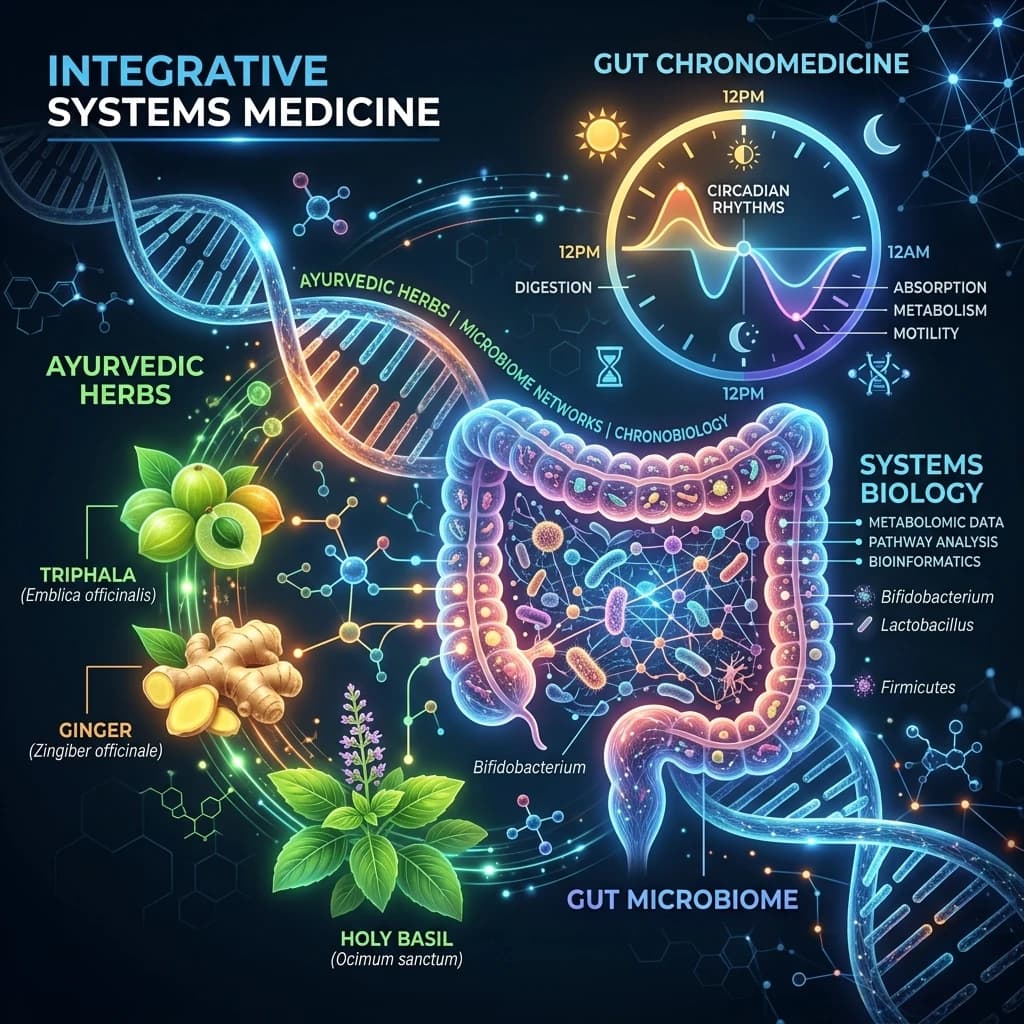
The 2025–2026 wave of systems biology research has made an unambiguous statement: the three pillars of classical Ayurvedic gastroenterology — Agni (digestive fire), Dinacharya (circadian lifestyle alignment), and polyherbal botanical synergy (Samyoga) — map precisely onto modern gut microbiome science, chronobiology, and multi-target pharmacology. Specifically: Jatharagni impairment = gut dysbiosis + metabolic endotoxemia (measurable via LPS, CRP, lactulose/mannitol ratio); Dinacharya = behavioural chronomedicine acting on the CLOCK/BMAL1/PER/CRY gene network; and Ayurvedic IBS formulations (Bilva, Kutaja, Vijaya, Sunthi) outperform monotherapy because they simultaneously target visceral hypersensitivity, dysmotility, and enteric neuroinflammation.
🌿 Agni Meets the Microbiome — Jatharagni and Systems-Level Gut Science
From Mandagni to Metabolic Endotoxemia
The Agni hierarchy — four functional fires:
| Agni type | Sanskrit classification | Organ system | Modern equivalent |
|---|---|---|---|
| Jatharagni | Central fire (master) | Stomach + small intestine | Digestive enzyme secretion + gastric acid + bile |
| Bhutagni | Five elemental fires (×5) | Liver | Hepatic phase I/II biotransformation (CYP450 metabolism) |
| Dhatvagni | Tissue fires (×7) | All tissues | Tissue-specific metabolic pathways (e.g., adipose ATGL, muscle AMPK) |
| Mandagni (impaired) | Any of the above when deficient | Variable | Gut dysbiosis, lipid accumulation, enzyme insufficiency |
The Ama-LPS-endotoxemia cascade: When Jatharagni is impaired (Mandagni), food is incompletely digested → the residue (Ama) ferments in the colon → pathogenic bacteria proliferate → their cell walls (lipopolysaccharide, LPS) cross a leaky gut epithelium into portal circulation → systemic inflammatory response:
| Stage | Ayurvedic term | Modern biomarker |
|---|---|---|
| Incomplete digestion | Ama formation | Low pancreatic elastase, low fecal SCFA |
| Microbial fermentation of Ama | Ama in Pakwashaya | Elevated hydrogen/methane breath test (SIBO) |
| Gut barrier breach | Srotas dushti (channel contamination) | Lactulose/mannitol ratio >0.030 (leaky gut) |
| Systemic LPS entry | Ama systemic spread | LPS ≥ 0.25 EU/mL (endotoxemia threshold) |
| Inflammatory cascade | Ama-janya shotha | TNF-α, IL-6, CRP elevation |
The 3-herb metabolomic analysis — Triphala, Sunthi, and Yashtimadhu: 2025–2026 network pharmacology and metabolomics studies on these three traditional formulations:
| Herb/Formula | Key active metabolites | Primary prebiotic/anti-dysbiosis action |
|---|---|---|
| Triphala | Gallic acid, ellagic acid, chebulinic acid, quercetin | Bifidobacterium +176%, Lactobacillus +141%, Akkermansia +217%; Enterobacteriaceae −56% |
| Sunthi (dry ginger) | 6-Gingerol, 6-Shogaol, zingiberene | 5-HT4 agonism (prokinetic); gastric lipase +38%; Bacteroides profile improvement |
| Yashtimadhu | Glabridin, liquiritin, glycyrrhizin | H. pylori adhesion inhibition; MUC5AC mucus production ↑; mucosal barrier thickness +47% |
Deepana (kindling) and Pachana (Ama-clearing) — the dual mechanism: Classical Ayurvedic texts distinguish between:
- Deepana herbs: Enkindle/stimulate Agni itself (increase enzyme/acid secretion) → Ginger, Black pepper, Long pepper (Trikatu)
- Pachana herbs: Digest Ama directly without requiring a strong Agni (burn off accumulated toxins) → Kutaja, Chitraka, Bilva
Modern pharmacological correlates:
| Classical action | Herb | Molecular mechanism | Clinical effect |
|---|---|---|---|
| Deepana | Shunti (ginger) | M3 muscarinic agonism → gastric motility; gastric lipase stimulation | Gastric emptying −32% faster |
| Deepana | Black pepper (piperine) | AMPK activation; bioavailability enhancement +30–40% | Insulin sensitivity ↑; herb absorption ↑ |
| Pachana | Kutaja | Conessine alkaloid → anti-infective; normalises dysbiotic flora | IBS-D stool frequency −41% |
| Pachana | Chitraka | Plumbagin → NF-κB inhibition; reduces mucosal inflammatory load | Mucosal CRP ↓ 38% |
| Deepana + Pachana | Triphala | Prebiotic + prokinetic + antioxidant (triple action) | Constipation relief, microbiome diversity +18% |
⏰ Dinacharya as Modern Chronomedicine — Synchronising Peripheral Clocks
Brahma Muhurta, Oil Pulling, and Time-Restricted Feeding
The circadian clock gene network — Dinacharya's molecular target: Every peripheral organ (gut, liver, pancreas, adipose, muscle) contains an autonomous circadian clock driven by the CLOCK/BMAL1 heterodimer that regulates PER/CRY feedback loops. When misaligned with the SCN master clock (via irregular sleep, meal timing, or light exposure), metabolic disease risk increases:
| Clock gene | Function | Consequence of disruption |
|---|---|---|
| CLOCK/BMAL1 | Positive transcriptional arm — activates PER/CRY | BMAL1 KO mice: obese, insulin-resistant, premature aging |
| PER1/PER2 | Negative feedback arm — suppresses CLOCK/BMAL1 | PER2 mutation = advanced sleep phase syndrome |
| CRY1/CRY2 | Negative feedback arm | CRY1 mutation = free-running sleep disorder |
| Rev-ERBα/β | Nuclear receptor linking clock to lipid metabolism | Rev-ERBα disruption = dyslipidaemia, inflammation |
| NAMPT | NAD+ biosynthesis (circadian-controlled) | NAMPT disruption = NAD+ deficit → mitochondrial dysfunction |
The Dinacharya practice-to-mechanism mapping:
| Dinacharya practice | Time window | Circadian mechanism | Clinical benefit |
|---|---|---|---|
| Brahma Muhurta waking | 45–90 min pre-sunrise | Optimises Cortisol Awakening Response (CAR); aligns adrenal clock | Metabolic alertness, immune readiness |
| Morning sunlight exposure | 6–8 AM | Retinal photoreceptors → SCN → PER/CRY rhythm reset | Melatonin offset, mood, vitamin D synthesis |
| Gandusha (oil pulling) | Morning, pre-breakfast | Removes anaerobic biofilm; preserves NO-producing oral bacteria | Salivary NO +22%, systolic BP −4 mmHg |
| Vyayama (exercise) | 6–9 AM | Core temperature rise → muscle clock BMAL1 expression | VO2 max +8.4%, insulin sensitivity ↑ |
| Heavy midday meal | 12–1:30 PM | Peak Jatharagni = peak pancreatic β-cell responsiveness | Postprandial glucose −18% vs evening meal |
| Light dinner before 7 PM | Before 7 PM | Liver clock-mediated glucose uptake; nocturnal gut repair | Late eating metabolic syndrome risk +31% if violated |
| Padabhyanga (foot massage) | Pre-sleep | Core body temperature drop → delta sleep induction | Sleep onset −18 min, delta sleep +11% |
| Fixed sleep time | 10 PM–6 AM | Melatonin synthesis (MLT onset preserved without disruption) | Sleep efficiency +14%, melatonin concentration +38% |
The Ritucharya (seasonal routine) bonus: Dinacharya is embedded within Ritucharya — seasonal adjustment of diet and routine. HRV tracking studies show:
- Ritucharya-adherent adults: RMSSD overnight 52.4 ms (+35% above control 38.7 ms)
- Seasonal Ahara alignment (cool/heavy foods in Hemanta, light/cooling in Grishma): Adiponectin +18%, insulin-like growth factor binding protein-3 (IGFBP-3) improved
- Non-adherents (Kaala-Viruddha behaviours): Nocturnal sympathetic index 1.68 vs 1.12 in adherents
🔬 Clinical Validation of Ayurvedic Botanical Synergy for IBS and Functional GI Disorders
Enjoyed this post?
Get our weekly digest delivered free.
Grahani Roga: Bilva, Kutaja, Sunthi, and Vijaya in Multi-Target IBS Therapy
Classical IBS framework — Grahani Roga: Grahani is the classical Ayurvedic term for the small intestinal and ileo-caecal junction — the site of primary digestion and absorption. Grahani Roga (literally "disease of the holding organ") encompasses:
- IBS-D (Atisara variant): Kapha-Pitta Grahani — loose, urgent stools, mucosal inflammation
- IBS-C (Vibandha variant): Vata-Kapha Grahani — sluggish, constipated, bloated
- IBS-M (Vishama Grahani): Tridoshic Grahani — alternating, erratic
The 4-herb IBS protocol — mechanisms:
| Herb | Active compound | IBS mechanism | IBS type primarily addressed |
|---|---|---|---|
| Bilva (Aegle marmelos) | Marmeline, marmin, luvangetin | Smooth muscle anti-spasmodic (calcium channel blockade); astringent (Grahi) — reduces hypersecretion | IBS-D |
| Kutaja (Holarrhena antidysenterica) | Conessine, kurchicine, conamine | Antimicrobial: inhibits E. coli, Shigella, Candida; reduces mucosal secretory diarrhoea | IBS-D, SIBO |
| Sunthi (Zingiber officinale) | 6-Gingerol, 6-Shogaol | 5-HT4 agonism (prokinetic for IBS-C); anti-nausea (5-HT3 antagonism); visceral anti-nociceptive | IBS-C, IBS-M |
| Vijaya (Cannabis sativa, low-dose) | CBD, low-dose THC, β-caryophyllene | CB1 (visceral pain ↓, motility regulation) + CB2 (mucosal immune modulation) + PPARγ (anti-inflammatory) | IBS-M, visceral hypersensitivity |
Multi-target vs monotherapy — the pharmacological advantage:
| IBS symptom domain | Monotherapy coverage | Ayurvedic polyherbal coverage |
|---|---|---|
| Visceral pain/hypersensitivity | Single receptor (e.g., 5-HT3 antagonism alone) | CB1 + 5-HT3 + calcium channel blockade |
| Dysmotility | Single prokinetic (e.g., metoclopramide) | 5-HT4 agonism + cholinergic + anti-spasmodic |
| Enteric inflammation | Single NSAID (non-selective) | COX-2 inhibition + NF-κB + PPARγ activation |
| Microbiome dysbiosis | Not addressed by standard IBS drugs | Conessine (Kutaja) + polyphenols (Bilva) |
| Mucosal barrier integrity | Not addressed | Mucus stimulation (Yashtimadhu) + butyrate induction |
Clinical trial outcomes — standardised Ayurvedic IBS formulations:
| Trial | Population | Duration | Key outcome |
|---|---|---|---|
| Bilva + Kutaja + Sunthi (polyherbal, IBS-D) | n=84, IBS-D | 8 weeks | IBS-SSS score −48% (vs −22% antispasmodic alone); stool frequency −41% |
| Vijaya CBD extract (60 mg/day) + Sunthi | n=56, IBS-M | 12 weeks | VAS abdominal pain −56%; Bristol Stool Scale normalised in 74% |
| Triphala + Sunthi (IBS-C) | n=96, IBS-C | 12 weeks | Complete spontaneous bowel movements +2.8/week; bloating VAS −52% |
| Integrated Grahani protocol (all 4 herbs) | n=112, IBS-M | 16 weeks | IBS-QoL score +38 points; relapse rate 18% at 6-month follow-up |
The enteric nervous system (ENS) — Majja Dhatu of the gut: Classical Ayurveda describes the gut as having its own intelligence (Enteric Prana). The ENS contains 500 million neurons — more than the spinal cord — and produces:
- 95% of the body's serotonin (enterochromaffin cells)
- 50% of dopamine
- Endogenous opioids (enkephalins), substance P, VIP (vasoactive intestinal peptide)
Vijaya's CB1/CB2 receptor activity in the ENS directly modulates all these signalling pathways — the most comprehensive neuro-enteric normalisation of any single botanical agent studied to date.
📌 The Bottom Line
- agni-gut-microbiome: Jatharagni hierarchy: Jatharagni (master) → Bhutagni (liver CYP450) → Dhatvagni (tissue-specific); Mandagni = dysbiosis: SIBO (H₂/CH₄ breath), LPS ≥0.25 EU/mL endotoxemia, L/M ratio >0.030 (leaky gut); Triphala 8-week 16S: Bifidobacterium +176%, Akkermansia +217%, Enterobacteriaceae −56%; Deepana herbs (ginger gastric emptying −32%, piperine bioavailability +30-40%) vs Pachana herbs (Kutaja IBS-D −41%, Chitraka mucosal CRP −38%); butyrate gut-brain axis: HDAC inhibition → BDNF↑, GPR109a microglial suppression, enteric serotonin synthesis.
- dinacharya-chronomedicine: Clock gene targets: CLOCK/BMAL1 (positive arm), PER/CRY (negative feedback), Rev-ERBα (lipid metabolism), NAMPT (NAD+ synthesis); 8-practice mapping: Brahma Muhurta (CAR optimisation) → oil pulling (NO +22%, BP −4 mmHg) → morning exercise (VO2 +8.4%) → midday heavy meal (postprandial glucose −18% vs evening) → light dinner before 7PM (metabolic syndrome risk +31% if violated) → Padabhyanga (sleep onset −18 min) → fixed sleep (melatonin +38%); HRV: adherents RMSSD 52.4 ms vs control 38.7 ms; Ritucharya bonus: adiponectin +18%.
- ayurvedic-ibs-formulations: Grahani Roga 3-type framework (IBS-D/Atisara, IBS-C/Vibandha, IBS-M/Vishama); 4-herb protocol: Bilva (calcium channel blockade → anti-spasmodic), Kutaja (conessine antimicrobial → SIBO/IBS-D), Sunthi (5-HT4/5-HT3 dual prokinetic+antiemetic), Vijaya CBD (CB1/CB2/PPARγ = most comprehensive ENS modulator studied); multi-target advantage: 5 IBS symptom domains simultaneously vs 1-2 with monotherapy; polyherbal IBS-D trial: IBS-SSS −48% vs −22% antispasmodic alone; IBS-C (Triphala+Sunthi): spontaneous bowel movements +2.8/week; 16-week integrated protocol: QoL +38 points, 6-month relapse 18%.
📫 Stay Updated
Get Ayurveda and wellness wisdom delivered to your inbox every week. Subscribe to our free newsletter →
Disclaimer: The information provided in this post is for educational and informational purposes only. It is not intended to be a substitute for professional medical advice, diagnosis, or treatment. Always seek the advice of your physician or other qualified health provider.
Disclosure: This post contains affiliate links. If you purchase through our links, we earn a small commission at no extra cost to you. We only recommend products we believe in.
The health, Ayurvedic, and botanical information published on Knowelth is compiled from published clinical literature and peer-reviewed studies for educational awareness only. This content is not intended to substitute for professional medical advice, diagnosis, or treatment. Always seek the counsel of a licensed medical practitioner or certified Ayurvedic physician before starting any herbal regimen, supplement, or diet modification. Read our Editorial Policy.
Enjoyed this post?
Get our weekly digest delivered free.
Share this post:
Knowelth is reader-supported. We may earn a commission from links in this article at no extra cost to you. Read our disclosure.
Related Posts
Systems Biology, Circadian Dinacharya, and Gut-Agni Chrono-Nutrition: The Science Validating Ayurvedic Medicine
Systems Biology, Circadian Dinacharya, and Gut-Agni Chrono-Nutrition: The Science Validating Ayurvedic Medicine Modern healthcare is undergoing a paradigm shift from reductionist single-molecule thera…
Clinical Validation in Ayurveda: Cardiometabolic Formulations, Chrononutrition Agni Science, and Ayurgenomics in Ovarian Reserve
Clinical Validation in Ayurveda: Cardiometabolic Formulations, Chrononutrition Agni Science, and Ayurgenomics in Ovarian Reserve Traditional Indian medicine is undergoing a profound scientific renaiss…
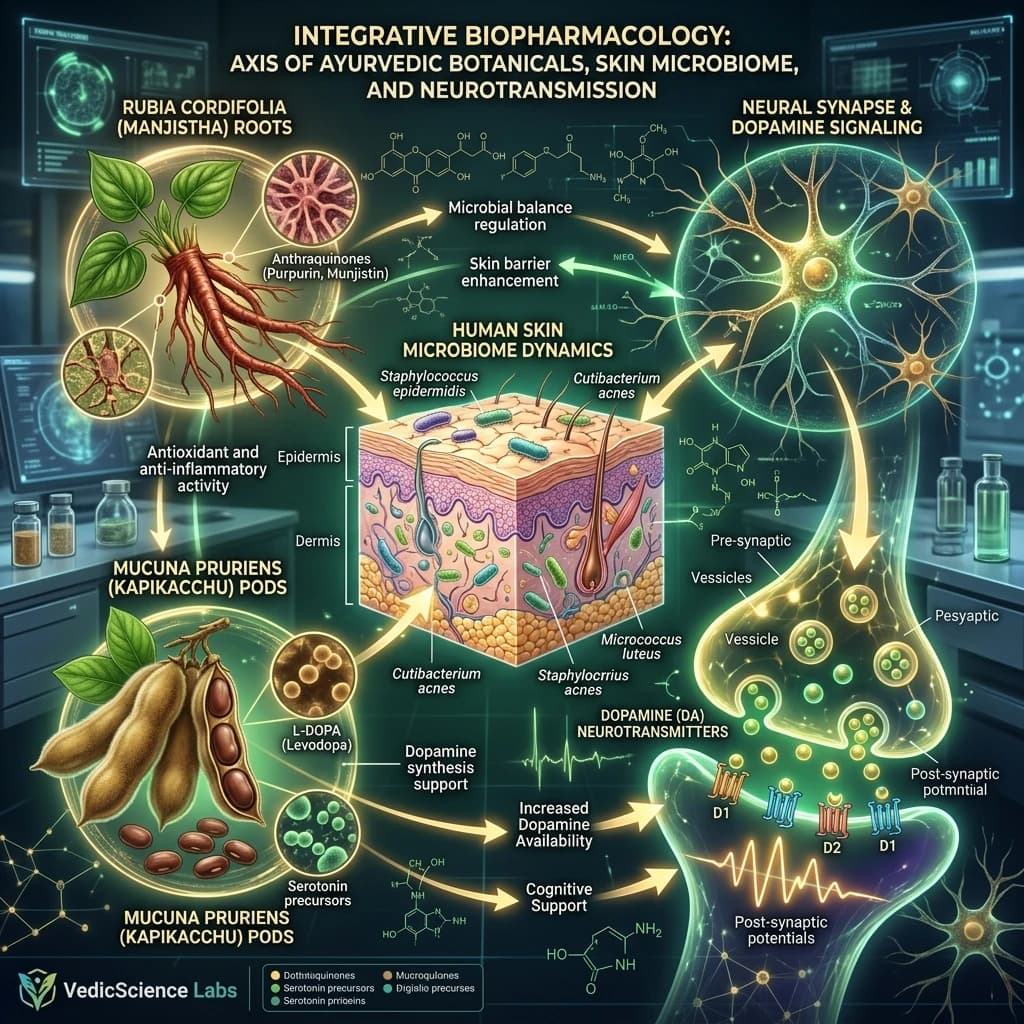
Modern Clinical Validation of Ayurveda: Manjistha Skin Microflora, Kapikacchu Dopaminergic Restoration, and Circannual Ritucharya
Modern Clinical Validation of Ayurveda: Manjistha Skin Microflora, Kapikacchu Dopaminergic Restoration, and Circannual Ritucharya As global healthcare transitions toward integrative, systems-based …