Modern Chronobiology Validates Ayurveda: How Dinacharya, Tulsi, and Agni Science Transform Metabolic Health

Modern Chronobiology Validates Ayurveda: How Dinacharya, Tulsi, and Agni Science Transform Metabolic Health
For thousands of years, classical Ayurvedic medicine has emphasized that optimal health relies on living in harmony with nature's diurnal cycles and preserving internal metabolic balance. Recent breakthroughs in chronobiology, molecular genetics, and microbiome research are now confirming what ancient seers documented in foundational texts like the Charaka Samhita: timing is everything. By bridging traditional principles of Dinacharya (daily routine), herbal adaptogens, and Agni (digestive fire) with contemporary scientific evidence, modern integrative medicine is unlocking new pathways for long-term health and vitality.
🌿 Dinacharya & Chronobiology: How Ancient Daily Rhythms Align with Modern Biomarkers
In classical Ayurveda, the 24-hour day is divided into six distinct four-hour windows, each governed by one of the three foundational biological energy forces (Doshas): Vata, Pitta, and Kapha. Kapha periods (6:00 AM–10:00 AM and 6:00 PM–10:00 PM) are characterized by heaviness, stability, and structure. Pitta phases (10:00 AM–2:00 PM and 10:00 PM–2:00 AM) represent high metabolic transformation, heat, and enzymatic activity. Finally, Vata periods (2:00 AM–6:00 AM and 2:00 PM–6:00 PM) govern movement, nervous system activity, and cellular elimination. Classical Dinacharya instructs individuals to wake during the pre-dawn Vata window (Brahma Muhurta), consume their largest meal during the peak Pitta period at midday, and enter restful sleep before the nocturnal Pitta repair cycle begins at 10:00 PM.
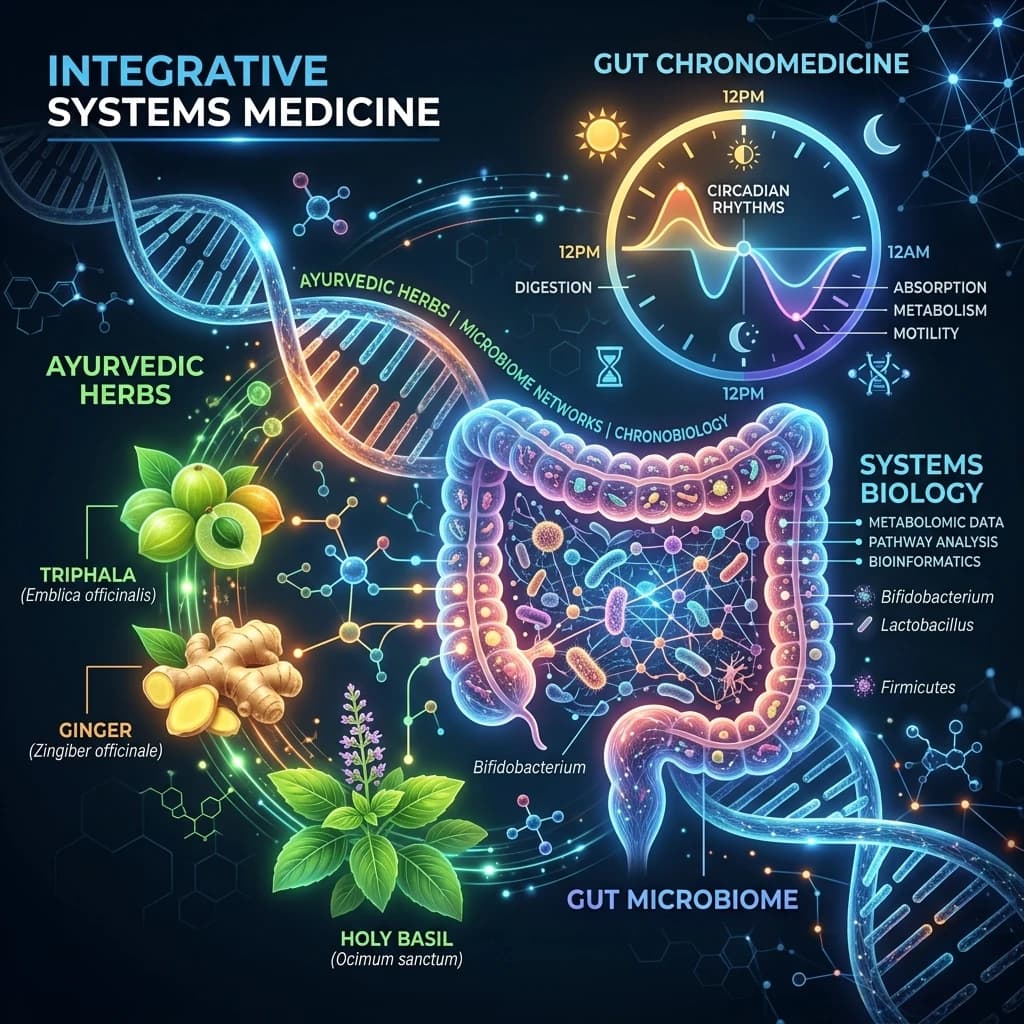
Recent neuroendocrinology and chronobiology research demonstrates remarkable parity between these ancient Dosha windows and key biological biomarkers. Studies mapping peripheral tissue clocks reveal that human cortisol awakening response (CAR) spikes precisely during the early morning transition from Vata to Kapha, preparing the body for daytime stress resilience. Similarly, gastrointestinal motility, bile acid secretion, and pancreatic enzyme activity peak during solar noon—precisely corresponding to peak Pitta Agni. Conversely, insulin sensitivity drops significantly during late evening Kapha hours, explaining why late-night meals contribute disproportionately to metabolic syndrome and lipid deregulation.
Modern clinical trials evaluating structured Dinacharya interventions show significant improvements in sleep latency, systemic inflammatory markers (such as high-sensitivity C-reactive protein), and heart rate variability (HRV). Researchers emphasize that chronotherapy—aligning lifestyle behavior with internal peripheral clocks—is one of the most cost-effective non-pharmacological tools for managing chronic conditions. Adopting a simplified Dinacharya schedule by rising before 6:00 AM, eating a robust lunch, and dimming light exposure after sunset provides an empirical framework to reset modern circadian desynchrony caused by screen use and shift work.
🧪 Tulsi (Ocimum Sanctum): The Adaptogenic Herb Regulating Clock Genes and Cortisol
Holy Basil, known classically as Tulsi (Ocimum sanctum or Ocimum tenuiflorum), holds a sacred status in Ayurveda as a supreme Rasayana (rejuvenative herb). Ayurvedic pharmacology categorizes Tulsi as possessing Katu (pungent) and Tikta (bitter) tastes, a warming thermal velocity (Ushna Virya), and an overall balancing effect on Kapha and Vata doshas. Historically prescribed for respiratory ailments, cognitive sluggishness, and boosting vital immunity (Ojas), Tulsi is celebrated for its ability to restore clarity and equilibrium without causing sedation or overstimulation.
Contemporary pharmacological investigations have identified rich concentrations of bioactive phytochemicals in Tulsi, including eugenol, ursolic acid, rosmarinic acid, and apigenin. Recent molecular studies spotlight Tulsi as a potent chronotherapeutic adaptogen capable of modulating central and peripheral clock genes (CLOCK, BMAL1, PER2, and CRY1). By dampening hyperactive hypothalamic-pituitary-adrenal (HPA) axis signaling, Tulsi extracts systematically lower elevated salivary cortisol levels during acute and chronic stress. This dual regulation of stress hormones and clock gene expression helps resynchronize circadian rhythms disrupted by jet lag, chronic insomnia, or erratic work hours.
Randomized, double-blind, placebo-controlled human trials highlight Tulsi's multifaceted clinical benefits. Participants receiving standardized Ocimum sanctum extract demonstrated statistically significant reductions in subjective stress, generalized anxiety symptoms, and morning fatigue, alongside improvements in executive cognitive performance and sleep architecture. Furthermore, its antioxidant compounds scavenge reactive oxygen species (ROS) in neural tissue, protecting microglial cells from neuroinflammation. Consuming fresh Tulsi leaf infusions or standardized herbal extracts in the early morning and late afternoon serves as an effective, science-backed routine to fortify resilience against modern stressors.
🔥 Agni & Microbiome Integrity: Re-evaluating Metabolic Fire Through Gut Health
In Ayurvedic pathology, Agni (the internal digestive fire) is considered the cornerstone of human longevity, vitality, and metabolic health. Agni is responsible not only for breaking down physical food (Ahara Paka) in the gastrointestinal tract, but also for transforming molecular nutrients into tissue elements (Dhatus). When Agni is compromised—whether by irregular eating, incompatible food combinations (Viruddha Ahara), or chronic stress—the digestive process leaves behind an unrefined, toxic byproduct known as Ama. In classical texts, Ama is described as a sticky, foul-smelling substance that clogs bodily channels (Srotas), triggering systemic illness.
Modern gastroenterology and gut microbiome science are uncovering exact biophysical correlates to the concept of Agni and Ama. Researchers now recognize that Agni encompasses the digestive enzyme cascade, stomach acid production, mucosal immunity, and the metabolic activity of trillions of resident gut microbes. High Agni corresponds to a diverse, resilient gut microbiome capable of producing beneficial short-chain fatty acids (SCFAs) like butyrate, acetate, and propionate, which maintain the intestinal lining. Conversely, impaired Agni leads to dysbiosis and increased intestinal permeability ("leaky gut"). This allows lipopolysaccharides (LPS) and bacterial endotoxins to translocate into the bloodstream—a physiological event that precisely parallels the systemic accumulation of Ama.
Clinical studies confirm that supporting Agni through traditional dietary principles promotes gut barrier integrity and metabolic homeostasis. Practicing mindful eating, consuming warm, freshly cooked whole foods infused with carminative spices (such as cumin, coriander, fennel, and ginger), and maintaining minimum 4-hour fasting intervals between meals allow the gut's migrating motor complex (MMC) to clear debris. Modern research proves that these Ayurvedic dietary protocols optimize microbial SCFA production, mitigate endotoxemia, and enhance mitochondrial bioenergetics, confirming that nurturing Agni is essential for preventing autoimmune and metabolic disorders.
📌 The Bottom Line
- dinacharya-circadian-rhythms: Aligning daily schedules with traditional Dosha-Kala cycles synchronizes cortisol, melatonin, and metabolic rhythms for optimal biological vitality.
- tulsi-chronotherapy: Ocimum sanctum modulates clock gene expression and HPA-axis function, acting as a scientifically validated adaptogen for stress and circadian disruption.
- agni-gut-microbiome: Ayurvedic Agni mirrors gut microbiome dynamics and mitochondrial function; maintaining digestive fire prevents metabolic endotoxemia (Ama).
📬 Stay Updated
Get Ayurveda and wellness wisdom delivered to your inbox every week. Subscribe to our free newsletter →
Disclaimer: The information provided in this post is for educational and informational purposes only. It is not intended to be a substitute for professional medical advice, diagnosis, or treatment. Always seek the advice of your physician or other qualified health provider.
Disclosure: This post contains affiliate links. If you purchase through our links, we earn a small commission at no extra cost to you. We only recommend products we believe in.
Enjoyed this post?
Get our weekly digest delivered free.
Share this post:
Knowelth is reader-supported. We may earn a commission from links in this article at no extra cost to you. Read our disclosure.
Related Posts

Systems Biology, Circadian Dinacharya, and Gut-Agni Chrono-Nutrition: The Science Validating Ayurvedic Medicine
Systems Biology, Circadian Dinacharya, and Gut-Agni Chrono-Nutrition: The Science Validating Ayurvedic Medicine Modern healthcare is undergoing a paradigm shift from reductionist single-molecule thera…

Clinical Validation in Ayurveda: Cardiometabolic Formulations, Chrononutrition Agni Science, and Ayurgenomics in Ovarian Reserve
Clinical Validation in Ayurveda: Cardiometabolic Formulations, Chrononutrition Agni Science, and Ayurgenomics in Ovarian Reserve Traditional Indian medicine is undergoing a profound scientific renaiss…
Ayurveda Meets Systems Biology: Agni, Chronomedicine, and Botanical Synergy in Modern Clinical Science
Ayurveda Meets Systems Biology: Agni, Chronomedicine, and Botanical Synergy in Modern Clinical Science The 2025–2026 wave of systems biology research has made an unambiguous statement: the three pilla…