The New Science of Ayurveda: How Agni, Brahmi, and Dinacharya Are Redefining Modern Gut and Brain Health

The New Science of Ayurveda: How Agni, Brahmi, and Dinacharya Are Redefining Modern Gut and Brain Health
For millennia, traditional Indian medicine has approached health not as the mere absence of disease, but as a dynamic equilibrium between internal metabolic processes, mental clarity, and environmental rhythms. As modern medical science increasingly looks beyond single-target pharmaceuticals toward systems biology, peer-reviewed clinical research is validating the fundamental tenets of classical Ayurveda.
Recent clinical studies and research publications are illuminating how ancient concepts—such as digestive fire (Agni), neuro-protective herbs like Brahmi, and daily rhythmic routines (Dinacharya)—directly correlate with modern gastroenterology, neurobiology, and chronomedicine. Here is an in-depth look at three major scientific developments transforming our understanding of holistic healthcare.
🌿 Decoding Agni: Clinical Validation of Digestive Fire and Microbiome Eubiosis
In classical Ayurvedic literature, Agni represents the central metabolic and digestive force responsible for breaking down food, absorbing nutrients, and eliminating metabolic waste. Classical texts describe four fundamental states of digestive capacity: Samagni (balanced, optimal digestion), Vishamagni (irregular digestion driven by Vata), Tikshnamagni (hyperactive, sharp digestion driven by Pitta), and Mandagni (sluggish, impaired digestion driven by Kapha). When Agni is impaired (Agnimandya), incomplete digestion produces Ama—a toxic, sticky metabolic byproduct believed to circulate through micro-channels (srotas) and initiate chronic systemic dysfunction.
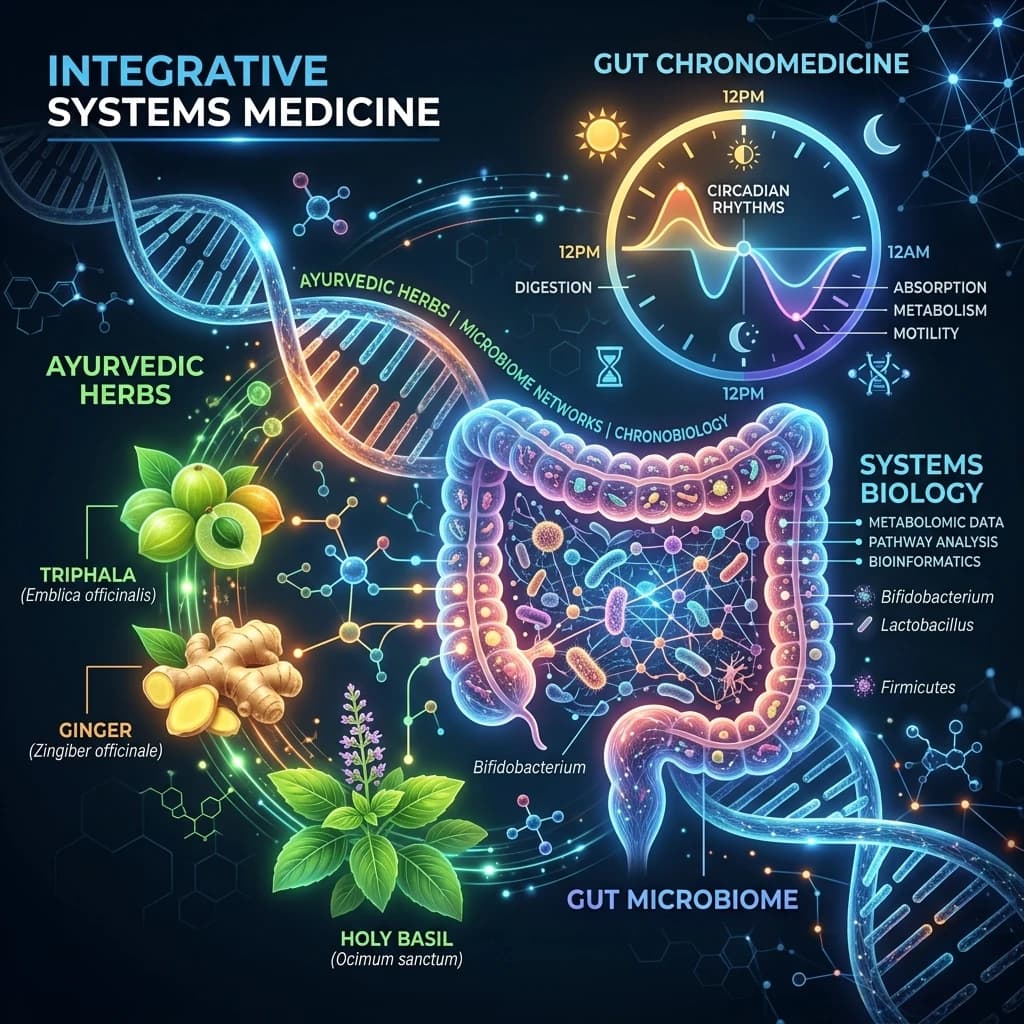
Recent medical research has established a compelling biomolecular bridge between Agni and contemporary microbiome science. Published clinical literature and diagnostic developments have centered on mapping Agni to intestinal microbial eubiosis—the balanced ecosystem of gut bacteria essential for immune homeostasis and metabolic function. Conversely, Agnimandya and Ama accumulation directly reflect intestinal dysbiosis, compromised mucosal tight junctions ("leaky gut"), and the release of lipopolysaccharides (LPS) into systemic circulation, triggering low-grade chronic inflammation.
A key milestone in this research is the clinical validation of the Agni Assessment Scale (AAS). Developed and psychometrically evaluated across clinical cohorts, the AAS provides researchers with a standardized 26-item diagnostic metric measuring functional digestive capacity based on Ayurvedic parameters such as postprandial lightness, bowel regularity, hunger perception, and tongue coating. Comparative trials demonstrate that individuals scoring in the Samagni range exhibit significantly higher microbial diversity, elevated short-chain fatty acid (SCFA) production (particularly butyrate), and lower serum inflammatory biomarkers like C-reactive protein (CRP) and IL-6.
From an integrative therapeutic standpoint, targeting Agni involves employing warm, aromatic digestive spices (Deepana and Pachana herbs like ginger, cumin, and black pepper) along with tailored dietary protocols. By restoring digestive efficiency before administering restorative tonics, clinicians can optimize nutrient assimilation while preventing the bio-accumulation of metabolic toxins.
🧠 Beyond Memory: Brahmi's Role in the Gut-Brain Axis and Neuro-Intestinal Health
Brahmi (Bacopa monnieri) has long held a revered status in the Ayurvedic pharmacopeia as a premier Medhya Rasayana—a rejuvenative herb specifically formulated to nourish the brain, enhance intellect (Medha), and calm the nervous system. Traditionally characterized by its Tikta (bitter) and Kashaya (astringent) tastes, Sheeta (cooling) energy, and Madhura (sweet) post-digestive effect, Brahmi is prescribed to balance Pitta and Vata doshas, easing mental fatigue and promoting emotional stability.
While historical applications focused heavily on memory retention and cognitive performance, 2025 and 2026 clinical investigations have uncovered Brahmi's profound interactions with the enteric nervous system (ENS)—frequently termed the "second brain." Research shows that active triterpenoid saponins in Brahmi, known as bacosides A and B, exert dual action across both the central and enteric nervous systems. Beyond modulating neurotransmitters like acetylcholine and gamma-aminobutyric acid (GABA) in the brain, bacosides modulate tryptophan metabolic pathways in the gut mucosa, where over 90% of the body's serotonin is synthesized.
Recent randomized controlled trials comparing standardized Brahmi extract with conventional selective serotonin reuptake inhibitors (SSRIs) and cognitive adaptogens have highlighted its unique therapeutic profile. Participants receiving Brahmi demonstrated significant reductions in perceived stress, improved sleep quality, and enhanced executive function without the gastrointestinal disturbances often associated with synthetic pharmaceuticals. Microbiome sequencing further revealed that Brahmi acts as a selective prebiotic, fostering beneficial bacterial strains like Bifidobacterium and Lactobacillus while suppressing pro-inflammatory pathobionts.
These findings suggest that Brahmi's cognitive and anxiolytic benefits stem not only from direct cerebral neuroprotection but also from restoring harmony within neuro-intestinal signaling networks. This dual gut-brain action solidifies Brahmi as a vital botanical agent for modern stress resilience and gut-mediated neurohealth.
⏰ Dinacharya & Circadian Biology: The Science of Ayurvedic Daily Regimens
Enjoyed this post?
Get our weekly digest delivered free.
The concept of Dinacharya—a structured daily lifestyle regimen—is one of Ayurveda's most preventive hygiene frameworks. Classical treatises like the Charaka Samhita and Ashtanga Hridaya detail specific daily behaviors tailored to natural solar and doshic cycles. Core practices include waking during Brahma Muhurta (early morning before sunrise), oral hygiene through tongue scraping (Jihwa Nirlekhana) and oil pulling (Gandusha), synchronized meal timing aligned with solar intensity, daily self-massage with warm herbal oils (Abhyanga), and restorative evening wind-down protocols.
Contemporary medical research in behavioral chronomedicine and circadian biology is providing molecular confirmation for these centuries-old practices. Scientists studying clock genes (PER1, PER2, CRY1) have shown that peripheral tissue clocks located in the liver, stomach, and pancreas require consistent temporal cues (zeitgebers) to optimize metabolic enzyme secretion, insulin sensitivity, and gut motility. When daily habits are erratic, peripheral clocks become desynchronized from the central master clock in the brain's suprachiasmatic nucleus, contributing to metabolic syndrome, insulin resistance, and systemic low-grade inflammation.
Recent clinical reviews evaluating Dinacharya as a framework for metabolic health demonstrate that timing meals according to peak solar hours aligns precisely with maximal digestive enzyme secretion and gastric motility. Studies show that aligning physical activity and breakfast routines with early morning hours enhances diurnal cortisol patterns, improves leptin sensitivity, and stabilizes nocturnal melatonin production. Furthermore, simple morning hygiene rituals such as tongue scraping have been shown to reduce oral bacterial load and prevent volatile sulfur compound formation, supporting both oral microbiome health and systemic cardiovascular wellness.
By reframing Dinacharya not as rigid dogma but as an intuitive blueprint for circadian alignment, modern integrative medicine offers individuals a practical, evidence-based lifestyle framework to prevent chronic metabolic desynchronization.
📌 The Bottom Line
- [agni-microbiome]: Modern clinical research validates Agni as a direct biomarker for gut microbiome diversity, eubiosis, and mucosal barrier health.
- [brahmi-gut-brain]: Brahmi acts as both a brain tonic and enteric nervous system regulator, enhancing mood and cognition via gut-brain signaling.
- [dinacharya-chronomedicine]: Synchronizing daily routines (Dinacharya) with natural light cycles aligns with circadian gene expression and metabolic stability.
📫 Stay Updated
Get Ayurveda and wellness wisdom delivered to your inbox every week. Subscribe to our free newsletter →
Disclaimer: The information provided in this post is for educational and informational purposes only. It is not intended to be a substitute for professional medical advice, diagnosis, or treatment. Always seek the advice of your physician or other qualified health provider.
Disclosure: This post contains affiliate links. If you purchase through our links, we earn a small commission at no extra cost to you. We only recommend products we believe in.
The health, Ayurvedic, and botanical information published on Knowelth is compiled from published clinical literature and peer-reviewed studies for educational awareness only. This content is not intended to substitute for professional medical advice, diagnosis, or treatment. Always seek the counsel of a licensed medical practitioner or certified Ayurvedic physician before starting any herbal regimen, supplement, or diet modification. Read our Editorial Policy.
Enjoyed this post?
Get our weekly digest delivered free.
Share this post:
Knowelth is reader-supported. We may earn a commission from links in this article at no extra cost to you. Read our disclosure.
Related Posts

Systems Biology, Circadian Dinacharya, and Gut-Agni Chrono-Nutrition: The Science Validating Ayurvedic Medicine
Systems Biology, Circadian Dinacharya, and Gut-Agni Chrono-Nutrition: The Science Validating Ayurvedic Medicine Modern healthcare is undergoing a paradigm shift from reductionist single-molecule thera…

Clinical Validation in Ayurveda: Cardiometabolic Formulations, Chrononutrition Agni Science, and Ayurgenomics in Ovarian Reserve
Clinical Validation in Ayurveda: Cardiometabolic Formulations, Chrononutrition Agni Science, and Ayurgenomics in Ovarian Reserve Traditional Indian medicine is undergoing a profound scientific renaiss…
Ayurveda Meets Systems Biology: Agni, Chronomedicine, and Botanical Synergy in Modern Clinical Science
Ayurveda Meets Systems Biology: Agni, Chronomedicine, and Botanical Synergy in Modern Clinical Science The 2025–2026 wave of systems biology research has made an unambiguous statement: the three pilla…