Ayurveda Meets Modern Science: Gut Microbiome Modulation, Circadian Alignment, and Neuroprotective Botanicals

Ayurveda Meets Modern Science: Gut Microbiome Modulation, Circadian Alignment, and Neuroprotective Botanicals
For centuries, Ayurveda has offered a systemic, personalized blueprint for human longevity, viewing optimal health through the lens of digestive intelligence, circadian biological rhythms, and nervous system resilience. Today, cutting-edge clinical trials, high-throughput metabolomics, and chronobiology are validating these traditional tenets with unprecedented molecular precision. By bridging millennia-old Ayurvedic principles with contemporary peer-reviewed medical research, modern wellness seekers can unlock scientifically proven tools for holistic vitality.
🌿 Triphala and Agni: How Ancient Gut Science Maps to Microbial Urolithin Production
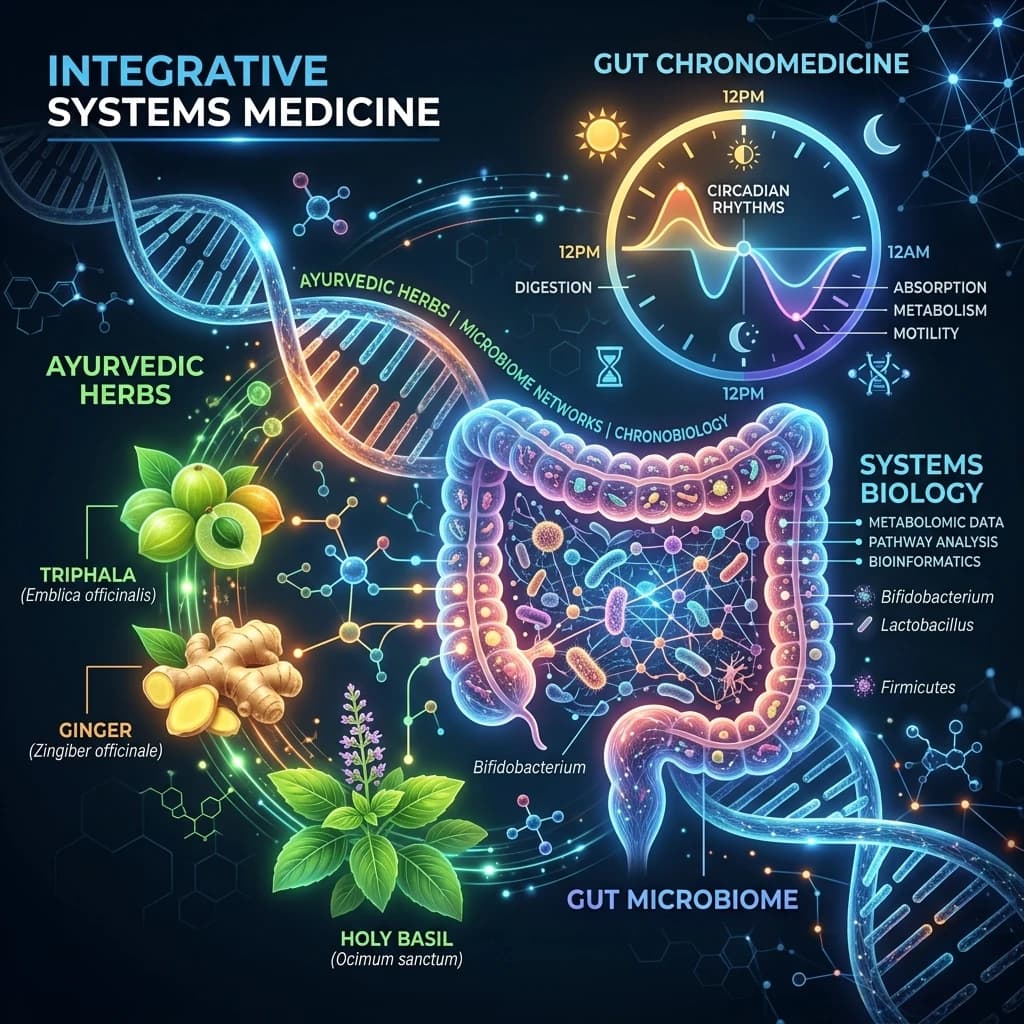
In traditional Ayurvedic medicine, digestive capacity—known as Agni or digestive fire—is regarded as the foundational pillar of overall health. When Agni is balanced (Sama Agni), food is efficiently metabolized, nourishing all cellular tissues (Dhatus). Conversely, impaired digestion (Mandagni) leads to the accumulation of toxic metabolic byproducts (Ama), initiating systemic inflammation and disease. To restore Agni and clear Ama, classical texts prescribe Triphala, a balanced synergy of three native Indian superfruits: Amalaki (Emblica officinalis), Bibhitaki (Terminalia bellirica), and Haritaki (Terminalia chebula).
Modern gastrointestinal research published in 2025 and 2026 provides a profound biochemical validation of this principle. Advanced metabolomic profiling using UPLC-QTOF-MS demonstrates that human gut microbiota biotransform Triphala's rich ellagitannins and polyphenols into potent bioavailable secondary metabolites called urolithins (primarily Urolithin A and Urolithin B). These microbially derived metabolites exert robust anti-inflammatory and antioxidant activities, repairing the colonic epithelial barrier and triggering mitochondrial autophagy (mitophagy) in intestinal endothelial cells.
Furthermore, multi-omic clinical investigations confirm that Triphala acts as a powerful prebiotic modulator. Supplementation significantly increases the relative abundance of beneficial commensal bacteria—specifically Bifidobacterium, Lactobacillus, and Bacteroides species—while selectively suppressing opportunistic pathogens. This microbial shift dramatically elevates short-chain fatty acid (SCFA) synthesis, particularly butyrate. Butyrate serves as the primary energy substrate for colonocytes, reducing systemic gut permeability ("leaky gut") and downregulating pro-inflammatory cytokines such as TNF-α and IL-6.
Practical Application & Guidance: To harness Triphala’s prebiotic and restorative properties, consume 1 to 2 grams (approximately 1/2 teaspoon) of organic Triphala powder (churna) stirred into 8 ounces of warm filtered water approximately 30 minutes before sleep. Alternatively, standardized 500 mg extract capsules can be taken. Precautions: Due to its mild laxative and peristaltic actions, Triphala is contraindicated during pregnancy, acute diarrhea, or active inflammatory bowel disease flare-ups. Individuals taking blood-thinning medications should consult their physician prior to starting supplementation.
⏰ Dinacharya and Chronobiology: Aligning Dosha Timing with Circadian Endocrinology
Ayurvedic lifestyle philosophy centers heavily on Dinacharya—a structured daily routine designed to harmonize human physiology with natural environmental cycles. Classical Ayurveda divides the 24-hour day into distinct four-hour windows dominated by specific biological energies (Dosha Kala): Kapha dominance (6:00 AM–10:00 AM and 6:00 PM–10:00 PM), Pitta dominance (10:00 AM–2:00 PM and 10:00 PM–2:00 AM), and Vata dominance (2:00 AM–6:00 AM and 2:00 PM–6:00 PM). Key Dinacharya recommendations include waking during Brahma Muhurta (approx. 45–90 minutes before sunrise) and consuming the heaviest meal (Ahara) during mid-day Pitta hours.
Recent breakthrough studies in chronobiology and metabolic endocrinology demonstrate a remarkable convergence between Dosha Kala and human circadian gene expression (CLOCK, BMAL1, and PER2). Research reveals that waking early during Brahma Muhurta aligns precisely with the peak phase of the Cortisol Awakening Response (CAR), which optimizes metabolic alertness, mobilizes thyroid hormones, and establishes robust circadian amplitude. Morning light exposure during this period suppresses pineal melatonin secretion and resets central hypothalamic clock rhythms, mitigating metabolic syndrome and mood dysregulation.
Simultaneously, chronomedicine confirms that human digestive physiology operates on a strict circadian cadence. Gastric acid secretion, pancreatic amylase activity, bile acid synthesis, and insulin sensitivity reach their physiological peak between 11:30 AM and 1:30 PM—matching peak Pitta Agni. Conversely, late-night eating during evening Kapha hours coincides with elevated peripheral insulin resistance and reduced gastric motility, driving lipogenesis, elevated visceral adipose tissue, and disrupted nocturnal growth hormone release.
Practical Application & Guidance: Align your daily rhythm with natural chronobiology by waking between 5:30 AM and 6:30 AM. Obtain 10–15 minutes of direct morning sunlight exposure without sunglasses to entrain circadian pacemakers. Consume your largest, nutrient-dense meal between 12:00 PM and 1:30 PM when metabolic capacity is at its peak. Complete dinner before 7:30 PM and institute a digital sunset (dimming screen lighting) by 9:00 PM to facilitate natural melatonin synthesis. Precautions: Shift workers or individuals with severe adrenal fatigue should adjust waking schedules gradually in 15-minute increments rather than initiating abrupt circadian shifts.
🧠 Ashwagandha and Brahmi: Decoding Adaptogenic GABA Signalling and Nootropic Synaptic Plasticity
Enjoyed this post?
Get our weekly digest delivered free.
In the Ayurvedic pharmacopeia, brain rejuvenators and vitality enhancers are categorized as Medhya Rasayanas. Among these, Ashwagandha (Withania somnifera) and Brahmi (Bacopa monnieri) stand out as premier botanical therapeutics. Ashwagandha is historically revered as a Balya (strength-giving) adaptogen that builds physiological resilience against stress, whereas Brahmi is celebrated for enhancing Dhi (acquisition), Dhriti (retention), and Smriti (memory recall).
2025–2026 double-blind, placebo-controlled randomized clinical trials have elucidated the distinct yet complementary neurobiological pathways of these two botanicals. Ashwagandha’s active steroidal lactones (withanolides, particularly Withaferin A and Withanolide A) cross the blood-brain barrier to act as GABA-A receptor agonists while attenuating Hypothalamic-Pituitary-Adrenal (HPA) axis hyperreactivity. Clinical biomarkers confirm that standardized Ashwagandha root extract reduces serum morning cortisol levels by up to 27%, improves sleep architecture by lengthening slow-wave (N3) restorative sleep, and lowers subjective perceived stress scores significantly compared to placebo.
Concurrently, neuroimaging and biomarker studies on Brahmi highlight its direct nootropic mechanisms mediated by triterpenoid saponins known as bacosides A and B. Bacosides enhance cerebral blood flow, inhibit acetylcholinesterase, and promote neurogenesis by upregulating Brain-Derived Neurotrophic Factor (BDNF) in the hippocampus. This translates to increased dendritic arborization and synaptic plasticity, accelerating cognitive processing speed, working memory retention, and executive task-switching performance. Recent clinical trials evaluating synergistic combinations of standardized Ashwagandha and Brahmi (such as the BacoZen™ protocol) demonstrate a dual-action benefit: rapid downregulation of physiological stress alongside measurable cognitive enhancement.
Practical Application & Guidance: For optimal neurological support, take 300 to 600 mg of standardized Ashwagandha root extract (containing at least 5% withanolides) with dinner or warm milk in the evening to optimize stress recovery and restorative sleep. Pair this with 300 to 450 mg of standardized Brahmi extract (containing at least 20% bacosides) taken with a healthy fat source (such as ghee, avocado, or nuts) in the morning to enhance memory and focus throughout the day. Precautions: Ashwagandha may mildly stimulate thyroid hormone production; individuals with hyperthyroidism, autoimmune conditions (e.g., Hashimoto's thyroiditis), or those taking sedative pharmaceuticals should seek medical supervision before use.
📌 The Bottom Line
- triphala-gut-microbiome: Triphala polyphenols are biotransformed by gut bacteria into anti-inflammatory urolithins and SCFA butyrate, restoring Agni and colonic epithelial barrier integrity.
- dinacharya-circadian-health: Syncing daily routines with Dosha Kala optimizes the Cortisol Awakening Response and aligns mid-day meal consumption with peak metabolic insulin sensitivity.
- ashwagandha-brahmi-synergy: Ashwagandha lowers HPA-axis cortisol and enhances slow-wave sleep via GABA signaling, while Brahmi upregulates BDNF and bacoside-driven synaptic plasticity for sharp cognitive clarity.
📫 Stay Updated
Get Ayurveda and wellness wisdom delivered to your inbox every week. Subscribe to our free newsletter →
Disclaimer: The information provided in this post is for educational and informational purposes only. It is not intended to be a substitute for professional medical advice, diagnosis, or treatment. Always seek the advice of your physician or other qualified health provider.
Disclosure: This post contains affiliate links. If you purchase through our links, we earn a small commission at no extra cost to you. We only recommend products we believe in.
The health, Ayurvedic, and botanical information published on Knowelth is compiled from published clinical literature and peer-reviewed studies for educational awareness only. This content is not intended to substitute for professional medical advice, diagnosis, or treatment. Always seek the counsel of a licensed medical practitioner or certified Ayurvedic physician before starting any herbal regimen, supplement, or diet modification. Read our Editorial Policy.
Enjoyed this post?
Get our weekly digest delivered free.
Share this post:
Knowelth is reader-supported. We may earn a commission from links in this article at no extra cost to you. Read our disclosure.
Related Posts

Systems Biology, Circadian Dinacharya, and Gut-Agni Chrono-Nutrition: The Science Validating Ayurvedic Medicine
Systems Biology, Circadian Dinacharya, and Gut-Agni Chrono-Nutrition: The Science Validating Ayurvedic Medicine Modern healthcare is undergoing a paradigm shift from reductionist single-molecule thera…

Clinical Validation in Ayurveda: Cardiometabolic Formulations, Chrononutrition Agni Science, and Ayurgenomics in Ovarian Reserve
Clinical Validation in Ayurveda: Cardiometabolic Formulations, Chrononutrition Agni Science, and Ayurgenomics in Ovarian Reserve Traditional Indian medicine is undergoing a profound scientific renaiss…
Ayurveda Meets Systems Biology: Agni, Chronomedicine, and Botanical Synergy in Modern Clinical Science
Ayurveda Meets Systems Biology: Agni, Chronomedicine, and Botanical Synergy in Modern Clinical Science The 2025–2026 wave of systems biology research has made an unambiguous statement: the three pilla…