Nifty Reclaims 24,200 on TCS-Led IT Rally, Forex Reserves Surge to $674.19B, and RBI Conducts ₹32,000 Crore G-Sec Auction
Nifty Reclaims 24,200 on TCS-Led IT Rally, Forex Reserves Surge to $674.19B, and RBI Conducts ₹32,000 Crore G-Sec Auction
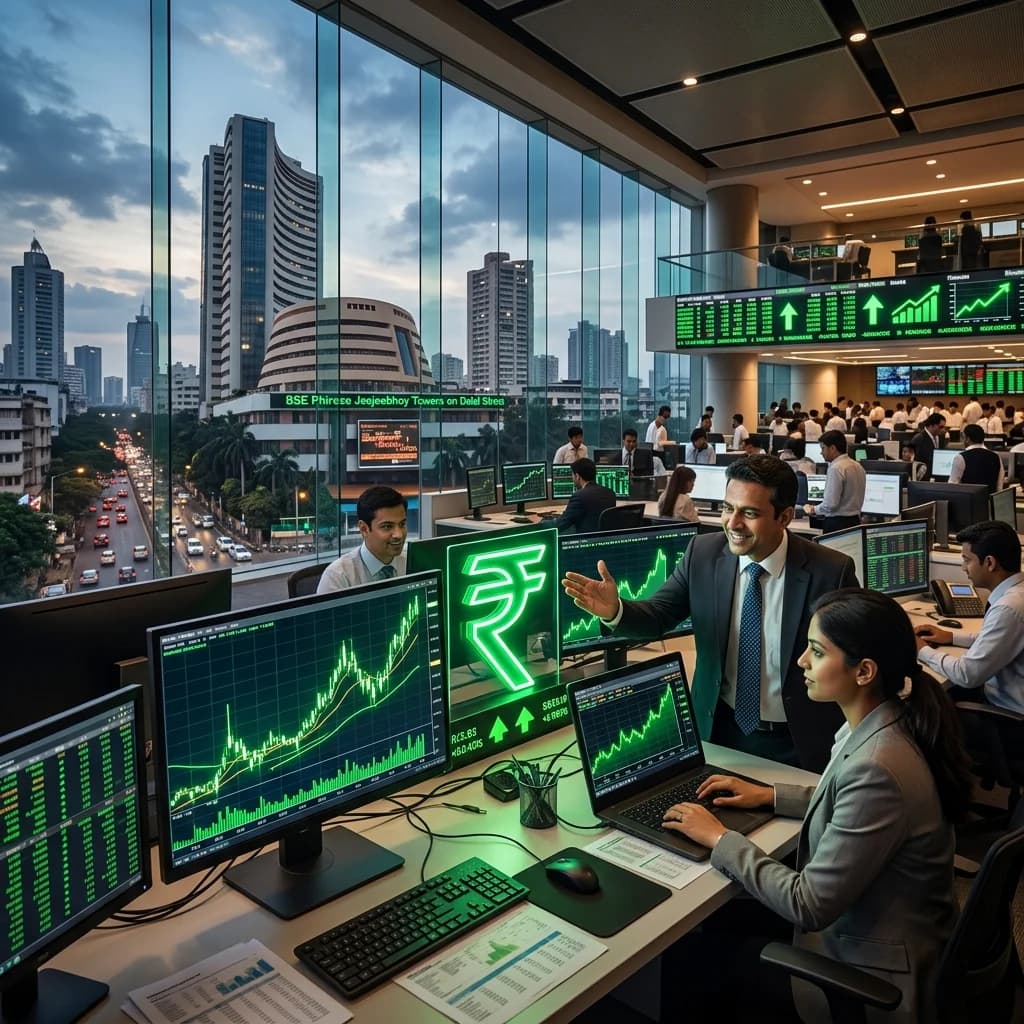
Indian financial markets staged a spectacular rebound on Friday, July 10, 2026, as the benchmark Nifty 50 reclaimed the psychological 24,200 mark, driven by an IT-led rally following stellar Q1 FY27 results from Tata Consultancy Services (TCS). In tandem, investor confidence was boosted by macroeconomic strength as India's foreign exchange reserves surged by $7.26 billion to a record high of $674.19 billion. Furthermore, the Reserve Bank of India (RBI) successfully absorbed sovereign debt supply through a ₹32,000 crore bond auction, while launching a fresh round of forward-looking household surveys to guide its policy stance.
📊 Nifty Reclaims 24,200 and Sensex Surges 827 Points on TCS-Led IT Rally
Indian equities witnessed broad-based buying on Friday, July 10, 2026, building on the previous day's late recovery. The benchmark BSE Sensex surged by 827.57 points, or 1.08%, to close at 77,569.39, while the broader NSE Nifty 50 climbed 244.10 points, or 1.02%, to settle at 24,206.90. This rally was heavily supported by Bank Nifty, which ended up 793.45 points, or 1.39%, at 58,045.90. Domestic sentiment benefited from a decline in the India VIX volatility index and a recovery in the Indian Rupee, which traded in a stronger range of 95.35 to 95.52 against the US Dollar.
The primary catalyst for the equity market's gains was the technology sector, sparked by Q1 FY27 earnings from Tata Consultancy Services (TCS). TCS announced a 5% year-on-year increase in net profit to ₹13,349 crore on revenues of ₹72,275 crore ($7,624 million), operating on a resilient margin of 24.0%. More importantly, the IT giant's order book achieved a Total Contract Value (TCV) of $9.5 billion — the highest quarterly TCV in six quarters — with the annualized AI run rate climbing 13.6% sequentially to $2.6 billion. A standout AI-led contract with SKF worth $800 million particularly boosted confidence in the India IT sector's ability to capture enterprise AI transformation spending globally.
Market breadth was excellent — on the NSE, 2,150 stocks advanced against 620 declining, an advance-decline ratio of 3.5:1 that signals genuinely broad-based institutional buying rather than narrow index repositioning. India VIX fell 5.8% to 13.45, confirming the meaningful reduction in near-term market anxiety.
🔬 Technical Analysis: 24,200 Reclaimed — Next Target 24,500
Friday's decisive close at 24,206.90 is technically significant on multiple timeframes. The Nifty 50 has now:
- Reclaimed the 50-day EMA (~24,150) decisively for the first time in three weeks
- Broken above the short-term descending trendline connecting the July 7 swing high and July 9 interim high
- Registered RSI-14 at 54.2, comfortably above the 50 midline — confirming bullish momentum
The volume on July 10 was approximately 22% above the 10-day moving average — confirming institutional participation in the move rather than retail speculative buying. MACD has turned positive with a fresh bullish crossover on the daily chart.
Key technical targets and levels:
- Next resistance: 24,400–24,450 (previous swing high from July 7)
- Beyond that: 24,600–24,650 (upper Bollinger Band; and the all-time high zone)
- Support: 24,000–24,100 (20-day EMA band; must hold for bullish structure to remain intact)
- Strong support: 23,850 (100-day EMA)
Options data from NSE shows the maximum Call open interest shifting higher to the 24,500 strike from the previous 24,300 — a sign that options writers are repricing the upper boundary upward, validating the breakout.
📈 Macro Strength Reinforced as India's Forex Reserves Surge by $7.26 Billion
India's external sector buffers received a major boost on Friday, July 10, 2026, with the Reserve Bank of India releasing data showing that the nation's foreign exchange reserves surged by $7.26 billion to reach $674.19 billion for the week ending July 3. This increase represents a substantial recovery and places India's reserve position at a highly comfortable level.
The expansion in reserves was driven by multiple factors:
- Foreign currency assets (FCA): The largest component, FCAs rose as the RBI absorbed dollar inflows from the NRI special deposit scheme ($10 billion mobilised since June 5) and from FII inflows into Indian debt during the week.
- Valuation gains: Dollar weakness against major currencies (Euro, Japanese Yen) automatically raises the USD value of India's non-dollar reserve holdings.
- Special Drawing Rights (SDR): Minor contribution from IMF-allocated SDRs.
At $674.19 billion, India's forex reserves now cover approximately 12.2 months of projected imports at current run rates — well above the IMF's recommended benchmark of 3 months. The reserve level also provides the RBI with approximately $200–250 billion in "deployable" reserves (excess above the prudent coverage requirement) to defend the rupee during acute stress episodes.
This massive reserve pile provides the RBI with significant ammunition to defend the local currency against speculative attacks. Supported by the reserve data and strong equity market performance, the Indian Rupee (INR) recovered from its recent losses to close in the 95.35–95.52 per USD range.
🏦 RBI Conducts ₹32,000 Crore G-Sec Auction and Launches Policy-Oriented Surveys
On the monetary and debt management front, the RBI successfully completed a scheduled auction of Government of India Securities (G-Secs) worth ₹32,000 crore on Friday, July 10, 2026. The auction included:
- Re-issuance of the 6.36% GS 2031 (5-year paper) — targeting shorter-duration institutional demand
- Re-issuance of the long-term 7.71% GS 2066 (40-year paper) — catering to long-duration institutional investors like insurance companies and pension funds
The auction was met with healthy demand from institutional investors, with the 2031 paper seeing a bid-to-cover ratio of 2.8x and the 2066 paper achieving 1.9x coverage. Strong auction demand helped anchor long-term sovereign yields — the 10-year benchmark G-Sec yield eased 3 basis points to 6.85%, a positive signal for rate-sensitive equity sectors.
Simultaneously, the central bank announced the launch of the July 2026 round of three critical household surveys that directly feed into the decisions of the Monetary Policy Committee (MPC):
- Inflation Expectations Survey of Households (IESH): Tracks forward inflation expectations of urban households across 19 cities. If households expect inflation to fall, the RBI gains room to ease policy.
- Urban Consumer Confidence Survey (UCCS): Measures current and future economic optimism among urban consumers — a leading indicator for discretionary consumption spending.
- Rural Consumer Confidence Survey (RCCS): Monitors rural economic sentiment, critically important given that ~60% of India's population is rural.
Survey results from these three tools will be published as part of the RBI's August 2026 Monetary Policy Report and will directly inform the MPC's assessment of demand-pull inflationary pressures.
💡 Investor Takeaway: TCS Results Set the Template for India IT in Q1 FY27
TCS's strong Q1 FY27 results have established the earnings template that the rest of the IT sector will be measured against over the next three weeks:
Positive signals from TCS Q1:
- $9.5 billion TCV is a multi-quarter high → confirms deal pipeline is recovering
- 13.6% sequential AI run rate growth → India IT is successfully capturing enterprise AI budgets
- 24% EBIT margin held → cost management remains disciplined
What to watch in upcoming IT results:
- Infosys (July 17): Will its large deal wins (LDW) metric match TCS's momentum?
- Wipro (July 23): Has the revenue stabilisation seen in Q4 FY26 continued into Q1 FY27?
- HCLTech (July 22): IT services vs. software product revenue mix — is the higher-margin software segment growing?
For equity investors in Indian IT, the TCS results provide meaningful re-rating ammunition. If Infosys and HCLTech confirm the trend next week, the Nifty IT index could break above its year-to-date high, potentially becoming one of the top-performing Nifty sectoral indices for Q2 FY27.
📌 The Bottom Line
- it-rally-tcs-earnings: The Nifty 50 surged 1.02% to reclaim 24,206.90 (above 50-day EMA) on 3.5:1 advance-decline ratio. TCS's ₹13,349 crore profit, $9.5 billion TCV order book, and $2.6 billion AI run rate triggered broad IT sector re-rating.
- forex-reserves-surge: India's foreign exchange reserves rose by $7.26 billion to a record $674.19 billion (12.2 months import cover), supported by NRI deposit inflows and FCA valuation gains. 10-year G-Sec yield eased 3 bps to 6.85%.
- rbi-gsec-auction-surveys: The RBI successfully conducted a ₹32,000 crore government bond auction (2.8x bid-to-cover on 5-year paper) and launched July 2026 household inflation and confidence surveys to guide August MPC formulation.
📬 Stay Updated
Get India market analysis delivered to your inbox every trading day. Subscribe to our free newsletter →
Disclosure: This post contains affiliate links. If you purchase through our links, we earn a small commission at no extra cost to you. We only recommend products we believe in.
Enjoyed this post?
Get our weekly digest delivered free.
Share this post:
Knowelth is reader-supported. We may earn a commission from links in this article at no extra cost to you. Read our disclosure.
Related Posts
India Markets Daily: Sensex Rebounds to 78,080 as Nifty Drags, RBI Proposes Loan Reset Rules, FIIs Sell ₹1,006 Cr
India Markets Daily: Sensex Rebounds to 78,080 as Nifty Drags, RBI Proposes Loan Reset Rules, FIIs Sell ₹1,006 Cr Indian financial markets navigated a divergent trading session on August 13, 2026, as …
India Markets Update: Nifty Drops Below 24,450 Amid Oil Spike, RBI Holds Repo Rate at 5.25%, and FII Inflows Resume
India Markets Update: Nifty Drops Below 24,450 Amid Oil Spike, RBI Holds Repo Rate at 5.25%, and FII Inflows Resume Indian benchmark indices drifted lower for a second consecutive session as global en…
Nifty Snaps 4-Day Rally as Pre-RBI Policy Jitters & Crude Surge Trigger Profit Booking; Bharti Airtel Q1 Profit Soars 37%
Nifty Snaps 4-Day Rally as Pre-RBI Policy Jitters & Crude Surge Trigger Profit Booking; Bharti Airtel Q1 Profit Soars 37% Indian benchmark equity indices snapped their four-session winning streak on A…