Nifty Falls on Crude Spike, Rupee Crosses 96, CPI Inflation Breaches RBI's 4% Target
Nifty Falls on Crude Spike, Rupee Crosses 96, CPI Inflation Breaches RBI's 4% Target
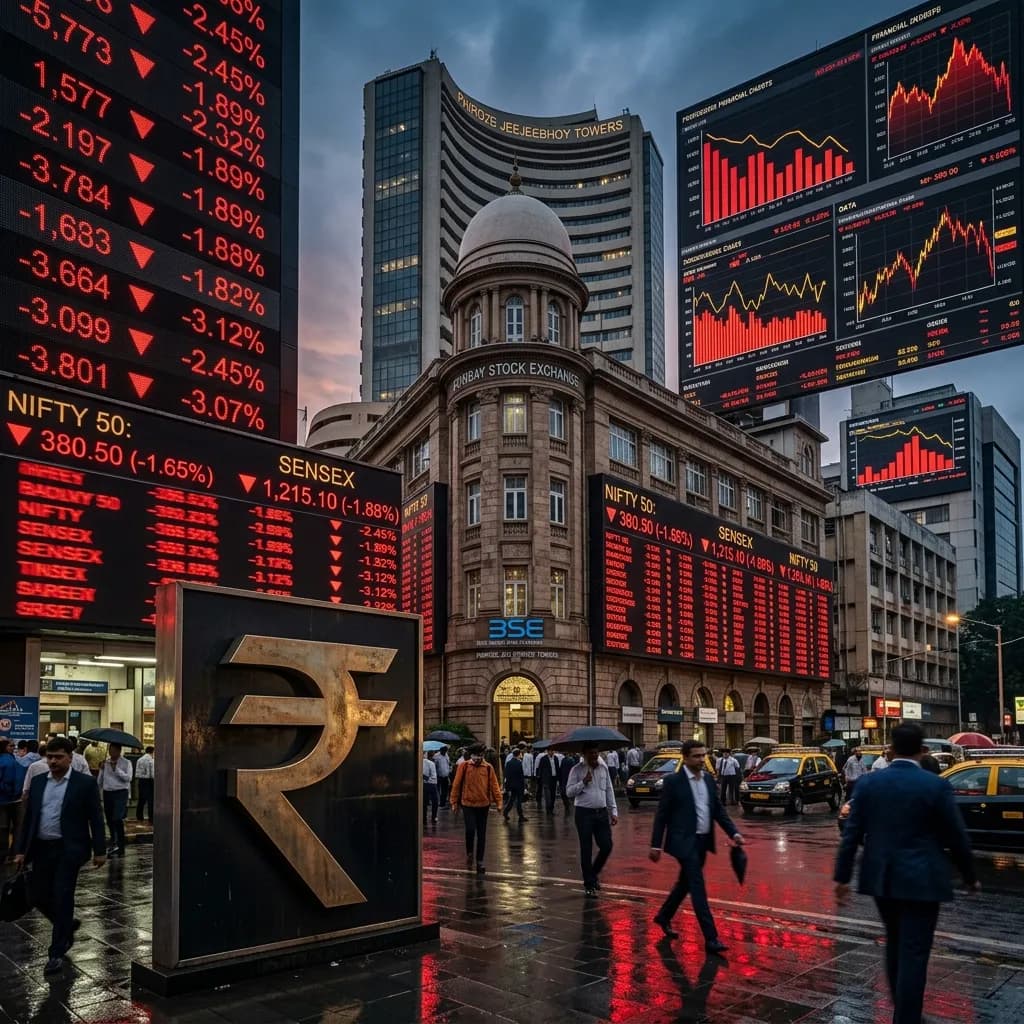
Indian financial markets witnessed significant stress on Tuesday, July 14, 2026, as a toxic combination of rising Brent crude prices and a spike in domestic retail inflation rattled investor confidence. Equity indices plunged in early trade, with the Nifty 50 slipping below the key 24,100 mark, while the Indian Rupee depreciated past 96 per US Dollar for the first time in nearly two months. Adding to the macroeconomic concerns, India's June CPI inflation accelerated to 4.38%, breaching the Reserve Bank of India's (RBI) medium-term target of 4.00%.
📊 Equities Plunge as Crude Nears $85 Amid Middle East Geopolitical Strife
Indian equity benchmark indices faced a sharp sell-off in early trade on Tuesday, July 14, 2026, tracking weak global market cues and a steep spike in international crude oil prices. The NSE Nifty 50 tumbled over 160 points or 0.66% to trade around the 24,050 level, while the BSE Sensex plummeted by more than 550 points to touch an intraday low of 77,063.40. Heightened geopolitical tensions in West Asia, specifically escalating conflicts involving the US and Iran, prompted foreign institutional investors (FIIs) to pull back, resulting in a wave of selling across domestic equities.
The morning trade saw widespread declines, particularly in rate-sensitive sectors such as banking, financial services, and automobiles, as well as energy-intensive manufacturing stocks. Big-ticket names in the auto and banking space led the losses, while defensive sectors like Information Technology (IT) and pharmaceuticals offered minor resilience. Market participants noted that FII outflows — which had reached ₹3,062.27 crore in the previous session — continued to weigh heavily on the index, with no sign of immediate reversal given the geopolitical overhang.
Market breadth was broadly negative, with approximately 1,650 stocks declining on the NSE against 950 advancing, pointing to wide-based institutional selling rather than isolated sectoral correction. India VIX surged 5.2% to 16.10, entering the elevated zone that typically signals increased hedging demand and potential for further near-term downside before stabilisation.
🔬 Technical Analysis: Critical Levels in Focus
The Nifty 50's breach of 24,100 pushed the index into technically precarious territory. The index is now operating just above its 100-day exponential moving average (EMA) at 23,950 — the last major structural support before a deeper corrective move would be signalled. The RSI-14 has declined to 38.5, approaching the oversold zone below 35, which historically marks near-term capitulation points for the Nifty 50 in geopolitically-driven corrections.
Key technical levels:
- Immediate resistance: 24,200–24,250 (reclaimed 20-day EMA zone)
- Next resistance: 24,450 (50-day EMA)
- Critical support: 23,950–24,000 (100-day EMA — must hold for bulls)
- Deeper support: 23,500–23,600 (200-day EMA and major swing low)
Options market data shows the maximum Put open interest at the 24,000 strike, signalling strong support at that level. Any close below 24,000 on expiry would force significant Put unwinding and could trigger stop-loss-driven selling cascades, making 24,000 the key line in the sand for the near term.
💸 Rupee Weakens Past 96-Per-USD Mark on Energy Import Costs and Dollar Strength
In the currency markets, the Indian Rupee (INR) fell past the key psychological threshold of 96.00 against the US Dollar (USD) for the first time since late May 2026. The domestic unit opened sharply lower and depreciated by 48 paise to hit an intraday low of 96.16 in early trading, compared to its previous close of 95.68 on Monday. The currency's rapid decline was fueled by a spike in Brent crude oil prices toward $85 per barrel, which immediately raised concerns over India's import bill and current account deficit.
Adding to the rupee's woes, the US Dollar Index (DXY) marched higher as global investors sought the safety of the greenback amid the Middle East conflict. Foreign exchange dealers reported that the Reserve Bank of India (RBI) likely intervened in the spot and non-deliverable forward (NDF) markets via state-run banks to prevent a sharp, disorderly depreciation of the currency.
India's current account deficit sensitivity to crude prices is well-documented: every sustained $10 per barrel increase in Brent crude adds approximately $13–15 billion to India's annual import bill. At $85/barrel sustained, India's CAD could widen to 1.8–2.0% of GDP for FY27, compared to the 1.2% registered in FY26. A deteriorating CAD creates negative feedback — it pressures the rupee, inflates import costs, and in turn accelerates the very inflation the RBI is trying to control.
📈 CPI Inflation Jumps to 4.38%, Breaching RBI's 4% Medium-Term Target
On the economic data front, India's retail inflation, measured by the Consumer Price Index (CPI), accelerated to 4.38% year-on-year in June 2026. This is a significant jump from the 3.93% recorded in May and represents the first time the inflation rate has breached the RBI's medium-term target of 4.00% since January 2025. The rise was primarily driven by hardening food and energy prices, exacerbated by supply chain disruptions and seasonal factors.
Core inflation — excluding food and fuel — remained relatively contained at 3.72%, suggesting the inflationary pressure is largely supply-side rather than demand-driven. However, the overall CPI headline breach matters enormously for monetary policy signalling. The Reserve Bank of India operates on a flexible inflation targeting (FIT) framework mandated to keep CPI at 4.00% ± 2.00%. A sustained breach above 4.00% removes any remaining probability of a near-term rate cut.
This CPI print complicates the policy path for the Reserve Bank of India's Monetary Policy Committee (MPC). With inflation now running above the central bank's key 4.00% target, analysts believe that the RBI will keep its policy repo rate on hold at 5.25% for longer than previously anticipated. Bond markets reacted swiftly — the benchmark 10-year Indian Government Bond (IGB) yield rose 5 basis points to 6.88%, as traders unwound earlier rate-cut expectations and repriced fixed income assets for a prolonged hold environment.
💡 What This Means for Investors
Tuesday's triple-threat — equity sell-off, rupee depreciation, and inflation miss — creates three distinct sets of implications for different investor types:
Equity investors: The episode underscores the vulnerability of Indian equities to global commodity shocks. Rate-sensitive sectors (banking, real estate, NBFCs) and energy-intensive sectors (metals, cement) are the most exposed. Defensives (IT, Pharma, FMCG) offer relative shelter but are not immune to global risk-off sentiment.
Fixed income investors: The CPI breach reduces the probability of an August 2026 rate cut to near zero. Investors in floating rate funds or short-duration debt are relatively shielded, while long-duration government bond holders face mark-to-market losses as yields rise.
Currency-sensitive investors/importers: Rupee depreciation beyond 96/USD increases import costs across petroleum, electronics, edible oils, and industrial commodities. Businesses with USD-denominated liabilities should consider near-term hedging strategies to lock in current forward rates before further rupee weakness.
📌 The Bottom Line
- equities-selloff-crude-spike: The Nifty 50 slipped below 24,100 to trade around 24,050 and the Sensex shed 550+ points, triggered by Brent crude surging toward $85 amid US-Iran tensions. India VIX surged to 16.10.
- rupee-slides-past-96: The Indian Rupee depreciated by 48 paise to 96.16 against the USD, breaching 96 for the first time since May. CAD risks mount as every $10/bbl crude rise adds $13-15 billion to India's annual import bill.
- cpi-inflation-breach: India's June CPI inflation accelerated to 4.38%, crossing the RBI's 4.00% medium-term target for the first time since January 2025. 10-year IGB yields rose 5 bps to 6.88% as rate cut hopes receded.
📬 Stay Updated
Get India market analysis delivered to your inbox every trading day. Subscribe to our free newsletter →
Disclosure: This post contains affiliate links. If you purchase through our links, we earn a small commission at no extra cost to you. We only recommend products we believe in.
Enjoyed this post?
Get our weekly digest delivered free.
Share this post:
Knowelth is reader-supported. We may earn a commission from links in this article at no extra cost to you. Read our disclosure.
Related Posts
India Markets Daily: Sensex Rebounds to 78,080 as Nifty Drags, RBI Proposes Loan Reset Rules, FIIs Sell ₹1,006 Cr
India Markets Daily: Sensex Rebounds to 78,080 as Nifty Drags, RBI Proposes Loan Reset Rules, FIIs Sell ₹1,006 Cr Indian financial markets navigated a divergent trading session on August 13, 2026, as …
India Markets Update: Nifty Drops Below 24,450 Amid Oil Spike, RBI Holds Repo Rate at 5.25%, and FII Inflows Resume
India Markets Update: Nifty Drops Below 24,450 Amid Oil Spike, RBI Holds Repo Rate at 5.25%, and FII Inflows Resume Indian benchmark indices drifted lower for a second consecutive session as global en…

Nifty Snaps 4-Day Rally as Pre-RBI Policy Jitters & Crude Surge Trigger Profit Booking; Bharti Airtel Q1 Profit Soars 37%
Nifty Snaps 4-Day Rally as Pre-RBI Policy Jitters & Crude Surge Trigger Profit Booking; Bharti Airtel Q1 Profit Soars 37% Indian benchmark equity indices snapped their four-session winning streak on A…