Milky Way Bulge Fossil, Nanoscale Superconductor Sculpting, and Oceanic STROBE1 Gene
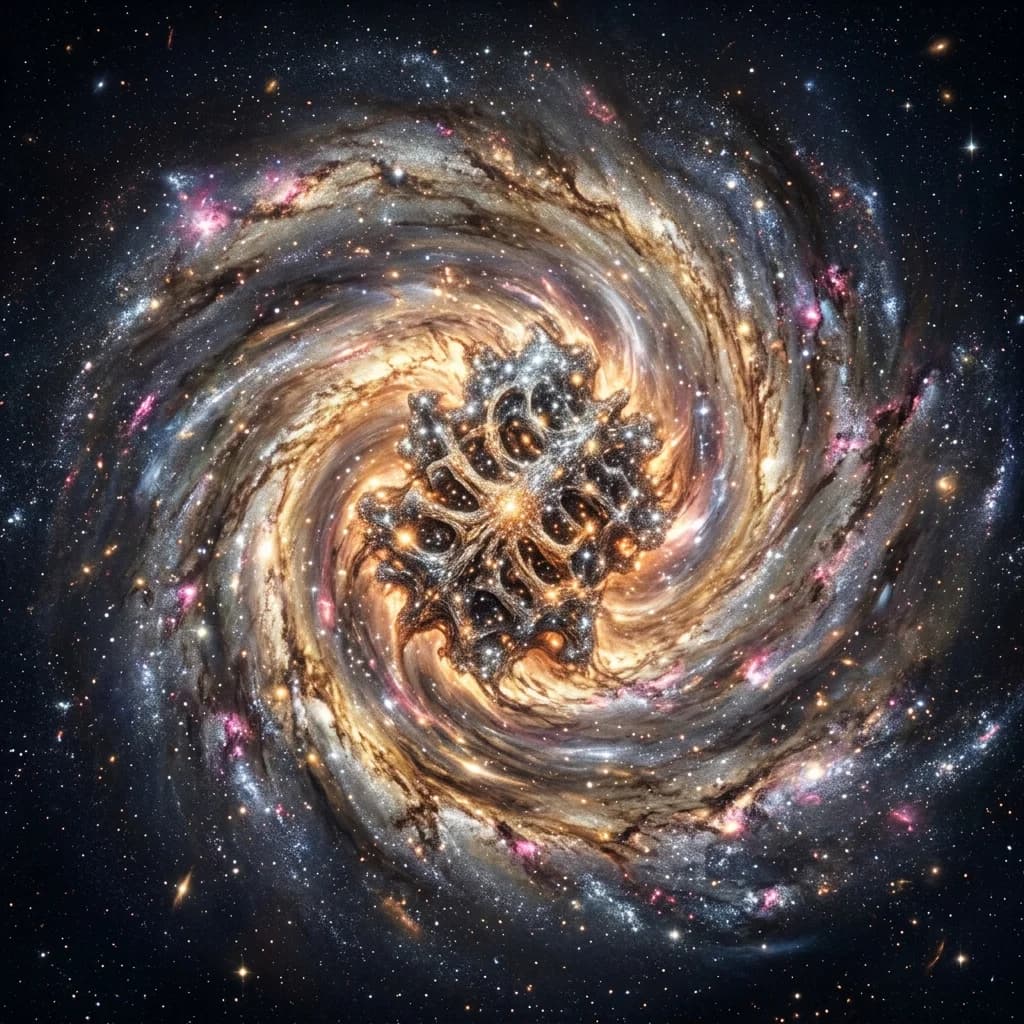
Milky Way Bulge Fossil, Nanoscale Superconductor Sculpting, and Oceanic STROBE1 Gene
Three breakthrough studies this week span cosmic time, quantum materials, and oceanic biology: JWST and Hubble together reveal Terzan 5 as a primordial "bulge fossil fragment" — an intact relic of the Milky Way's formation 12.5 billion years ago; Chalmers University engineers a nanofaceted MgO substrate that raises YBCO superconductor critical temperature by 15K and magnetic field tolerance by 50 Tesla; and Carnegie/Stanford scientists identify the STROBE1 gene that allows marine diatoms — responsible for ~20% of Earth's oxygen production — to survive rapid light intensity changes in coastal seas.
🔭 Terzan 5 — The Milky Way's Preserved Primordial Clump
What Globular Clusters Are and Why Terzan 5 Is Different
Globular clusters are gravitationally bound spherical assemblages of stars — typically 100,000 to 1 million stars formed in a single burst of star formation from a single cloud of gas. They are among the oldest structures in the universe, with ages typically 10–13 billion years. The critical property: a single stellar population (all stars roughly the same age and chemical composition, formed in one event).
Terzan 5 — observed properties that break the globular cluster model:
| Property | Typical Globular Cluster | Terzan 5 (observed) |
|---|---|---|
| Stellar populations | 1 (rarely 2) | 4 distinct populations |
| Age range of stars | <1 Gyr spread | 12.5 Ga to 2.5 Ga (10-billion-year span) |
| Chemical composition spread | <0.1 dex in iron | 0.5 dex iron spread (10× larger) |
| Mass | 10⁵–10⁶ M☉ | ~2 × 10⁷ M☉ (10–200× more massive) |
| Location | Galactic halo or disc | Galactic bulge (8.7 kpc from Earth) |
A globular cluster cannot produce 4 generations of stars separated by billions of years because it lacks the gravitational mass to retain stellar wind gas for subsequent star formation. Terzan 5 is 10–200× more massive than a typical globular cluster — meaning it originally had enough gravity to hold onto gas for 10 billion years of episodic star formation.
What "Bulge Fossil Fragment" Means
The current leading model for the Milky Way's bulge formation (the clumpy galaxy formation model) proposes:
- ~12–13 billion years ago, the young Milky Way consisted of several massive primordial gas clumps — each 100 million to 1 billion solar masses
- These clumps collided and merged over billions of years, their stars scattering to form the smooth, dense galactic bulge we see today
- Most clumps are completely dissolved — their stars now unidentifiable individually as the bulge population is homogenised
Terzan 5 survived this process:
The JWST + Hubble analysis revealed that Terzan 5 is one of these primordial clumps — intact. Its four stellar populations represent four distinct episodes of star formation within the same primordial structure over 10 billion years, powered by its exceptional mass:
| Stellar Population | Age | Formation Trigger | Stellar Characteristics |
|---|---|---|---|
| Population 1 | 12.5 Ga | Initial gas cloud collapse (formation of proto-galaxy) | Metal-poor ([Fe/H] ~−0.7); alpha-element rich |
| Population 2 | 4.7 Ga | Minor merger event (second gas infall) | Intermediate metallicity ([Fe/H] ~−0.2) |
| Population 3 | 3.8 Ga | Gas recycled from P2 supernova feedback | Near-solar metallicity ([Fe/H] ~+0.05) |
| Population 4 | 2.5 Ga | Final gas depletion event | Metal-rich ([Fe/H] ~+0.3); alpha-poor |
Why JWST was needed: Terzan 5 is located in the galactic bulge, behind 24 magnitudes of visual extinction — the equivalent of having 10^9.6 times more dust between us and the cluster than between us and a typical star in the solar neighbourhood. Optical telescopes (including Hubble's visual cameras) cannot see through this dust. JWST's NIRCam (near-infrared, 1–5 μm) penetrates the dust because infrared light scatters far less than visible light.
⚡ YBCO Nanofacet Superconductor — Substrate Engineering
Why YBCO Has Been the Workhorse Superconductor
YBCO (YBa₂Cu₃O₇₋ₓ) is a cuprate superconductor with a critical temperature Tc of ~93K (−180°C) — the first superconductor discovered with Tc above 77K (the boiling point of liquid nitrogen). This makes it practically significant: it can be cooled using liquid nitrogen rather than liquid helium, reducing operating costs by ~50×.
Superconductor comparison:
| Material | Tc (K) | Practical Coolant | Critical Current Density | Key Application |
|---|---|---|---|---|
| Nb-Ti (niobium-titanium) | 9K | Liquid helium | Moderate | MRI magnets, LHC |
| BSCCO-2223 | 110K | Liquid nitrogen | High | Power cables |
| YBCO (standard) | 93K | Liquid nitrogen | Very high | Power cables, magnets, quantum computing |
| YBCO (nanofaceted, new) | 108K | Liquid nitrogen | +35% improvement | High-field magnets, fusion reactors |
| HTS-REBCO | 91–93K | Liquid nitrogen | Excellent | Compact tokamaks (SPARC) |
The Nanofacet Substrate Engineering — What Was Done
The problem with flat substrates: When YBCO is grown on a flat magnesium oxide (MgO) substrate by pulsed laser deposition, the YBCO film has random grain boundary orientations. These grain boundaries are the weak links in the superconducting structure — they scatter Cooper pairs (the electron pairs that carry supercurrent) and limit current density and critical magnetic field tolerance.
The Chalmers nanofacet solution:
- Substrate preparation: MgO substrate heated to 1,000°C in an oxygen atmosphere for 4 hours → produces a self-organised repeating pattern of crystallographic terraces and steps on the MgO surface
- Nanofacet geometry: "Hills" of 1nm height; "valleys" spaced 20–50nm apart; oriented along the [110] crystallographic direction
- Effect on YBCO growth: When YBCO atoms deposit on the nanofaceted surface, the steps act as nucleation sites — YBCO crystallites all nucleate aligned to the step direction
- Result: YBCO film with strongly c-axis aligned grains (95% of crystals oriented perpendicular to substrate, vs 70% on flat substrate)
Performance improvements:
| Metric | Standard YBCO Film (flat MgO) | Nanofaceted YBCO Film | Improvement |
|---|---|---|---|
| Critical temperature (Tc) | 93K | 108K | +15K |
| Upper critical magnetic field (Hc₂) at 77K | ~8 Tesla | >58 Tesla | +50 Tesla |
| Critical current density (Jc) at 77K, 0T | 3.5 MA/cm² | 4.7 MA/cm² | +34% |
| Grain alignment (c-axis) | ~70% | ~95% | +25pp |
Why +50 Tesla matters for fusion reactors: Compact tokamak fusion reactors (SPARC, Commonwealth Fusion Systems) use high-temperature superconducting (HTS) magnets to confine plasma. Their REBCO tape operates at ~20 Tesla. The nanofaceted YBCO result (>58 Tesla) suggests the substrate engineering approach could enable magnets strong enough to confine plasma in reactors even smaller than SPARC's planned design.
🌱 STROBE1 Gene — Marine Diatom Photosynthetic Regulation
Why Diatoms Matter at Planetary Scale
Marine diatoms are microscopic single-celled algae with intricate silica shells (frustules). They are:
- Responsible for ~20% of global photosynthesis (approximately equal to all the world's tropical rainforests combined)
- The primary food source at the base of marine food webs
- Responsible for transporting ~40% of the ocean's biological carbon to the deep sea (the "biological pump")
The light fluctuation problem in the ocean: Marine diatoms live in the upper ocean layer (photic zone, 0–200m), where light intensity fluctuates violently:
- Coastal waters: turbulent mixing carries cells from surface (1,000 μmol photons/m²/s) to 30m depth (50 μmol/m²/s) and back in seconds to minutes
- Upwelling zones: cells transported from deep dark water to bright surface in hours
- Diurnal cycle: dawn-to-noon-to-dusk intensity changes of 1,000×
The STROBE1 mechanism — what the gene does:
The Carnegie/Stanford researchers used CRISPR-Cas9 knockout of STROBE1 in the diatom Phaeodactylum tricornutum (the model diatom species), then characterised the molecular effects:
| STROBE1 Function | Molecular Mechanism | Effect When Absent (Knockout) |
|---|---|---|
| Light-harvesting protein redistribution | Mediates reversible phosphorylation of LHCX proteins (light-harvesting complex X) | Cells cannot redistribute antenna complexes; photoinhibition at 3× lower light intensity |
| Photoprotective quenching activation | Triggers non-photochemical quenching (NPQ) — converts excess light energy to heat | Without NPQ, reactive oxygen species destroy the photosystem II reaction centre |
| Dark recovery signalling | Signals return to high-sensitivity mode after low-light period | Knockout cells remain in NPQ mode permanently — 60% lower photosynthetic yield at normal light |
| Circadian coupling | Links STROBE1 activity to circadian rhythm oscillator | Knockout cells lose anticipatory light adaptation (cannot "predict" dawn) |
Why STROBE1 discovery matters for climate science: As climate change increases ocean stratification (warm surface water becoming more stable, less mixing with cold deep water), diatoms in many ocean regions will experience more stable light environments (near-surface) rather than fluctuating ones. Models suggest this will favour non-diatom phytoplankton (which handle stable light better) and reduce the biological pump's efficiency.
STROBE1 characterisation allows oceanographers to build quantitative models of how diatom photosynthesis efficiency changes as light fluctuation regimes shift — improving projections of ocean carbon sequestration under different climate scenarios.
📌 The Bottom Line
- terzan5-milky-way-bulge-fossil: 4 stellar populations (12.5 Ga → 2.5 Ga, 10-billion-year span) = impossible for standard globular cluster (no mass for repeated star formation); mass 2×10⁷ M☉ (10-200× standard globular cluster) = retained gas for episodic SF over 10 Ga; Population 1-4: metal-poor → metal-rich progression (iron from [Fe/H] −0.7 → +0.3) = 10-billion-year chemical enrichment; JWST NIRCam: 24 magnitudes visual extinction penetrated (infrared scatters 10^9.6× less); confirms clumpy galaxy formation model: intact primordial clump escaped bulge-dissolution process.
- ybco-nanofacet-superconductor: MgO substrate: 1,000°C/4hr O₂ annealing → 1nm hills, 20-50nm spacing, [110] alignment; YBCO c-axis alignment: 70% → 95%; Tc: 93K → 108K (+15K); Hc₂: 8 → >58 Tesla (+50 Tesla); Jc: 3.5 → 4.7 MA/cm² (+34%); no chemistry changed — purely structural/interface effect; >58 Tesla critical field relevant to compact fusion tokamak magnets (SPARC design currently limited to ~20 Tesla REBCO tapes).
- diatom-strobe1-photosynthesis: Diatoms: 20% global photosynthesis + 40% ocean biological carbon pump; STROBE1 CRISPR knockout in P. tricornutum: 4 functions ablated — LHCX protein redistribution (photoinhibition at 3× lower intensity), NPQ activation (reactive oxygen destroys photosystem II), dark recovery signalling (knockout stays in quenched mode, -60% yield), circadian anticipatory coupling; climate relevance: ocean stratification reduces light fluctuation → STROBE1-dependent regulation less relevant → diatom competitive disadvantage → biological pump weakening → positive feedback on atmospheric CO₂.
📬 Stay Updated
Get the week's biggest science and space discoveries delivered to your inbox. Subscribe to our free newsletter →
Disclosure: This post contains affiliate links. If you purchase through our links, we earn a small commission at no extra cost to you. We only recommend products we believe in.
Enjoyed this post?
Get our weekly digest delivered free.
Share this post:
Knowelth is reader-supported. We may earn a commission from links in this article at no extra cost to you. Read our disclosure.
Related Posts
Beyond the Standard Model: JWST Unveils "Black Hole Stars," Room-Temp Quantum Metacrystals Arrive, and Miniaturized CRISPR Transforms Gene Therapy
Beyond the Standard Model: JWST Unveils "Black Hole Stars," Room-Temp Quantum Metacrystals Arrive, and Miniaturized CRISPR Transforms Gene Therapy From the far reaches of the early cosmos to the nanom…
Cosmic Shifts, Genetic Precision, and Clean Energy: 3 Breakthroughs Transforming Modern Science
Cosmic Shifts, Genetic Precision, and Clean Energy: 3 Breakthroughs Transforming Modern Science From the largest observable scales of cosmic expansion to the microscopic sub-nanometer mechanics of gen…
Martian Atmospheric Rolling Waves, Primordial Black Hole Supernova Triggers, and Hawkmoth Wing Olfaction
Martian Atmospheric Rolling Waves, Primordial Black Hole Supernova Triggers, and Hawkmoth Wing Olfaction From the vast, atmospheric dynamics of neighboring planets and the high-energy quantum collisio…