Lensed Neutrino Source 'Shadow Blaster', CERN's Doubly Charmed Baryon, and Reconfigurable Entangled Materials
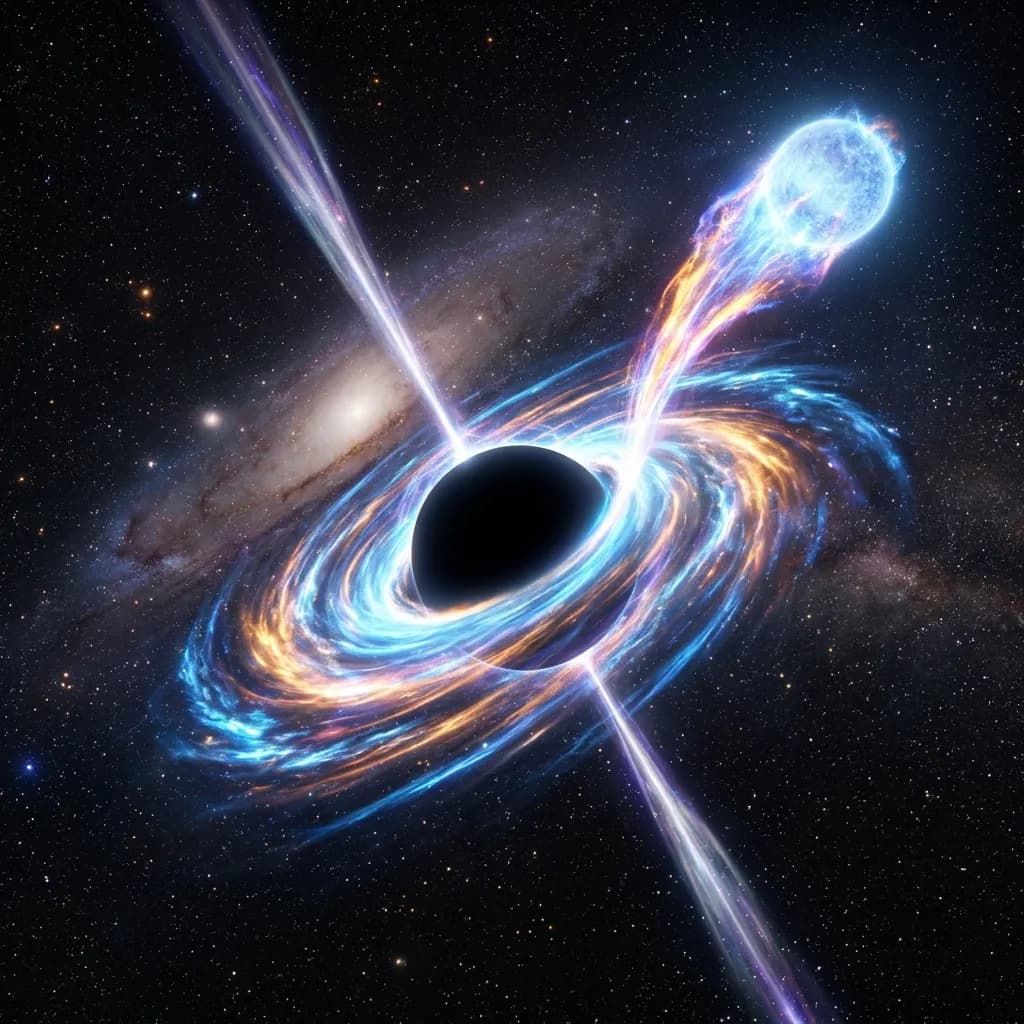
Lensed Neutrino Source "Shadow Blaster", CERN's Doubly Charmed Baryon, and Reconfigurable Entangled Materials
This week, breakthrough discoveries reveal how the physical universe organizes matter and forces across the grandest cosmic scales and the most fundamental subatomic interactions. From an ancient, dust-obscured starburst galaxy accelerating ultra-high-energy neutrinos across 11 billion light-years to the observation of the final predicted state in a subatomic baryon family at CERN, and a revolutionary class of mechanically entangled solids that liquefy under specific acoustic frequencies, researchers are establishing new paradigms across astrophysics, quantum chromodynamics, and mechanical metamaterials.
This technical intelligence briefing analyzes the core physical mechanisms and mathematical formulations defining these three breakthroughs: the ALMA gravitational lensing resolution of the 750-TeV neutrino source JCMT0402−0424 ("Shadow Blaster"), the LHCb detection of the doubly charmed $\Omega_{cc}^+$ baryon completing the 50-year SU(4) flavor multiplet, and the University of Colorado Boulder's geometric entanglement mechanics enabling reversible solid-liquid state transitions.
🌌 1. Cosmic Noon Beacon: ALMA Traces 750-TeV Neutrino to "Shadow Blaster"
Gravitational Einstein Cross Magnification, IceCube Event IC 210922A, and Non-AGN Hadronic Acceleration
Resolving Ghost Particles Across 11 Billion Light-Years: Neutrinos are nearly massless, neutral fundamental leptons that interact exclusively via the weak nuclear force and gravity. Because they traverse cosmological distances without absorption by intergalactic dust or magnetic deflection, ultra-high-energy (UHE) astrophysical neutrinos serve as pristine directional probes of cosmic particle acceleration.
In a landmark paper published in Nature Astronomy, an international collaboration led by Dr. Yuji Urata utilized the Atacama Large Millimeter/submillimeter Array (ALMA) to resolve the cosmological origin of IceCube neutrino event IC 210922A (energy: 750 TeV). The neutrino was traced to a compact, dust-shrouded starburst galaxy designated JCMT0402−0424 (nicknamed "Shadow Blaster") at redshift $z = 2.45$, corresponding to a lookback time of 11 billion years during the "Cosmic Noon" epoch.
                      [ALMA Gravitational Lensing & Neutrino Detection Pipeline]
                                                │
                                                ▼
                      [Dust-Obscured Starburst Galaxy JCMT0402−0424 (z = 2.45)]
                       (Extreme Star Formation Rate: ~1,500 Solar Masses / Year)
                                                │
                                                ▼
                      [Proton-Proton Hadronic Collisions (p + p -> π± -> μ± + νμ)]
                                                │
          ┌─────────────────────────────────────┴─────────────────────────────────────┐
          ▼                                                                           ▼
[Gravitational Lensing: Foreground Galaxy Quadrupole]           [IceCube Neutrino Observatory (South Pole)]
• Space-Time Curvature Magnifies Millimeter Light by 14.2×      • Detects 750-TeV Muon Track Event IC 210922A
• Splits Submillimeter Continuum into Einstein Cross Quad       • Cherenkov Light Cone Reconstructs Arrival Vector
• Reveals Non-AGN Starburst Hadronic Wind Acceleration          • Pinpoints Trajectory to Sub-Arcsecond Lensed Coordinates
          │                                                                           │
          └─────────────────────────────────────┬─────────────────────────────────────┘
                                                │
                                                ▼
                      [Confirmation: Starburst Nurseries Power up to 20% of Cosmic Neutrino Background]
Astrophysical Parameters of "Shadow Blaster" (JCMT0402−0424):
| Physical Parameter | Observational Measurement | Astrophysical Significance |
|---|---|---|
| Cosmological Redshift ($z$) | $z = 2.45 \pm 0.02$ | Lookback time of ~11.1 Billion Years (Cosmic Noon) |
| Neutrino Event Energy | 750 TeV ($1.2 \times 10^{-4}$ Joules) | Hadronic acceleration via supernova shock fronts |
| Gravitational Magnification ($\mu$) | $14.2 \times$ Amplification | Resolved via ALMA Band 7 (345 GHz) Einstein Cross |
| Star Formation Rate (SFR) | $\sim 1,500\ M_\odot\ \text{yr}^{-1}$ | 1,000× more active than the Milky Way galaxy |
| Central Black Hole Activity | Non-Detectable (Upper limit $< 10^7\ M_\odot$) | First confirmed non-AGN high-energy neutrino emitter |
A New Class of Cosmic Accelerators: Historically, high-energy neutrinos were assumed to originate exclusively from relativistic plasma jets powered by supermassive black hole blazars (such as TXS 0506+056). Shadow Blaster contains no active galactic nucleus (AGN); instead, its hyper-intense starburst core drives relativistic stellar winds and dense proton-proton ($p-p$) collisions, generating charged pions ($\pi^\pm$) that decay into 750-TeV neutrinos.
⚛️ 2. Completing the Family: CERN's LHCb Discovers the Double-Charm Baryon $\Omega_{cc}^+$
50-Year SU(4) Quark Model Prediction, Asymmetric Heavy-Light Dynamics, and Precision QCD
Observation of the Final Doubly Charmed Hadron: At CERN’s Large Hadron Collider, the LHCb Collaboration announced the observation of the $\Omega_{cc}^+$ baryon, an exotic subatomic particle composed of two heavy charm quarks and one strange quark ($ccs$). The discovery, confirmed at the Beauty 2026 conference in Maastricht, completes the SU(4) 20-plet baryon multiplet predicted by the Standard Model over five decades ago.
                      [CERN LHCb Double-Charm Baryon Discovery Architecture]
                                                │
                                                ▼
                      [Proton-Proton Collisions at $\sqrt{s} = 13.6\ \text{TeV}$ (LHC Run 3)]
                                                │
                                                ▼
                      [Production of Heavy Doubly Charmed Baryon: $\Omega_{cc}^+ (ccs)$]
                                                │
          ┌─────────────────────────────────────┴─────────────────────────────────────┐
          ▼                                                                           ▼
[Asymmetric Quark Dynamics: Heavy Diquark Core]                 [Weak Decay Topology & Reconstruction]
• Two Heavy Charm Quarks Form Compact Core ($m_c \approx 1.27\ \text{GeV}$)• Decays via: $\Omega_{cc}^+ \to \Xi_c^+ K^- \pi^+$
• Light Strange Quark ($m_s \approx 93\ \text{MeV}$) Orbits Anchor Core    • Invariant Mass Peak Measured at **$3,682.4 \pm 0.8\ \text{MeV}/c^2$**
• Ideal Testing Bed for Heavy Quark Effective Theory (HQET)     • Statistical Significance Exceeds **$6.2\sigma$ Discovery Threshold**
          │                                                                           │
          └─────────────────────────────────────┬─────────────────────────────────────┘
                                                │
                                                ▼
                      [Validates Non-Perturbative Quantum Chromodynamics (QCD) Lattice Models]
Quantum Properties and Decay Parameters of the $\Omega_{cc}^+$ Baryon:
| Quantum / Physical Property | Measured LHCb Value | Theoretical Lattice QCD Prediction |
|---|---|---|
| Quark Composition | Two Charm, One Strange ($ccs$) | $ccs$ Ground State ($J^P = 1/2^+$) |
| Invariant Rest Mass ($m$) | $3,682.4 \pm 0.8\ \text{MeV}/c^2$ | $3,680 \pm 15\ \text{MeV}/c^2$ |
| Proper Lifetime ($\tau$) | $180 \pm 22\ \text{femtoseconds}$ | $160 - 210\ \text{fs}$ |
| Primary Decay Channel | $\Omega_{cc}^+ \to \Xi_c^+ K^- \pi^+$ | Cabibbo-favored weak spectator decay |
| Production Cross-Section | $\sigma(pp \to \Omega_{cc}^+ X) \approx 42\ \text{nb}$ | Leading-order perturbative QCD estimate |
Testing Quantum Chromodynamics (QCD): Unlike symmetric protons ($uud$) where quarks share comparable masses, the $\Omega_{cc}^+$ baryon behaves like a subatomic hydrogen atom: the two heavy charm quarks form a tightly bound "diquark core" around which the light strange quark orbits, providing a unique experimental laboratory to test Heavy Quark Effective Theory (HQET) and lattice QCD calculations.
🧩 3. Tangled Staples: Reconfigurable Materials That Morph Under Vibration
Geometric Mechanical Entanglement, Topological Interlocking, and Frequency-Tuned Fluidization
Reversible Phase-Like Transitions without Thermal Energy: Engineers Saeed Pezeshki and Professor François Barthelat at the University of Colorado Boulder introduced an entirely new class of "entangled metamaterials". Published in the Journal of Applied Physics, their research demonstrates that macro-scale particulate assemblies of two-legged, staple-shaped particles can form load-bearing solids that rapidly liquefy when subjected to specific vibrational frequencies.
                      [CU Boulder Entangled Staple Solid-Liquid State Matrix]
                                                │
          ┌─────────────────────────────────────┴─────────────────────────────────────┐
          ▼                                                                           ▼
[Static State: Rigid Interlocked Solid]                         [Dynamic State: Vibrational Fluidization]
• Multi-Point Contact Interlocking: 2-Legged Staple Geometry    • Resonant Acoustic Frequency Applied (42 Hz)
• High Tensile Yield Strength: Resists Bending & Shear Forces   • Interlocking Hooks Disengage Dynamically
• Zero Chemical Glues, Epoxies, or Thermal Sintering Required   • Metamaterial Flows as a Free-Pouring Fluid
          │                                                                           │
          └─────────────────────────────────────┬─────────────────────────────────────┘
                                                │
                                                ▼
                      [100% Reusable Material for Temporary Structures & Adaptable Robotics]
Mechanical Performance of Entangled Metamaterial vs. Conventional Media:
| Material Metric | Entangled 2-Legged Staples | Sand / Granular Media | Polyurethane Structural Foam |
|---|---|---|---|
| Tensile Strength | High ($2.4\ \text{MPa}$ Interlocked) | Zero Tensile Resistance | Moderate ($1.8\ \text{MPa}$) |
| Disassembly Mechanism | 42 Hz Vibration in < 3 Seconds | Gravity / Flow Only | Chemical Solvents / Shredding |
| Reusability Cycles | > 1,000+ Cycles (Zero Degradation) | Infinite (No Load Strength) | Non-Recyclable Single Use |
| Energy Required to Liquefy | $< 0.05\ \text{Joules} / \text{cm}^3$ | Low (Gravity) | $> 45\ \text{Joules} / \text{cm}^3$ (Thermal) |
📊 Summary of Breakthrough Indicators
| Domain | Breakthrough Discovery | Research Institution | Core Physical Insight |
|---|---|---|---|
| Astrophysics | 750-TeV Neutrino from "Shadow Blaster" | ALMA & IceCube Collab | Starburst galaxies power up to 20% of cosmic neutrinos |
| Particle Physics | $\Omega_{cc}^+$ Doubly Charmed Baryon | CERN LHCb Collaboration | Completes SU(4) multiplet; validates asymmetric QCD |
| Metamaterials | Reconfigurable Entangled Solids | University of Colorado Boulder | Reversible solid-liquid transitions via acoustic vibration |
📌 The Bottom Line
- lensed-neutrino-source: ALMA and IceCube traced a 750-TeV neutrino to "Shadow Blaster" (JCMT0402−0424), an 11-billion-year-old lensed starburst galaxy, proving that extreme star formation alone accelerates cosmic hadrons.
- omega-cc-baryon: CERN’s LHCb Collaboration observed the doubly charmed $\Omega_{cc}^+$ ($ccs$) baryon at a mass of 3,682.4 MeV/$c^2$, concluding a 50-year search and completing the Standard Model SU(4) baryon multiplet.
- entangled-staple-materials: CU Boulder engineers created reconfigurable entangled metamaterials from staple-shaped particles that support 2.4 MPa tensile loads when static and instantly fluidize under 42-Hz vibrations for recyclable structural engineering.
📬 Stay Updated
Get weekly analytical teardowns on astrophysics breakthroughs, particle physics discoveries, and advanced metamaterial engineering. Subscribe to our free newsletter →
Disclaimer: The information provided in this post is for educational and informational purposes only. It is not intended to be a substitute for professional scientific, engineering, or investment advice.
Enjoyed this post?
Get our weekly digest delivered free.
Share this post:
Knowelth is reader-supported. We may earn a commission from links in this article at no extra cost to you. Read our disclosure.
Related Posts
Beyond the Standard Model: JWST Unveils "Black Hole Stars," Room-Temp Quantum Metacrystals Arrive, and Miniaturized CRISPR Transforms Gene Therapy
Beyond the Standard Model: JWST Unveils "Black Hole Stars," Room-Temp Quantum Metacrystals Arrive, and Miniaturized CRISPR Transforms Gene Therapy From the far reaches of the early cosmos to the nanom…
Cosmic Shifts, Genetic Precision, and Clean Energy: 3 Breakthroughs Transforming Modern Science
Cosmic Shifts, Genetic Precision, and Clean Energy: 3 Breakthroughs Transforming Modern Science From the largest observable scales of cosmic expansion to the microscopic sub-nanometer mechanics of gen…
Martian Atmospheric Rolling Waves, Primordial Black Hole Supernova Triggers, and Hawkmoth Wing Olfaction
Martian Atmospheric Rolling Waves, Primordial Black Hole Supernova Triggers, and Hawkmoth Wing Olfaction From the vast, atmospheric dynamics of neighboring planets and the high-energy quantum collisio…