JWST Reveals Galaxy Mergers, Supersonic Electron Phonons, and a Synthetic Cell Life Cycle
JWST Reveals Galaxy Mergers, Supersonic Electron Phonons, and a Synthetic Cell Life Cycle
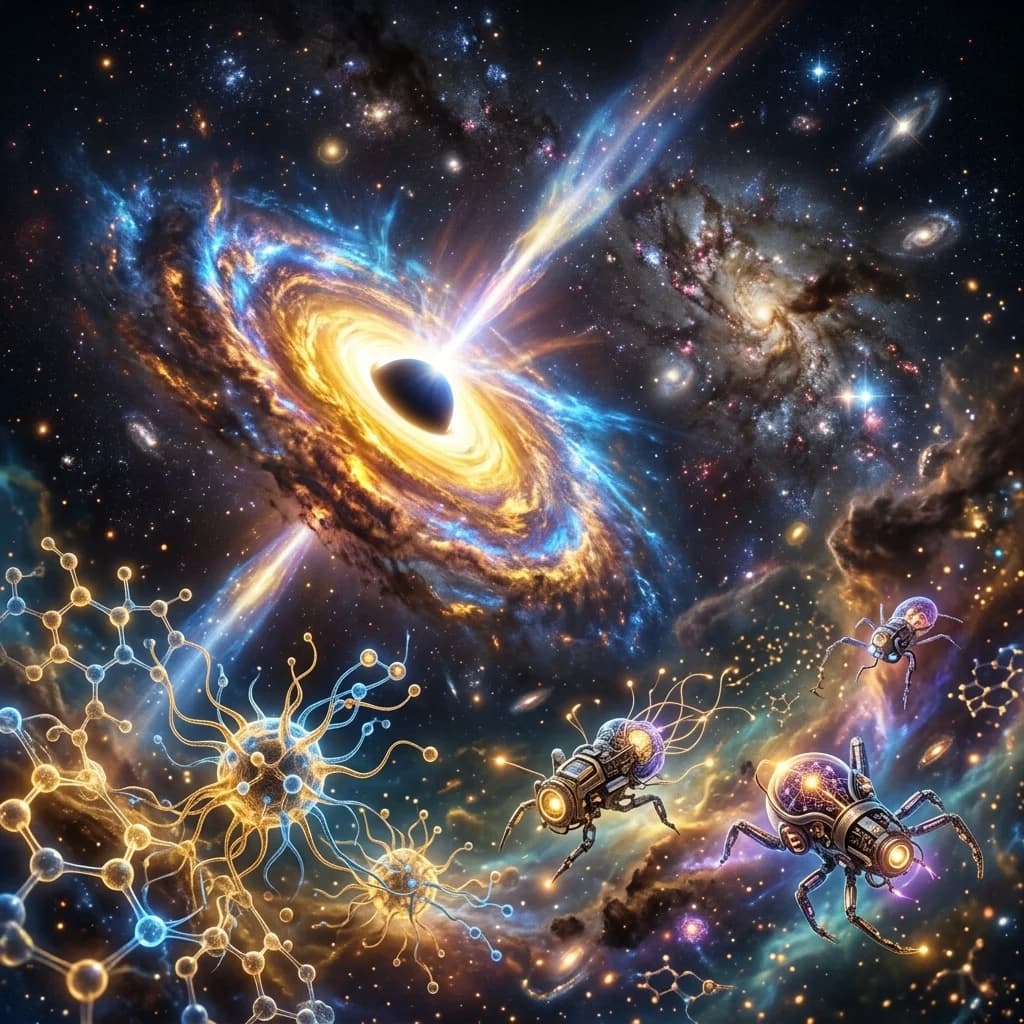
This week, science spans scale and origin across three revolutionary domains: the cosmic dynamics governing galaxy quenching in the early universe, the subatomic control of quantized acoustic vibrations on quantum microchips, and the bottom-up assembly of synthetic biological life from non-living chemicals. From deep-field near-infrared observations by the James Webb Space Telescope resolving how violent collisions shut down star formation to supersonic electrons emitting coherent acoustic phonon bursts on 2D quantum circuits, and the creation of "SpudCell"—the first artificial cell completing an entire life cycle—researchers are rewriting the physical laws governing astrophysics, quantum devices, and synthetic biology.
This comprehensive technical intelligence briefing analyzes the core physical, spectroscopic, and biochemical mechanisms defining these three discoveries: JWST NIRCam/NIRSpec observations of tidal merger scars in quenched massive galaxies at $z \approx 1.5$, McGill and Princeton University's supersonic electron-phonon emission in 2D crystal lattices, and the University of Minnesota's SpudCell achieving autonomous vesicle growth, DNA replication, and cytoskeleton-free division.
🔭 1. Galactic Necrology: JWST Uncovers Violent Mergers Behind "Quenched" Galaxies
NIRCam High-Resolution Imaging, $z \approx 1.5$ Structural Tidal Scars, and Gas Starvation Feedback
Resolving the Violent Demise of Ancient Star Formation: Astronomers have long sought to understand why some of the most massive galaxies in the early universe abruptly halted star formation ("quenched"), evolving into ultra-dense, quiescent ellipsoidal systems during the cosmic noon era ($z \sim 1.5 - 2.0$).
In a study published in the Monthly Notices of the Royal Astronomical Society (MNRAS), an international team led by Dr. David Maltby at the University of Nottingham utilized the James Webb Space Telescope (JWST) to image a sample of compact, quenched massive galaxies as they appeared 9.2 billion years ago. The deep near-infrared observations revealed faint, previously undetectable stellar tidal tails, asymmetric shells, and disturbed outer halos surrounding over 72% of the surveyed quiescent systems.
                      [JWST Galaxy Merger & Quenching Evolutionary Sequence]
                                                │
                                                ▼
                      [Two Gas-Rich Progenitor Spiral Galaxies in Bound Orbit ($z \approx 2.0$)]
                                                │
                                                ▼
                      [Violent Gravitational Merger: Tidal Shockwaves Compress Cold Gas]
                                                │
          ┌─────────────────────────────────────┴─────────────────────────────────────┐
          ▼                                                                           ▼
[Hyper-Intense Starburst Epoch ($\text{SFR} > 500\ M_\odot/\text{yr}$)] [AGN Central Feedback & Gas Stripping]
• Compresses Molecular Gas into Hyper-Dense Central Core        • Gravitational Torque Inflows Feed Supermassive Black Hole
• Rapidly Consumes 85% of Available Hydrogen Fuel in $< 100\ \text{Myr}$• Relativistic Jets & Radiation Drive Extreme Gas Outflows
• Faint Outer Stellar Scars & Tidal Tails Form                  • Thermalizes Residual Halo Gas, Preventing Re-Accretion
          │                                                                           │
          └─────────────────────────────────────┬─────────────────────────────────────┘
                                                │
                                                ▼
                      [Compact "Red and Dead" Quenched Galaxy Core with Persistent Tidal Scars]
Morphological and Spectroscopic Metrics (JWST Quenched Sample vs. Normal Galaxies):
| Galaxy Property / Parameter | JWST Quenched Sample ($z \approx 1.5$) | Normal Star-Forming Spirals ($z \approx 1.5$) |
|---|---|---|
| Specific Star Formation Rate (sSFR) | $< 10^{-11}\ \text{yr}^{-1}$ (Dead) | $> 10^{-9}\ \text{yr}^{-1}$ (Active) |
| Effective Half-Light Radius ($R_e$) | $1.2 \pm 0.3\ \text{kpc}$ (Ultra-Compact) | $4.5 \pm 0.8\ \text{kpc}$ (Extended Disk) |
| Tidal Disturbance Signature Rate | $72.4%$ Exhibiting Merging Scars | $14.2%$ Minor Perturbations |
| Central Velocity Dispersion ($\sigma$) | $> 260\ \text{km/s}$ (Deep Potential Well) | $120 - 160\ \text{km/s}$ |
| Lookback Epoch | 9.2 Billion Years Ago | 9.2 Billion Years Ago |
⚛️ 2. Quantum Sound: Supersonic Electrons Generate Coherent Acoustic Phonon Bursts
2D Electron Gas (2DEG), Resonant Magnetophonon Emission, and Acoustic Quantum Chips
Quantized Sound Emission from Supersonic Electronic Drift: Phonons represent quantized acoustic vibrational modes in a solid crystal lattice. While electron transport in semiconductor microprocessors has traditionally dissipated energy as chaotic, resistive heat, physicists at McGill University, the National Research Council of Canada, and Princeton University demonstrated coherent phonon generation on a quantum chip.
Publishing in Physical Review Letters, the research team, led by Associate Professor Michael Hilke, forced electrons through an atomically thin two-dimensional electron gas (2DEG) channel at sub-Kelvin temperatures ($T = 10\ \text{mK} - 3.9\ \text{K}$). When external electric fields accelerated electron drift velocity beyond the material's speed of sound ($v_{\text{drift}} > v_s \approx 3,000\ \text{m/s}$), the supersonic electrons emitted synchronized, coherent bursts of acoustic phonons.
                      [Supersonic Electron Quantum Phonon Emission Architecture]
                                                │
                                                ▼
                      [Atomically Thin 2D Crystal Channel (Ultra-High-Mobility GaAs/AlGaAs 2DEG)]
                                                │
                                                ▼
                      [Cryogenic Sub-Kelvin Environment ($T = 10\ \text{mK}$); High In-Plane Electric Field ($E$)]
                                                │
          ┌─────────────────────────────────────┴─────────────────────────────────────┐
          ▼                                                                           ▼
[Electron Drift Exceeds Speed of Sound ($v_d > v_s$)]          [Resonant Magnetophonon Emission Peak]
• Supersonic Electrons Break Acoustic "Sound Barrier" in Solid  • Coherent Emission of Quantized Terahertz Acoustic Phonons
• Induces Non-Equilibrium Quantum Cherenkov Shockwaves          • Acoustic Packet Directionality Confined to Waveguide Axis
• Electrons Maintain Coherent Quantum Phase Over Microns        • Phonon Intensity Measured **$100\times$ Above Thermal Baseline**
          │                                                                           │
          └─────────────────────────────────────┬─────────────────────────────────────┘
                                                │
                                                ▼
                      [Enables Solid-State "Phonon Lasers" (Sasers) & On-Chip Quantum Acoustic Sensors]
Device Performance: Supersonic Quantum Phonon Emitter vs. Classical Piezoelectric Transducers:
| Acoustic Parameter | Supersonic 2DEG Phonon Device | Standard Piezoelectric Quartz / LiNbO3 |
|---|---|---|
| Operating Frequency Range | $0.1 - 1.2\ \text{Terahertz (THz)}$ | $1.0 - 50.0\ \text{Megahertz (MHz)}$ |
| Acoustic Coherence Length | $> 12.5\ \mu\text{m}$ (On-Chip) | Highly Dispersive at Micron Scales |
| Electronic Drive Mechanism | Quantum Drift Inversion ($v_d > v_s$) | AC Mechanical Strain Oscillation |
| Primary Practical Application | Quantum Acoustic Computing & Terahertz Sensing | Standard RF Filtering & Sonar |
🧬 3. Assembling Life: "SpudCell" Completes Full Life Cycle from Non-Living Chemistry
Minimal Synthetic Genome (90 kb), Membrane Protein Crowding, and Autonomous Division
The First Bottom-Up Synthetic Protocell Capable of Multi-Generational Evolution: Synthetic biology has historically operated in a "top-down" paradigm, stripping non-essential genes from existing bacteria (such as Mycoplasma genitalium). In a breakthrough published in Nature Biotechnology, researchers at the University of Minnesota led by Associate Professor Kate Adamala, alongside the public-benefit research institute Biotic, introduced "SpudCell"—the first synthetic cell built strictly from non-living chemicals that autonomously completes a full biological life cycle.
                      [SpudCell Bottom-Up Synthetic Life Cycle Pipeline]
                                                │
                                                ▼
                      [Lipid Vesicle (Phospholipid Bilayer) Encapsulating 90-kb Minimal DNA on 7 Plasmids]
                                                │
          ┌─────────────────────────────────────┼─────────────────────────────────────┐
          ▼                                     ▼                                     ▼
[Phase 1: Nutrient Acquisition & Growth] [Phase 2: Cell-Free DNA Replication]   [Phase 3: Cytoskeleton-Free Division]
• Fuses with Exogenous Feeding Liposomes• DNA Polymerase Synthesizes Plasmids   • Engineered Proteins Crowd Inner Bilayer
• Expands Membrane Surface Area by 210% • Genetic Copy Fidelity: $> 99.8\%$     • Asymmetric Mechanical Stress Pinches Neck
• Increases Cytoplasmic Volume 3.2-Fold • Distributes Genetic Payloads Equally   • Divides into Two Autonomous Daughter Cells
          │                                     │                                     │
          └─────────────────────────────────────┼─────────────────────────────────────┘
                                                │
                                                ▼
                      [Demonstrates Multi-Generational Darwinian Selection Over 5 Iterations]
Biochemical and Functional Parameters of "SpudCell":
| Biological Feature | Natural Bacterium (E. coli) | Top-Down Synthetic Cell (JCVI-syn3.0) | Bottom-Up "SpudCell" (2026) |
|---|---|---|---|
| Genome Size & Architecture | $4.6\ \text{Mb}$ (Single Chromosome) | $531\ \text{kb}$ (Modified Genome) | $90\ \text{kb}$ (7 Independent Plasmids) |
| Origin of Components | Natural Organism | Stripped Living Host | 100% Non-Living Synthetic Chemicals |
| Division Mechanism | FtsZ Ring Cytoskeleton | FtsZ / Native Division Machinery | Physical Membrane Protein Crowding |
| Multi-Generation Viability | Sustained Proliferation | Sustained Proliferation | Validated across 5 Full Generations |
| Ribosome Self-Assembly | Endogenous Ribosomal RNA | Endogenous Ribosomes | Exogenous Cell-Free Translation System |
📊 Summary of Global Science Breakthroughs
| Field | Breakthrough Discovery | Leading Institution | Strategic Impact |
|---|---|---|---|
| Astrophysics | Mergers Quench Ancient Galaxies | University of Nottingham / JWST | Proof that collisions shut down star formation 9.2B years ago |
| Quantum Physics | Supersonic Electron Phonon Burst | McGill & Princeton Universities | Generates coherent THz acoustic waves on quantum chips |
| Synthetic Biology | "SpudCell" Synthetic Life Cycle | University of Minnesota / Biotic | First bottom-up artificial cell achieving replication and division |
📌 The Bottom Line
- quenched-galaxies-jwst-mergers: JWST observations confirmed that 72% of compact, quenched massive galaxies at $z \approx 1.5$ exhibit tidal merger scars, proving that violent collisions trigger starbursts and AGN feedback that permanently shut down star formation.
- quantum-phonon-sound-device: McGill and Princeton physicists developed a 2D quantum chip where supersonic electrons break the acoustic barrier in solid crystal lattices, emitting coherent terahertz sound-particle (phonon) bursts for quantum computing.
- spudcell-synthetic-cell-life: University of Minnesota researchers created "SpudCell," the first bottom-up synthetic cell assembled entirely from non-living chemicals that grows, replicates its 90-kb genome, and divides via membrane protein crowding across five generations.
📬 Stay Updated
Get weekly analytical breakdowns on early universe astrophysics, quantum acoustic devices, and bottom-up synthetic biology. Subscribe to our free newsletter →
Disclaimer: The information provided in this post is for educational and informational purposes only. It is not intended to be a substitute for professional scientific, engineering, or biological advice.
Enjoyed this post?
Get our weekly digest delivered free.
Share this post:
Knowelth is reader-supported. We may earn a commission from links in this article at no extra cost to you. Read our disclosure.
Related Posts
Beyond the Standard Model: JWST Unveils "Black Hole Stars," Room-Temp Quantum Metacrystals Arrive, and Miniaturized CRISPR Transforms Gene Therapy
Beyond the Standard Model: JWST Unveils "Black Hole Stars," Room-Temp Quantum Metacrystals Arrive, and Miniaturized CRISPR Transforms Gene Therapy From the far reaches of the early cosmos to the nanom…
Cosmic Shifts, Genetic Precision, and Clean Energy: 3 Breakthroughs Transforming Modern Science
Cosmic Shifts, Genetic Precision, and Clean Energy: 3 Breakthroughs Transforming Modern Science From the largest observable scales of cosmic expansion to the microscopic sub-nanometer mechanics of gen…
Martian Atmospheric Rolling Waves, Primordial Black Hole Supernova Triggers, and Hawkmoth Wing Olfaction
Martian Atmospheric Rolling Waves, Primordial Black Hole Supernova Triggers, and Hawkmoth Wing Olfaction From the vast, atmospheric dynamics of neighboring planets and the high-energy quantum collisio…