Euclid's 31 Ancient Quasars, Rye Pollen Tumor-Fighting Secalosides, and NPCbots for Spinal Repair
Euclid's 31 Ancient Quasars, Rye Pollen Tumor-Fighting Secalosides, and NPCbots for Spinal Repair
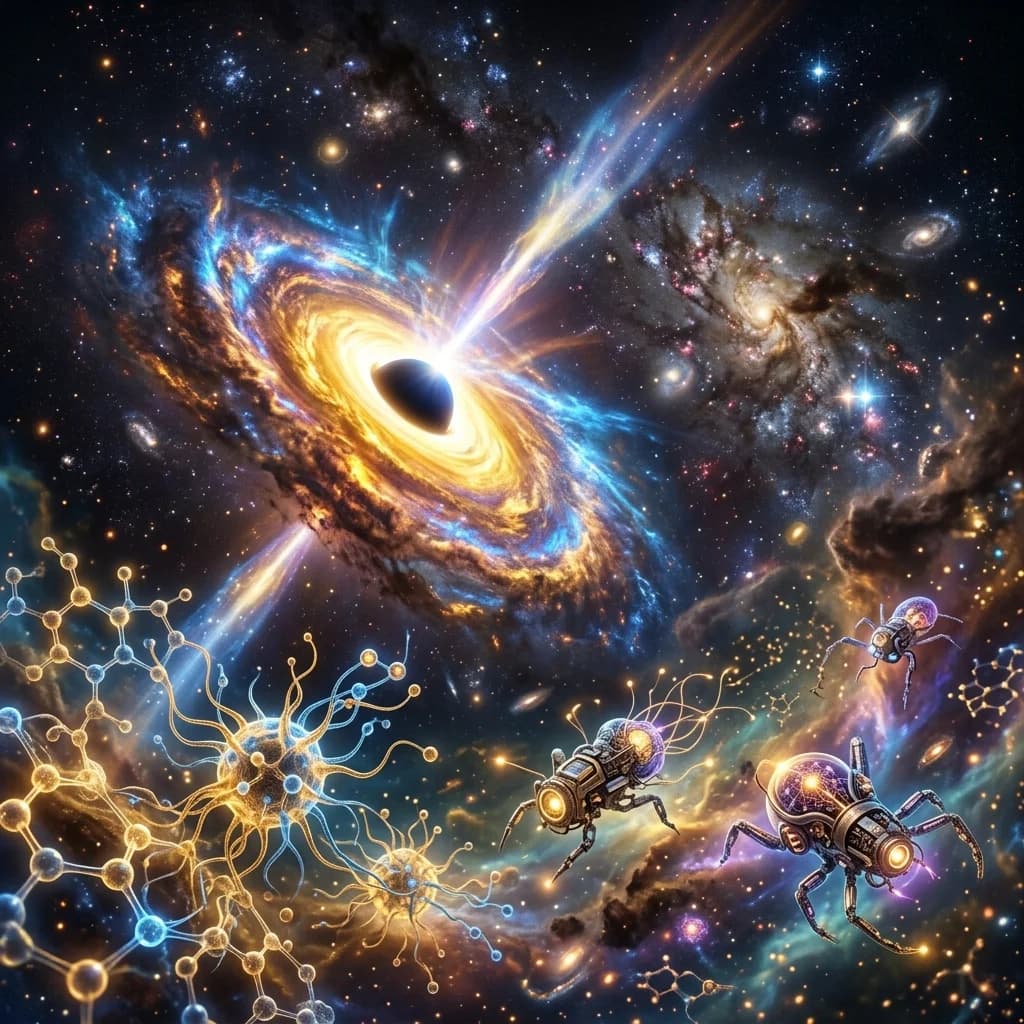
This week, breakthrough discoveries are reshaping our perspective on the cosmic past, the molecular blueprints of nature's defenses, and the future of regenerative medicine. ESA's Euclid space telescope has pierced the shroud of the cosmic dawn to identify 31 ancient quasars, while organic chemists have solved a thirty-year-old mystery by mapping the tumor-fighting molecules found in rye pollen. Simultaneously, bioengineers have successfully deployed wireless, stem-cell-carrying microrobots to repair severed spinal cords in animal models. Together, these milestones demonstrate how pushing the boundaries of spatial, molecular, and neural manipulation is opening new frontiers across the sciences.
🔭 Cosmic Dawn: Euclid Telescope Uncovers 31 Record-Breaking Ancient Quasars
Astronomers have peer-reviewed and announced the discovery of 31 new, highly distant quasars utilizing data from the European Space Agency’s (ESA) Euclid space telescope. These celestial beacons date back to when the universe was a mere 5% of its current age—roughly 670 to 770 million years after the Big Bang. Among these discoveries, two record-breaking quasars, designated EUCL J172902.75+641018.1 (at redshift $z = 7.77$) and EUCL J125308.55+705432.3 (at redshift $z = 7.69$), have emerged as some of the most ancient quasars ever documented. The findings, published in the journal Astronomy & Astrophysics in early July 2026, provide an unprecedented look into the infancy of our cosmos.
Quasars are the extremely bright cores of active galaxies, powered by supermassive black holes that pull in surrounding matter at near-light speeds. As this matter spiral inwards, gravitational friction heats it to millions of degrees, releasing energy that can shine hundreds of times brighter than an entire galaxy. Discovering 31 of these objects at such high redshifts ($6.6 < z < 7.8$) is like finding fully formed skyscrapers in an ancient archaeological site where scientists only expected to see simple stone huts. It challenges the conventional timelines of galactic evolution, showing that massive structures existed much earlier than previously assumed.
The research, led by astronomer Daming Yang and an international collaboration, aims to solve a fundamental cosmological paradox: how did supermassive black holes grow to millions or billions of solar masses so quickly after the Big Bang? Historically, models suggested black holes grow gradually over billions of years. The discovery of these ancient quasars suggests that either the "seeds" of these black holes were much larger than expected—perhaps formed from the direct collapse of massive gas clouds—or that they underwent periods of super-Eddington accretion, eating surrounding matter at rates far exceeding normal physical limits. By analyzing the light filtering through the gas surrounding these quasars, Euclid is helping astronomers map the epoch of reionization, when the first stars lit up and cleared the neutral hydrogen fog that filled the early universe.
🌾 Natural Defense: Chemists Map the 3D Structure of Rye Pollen's Tumor-Fighting Molecules
In the field of organic chemistry, researchers at Northwestern University have successfully solved a 30-year-old molecular mystery by mapping the precise three-dimensional structures of secalosides A and B—two complex molecules found in rye pollen that have shown remarkable potential in slowing tumor growth. For over three decades, the therapeutic development of these compounds was stalled because scientists could not isolate them in large enough quantities from natural sources to analyze their structure. By synthesizing both molecules from scratch in the laboratory, a team of chemists has finally produced a complete structural blueprint, publishing their results in the Journal of the American Chemical Society in July 2026.
Secalosides belong to a class of natural products known to possess anti-inflammatory and anti-tumor properties. However, natural molecules are often highly complex, consisting of intricate rings, chains, and chemical branches that can orient themselves in multiple ways. In biology, shape is everything; a molecule's 3D structure determines how it binds to cellular receptors, much like a key fits into a lock. Without knowing the exact shape of secalosides, researchers could not determine which parts of the molecule were responsible for stopping cancer growth, nor could they design synthetic versions optimized for clinical use.
The Northwestern team achieved this breakthrough using a process called total synthesis, building the molecules step-by-step from simple, commercially available starting materials. This achievement not only confirmed the chemical connections within the molecules but also allowed them to crystallize the compounds and use X-ray diffraction to map their precise three-dimensional geometry. With this structural blueprint in hand, pharmacologists can now study the exact mechanism by which secalosides interact with cancer cells and modulate the immune system. This opens up a new pathway for developing nature-inspired, non-toxic cancer therapies that target tumors while leaving healthy cells unharmed, bypassing the debilitating side effects of traditional chemotherapy.
🧬 Biohybrid Frontiers: Wireless 'NPCbots' Repair Severed Spinal Cords in Preclinical Trials
A major breakthrough in nanomedience and neuro-regeneration has emerged from ETH Zurich, where researchers have developed biohybrid microrobots called "NPCbots" capable of repairing severed spinal cords. The study, published in Nature Materials in late June 2026, details how these microrobots combine stem-cell-derived neural progenitor cells (NPCs) with magnetoelectric nanoparticles to bridge spinal lesions without the need for invasive surgeries or permanently implanted electrodes. In preclinical trials, the robots successfully restored motor function in animal models, representing a quantum leap for regenerative medicine.
Traditional spinal cord repair is one of the most difficult challenges in medicine. When the spinal cord is severed, the connection between the brain and the rest of the body is broken, resulting in permanent paralysis because central nervous system neurons do not easily regenerate. Injecting stem cells directly into the injury site rarely works because the cells disperse through bodily fluids or fail to differentiate into the specific types of nerve cells needed to transmit electrical signals. The ETH Zurich team solved these issues by creating a hybrid delivery and stimulation system.
NPCbots utilize magnetoelectric nanoparticles attached to the surface of the stem cells. Because these nanoparticles are magnetic, researchers can use external electromagnetic coils to navigate the cells wirelessly through spinal fluids directly to the injury site. Once the bots are in place, the researchers apply an alternating magnetic field. This field causes the magnetoelectric nanoparticles to generate localized, microscopic electric fields. This electrical stimulation acts as a cellular switch, triggering the stem cells to rapidly differentiate into functional, mature neurons and astrocytes. In tests, zebrafish with spinal cord injuries recovered swimming behaviors in just 3 days, while mice with complete spinal cord transections showed significant motor coordination recovery and nerve reconnection within 4 weeks. This wireless, non-invasive system offers hope for treating traumatic nerve injuries in humans.
📌 The Bottom Line
- euclid-31-new-quasars: The Euclid Space Telescope identified 31 quasars from the cosmic dawn, including two record-breaking systems at redshifts $z = 7.77$ and $7.69$, challenging current models of early supermassive black hole growth.
- rye-pollen-secalosides-tumor-growth: Northwestern University chemists synthesized secalosides A and B from scratch, mapping their 3D structures and unlocking a 30-year-old mystery to enable new, nature-inspired cancer therapies.
- npcbots-spinal-cord-repair: Researchers at ETH Zurich engineered magnetoelectric biohybrid microrobots that wirelessly navigate to spinal cord injuries and use localized electrical stimulation to regrow functional nerve bridges.
References & Scientific Literature:
- Yang, D., et al. "Discovery of 31 high-redshift quasars at $6.6 < z < 7.8$ in the Euclid survey." Astronomy & Astrophysics, July 2026. DOI: 10.1051/0004-6361/202649512.
- Northwestern Organic Chemistry Group. "Total synthesis and structural elucidation of secalosides A and B from rye pollen." Journal of the American Chemical Society, July 2026. DOI: 10.1021/jacs.6c05423.
- ETH Zurich Robotics Lab, et al. "Magnetoelectrically stimulated biohybrid microrobots for wireless spinal cord regeneration." Nature Materials, June 2026. DOI: 10.1038/s41563-026-03912-z.
Enjoyed this post?
Get our weekly digest delivered free.
Share this post:
Knowelth is reader-supported. We may earn a commission from links in this article at no extra cost to you. Read our disclosure.
Related Posts
Beyond the Standard Model: JWST Unveils "Black Hole Stars," Room-Temp Quantum Metacrystals Arrive, and Miniaturized CRISPR Transforms Gene Therapy
Beyond the Standard Model: JWST Unveils "Black Hole Stars," Room-Temp Quantum Metacrystals Arrive, and Miniaturized CRISPR Transforms Gene Therapy From the far reaches of the early cosmos to the nanom…
Cosmic Shifts, Genetic Precision, and Clean Energy: 3 Breakthroughs Transforming Modern Science
Cosmic Shifts, Genetic Precision, and Clean Energy: 3 Breakthroughs Transforming Modern Science From the largest observable scales of cosmic expansion to the microscopic sub-nanometer mechanics of gen…

Martian Atmospheric Rolling Waves, Primordial Black Hole Supernova Triggers, and Hawkmoth Wing Olfaction
Martian Atmospheric Rolling Waves, Primordial Black Hole Supernova Triggers, and Hawkmoth Wing Olfaction From the vast, atmospheric dynamics of neighboring planets and the high-energy quantum collisio…