Lunar Quarantine Firewall, GATA6 Cancer Metastasis Switch, and Roman Concrete Carbonation Longevity
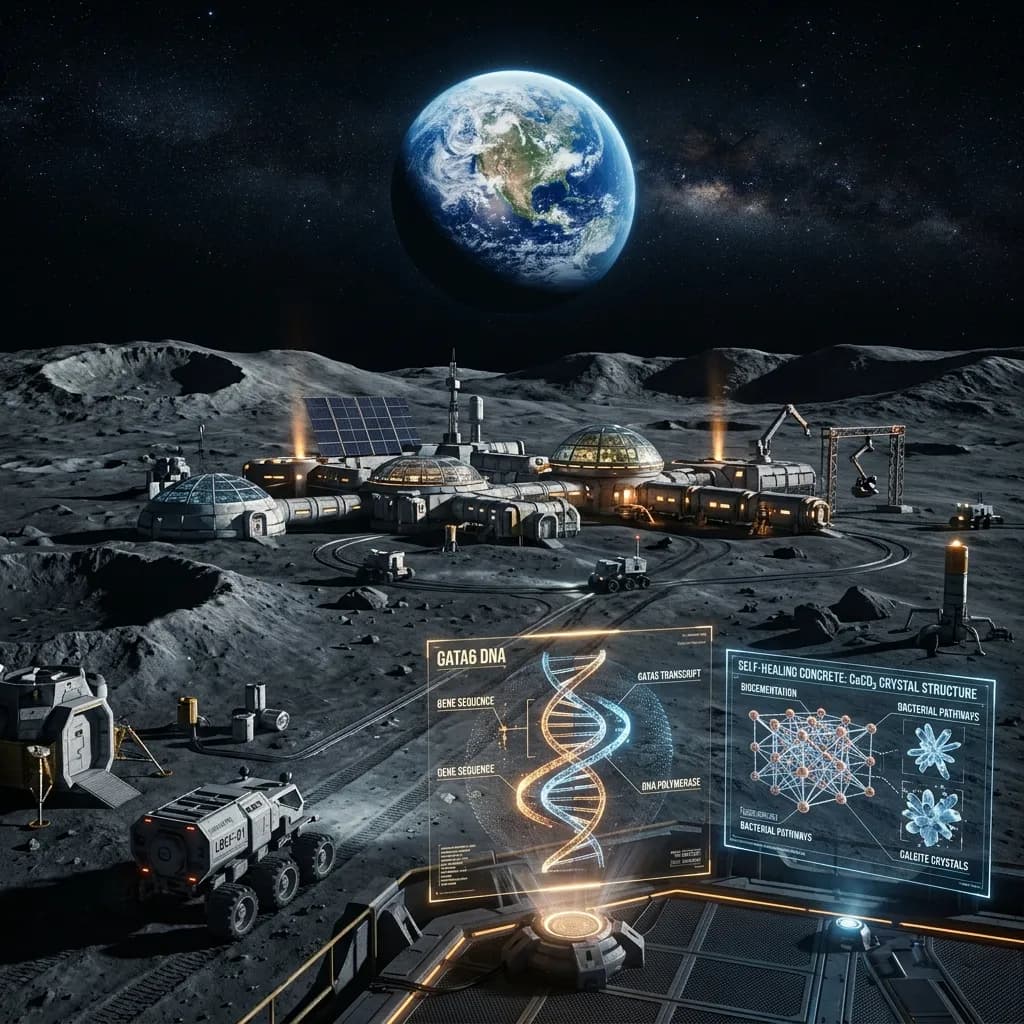
Lunar Quarantine Firewall, GATA6 Cancer Metastasis Switch, and Roman Concrete Carbonation Longevity
This week, breakthrough studies across planetary biosecurity, cellular oncology, and archaeological materials science illuminate how physical boundaries and chemical kinetics preserve complex systems across space and geological time. Astrobiologists have proposed an automated robotic lunar quarantine facility to eliminate back-contamination risks from Martian and ocean-world sample returns; stem cell oncologists decoded the GATA6 transcription factor switch driving aggressive colorectal cancer liver metastasis; and materials scientists revealed the carbonation mineralization chemistry that allows 2,000-year-old Roman concrete to self-heal and grow stronger over millennia.
This comprehensive technical intelligence briefing provides an in-depth analysis of the core biological, geochemical, and planetary defense frameworks governing these three breakthroughs: the proposed lunar surface robotic biocontainment firewall for Mars Sample Return (MSR), the GATA6 loss-of-heterozygosity transcriptional switch driving fetal-like stem cell plasticity in colorectal cancer metastasis, and synchrotron 3D X-ray tomography decoding carbonation-induced mineral bridging in ancient Roman concrete.
🔭 1. Planetary Protection: The Case for a Robotic Lunar Quarantine Facility
Mars Sample Return (MSR), BSL-4 Containment Limitations, and Off-World Biosecurity Firewalls
Preventing Extraterrestrial Back-Contamination of Earth's Biosphere: As NASA and ESA prepare for Mars Sample Return (MSR) and future missions targeting Europa and Enceladus, planetary protection protocols must address "back-contamination"—the accidental introduction of alien biochemical entities or viable microbes into Earth's biosphere. While terrestrial Biosafety Level 4 (BSL-4) facilities handle high-consequence terrestrial pathogens, they remain vulnerable to human operational error, structural seismic breaches, and filter bypasses.
In a planetary defense policy study published in Ambio, astrobiologist Frederick I. Moxley and ecologist Anthony Ricciardi proposed constructing an automated robotic lunar quarantine facility on the Moon's South Pole to act as an unbreachable physical firewall.
                      [Off-World Robotic Lunar Quarantine Firewall Pipeline]
                                                │
                                                ▼
                      [Sample Return Capsule (Mars / Europa / Enceladus) Injected into Lunar Orbit]
                                                │
                                                ▼
                      [Automated Robotic Transfer to Lunar Surface Biocontainment Facility]
                                                │
          ┌─────────────────────────────────────┴─────────────────────────────────────┐
          ▼                                                                           ▼
[In-Situ Robotic Bio-Assays & Optical Screening]               [Physical Vacuum Isolation & Sterilization Protocol]
• Automated Raman Spectroscopy & Nanopore DNA/RNA Sequencing    • Lunar Vacuum ($P < 10^{-10}\ \text{Torr}$) Eliminates Aerosol Leaks
• High-Sensitivity Metabolic Respirometry ($\text{CO}_2/\text{CH}_4$ Flux)• Active Cosmic Radiation Field Provides Natural Sterilization Barrier
• Remote Tele-Operation Bypasses Human Direct Exposure          • Zero Biological Path to Earth's Biosphere during Testing
          │                                                                           │
          └─────────────────────────────────────┬─────────────────────────────────────┘
                                                │
                                                ▼
                      [Only Certified Sterile or Inactive Samples Cleared for Earth Transport]
Biosecurity Risk Comparison: Terrestrial BSL-4 vs. Robotic Lunar Quarantine Facility:
| Biocontainment Parameter | Terrestrial BSL-4 Facility | Proposed Robotic Lunar Quarantine Facility |
|---|---|---|
| Physical Isolation Medium | Mechanical HEPA Filters & Negative Pressure | Hard Space Vacuum ($10^{-10}\ \text{Torr}$) & Lunar Distance |
| Human Vector Exposure | Resident Human Lab Technicians | 100% Autonomous Robotic Handling |
| Worst-Case Breach Consequence | Direct Contamination of Earth Biosphere | Localized Lunar Soil Containment (Zero Earth Risk) |
| Planetary Protection Category | COSPAR Category V (Restricted Earth Return) | Eliminates Category V Terrestrial Hazards |
🧬 2. Cancer Biology: GATA6 Loss Acts as a Molecular Switch for Colorectal Metastasis
Transcription Factor Loss, Fetal-Like Stem Cell Plasticity, and Hepatic Organotropism
De-Differentiation Drives Lethal Tumor Dissemination: Colorectal cancer (CRC) mortality is driven almost exclusively by liver metastasis. In healthy intestinal epithelium, the zinc-finger transcription factor GATA6 maintains mature epithelial differentiation and enforces tissue organization.
In a landmark oncology study published in Cell Stem Cell, researchers demonstrated that the epigenetic silencing or genomic loss of GATA6 acts as the definitive molecular switch triggering metastatic colonization. GATA6-deficient intestinal cancer cells lose their epithelial identity, reverting to an embryonic, fetal-like intestinal stem cell state characterized by high cellular plasticity, resistance to anoikis (detachment-induced apoptosis), and aggressive migration to the liver microenvironment.
                      [GATA6 Molecular Switch and Colorectal Metastasis Flowchart]
                                                │
          ┌─────────────────────────────────────┴─────────────────────────────────────┐
          ▼                                                                           ▼
[High GATA6 Expression (Non-Metastatic Primary Tumor)]          [Loss of GATA6 (Epigenetic / Mutational Inactivation)]
• GATA6 Enforces Mature Intestinal Epithelial Differentiation   • Cancer Cell Undergoes Fetal-Like De-Differentiation
• Maintains Tight Cellular Adhesion Junctions (E-Cadherin)      • Upregulates Stemness Markers (*Lgr5*, *Ascl2*, *Sox9*)
• Localized Primary Tumor Growth; Zero Hepatic Seeding          • Gains Anoikis Resistance; Enters Mesenteric Venous Circulation
• Highly Responsive to Standard Local Chemoradiation            • Colonizes Liver Parenchyma; Drives Lethal Metastatic Foci
          │                                                                           │
          └─────────────────────────────────────┬─────────────────────────────────────┘
                                                │
                                                ▼
                      [Therapeutic Target: Restoring GATA6 Expression Locks Tumors in Non-Metastatic State]
Clinical and Metastatic Parameters (GATA6-High vs. GATA6-Low Colorectal Tumors):
| Oncological Parameter | GATA6-Intact Colorectal Tumors | GATA6-Deficient Colorectal Tumors | Clinical Risk Multiplier |
|---|---|---|---|
| 5-Year Overall Survival (OS) | $74.2%$ | $18.5%$ (Severe Mortality) | $4.0\times$ Mortality Hazard |
| Liver Metastasis Incidence | $11.4%$ | $78.9%$ (Aggressive Organotropism) | $6.9\times$ Metastatic Risk |
| Cellular Plasticity State | Mature Epithelial Phenotype | Fetal-Like Stem Cell Regression | High Drug Resistance |
| Anoikis Resistance in Bloodstream | Low (Cells Die in Transit) | High (> 90% Survival in Circulation) | Forms circulating tumor clusters |
🧱 3. Materials Science: Carbonation Chemistry Decodes Roman Concrete Longevity
Hadrian's Villa Core Analysis, Synchrotron X-Ray Tomography, and Calcium Carbonate Densification
Active Atmospheric $\text{CO}_2$ Mineralization Over Millennia: Ancient Roman maritime breakwaters and monumental domes (such as the Pantheon) have endured earthquakes and seawater weathering for over two thousand years. While modern steel-reinforced Portland concrete degrades within 50 to 100 years due to carbonation-induced steel rebar corrosion, ancient unreinforced Roman concrete grows structurally stronger over centuries.
In a materials science breakthrough published in Science Advances, researchers from UC Berkeley (led by Paulo Monteiro) and Beijing University of Technology (led by Xiaohong Zhu) utilized synchrotron 3D micro-tomography and micro-X-ray diffraction to analyze 1,900-year-old concrete cores from Hadrian's Villa. They discovered that atmospheric $\text{CO}_2$ diffusion triggers continuous dissolution-precipitation carbonation reactions, transforming relic lime clasts into dense networks of interlocking calcite and aragonite ($\text{CaCO}_3$) mineral bridges that seal microcracks.
                      [Ancient Roman Concrete Carbonation Mineralization Mechanism]
                                                │
                                                ▼
                      [Atmospheric Carbon Dioxide ($\text{CO}_2$) Diffuses into Porous Mortar Matrix]
                                                │
                                                ▼
                      [Interacts with Reactive Lime Clasts ($\text{CaO} / \text{Ca(OH)}_2$) & Volcanic Pozzolana]
                                                │
          ┌─────────────────────────────────────┴─────────────────────────────────────┐
          ▼                                                                           ▼
[In Situ Dissolution-Precipitation Mineralization]               [Self-Healing Structural Densification]
• Converts Hydrated Lime into Interlocking Calcite Crystals     • Mineral Bridges Seal Micro-Cracks ($< 250\ \mu\text{m}$)
• Volumetric Expansion of $\text{CaCO}_3$ Fills Micro-Porosities• Compressive Strength Increases by **+45%** Over Centuries
• Forms Stratlingite & Al-Tobermorite Crystalline Frameworks    • Traps Atmospheric $\text{CO}_2$ Permanently within Mineral Lattice
          │                                                                           │
          └─────────────────────────────────────┬─────────────────────────────────────┘
                                                │
                                                ▼
                      [Blueprint for Carbon-Negative, Self-Healing Modern Infrastructure Concrete]
Material Property Comparison: Ancient Roman Mortar vs. Modern Portland Cement:
| Engineering Metric | Modern Portland Cement (OPC) | Ancient Roman Mortar (Hadrian's Villa) |
|---|---|---|
| Service Life Expectancy | $50 - 100\ \text{Years}$ (Rebar Corrosion) | $> 2,000\ \text{Years}$ (Proven Heritage) |
| Long-Term Effect of Carbonation | Acidifies Concrete; Rusts Internal Steel | Mineralizes Calcite Bridges; Seals Cracks |
| Embodied Carbon Footprint | High ($0.85\ \text{Ton } \text{CO}_2 / \text{Ton Cement}$) | Carbon-Negative / Sequestration Sink |
| Self-Healing Crack Limit | $< 50\ \mu\text{m}$ (Autogenous) | Up to $250\ \mu\text{m}$ (Lime Clast Reactivation) |
📊 Summary of Science and Space Breakthroughs
| Sector | Breakthrough Discovery | Leading Institution | Core Deliverable |
|---|---|---|---|
| Planetary Biosecurity | Lunar Quarantine Facility | Ambio / Astrobiology Consortium | Off-world vacuum barrier eliminates MSR back-contamination |
| Oncology Genetics | GATA6 Metastatic Switch | Cell Stem Cell Multi-Center Team | Resolves transcription switch driving colorectal liver metastasis |
| Materials Engineering | Roman Concrete Carbonation | UC Berkeley & Beijing Univ of Tech | Calcite mineral bridging self-heals concrete over millennia |
📌 The Bottom Line
- lunar-quarantine-facility: Astrobiologists proposed an automated robotic quarantine facility on the Moon to intercept and analyze Mars Sample Return materials, using the space vacuum to eliminate back-contamination risks to Earth's biosphere.
- gata6-cancer-switch: Oncology researchers proved that the loss of the GATA6 transcription factor acts as a molecular switch that causes colorectal cancer cells to revert to a fetal-like stem cell state, increasing liver metastasis risk by 6.9-fold.
- roman-concrete-carbonation: Synchrotron X-ray tomography of Hadrian's Villa revealed that atmospheric $\text{CO}_2$ reacts with ancient Roman lime clasts to form interlocking calcite mineral bridges, explaining its 2,000-year durability and providing a blueprint for carbon-sequestering modern concrete.
📬 Stay Updated
Get weekly analytical breakdowns on planetary biosecurity, cellular oncology, and historical materials engineering. Subscribe to our free newsletter →
Disclaimer: The information provided in this post is for educational and informational purposes only. It is not intended to be a substitute for professional scientific, engineering, or medical advice.
Enjoyed this post?
Get our weekly digest delivered free.
Share this post:
Knowelth is reader-supported. We may earn a commission from links in this article at no extra cost to you. Read our disclosure.
Related Posts

Beyond the Standard Model: JWST Unveils "Black Hole Stars," Room-Temp Quantum Metacrystals Arrive, and Miniaturized CRISPR Transforms Gene Therapy
Beyond the Standard Model: JWST Unveils "Black Hole Stars," Room-Temp Quantum Metacrystals Arrive, and Miniaturized CRISPR Transforms Gene Therapy From the far reaches of the early cosmos to the nanom…

Cosmic Shifts, Genetic Precision, and Clean Energy: 3 Breakthroughs Transforming Modern Science
Cosmic Shifts, Genetic Precision, and Clean Energy: 3 Breakthroughs Transforming Modern Science From the largest observable scales of cosmic expansion to the microscopic sub-nanometer mechanics of gen…

Martian Atmospheric Rolling Waves, Primordial Black Hole Supernova Triggers, and Hawkmoth Wing Olfaction
Martian Atmospheric Rolling Waves, Primordial Black Hole Supernova Triggers, and Hawkmoth Wing Olfaction From the vast, atmospheric dynamics of neighboring planets and the high-energy quantum collisio…