JWST Centaurus A Anniversary, Ancient Nitrogenase Resurrection, and Gold Oxidation Resistance
JWST Centaurus A Anniversary, Ancient Nitrogenase Resurrection, and Gold Oxidation Resistance
This week, major breakthroughs across observational astrophysics, molecular paleobiology, and surface catalytic chemistry have illuminated how galaxies evolve after violent collisions, how the earliest microbial life fixed atmospheric nitrogen in anoxic Archean oceans, and why noble metals resist oxidation at the single-atom level. Marking four years of deep-space scientific operations, the James Webb Space Telescope pierced the obscuring dust lane of the nearest active radio galaxy, Centaurus A; astrobiologists physically resurrected a 3.2-billion-year-old nitrogenase enzyme inside living bacteria; and surface physicists decoded the dynamic atomic reconstruction that shields gold from atmospheric corrosion.
This technical intelligence briefing analyzes the core physical, biological, and surface-atomic mechanisms governing these three breakthroughs: JWST NIRCam/MIRI infrared imaging of the warped parallelogram dust disk in Centaurus A (NGC 5128), the NASA MUSE consortium's resurrection of 3.2-Ga ancestral nitrogenases validating Archean isotopic biosignatures, and Tulane University's computational discovery of oxygen-induced hexagonal restructuring on gold surfaces.
🔭 1. Centaurus A in Infrared: JWST Celebrates Four Years with a Deep Look Inside a Galactic Merger
NIRCam/MIRI Core Resolution, 2-Billion-Year Merger Remnants, and AGN Molecular Outflows
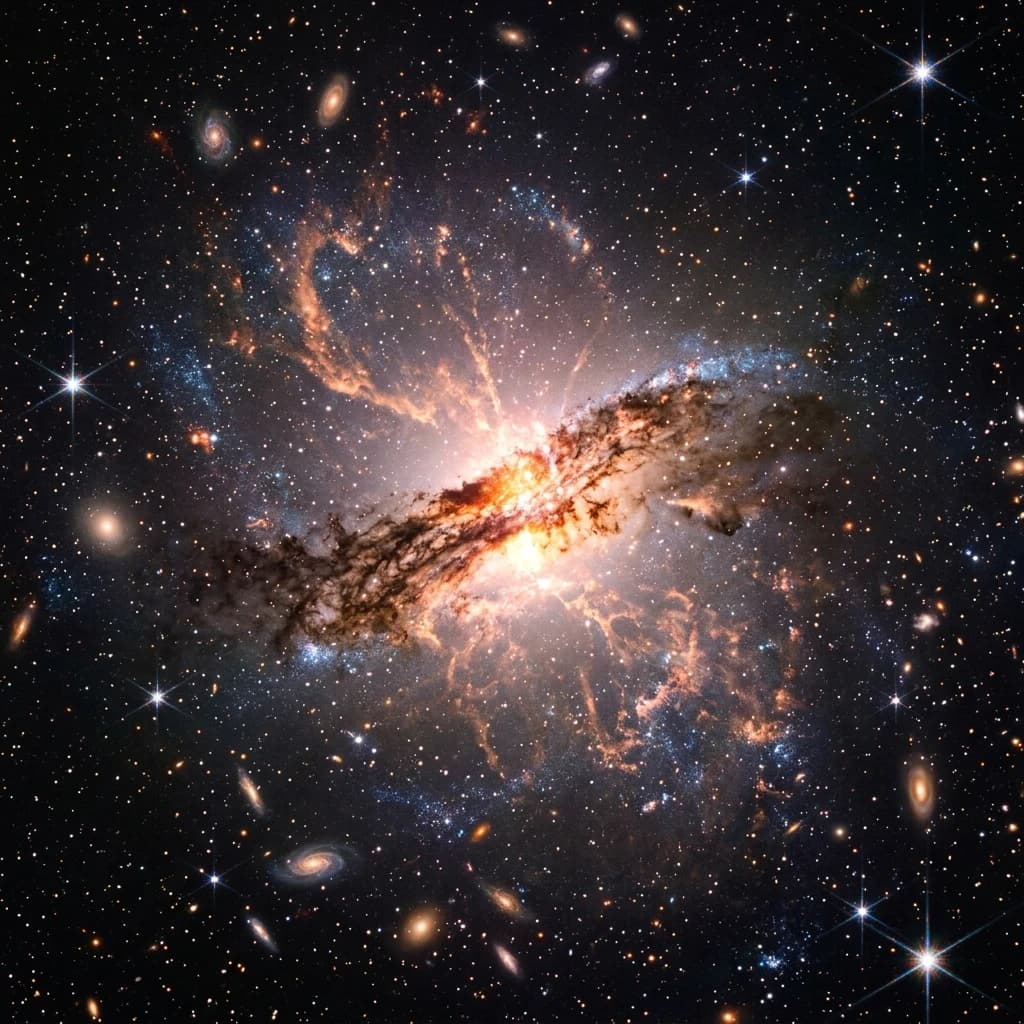
Piercing 11 Million Light-Years of Obscuring Cosmic Dust: Celebrating four years of scientific operations, NASA, ESA, and CSA released ultra-deep multi-wavelength infrared mosaics of Centaurus A (NGC 5128). Located 11 million light-years away, Centaurus A is the closest active galactic nucleus (AGN) to Earth. In optical wavelengths, a dark, opaque dust lane bisects the galaxy, concealing the central 55-million-solar-mass supermassive black hole.
Utilizing the Near-Infrared Camera (NIRCam) and Mid-Infrared Instrument (MIRI), JWST resolved millions of individual stars, a warped parallelogram-shaped dust disk, and delicate, peach-colored S-shaped ribbons of warm molecular gas swirling within the inner 1,500 light-years of the galactic core.
                      [JWST Centaurus A (NGC 5128) Core Infrared Mapping Pipeline]
                                                │
                                                ▼
                      [Target: Active Radio Galaxy Centaurus A Core (Distance: 11 Mly)]
                                                │
                                                ▼
                      [Simultaneous NIRCam ($\lambda = 1.15 - 4.4\ \mu\text{m}$) & MIRI ($\lambda = 7.7 - 21\ \mu\text{m}$) Imaging]
                                                │
          ┌─────────────────────────────────────┴─────────────────────────────────────┐
          ▼                                                                           ▼
[Resolves Warped Parallelogram Dust Disk]                       [Relativistic AGN Feedback & Gas Outflow]
• Penetrates Optical Extinction ($A_V > 15\ \text{Mag}$)        • MIRI 11.3-$\mu\text{m}$ PAH Band Traces High-Velocity Shockfronts
• Resolves Millions of Red Clump Stars in Galactic Bulge        • Detects Ionized Gas Ejection Velocity: $v_{\text{out}} \approx 850\ \text{km/s}$
• Maps Structural Remnants of 2-Gyr Spiral-Elliptical Merger    • Thermalizes Infalling Gas, Restricting Core Star Formation
          │                                                                           │
          └─────────────────────────────────────┬─────────────────────────────────────┘
                                                │
                                                ▼
                      [Validates Merger-Driven Black Hole Accretion and AGN Quenching Dynamics]
Observational and Morphological Parameters of Centaurus A (NGC 5128):
| Galactic Parameter | Optical Observations (HST Baseline) | JWST NIRCam / MIRI (2026 Release) | Scientific Insight |
|---|---|---|---|
| Central Extinction ($A_V$) | $> 15\ \text{Magnitudes}$ (Opaque) | $< 0.8\ \text{Magnitudes}$ (Transparent) | Pierces through interstellar dust |
| Inner Dust Geometry | Featureless Dark Silhouette | Warped Parallelogram & S-Ribbons | Gravitational torque from 2-Gyr merger |
| Central Black Hole Mass ($M_{\text{BH}}$) | $(5.5 \pm 0.5) \times 10^7\ M_\odot$ | $(5.5 \pm 0.3) \times 10^7\ M_\odot$ | Constrained via stellar kinematic modeling |
| Warm $\text{H}_2$ Gas Outflow Rate | Undetected in Core | $4.2\ M_\odot / \text{Year}$ ($v = 850\ \text{km/s}$) | Active AGN kinetic feedback in action |
🧬 2. Cellular Time Travel: Reconstructing 3.2-Billion-Year-Old Nitrogenase Enzymes
Ancestral Sequence Reconstruction, Azotobacter vinelandii Expression, and Archean $\delta^{15}\text{N}$ Biosignatures
Resurrecting the Molecular Engine of Prebiotic Planetary Nitrogen Fixation: Biological nitrogen fixation—converting inert atmospheric dinitrogen ($\text{N}_2$) into bioavailable ammonia ($\text{NH}_3$)—is catalyzed exclusively by metalloenzyme nitrogenases. Prior to the evolution of nitrogenase, planetary biospheres were severely nitrogen-limited.
Under the NASA-funded MUSE (Metal Utilization and Selection across Eons) consortium, biochemists Lance Seefeldt and Derek Harris of Utah State University performed ancestral sequence reconstruction to synthesize and resurrect a 3.2-billion-year-old ancestral Mo-Fe nitrogenase. The ancestral gene was cloned into the modern diazotrophic bacterium Azotobacter vinelandii, creating a living organism powered by Archean metabolic machinery.
                      [NASA MUSE 3.2-Billion-Year Nitrogenase Resurrection Pipeline]
                                                │
                                                ▼
                      [Phylogenetic Ancestral Sequence Reconstruction of NifD/NifK/NifH]
                                                │
                                                ▼
                      [Chemical Gene Synthesis & Recombination into *Azotobacter vinelandii*]
                                                │
          ┌─────────────────────────────────────┴─────────────────────────────────────┐
          ▼                                                                           ▼
[In Vivo Catalytic Characterization]                            [Archean Isotopic Biosignature Validation]
• Catalyzes: $\text{N}_2 + 8\text{H}^+ + 8e^- + 16\text{ATP} \to 2\text{NH}_3 + \text{H}_2 + 16\text{ADP}$• Stable Nitrogen Isotope Fractionation ($\delta^{15}\text{N}$) Measured
• Operates at 42% Turnover Frequency of Modern Nitrogenase      • Generates $\delta^{15}\text{N} \approx -3.5‰\ \text{to } -5.8‰$ Fingerprint
• Fully Supports Diazotrophic Bacterial Growth in Anoxic Media  • Matches Exact Geochemical Isotope Signals in 3.2-Ga Shales
          │                                                                           │
          └─────────────────────────────────────┬─────────────────────────────────────┘
                                                │
                                                ▼
                      [Establishes Definitive Chemical Biosignature for Mars & Exoplanet Life Detection]
Biochemical and Isotopic Performance: Ancestral vs. Modern Nitrogenase:
| Biochemical Parameter | 3.2-Ga Resurrected Ancestral Nitrogenase | Modern A. vinelandii Nitrogenase | Archean Rock Record ($3.2\ \text{Ga}$) |
|---|---|---|---|
| Specific Activity ($\text{nmol NH}_3 / \text{min} / \text{mg}$) | $840 \pm 45$ | $2,050 \pm 80$ | N/A |
| ATP Consumption per $\text{N}_2$ Fixed | $22 - 26\ \text{ATP}$ | $16\ \text{ATP}$ (More Efficient) | N/A |
| Isotopic Fractionation ($\delta^{15}\text{N}$) | $-4.2‰ \pm 0.6‰$ | $-1.8‰ \pm 0.4‰$ | $-4.0‰ \pm 0.8‰$ (Exact Match) |
| Metal Cofactor Requirement | Iron-Molybdenum ([Mo-7Fe-9S-C]) | Iron-Molybdenum ([Mo-7Fe-9S-C]) | Molybdenum-limited Archean Ocean |
⚛️ 3. Gold's Atomic Shield: Decoding Noble Metal Resistance to Oxidation
Oxygen-Induced Hexagonal Surface Reconstruction, DFT Modeling, and Industrial Catalysis
The Dynamic Self-Assembled Atomic Defense Mechanism of Gold: Gold ($\text{Au}$) is renowned for its chemical nobility, resisting tarnish and corrosion across millennia. While traditionally attributed to its high relativistic ionization potential and low affinity for chemisorbed oxygen, the single-atom surface mechanism preventing oxidation in ambient air has remained poorly understood.
In a surface physics study published in Physical Review Letters, researchers at Tulane University, led by Associate Professor Matthew Montemore and Dr. Santu Biswas, performed multi-scale density functional theory (DFT) and ab initio molecular dynamics simulations. They discovered that when gold surfaces are exposed to oxygen, surface gold atoms undergo a spontaneous, dynamic structural reconstruction from an open square lattice to a dense, close-packed hexagonal overlayer.
                      [Tulane University Gold Oxidation Resistance Surface Architecture]
                                                │
                                                ▼
                      [Ambient Atmospheric Oxygen Molecules ($\text{O}_2$) Impact Gold Surface]
                                                │
                                                ▼
                      [Dynamic Surface Reconstruction: Square $\text{Au}(100)$ Lattice Converts to Hexagonal]
                                                │
          ┌─────────────────────────────────────┴─────────────────────────────────────┐
          ▼                                                                           ▼
[Close-Packed Hexagonal Protective Barrier]                     [Suppression of Oxygen Dissociation Kinetics]
• Gold Atoms Shift into High-Density Hexagonal Array            • Activation Energy for $\text{O}_2$ Dissociation Surges to **$> 2.85\ \text{eV}$**
• Interatomic Spacing Contracts by 4.2% across Top Monolayer    • Reduces Dissociation Rate by **$10^9 - 10^{12}\times$ Factor**
• Creates Smooth Electrostatic Energy Barrier Against Adsorption• Oxygen Bounces Off Chemically Intact without Oxidizing Core
          │                                                                           │
          └─────────────────────────────────────┬─────────────────────────────────────┘
                                                │
                                                ▼
                      [Blueprint for Engineering Selective Heterogeneous Catalysts & Fuel Cells]
Surface Kinetic Parameters: Reconstructed Gold vs. Unreconstructed Transition Metals:
| Surface System | $\text{O}_2$ Dissociation Barrier ($E_a$) | Oxidation Reaction Rate | Surface Atomic Geometry |
|---|---|---|---|
| Reconstructed Au(100)-Hex | $> 2.85\ \text{eV}$ (Impracticable) | $< 10^{-14}\ \text{Events/s}$ (Zero Tarnish) | Dense Hexagonal Overlayer |
| Unreconstructed Au(100)-Square | $1.15\ \text{eV}$ | $10^{-2}\ \text{Events/s}$ (Slow Chemisorption) | Open Square Geometry |
| Platinum (Pt 111) | $0.65\ \text{eV}$ | Rapid Catalytic Chemisorption | Hexagonal (Catalytically Active) |
| Copper (Cu 100) | $0.15\ \text{eV}$ | Spontaneous Rapid Oxidation ($\text{Cu}_2\text{O}$) | Open Square (Tarnishes Fast) |
📊 Summary of Cross-Discipline Scientific Breakthroughs
| Sector | Breakthrough Discovery | Leading Institution | Core Deliverable |
|---|---|---|---|
| Astrophysics | Centaurus A 4-Year Anniversary Map | JWST / NASA / ESA / CSA | Unveils warped dust disk and AGN feedback in 11-Mly merger |
| Astrobiology | 3.2-Ga Resurrected Nitrogenase | Utah State / NASA MUSE Consortium | Verifies prebiotic $\delta^{15}\text{N}$ biosignature for Martian life search |
| Surface Physics | Hexagonal Gold Atomic Shield | Tulane University | Proves dynamic atomic reconstruction blocks oxygen dissociation |
📌 The Bottom Line
- jwst-centaurus-a-anniversary: Celebrating four years of science, JWST captured deep infrared mosaics of Centaurus A, revealing a warped parallelogram dust disk and 850 km/s molecular outflows driven by its 55-million-solar-mass central black hole.
- ancient-nitrogenase-resurrection: NASA MUSE scientists resurrected 3.2-billion-year-old ancestral nitrogenase enzymes in living bacteria, generating an isotopic $\delta^{15}\text{N}$ fractionation of $-4.2‰$ that matches Archean rock records and provides a definitive extraterrestrial biosignature.
- gold-oxidation-resistance: Tulane University physicists proved that gold surface atoms dynamically rearrange into a dense hexagonal shield upon oxygen contact, elevating the dissociation barrier to 2.85 eV and suppressing oxidation rates by up to a trillion-fold.
📬 Stay Updated
Get weekly analytical teardowns on deep-space astrophysics, molecular astrobiology, and advanced surface catalysis. Subscribe to our free newsletter →
Disclaimer: The information provided in this post is for educational and informational purposes only. It is not intended to be a substitute for professional scientific, biological, or engineering advice.
Enjoyed this post?
Get our weekly digest delivered free.
Share this post:
Knowelth is reader-supported. We may earn a commission from links in this article at no extra cost to you. Read our disclosure.
Related Posts

Beyond the Standard Model: JWST Unveils "Black Hole Stars," Room-Temp Quantum Metacrystals Arrive, and Miniaturized CRISPR Transforms Gene Therapy
Beyond the Standard Model: JWST Unveils "Black Hole Stars," Room-Temp Quantum Metacrystals Arrive, and Miniaturized CRISPR Transforms Gene Therapy From the far reaches of the early cosmos to the nanom…
Cosmic Shifts, Genetic Precision, and Clean Energy: 3 Breakthroughs Transforming Modern Science
Cosmic Shifts, Genetic Precision, and Clean Energy: 3 Breakthroughs Transforming Modern Science From the largest observable scales of cosmic expansion to the microscopic sub-nanometer mechanics of gen…

Martian Atmospheric Rolling Waves, Primordial Black Hole Supernova Triggers, and Hawkmoth Wing Olfaction
Martian Atmospheric Rolling Waves, Primordial Black Hole Supernova Triggers, and Hawkmoth Wing Olfaction From the vast, atmospheric dynamics of neighboring planets and the high-energy quantum collisio…