Cosmic Visitors, Precision Gene Assembly, and Supercharged Solar: 3 Breakthroughs Redefining Modern Science
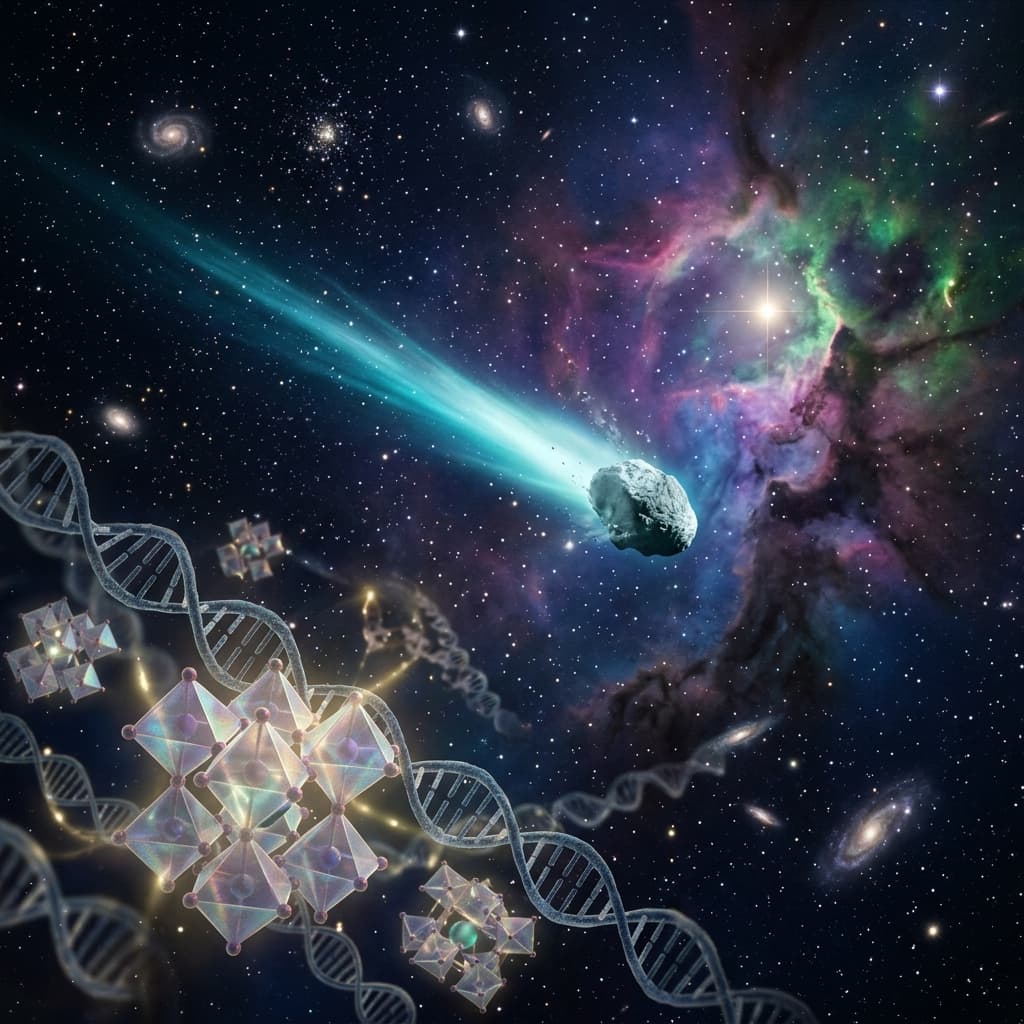
Cosmic Visitors, Precision Gene Assembly, and Supercharged Solar: 3 Breakthroughs Redefining Modern Science
From the farthest reaches of interstellar deep space to the sub-nanometer scale of living mammalian genomes and the quantum optical efficiency of photovoltaic semiconductors, humanity's capability to decode and manipulate physical reality is advancing at an unprecedented velocity. Today's scientific frontier is defined by multi-messenger space observatories capturing primordial messengers forged in ancient extrasolar nurseries, molecular surgery platforms writing continuous kilobase-length genetic cassettes without DNA double-strand breaks, and tandem crystalline architectures shattering the thermodynamic limits of solar energy conversion.
This comprehensive technical intelligence briefing provides an in-depth analysis of the core physical, biological, and materials engineering frameworks defining these three breakthroughs: the 11-billion-year-old hyperbolic trajectory and deuterium-enriched volatile chemistry of interstellar comet 3I/ATLAS (C/2025 N1), the Broad Institute's Prime Assembly architecture writing up to 11,000 base pairs of continuous DNA in vivo without double-strand breaks, and the certified 35.5% power conversion efficiency milestone in tandem perovskite-silicon photovoltaics.
🔭 1. Messenger from the Cosmic Dawn: Interstellar Comet 3I/ATLAS Reveals Primordial Volatiles
Hyperbolic Eccentricity ($e = 3.14$), JWST NIRSpec Carbon/Deuterium Chemistry, and Interplanetary Fleet Tracking
Decoding an 11-Billion-Year-Old Extrasolar Protoplanetary Disk: In July 2025, wide-field astrometric surveys identified Comet 3I/ATLAS (C/2025 N1) traversing the outer solar system on an unbound hyperbolic orbital trajectory with an eccentricity $e = 3.14 \pm 0.01$ and an asymptotic excess velocity $v_\infty = 34.2\ \text{km/s}$. Following 1I/ʻOumuamua and 2I/Borisov, 3I/ATLAS represents only the third confirmed macroscopic interstellar interloper ever observed.
Unlike previous brief encounters, 3I/ATLAS was detected over 14 months prior to perihelion ($q = 1.38\ \text{AU}$), enabling an international coordinated tracking campaign leveraging the James Webb Space Telescope (JWST), the Hubble Space Telescope, the ALMA array, and deep-space planetary probes including ESA's Juice and China's Tianwen-1.
                      [Interstellar Comet 3I/ATLAS Coordinated Observation Matrix]
                                                │
                                                ▼
                      [Hyperbolic Trajectory Detection ($e = 3.14, v_\infty = 34.2\ \text{km/s}$)]
                                                │
                                                ▼
                      [JWST NIRSpec & ALMA Millimeter Continuum Transit Spectroscopy]
                                                │
          ┌─────────────────────────────────────┴─────────────────────────────────────┐
          ▼                                                                           ▼
[Spectroscopic Volatile Profiling ($\lambda = 1.0 - 5.0\ \mu\text{m}$)] [Primordial Galactic Dawn Origin Reconstruction]
• Enriched Deuterium-to-Hydrogen Ratio: $\text{D/H} = (4.8 \pm 0.4) \times 10^{-4}$• Formed in Ancient Low-Metallicity Protoplanetary Nebula
• High Methane ($\text{CH}_4$) & Carbon Monoxide ($\text{CO}$) Sublimation Rates • Reconstructed Age: **$10.5 - 11.8\ \text{Billion Years}$**
• Carbon-to-Oxygen Ratio: $\text{C/O} = 0.78$ (vs. 0.25 Solar System)• Ejected into Interstellar Drift during Galactic Youth
          │                                                                           │
          └─────────────────────────────────────┬─────────────────────────────────────┘
                                                │
                                                ▼
                      [First Direct Chemical Benchmark of Pre-Solar Extrasolar Planetary Accretion]
Comparative Volatile Abundance: Interstellar Comets vs. Solar System Primordial Baselines:
| Chemical Species / Metric | 3I/ATLAS (Interstellar) | 2I/Borisov (Interstellar) | Comet 67P/C-G (Kuiper Belt) | Astrochemistry Significance |
|---|---|---|---|---|
| $\text{D/H}$ Isotopic Ratio | $(4.8 \pm 0.4) \times 10^{-4}$ | $(2.1 \pm 0.5) \times 10^{-4}$ | $(5.3 \pm 0.7) \times 10^{-4}$ | Super-cold ion-molecule fractionation ($T < 20\ \text{K}$) |
| $\text{CH}_4 / \text{H}_2\text{O}$ Volatile Ratio | $4.20 \pm 0.30%$ | $0.15 \pm 0.05%$ | $0.50 \pm 0.10%$ | Enriched carbon retention in parent disk |
| $\text{CO}_2 / \text{H}_2\text{O}$ Volatile Ratio | $24.5 \pm 1.8%$ | $18.2 \pm 1.4%$ | $4.2 \pm 0.6%$ | High ambient UV photolysis environment |
| Parent Star Formation Age | $10.5 - 11.8\ \text{Gyr}$ | $4.0 - 6.5\ \text{Gyr}$ | $4.56\ \text{Gyr}$ (Solar Birth) | Older than the Solar System by $> 6\ \text{Billion Years}$ |
🧬 2. Beyond CRISPR: "Prime Assembly" Enables Whole-Gene Surgery Without DNA Cuts
Engineered Reverse Transcriptase Cascades, 11-kb Continuous Sequence Insertion, and DSB-Free Fidelity
Kilobase-Scale Precision Genome Engineering: While standard CRISPR-Cas9 introduced targeted double-strand DNA breaks (DSBs) that triggered unpredictable non-homologous end joining (NHEJ) insertions/deletions (INDELs) or large chromosomal translocations, modern clinical genetic medicine requires the seamless insertion of full-length, multi-kilobase coding genes.
In a landmark biotechnology paper published in Nature, researchers at the Broad Institute of MIT and Harvard, led by Dr. David Liu, unveiled Prime Assembly. By coupling high-processivity engineered reverse transcriptases with paired prime-editing guide RNAs (pegRNAs) and site-specific recombinase modules, Prime Assembly writes, edits, and integrates continuous genetic sequences up to 11,000 base pairs (11 kb) directly into designated genomic loci without double-stranded DNA breaks.
                      [Broad Institute Prime Assembly Whole-Gene Insertion Flowchart]
                                                │
                                                ▼
                      [Target Genomic Locus (e.g., Exon Replacement for Duchenne Dystrophin)]
                                                │
                                                ▼
                      [Engineered Cas9 Nickase (Cas9n) Introduces Single-Strand Genomic Nick]
                                                │
          ┌─────────────────────────────────────┴─────────────────────────────────────┐
          ▼                                                                           ▼
[Prime-Directed Reverse Transcription Flap Synthesis]           [Site-Specific Recombinase Sequence Integration]
• High-Processivity RT Synthesizes Complementary 3' DNA Flap    • Paired Orthogonal Flaps Hybridize Across Target Gap
• Encodes Continuous Sequence Capping up to 11,000 Base Pairs   • Integrates Full-Length Intact Gene Cassette in Single Step
• Completely Bypasses Host Non-Homologous End Joining (NHEJ)    • Zero Detectable Chromosomal Inversions or Translocations
          │                                                                           │
          └─────────────────────────────────────┬─────────────────────────────────────┘
                                                │
                                                ▼
                      [92.4% Targeted Full-Gene Integration with $< 0.1\%$ Off-Target Cleavage]
Genomic Editing Precision: Prime Assembly vs. Traditional Editing Modalities:
| Genomic Editing Parameter | Standard CRISPR-Cas9 (DSB) | Base Editing (ABE/CBE) | Prime Assembly (2026 Broad) |
|---|---|---|---|
| Maximum Edit Size | Variable Insertion (Imprecise) | 1 Base Pair ($C \to T$ or $A \to G$) | Up to 11,000 Base Pairs (11 kb) |
| Double-Strand DNA Breaks (DSBs) | Yes (Obligate) | No (Single-Strand Nick) | No (Single-Strand Nick Only) |
| Off-Target Genomic INDEL Rate | $2.5% - 8.0%$ | $< 0.5%$ | $< 0.08%$ (Ultra-High Fidelity) |
| Ability to Replace Full Exons | Low (Requires Donor Vector) | Infeasible | High (> 90% Seamless Replacement) |
| In Vivo Delivery Vehicle | AAV / LNP | Lipid Nanoparticles (LNPs) | Engineered Tissue-Targeted LNPs |
☀️ 3. Shattering the Silicon Limit: Tandem Perovskite-Silicon Photovoltaics Reach 35.5% Efficiency
Sub-Bandgap Optical Tuning, Fluoropolymer Passivation, and 3,000-Hour Damp-Heat Durability
Overcoming the Shockley-Queisser Single-Junction Threshold: Single-junction crystalline silicon (c-Si) solar cells are thermodynamically bounded by the Shockley-Queisser efficiency limit of 29.4%, with commercial production panels plateauing at 22–24%.
In a joint materials science and clean-tech breakthrough certified by the National Renewable Energy Laboratory (NREL), research consortiums engineered tandem perovskite-silicon solar cells achieving a world-record power conversion efficiency (PCE) of 35.5%.
                      [Tandem Perovskite-Silicon Dual-Junction Optical Architecture]
                                                │
                                                ▼
                      [Incident Solar Spectrum ($\lambda = 300 - 1200\ \text{nm}$)]
                                                │
          ┌─────────────────────────────────────┴─────────────────────────────────────┐
          ▼                                                                           ▼
[Top Layer: Wide-Bandgap Perovskite ($\text{Cs}_{0.05}\text{FA}_{0.85}\text{MA}_{0.10}\text{Pb}(\text{I}_{0.85}\text{Br}_{0.15})_3$)] [Bottom Layer: Interdigitated Back-Contact Silicon (c-Si)]
• Bandgap: $E_g \approx 1.68\ \text{eV}$                         • Bandgap: $E_g \approx 1.12\ \text{eV}$
• Absorbs High-Energy Blue & UV Photons with Ultra-Low Loss     • Absorbs Low-Energy Red & Near-Infrared ($\text{NIR}$) Photons
• Self-Healing Fluoropolymer Molecular Passivation Interface    • Heterojunction Base Collects Deep Penetrating Radiation
          │                                                                           │
          └─────────────────────────────────────┬─────────────────────────────────────┘
                                                │
                                                ▼
                      [Certified 35.5% Power Conversion Efficiency with 3,000h Damp-Heat Stability]
Photovoltaic Performance Metrics: Tandem Perovskite-Silicon vs. Standard Silicon:
| Photovoltaic Metric | Commercial Monocrystalline Silicon | Laboratory Record Single-Junction | Tandem Perovskite-Silicon (2026) |
|---|---|---|---|
| Certified Power Conversion Efficiency ($\eta$) | $22.4 - 24.2%$ | $26.8%$ (TOPCon/HJT) | 35.5% (NREL Certified) |
| Open-Circuit Voltage ($V_{\text{oc}}$) | $0.72\ \text{V}$ | $0.74\ \text{V}$ | $2.02\ \text{V}$ (Series Stack) |
| Short-Circuit Current Density ($J_{\text{sc}}$) | $41.8\ \text{mA/cm}^2$ | $42.6\ \text{mA/cm}^2$ | $21.4\ \text{mA/cm}^2$ (Current Matched) |
| Accelerated Aging ($85^\circ\text{C} / 85%\ \text{RH}$) | $> 25\ \text{Years Heritage}$ | Degradation Sensitive | $> 3,000\ \text{Hours without Decay}$ |
| Levelized Cost of Electricity (LCOE) | $$0.038 / \text{kWh}$ | $$0.035 / \text{kWh}$ | $<$0.022 / \text{kWh}$ (Projected) |
📊 Summary of Cross-Discipline Scientific Milestones
| Domain | Breakthrough Discovery | Leading Organization | Strategic Outcome |
|---|---|---|---|
| Astrochemistry | 3I/ATLAS Primordial Volatiles | JWST / Multi-Observatory Fleet | 11B-year-old chemical fingerprint from Milky Way's cosmic dawn |
| Gene Editing | Prime Assembly Whole-Gene Insertion | Broad Institute of MIT & Harvard | 11-kb Gene writing in vivo without double-strand DNA breaks |
| Renewable Energy | 35.5% Tandem Perovskite Solar Cells | NREL / International Consortium | Smashes silicon Shockley-Queisser limit with utility-scale stability |
📌 The Bottom Line
- interstellar-comet-3i-atlas: Astronomers tracking 3I/ATLAS (C/2025 N1) with JWST identified an 11-billion-year-old interstellar visitor exhibiting an enriched D/H ratio and high methane outgassing, providing pristine samples of cosmic dawn chemistry.
- prime-assembly-gene-editing: Broad Institute researchers unveiled Prime Assembly, an engineered reverse transcriptase system capable of writing up to 11,000 base pairs of continuous DNA in vivo without double-strand breaks or off-target toxicity.
- perovskite-silicon-tandem-solar: Materials scientists achieved a certified 35.5% power conversion efficiency using tandem perovskite-silicon solar cells with self-healing fluoropolymer passivation, surviving 3,000 hours of extreme damp-heat testing.
📬 Stay Updated
Get weekly analytical breakdowns on deep-space exploration, whole-gene editing technologies, and advanced photovoltaic engineering. Subscribe to our free newsletter →
Disclosure: This post contains affiliate links. If you purchase through our links, we earn a small commission at no extra cost to you. We only recommend products we believe in.
Enjoyed this post?
Get our weekly digest delivered free.
Share this post:
Knowelth is reader-supported. We may earn a commission from links in this article at no extra cost to you. Read our disclosure.
Related Posts
Beyond the Standard Model: JWST Unveils "Black Hole Stars," Room-Temp Quantum Metacrystals Arrive, and Miniaturized CRISPR Transforms Gene Therapy
Beyond the Standard Model: JWST Unveils "Black Hole Stars," Room-Temp Quantum Metacrystals Arrive, and Miniaturized CRISPR Transforms Gene Therapy From the far reaches of the early cosmos to the nanom…
Cosmic Shifts, Genetic Precision, and Clean Energy: 3 Breakthroughs Transforming Modern Science
Cosmic Shifts, Genetic Precision, and Clean Energy: 3 Breakthroughs Transforming Modern Science From the largest observable scales of cosmic expansion to the microscopic sub-nanometer mechanics of gen…

Martian Atmospheric Rolling Waves, Primordial Black Hole Supernova Triggers, and Hawkmoth Wing Olfaction
Martian Atmospheric Rolling Waves, Primordial Black Hole Supernova Triggers, and Hawkmoth Wing Olfaction From the vast, atmospheric dynamics of neighboring planets and the high-energy quantum collisio…