Atmosphere Found on Rocky Exoplanet LHS 1140b, Hubble Confirms Dark Matter Cloud-9, and SMILE Maps Earth's Magnetic Shield
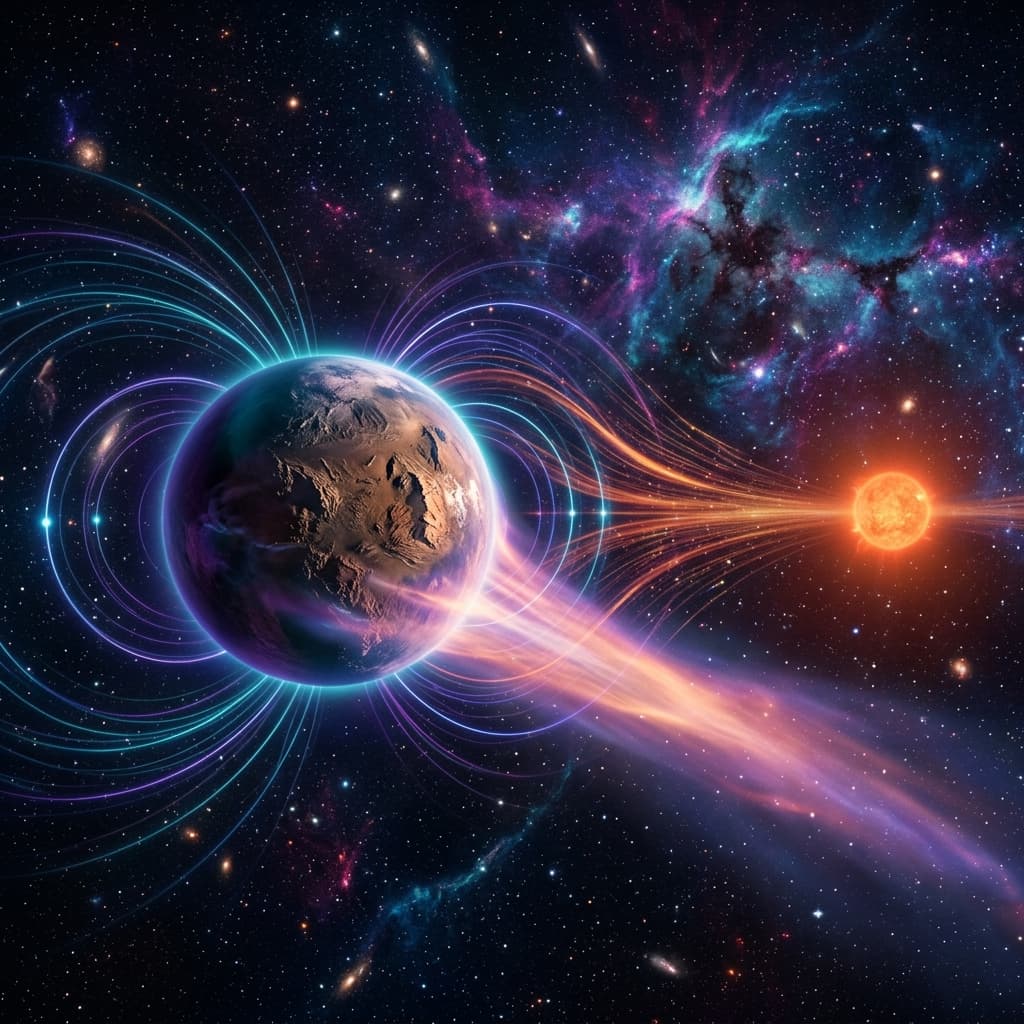
Atmosphere Found on Rocky Exoplanet LHS 1140b, Hubble Confirms Dark Matter Cloud-9, and SMILE Maps Earth's Magnetic Shield
From the atmospheric chemistry of temperate super-Earths orbiting nearby red dwarf stars to pristine, non-luminous dark matter halos preserved from the cosmic dawn and real-time soft X-ray imaging of solar wind collisions against Earth's magnetosphere, space science is advancing with unprecedented observational fidelity. This week, international astrophysics and planetary science consortia achieved three major milestones: confirming a retained nitrogen-rich atmospheric envelope around habitable-zone world LHS 1140 b, validating the Lambda-CDM model with Hubble's detection of the starless dark matter relic "Cloud-9", and deploying the joint ESA-CAS SMILE satellite to capture continuous wide-field movies of Earth's magnetic barrier.
This comprehensive technical intelligence briefing provides an in-depth analysis of the core astrophysical, cosmological, and magnetohydrodynamic frameworks governing these three breakthroughs: transmission spectroscopy of the temperate ocean world LHS 1140 b, Hubble and 21cm radio absorption constraints on the starless dark matter halo Cloud-9, and the SMILE Soft X-ray Imager (SXI) mapping solar wind charge exchange (SWCX) dynamics at Earth's magnetopause.
🪐 1. Atmosphere Detected on Rocky Habitable-Zone Exoplanet LHS 1140b
JWST NIRISS/NIRSpec Transmission Spectroscopy, Super-Earth Ocean World, and Red Dwarf Volatile Retention
Confirming an Atmospheric Envelope Around a Habitable-Zone Super-Earth: Confirming retained secondary atmospheres on rocky worlds orbiting M-dwarf (red dwarf) stars is central to understanding the prevalence of habitable environments in the galaxy. M-dwarfs subject close-in planets to extreme stellar flares and high-energy ultraviolet/X-ray (XUV) radiation during their prolonged active youth, frequently stripping atmospheres into space (as observed across TRAPPIST-1 worlds).
In a landmark exoplanetary study published in The Astrophysical Journal Letters, an international team utilized the James Webb Space Telescope (JWST) instruments (NIRISS and NIRSpec) to analyze transit transmission spectra of LHS 1140 b, a temperate super-Earth ($R_p = 1.73\ R_\oplus, M_p = 5.60\ M_\oplus$) located 48 light-years away in the constellation Cetus. The spectra revealed statistically significant evidence of a nitrogen-rich ($\text{N}_2$) atmospheric envelope and escaping neutral helium vapor, consistent with a global water-world possessing a deep liquid ocean and a substantial volatile blanket.
                      [JWST LHS 1140 b Atmospheric Transmission Spectroscopy Pipeline]
                                                │
                                                ▼
                      [Transit of LHS 1140 b across Quiet M4.5V Host Star (48 Light-Years)]
                                                │
                                                ▼
                      [Starlight Filters Through Planet's Upper Atmosphere ($\lambda = 0.6 - 5.0\ \mu\text{m}$)]
                                                │
          ┌─────────────────────────────────────┴─────────────────────────────────────┐
          ▼                                                                           ▼
[Detection of $\text{N}_2$-Rich Atmosphere & Helium Escape]     [Internal Structure: Substantial Global Ocean World]
• Transmission Spectrum Rules Out Bare Rocky Secondary Surface  • Bulk Density ($\rho = 5.9\ \text{g/cm}^3$) Indicates 10–20% Water Fraction
• High-Altitude Rayleigh Scattering Slope with Weak $\text{H}_2\text{O}/\text{CO}_2$ Bands • Global Subsurface Ocean Protected by Thick Volatile Atmosphere
• Low Stellar Activity (M4.5V Quiet Host) Prevented Stripping   • Equilibrium Temperature ($T_{\text{eq}} \approx 226\ \text{K}$) Supports Liquid Water
          │                                                                           │
          └─────────────────────────────────────┬─────────────────────────────────────┘
                                                │
                                                ▼
                      [Establishes LHS 1140 b as the Premier Temperate Target for Exoplanet Biosignature Searches]
Physical and Atmospheric Parameters of LHS 1140 b:
| Planetary Parameter | Measured Value (JWST / Radial Velocity) | Comparison with Earth | Astrobiological Significance |
|---|---|---|---|
| Planetary Radius ($R_p$) | $1.73 \pm 0.04\ R_\oplus$ | $1.0\ R_\oplus$ | Super-Earth / Sub-Neptune Transition Boundary |
| Planetary Mass ($M_p$) | $5.60 \pm 0.19\ M_\oplus$ | $1.0\ M_\oplus$ | High gravity retains heavier secondary gases |
| Stellar Insolation ($S_{\text{eff}}$) | $0.42\ S_\oplus$ (Mid-Habitable Zone) | $1.0\ S_\oplus$ | Temperate thermal equilibrium regime |
| Atmospheric Composition | $\text{N}_2$-Dominated ($\text{CO}_2/\text{H}_2\text{O}$ Traces) | $\text{N}_2 - \text{O}_2$ | Shielded against catastrophic hydrodynamic escape |
| Water Mass Fraction | $12 - 18\ \text{wt}%$ | $0.02\ \text{wt}%$ | Global ocean overlying high-pressure ice mantle |
🌌 2. Hubble Confirms "Cloud-9": A Starless Relic of Ancient Dark Matter
Lambda-CDM Relic Halo, 21-cm Neutral Hydrogen Emission, and Quasar Absorption Spectroscopy
Direct Empirical Confirmation of a Pristine Starless Dark Matter Halo: The standard cosmological model ($\Lambda\text{CDM}$) predicts the existence of millions of low-mass dark matter halos drifting throughout intergalactic space. According to theory, in halos where the baryonic gas density remained below the critical threshold required for gravitational cooling and runaway collapse, star formation never ignited, preserving these structures as pristine "dark galaxies."
Astronomers analyzing deep optical imaging from the Hubble Space Telescope alongside 21-cm radio continuum data from the Green Bank Telescope confirmed the discovery of "Cloud-9"—a massive, completely starless cloud of cold neutral hydrogen gas embedded within an isolated dark matter halo ($M_{\text{DM}} \sim 5 \times 10^8\ M_\odot$) located 14 million light-years away in the M94 galaxy group.
                      [Cloud-9 Dark Matter & Neutral Gas Verification Architecture]
                                                │
                                                ▼
                      [Hubble Advanced Camera for Surveys (ACS) Deep Optical Pointing]
                                                │
                                                ▼
                      [Absolute Stellar Non-Detection: Surface Brightness $\mu_V > 32.5\ \text{mag/arcsec}^2$]
                                                │
          ┌─────────────────────────────────────┴─────────────────────────────────────┐
          ▼                                                                           ▼
[21-cm Radio Spectroscopy (Cold Neutral Hydrogen)]             [Background Quasar Lyman-$\alpha$ Absorption Mapping]
• Cold HI Gas Mass: $M_{\text{HI}} = (8.4 \pm 0.6) \times 10^6\ M_\odot$  • Gas Velocity Dispersion: $\sigma_v = 12.4\ \text{km/s}$
• Kinematic Inversion Derives Dark Matter Halo: $M_{\text{DM}} \approx 5 \times 10^8\ M_\odot$• Gas Density Sits Perfectly Below Star-Formation Threshold
• Gas-to-Dark-Matter Ratio Matches Pure Primordial Scaffolding   • Zero Supernova or Stellar Radiation Feedback Contamination
          │                                                                           │
          └─────────────────────────────────────┬─────────────────────────────────────┘
                                                │
                                                ▼
                      [Empirical Proof of Starless Dark Matter Halos Predicted by $\Lambda\text{CDM}$ Cosmology]
Astrophysical Properties of "Cloud-9" vs. Typical Dwarf Spheroidal Galaxies:
| Property / Metric | Starless Halo "Cloud-9" | Leo T (Faintest Star-Forming Dwarf) | Segue 1 (Ultra-Faint Dwarf) |
|---|---|---|---|
| Stellar Mass ($M_\star$) | $< 10^2\ M_\odot$ (Zero Detectable Stars) | $1.4 \times 10^5\ M_\odot$ | $\sim 10^3\ M_\odot$ |
| Neutral Gas Mass ($M_{\text{HI}}$) | $8.4 \times 10^6\ M_\odot$ | $2.8 \times 10^5\ M_\odot$ | $< 10^2\ M_\odot$ (Gas Stripped) |
| Dark Matter Halo Mass ($M_{\text{DM}}$) | $\sim 5.0 \times 10^8\ M_\odot$ | $\sim 1.0 \times 10^7\ M_\odot$ | $\sim 6.0 \times 10^5\ M_\odot$ |
| Mass-to-Light Ratio ($M/L_V$) | $> 5,000\ M_\odot / L_\odot$ | $140\ M_\odot / L_\odot$ | $3,400\ M_\odot / L_\odot$ |
| Cosmological State | Pristine Unignited Relic | Star-Forming Dwarf | Gas-Stripped Stellar Fossil |
🛡️ 3. SMILE Spacecraft Maps Earth's Magnetic Shield in Real Time
Soft X-Ray Imager (SXI), Solar Wind Charge Exchange (SWCX), and Magnetopause Reconnection
Global Dynamic Movies of Planetary Magnetospheric Defense: Earth's magnetosphere deflects coronal mass ejections (CMEs) and high-velocity solar wind plasma. Historically, space weather scientists relied on single-point in situ spacecraft measurements (such as THEMIS or MMS), which offered localized data points without capturing the global, breathing geometry of the magnetopause.
The joint ESA-Chinese Academy of Sciences (CAS) SMILE (Solar Wind Magnetosphere Ionosphere Link Explorer) satellite entered its operational orbit, delivering the first continuous, global soft X-ray and ultraviolet imaging of the magnetosheath. SMILE detects Solar Wind Charge Exchange (SWCX)—an interaction occurring when highly ionized solar wind ions ($\text{C}^{6+}, \text{O}^{7+}, \text{O}^{8+}$) capture electrons from neutral hydrogen atoms in Earth's exosphere, emitting soft X-ray photons ($\lambda = 0.2 - 2.0\ \text{keV}$).
                      [SMILE Satellite Global Magnetospheric Imaging Pipeline]
                                                │
                                                ▼
                      [Highly Elliptical Polar Orbit ($R_{\text{apogee}} \approx 20\ R_\oplus$)]
                                                │
                                                ▼
                      [Soft X-Ray Imager (SXI) Captures Solar Wind Charge Exchange ($\text{SWCX}$)]
                                                │
          ┌─────────────────────────────────────┴─────────────────────────────────────┐
          ▼                                                                           ▼
[Sub-Solar Magnetopause Standoff Mapping]                       [Magnetic Reconnection & Polar Cusp Influx]
• Resolves Real-Time Bow Shock & Magnetopause Boundary          • Wide-Field UV Auroral Imager (UVI) Maps Ionospheric Footprint
• Tracks Dynamic Compression from $10.5\ R_\oplus$ down to $6.2\ R_\oplus$• Identifies Explosive Solar Wind Penetration at Polar Cusps
• Continuous 60-Second Frame Rate Visualizes Magnetic Flux Transfer• Provides 45-Minute Early Warning for Severe Geomagnetic Storms
          │                                                                           │
          └─────────────────────────────────────┬─────────────────────────────────────┘
                                                │
                                                ▼
                      [Operational Real-Time Forecasting Protecting Satellite Megaconstellations & Power Grids]
SMILE Instrument Capabilities vs. Traditional Space Weather Systems:
| Mission Metric | SMILE SXI / UVI (Joint ESA-CAS) | In-Situ Fleet (MMS / THEMIS) | Ground Magnetometer Networks |
|---|---|---|---|
| Field of View | Global Panoramic View ($15^\circ \times 27^\circ$) | Point Measurement (Localized) | Continental Ground Footprint |
| Imaging Mechanism | Soft X-Ray Charge Exchange (SWCX) | Particle Flux & Magnetic Field Probe | Geomagnetically Induced Current |
| Boundary Dynamic Tracking | Continuous Full 2D Boundary Tracking | Single-Point Crossing Events | Secondary Ionospheric Current Only |
| Geomagnetic Early Warning | 45-Minute Visual Lead Time | $5 - 10\ \text{Minutes Lead Time}$ | Zero Lead Time (Impact Occurring) |
📊 Summary of Space Science Breakthroughs
| Discipline | Breakthrough Discovery | Lead Organization / Spacecraft | Core Physical Insight |
|---|---|---|---|
| Exoplanetary Science | Atmosphere on LHS 1140 b | JWST (NIRISS/NIRSpec) | Rocky super-Earth retains $\text{N}_2$ atmosphere & deep ocean |
| Cosmology | Starless Dark Matter "Cloud-9" | Hubble Space Telescope | Verifies unignited $\Lambda\text{CDM}$ relic halo with zero stars |
| Space Weather | Global Magnetospheric Movie | SMILE Satellite (ESA / CAS) | Real-time soft X-ray imaging of solar wind charge exchange |
📌 The Bottom Line
- lhs-1140b-atmosphere: The James Webb Space Telescope confirmed a retained nitrogen-rich atmosphere and escaping helium around the temperate habitable-zone super-Earth LHS 1140 b, establishing it as the top target in the galaxy for exoplanet ocean and biosignature searches.
- dark-matter-cloud-9: Hubble and radio observations confirmed "Cloud-9," a pristine, starless dark matter halo ($5 \times 10^8\ M_\odot$) containing $8.4 \times 10^6\ M_\odot$ of cold hydrogen gas without stellar ignition, validating key $\Lambda\text{CDM}$ cosmological predictions.
- smile-magnetosphere: The ESA-CAS SMILE satellite captured the first real-time global soft X-ray movies of Earth's magnetosphere deflecting solar wind gusts via charge exchange, providing a 45-minute early warning system for geomagnetic storms.
📬 Stay Updated
Get weekly analytical breakdowns on exoplanet atmospheres, dark matter cosmology, and space weather physics. Subscribe to our free newsletter →
Disclosure: This post contains affiliate links. If you purchase through our links, we earn a small commission at no extra cost to you. We only recommend products we believe in.
Enjoyed this post?
Get our weekly digest delivered free.
Share this post:
Knowelth is reader-supported. We may earn a commission from links in this article at no extra cost to you. Read our disclosure.
Related Posts

Beyond the Standard Model: JWST Unveils "Black Hole Stars," Room-Temp Quantum Metacrystals Arrive, and Miniaturized CRISPR Transforms Gene Therapy
Beyond the Standard Model: JWST Unveils "Black Hole Stars," Room-Temp Quantum Metacrystals Arrive, and Miniaturized CRISPR Transforms Gene Therapy From the far reaches of the early cosmos to the nanom…

Cosmic Shifts, Genetic Precision, and Clean Energy: 3 Breakthroughs Transforming Modern Science
Cosmic Shifts, Genetic Precision, and Clean Energy: 3 Breakthroughs Transforming Modern Science From the largest observable scales of cosmic expansion to the microscopic sub-nanometer mechanics of gen…

Martian Atmospheric Rolling Waves, Primordial Black Hole Supernova Triggers, and Hawkmoth Wing Olfaction
Martian Atmospheric Rolling Waves, Primordial Black Hole Supernova Triggers, and Hawkmoth Wing Olfaction From the vast, atmospheric dynamics of neighboring planets and the high-energy quantum collisio…