Cosmic Shifts, Martian Signs, and Quantum Leaps: 3 Breakthroughs Redefining Modern Science
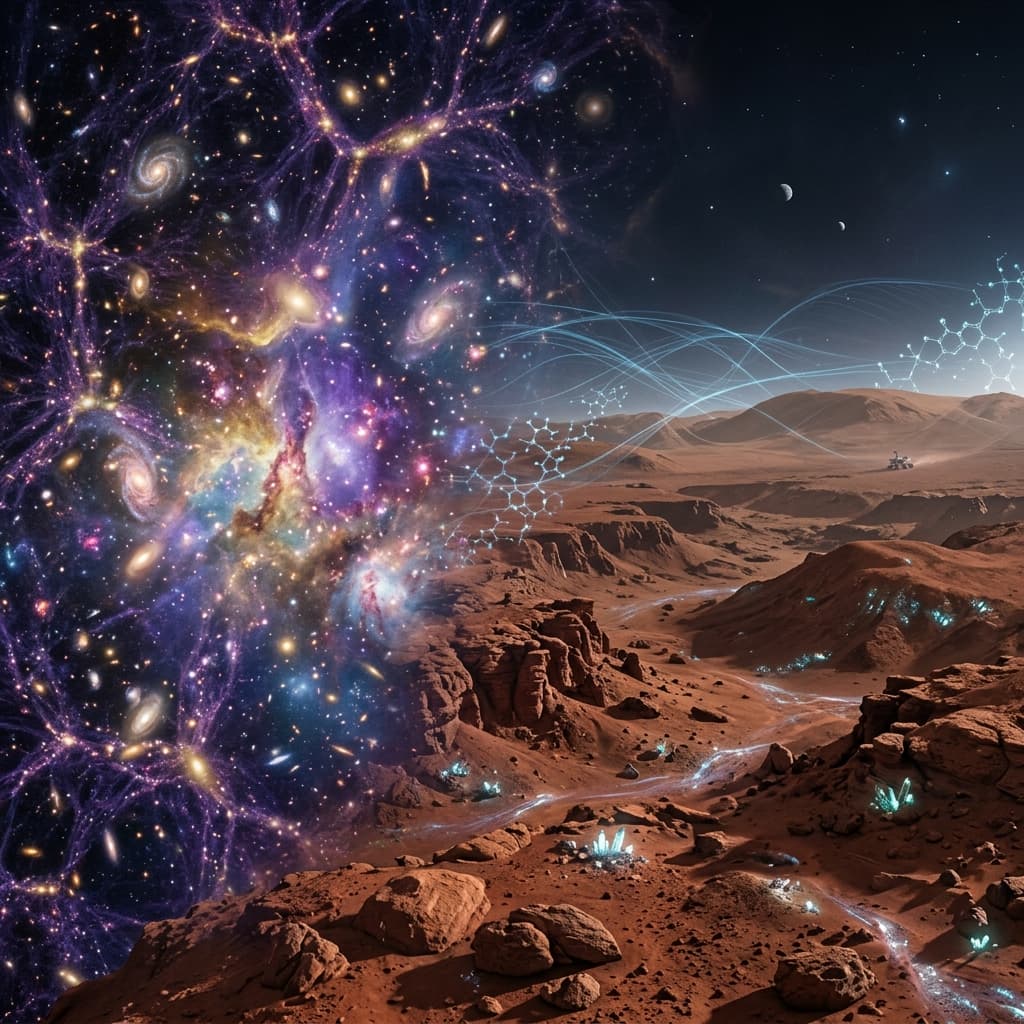
Cosmic Shifts, Martian Signs, and Quantum Leaps: 3 Breakthroughs Redefining Modern Science
From the farthest reaches of the expanding universe to the ancient lakebeds of Mars and the subatomic realm of quantum computing, science is undergoing a remarkable paradigm shift. Researchers are shattering long-held assumptions about cosmic structure, ancient alien environments, and the limits of molecular computation. Here is an in-depth look at three landmark discoveries pushing the boundaries of human knowledge today.
🔭 Expanding Horizons: DESI Hints That Dark Energy Is Evolving
For nearly three decades, modern cosmology has rested upon a foundational constant: Albert Einstein’s cosmological constant ($\Lambda$). According to standard cosmological models, dark energy—the mysterious force driving the accelerated expansion of the cosmos—remains strictly constant in density across space and time. However, major multi-year observational data from the Dark Energy Spectroscopic Instrument (DESI) has delivered a astonishing jolt to astrophysics, suggesting that dark energy may actually change and evolve over cosmic epochs.
By mounting a specialized robotic focal plane of 5,000 fiber-optic positions on the Mayall 4-meter Telescope at Kitt Peak, DESI completed the largest and most precise three-dimensional map of the cosmos ever constructed, measuring light from over 47 million galaxies and quasars spanning 11 billion years of cosmic history. By using Baryon Acoustic Oscillations—frozen sound waves from the early universe acting as a "standard ruler"—cosmologists measured how fast space expanded at different points in cosmic history. When combined with cosmic microwave background data and supernova surveys, the results indicated a statistical preference (ranging between $3.1\sigma$ and $4.2\sigma$) for a dynamic form of dark energy whose equation of state varies over time.
If confirmed by future data, an evolving dark energy component would fundamentally rewrite our understanding of fundamental physics. It would mean that dark energy is not an intrinsic, unvarying property of empty space, but rather a dynamic field or particle interaction that could weaken or strengthen over billions of years. Depending on its trajectory, the universe might not end in a perpetual freezing "Big Freeze," but could instead slow its expansion or even re-collapse in a distant "Big Crunch." While astrophysicists caution that the findings have not yet crossed the formal $5\sigma$ discovery threshold, DESI's extended operations through 2028 promise to bring unprecedented clarity to the ultimate fate of our universe.
🔴 Martian Spots of Life: Perseverance Discovers Chemical Biosignatures in "Cheyava Falls"
Deep inside Jezero Crater on Mars, NASA’s Perseverance rover has uncovered what scientists consider to be the most compelling chemical evidence of potential ancient Martian life to date. Exploring an ancient river channel called Neretva Vallis, the rover inspected a sedimentary mudstone rock target nicknamed "Cheyava Falls." Chemical scanning instruments onboard Perseverance revealed distinctive, millimeter-scale off-white splotches surrounded by dark rims—dubbed "leopard spots"—that contain striking chemical markers analogous to microbial fossil signatures found on Earth.
Detailed spectroscopy performed by the rover’s SHERLOC and PIXL instruments showed that the dark borders of these leopard spots are rich in iron and phosphate, while their central cores contain iron and sulfur compounds. On Earth, these specific redox (reduction-oxidation) chemical reactions are routinely driven by ancient microbes that harvest energy by transferring electrons between iron and sulfur in wet muds. Compounding the intrigue, Perseverance also detected complex organic carbon molecules—the fundamental chemical building blocks of cellular biology—trapped within the surrounding rock matrix.
While these features represent a major milestone for astrobiology, NASA scientists emphasize that non-biological (abiotic) chemical processes cannot yet be entirely ruled out. Water carrying dissolved iron could have reacted with minerals at elevated temperatures to form similar patterns without biological intervention. To solve this cosmic mystery, Perseverance extracted and sealed a core sample from the rock—officially named "Sapphire Canyon"—which now sits safely stored onboard the rover. Definitive confirmation will await Earth-based laboratory analysis via future Mars Sample Return missions, where high-powered electron microscopes and mass spectrometers can analyze the sample at sub-nanometer resolutions.
⚛️ The Quantum Revolution: Topological Qubits and Room-Temperature Photonics Accelerate Drug Discovery
While astronomers scrutinize the macro-cosmos, quantum physicists are orchestrating a parallel revolution at the subatomic frontier. In a major dual breakthrough, hardware developments in topological quantum computing and room-temperature photonics have successfully moved quantum processing out of cryogenic physics labs and into practical biomedical research. At the forefront is Microsoft's new Majorana 2 architecture, which utilizes topological qubits—quantum bits that encode information in geometric braiding states rather than fragile isolated electron spins. This topological shielding provides natural hardware-level protection against decoherence, resulting in a staggering 1,000-fold increase in qubit coherence times up to 20 seconds.
Simultaneously, researchers at Stanford University achieved a long-sought milestone in room-temperature quantum hardware. Using twisted light pulses focused on single-atom-thick monolayers of molybdenum diselenide ($MoSe_2$), the team demonstrated stable spin-photon entanglement at ambient temperatures without requiring liquid helium cooling apparatuses. This breakthrough paves the way for miniaturized photonic quantum processors that can operate inside standard server racks, eliminating the massive engineering footprint of traditional dilution refrigerators.
The real-world payoff of these hardware strides was showcased during the culmination of the global "Quantum for Bio" (Q4Bio) challenge. A collaboration led by Algorithmiq and IBM demonstrated utility-scale quantum algorithms running on 100+ qubit systems to simulate complex quantum-mechanical chemical bonds in large protein molecules. By accurately modeling electronic interactions that are completely intractable for classical supercomputers, these hybrid quantum-classical workflows have dramatically accelerated early-stage drug candidate identification—reducing the time needed to design targeted therapeutic molecules from years down to weeks.
📌 The Bottom Line
- evolving-dark-energy-desi: DESI's 47-million-galaxy map hints at dynamic dark energy, threatening to overthrow the standard cosmological constant model.
- mars-leopard-spots-biosignature: Perseverance rover detected iron-phosphate "leopard spot" chemical patterns and organic carbon on Mars, signaling potential ancient microbial activity.
- topological-quantum-biomedicine: Majorana 2 topological qubits and room-temperature photonics have unlocked utility-scale quantum simulation for rapid biomedical drug discovery.
📬 Stay Updated
Get the week's biggest science and space discoveries delivered to your inbox. Subscribe to our free newsletter →
Disclosure: This post contains affiliate links. If you purchase through our links, we earn a small commission at no extra cost to you. We only recommend products we believe in.
Enjoyed this post?
Get our weekly digest delivered free.
Share this post:
Knowelth is reader-supported. We may earn a commission from links in this article at no extra cost to you. Read our disclosure.
Related Posts
Beyond the Greenwald Limit: Exoplanet Atmospheres, Cosmic Dust, and the Future of Plasma Physics
Beyond the Greenwald Limit: Exoplanet Atmospheres, Cosmic Dust, and the Future of Plasma Physics The frontiers of science are expanding at a breathtaking pace, pushing the boundaries of what we though…
Atmosphere Discovered on Habitable-Zone Exoplanet LHS 1140 b, Materials-Driven Fusion Breakthrough, and 2D Topological Quantum Crystals
Atmosphere Discovered on Habitable-Zone Exoplanet LHS 1140 b, Materials-Driven Fusion Breakthrough, and 2D Topological Quantum Crystals The frontiers of human knowledge are expanding at an unprecedent…
12-Billion-Year Interstellar Comet, Quantum Proton Shuttles, and In Vivo Base Editing Breakthroughs
12-Billion-Year Interstellar Comet, Quantum Proton Shuttles, and In Vivo Base Editing Breakthroughs From the ancient depths of interstellar space to the quantum architecture of clean energy and the…