Beyond the Greenwald Limit: Exoplanet Atmospheres, Cosmic Dust, and the Future of Plasma Physics
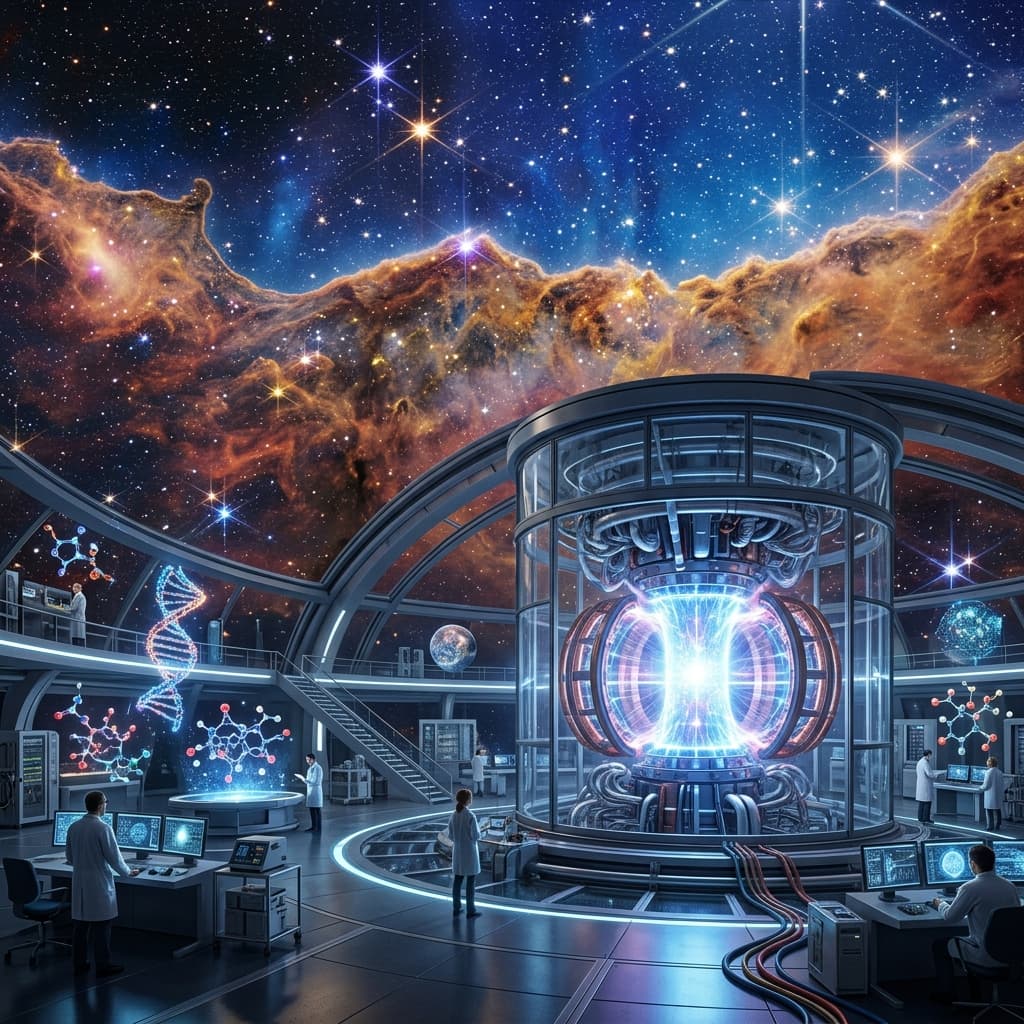
Beyond the Greenwald Limit: Exoplanet Atmospheres, Cosmic Dust, and the Future of Plasma Physics
The frontiers of science are expanding at a breathtaking pace, pushing the boundaries of what we thought possible. From detecting life-supporting conditions on distant worlds to recreating the dawn of organic chemistry and shattering long-held limits in plasma physics, this week’s breakthroughs are redefining our understanding of the universe.
🔭 The Atmosphere of LHS 1140 b: A Turning Point in the Search for Life
In a monumental leap for astrobiology, astronomers have confirmed the detection of a stable, helium-rich atmosphere around LHS 1140 b, a rocky exoplanet located 48 light-years away. Situated squarely in the habitable zone of its host star, this Earth-like world now presents the strongest evidence yet that such planets can retain an atmosphere capable of supporting life.
For years, scientists have grappled with the challenge of observing the delicate atmospheres of rocky exoplanets, which are often stripped away by the intense radiation of their stellar parents. Using next-generation telescopic arrays, researchers were able to capture the spectral fingerprint of helium and other volatile gases surrounding LHS 1140 b. This indicates a protective atmospheric blanket, crucial for insulating the planet and potentially allowing liquid water to pool on its surface.
This discovery is a watershed moment. It proves that rocky worlds orbiting M-dwarf stars—the most common type of star in our galaxy—can maintain the necessary conditions for habitability over billions of years. As we refine our observational tools, LHS 1140 b will undoubtedly become a prime target for biosignature searches, bringing us one step closer to answering the ultimate question: are we alone?
✨ Creating "Cosmic Dust" in the Lab: The Seeds of Organic Chemistry
Long before the Earth was formed, the building blocks of life may have been forged in the cold, unforgiving depths of interstellar space. In a groundbreaking new experiment, researchers have successfully recreated the extreme conditions of deep space within laboratory glass tubes, producing complex, carbon-rich "cosmic dust."
By bombarding a mixture of simple gases—similar to those found in interstellar molecular clouds—with high-energy particles at near-absolute zero temperatures, the team synthesized complex CHON molecules (containing Carbon, Hydrogen, Oxygen, and Nitrogen). These molecules are the fundamental precursors to amino acids and other life-essential organic compounds.
This experiment provides a tangible glimpse into the chemical evolution that predates our solar system. It suggests that the universe is inherently predisposed to create the ingredients for life, seeding young planetary systems with complex organics right from their inception. Understanding this cosmic chemistry not only sheds light on our own origins but also reinforces the likelihood that the building blocks of life are scattered abundantly throughout the cosmos.
⚛️ Shattering the Greenwald Limit: A Leap Forward for Fusion Energy
On Earth, a quiet revolution in plasma physics is taking place that could redefine the future of clean energy. Researchers in China have achieved a major milestone by experimentally verifying a theoretical "density-free" plasma operating regime. In doing so, they achieved stable electron densities that significantly exceed the Greenwald limit—a fundamental threshold that has constrained magnetic confinement fusion devices, like tokamaks, for decades.
The Greenwald limit dictates the maximum plasma density a fusion reactor can maintain without becoming unstable and abruptly terminating the reaction. By carefully tuning the magnetic fields and particle injection rates, the research team was able to bypass this traditional barrier, entering a new regime where the plasma remained stable and highly confined even at unprecedented densities.
This breakthrough has profound implications for the development of commercial fusion power. Higher plasma densities translate directly to higher energy yields, meaning future fusion reactors could be more compact, efficient, and economically viable. As humanity races to secure a clean, virtually limitless energy source, shattering the Greenwald limit brings the dream of practical fusion energy closer to reality than ever before.
📌 The Bottom Line
- exoplanet-atmosphere: Astronomers have confirmed a helium-rich atmosphere on rocky exoplanet LHS 1140 b, making it a prime candidate in the search for extraterrestrial life.
- cosmic-dust: Lab experiments replicating interstellar space have synthesized complex organic molecules, revealing how the ingredients for life form before planets do.
- plasma-physics: Physicists have successfully surpassed the Greenwald limit, achieving stable, high-density plasma that could drastically accelerate the advent of commercial fusion energy.
📬 Stay Updated
Get the week's biggest science and space discoveries delivered to your inbox. Subscribe to our free newsletter →
Disclosure: This post contains affiliate links. If you purchase through our links, we earn a small commission at no extra cost to you. We only recommend products we believe in.
Enjoyed this post?
Get our weekly digest delivered free.
Share this post:
Knowelth is reader-supported. We may earn a commission from links in this article at no extra cost to you. Read our disclosure.
Related Posts
Cosmic Shifts, Martian Signs, and Quantum Leaps: 3 Breakthroughs Redefining Modern Science
Cosmic Shifts, Martian Signs, and Quantum Leaps: 3 Breakthroughs Redefining Modern Science From the farthest reaches of the expanding universe to the ancient lakebeds of Mars and the subatomic realm o…
Atmosphere Discovered on Habitable-Zone Exoplanet LHS 1140 b, Materials-Driven Fusion Breakthrough, and 2D Topological Quantum Crystals
Atmosphere Discovered on Habitable-Zone Exoplanet LHS 1140 b, Materials-Driven Fusion Breakthrough, and 2D Topological Quantum Crystals The frontiers of human knowledge are expanding at an unprecedent…
12-Billion-Year Interstellar Comet, Quantum Proton Shuttles, and In Vivo Base Editing Breakthroughs
12-Billion-Year Interstellar Comet, Quantum Proton Shuttles, and In Vivo Base Editing Breakthroughs From the ancient depths of interstellar space to the quantum architecture of clean energy and the…