Cosmic Breakthroughs: JWST Sniffs Out Hidden Exoplanet, Hubble Tracks Omega Centauri Black Hole, and DESI Maps Evolving Dark Energy
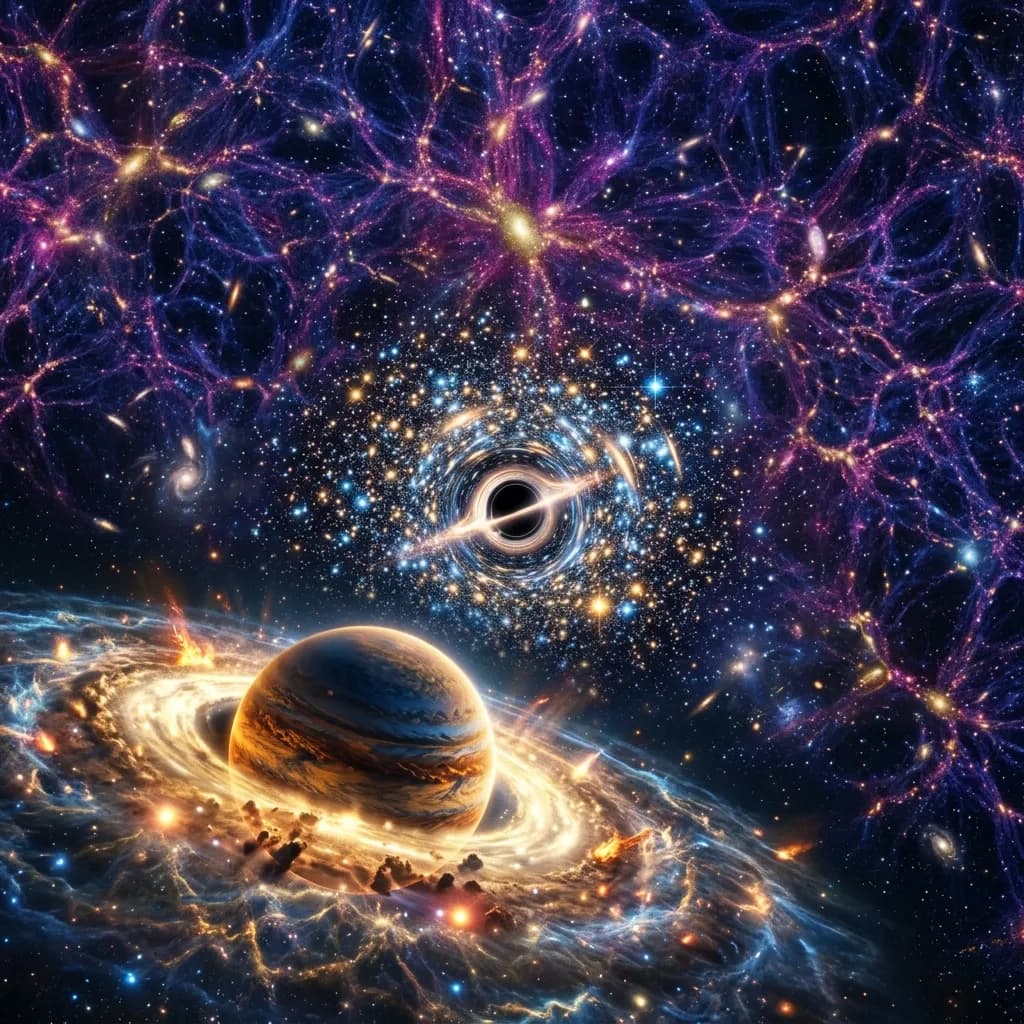
Cosmic Breakthroughs: JWST Sniffs Out Hidden Exoplanet, Hubble Tracks Omega Centauri Black Hole, and DESI Maps Evolving Dark Energy
Astronomers and cosmologists have pushed the boundaries of observational science with three groundbreaking milestones. From probing dusty planetary nurseries to unmasking hidden black holes and mapping 11 billion years of cosmic history, these discoveries are reshaping our understanding of star system formation, stellar remnants, and the ultimate fate of the universe.
🪐 JWST Spectroscopic Breakthrough: Unmasking Hidden Gas Giant Beta Pictoris d
Finding an exoplanet hidden inside a thick, blinding dust cloud is comparable to spotting a firefly floating next to a high-powered searchlight from miles away. Yet NASA's James Webb Space Telescope (JWST) accomplished this remarkable feat by discovering a newly identified gas giant named Beta Pictoris d. Situated roughly 63 light-years from Earth in the southern constellation Pictor, the Beta Pictoris system has long served as a cosmic laboratory for planetary formation due to its young age—roughly 20 million years—and its massive circumstellar debris disk.
Unlike traditional exoplanet detection methods—such as the transit technique, which measures the slight dimming of a star as a planet passes across its disk, or radial velocity, which detects gravitational wobbles—JWST identified Beta Pictoris d through direct spectroscopic analysis. Operating near the mid-infrared spectrum, JWST’s coronagraphic optics blocked out the intense glare of the central star. This allowed astronomers to isolate the faint infrared light emitted directly by the hot, young planet as it plowed through surrounding space dust.
The spectroscopic data revealed more than just the planet’s presence; it unmasked the chemical blueprint of its upper atmosphere. Scientists identified prominent absorption features corresponding to carbon monoxide, water vapor, and methane. Detecting methane in young, hot super-Jupiters provides crucial clues about atmospheric mixing and planetary cooling rates. Because young gas giants retain the primordial heat of their formation, their atmospheres act as thermal time capsules, offering direct windows into how gas giants assemble from dusty protoplanetary disks.
Beta Pictoris d joins its sibling worlds, Beta Pictoris b and c, making this system one of the very few known extra-solar planetary architectures featuring three directly imaged giant planets. The breakthrough highlights how Webb’s state-of-the-art instruments can dissect high-contrast, dust-shrouded planetary systems that were previously inaccessible to ground-based telescopes. As astronomers continue to refine high-contrast spectroscopic techniques, this discovery paves the way for characterising the atmospheres of smaller, potentially rocky worlds hidden within glare-heavy stellar environments.
🕳️ Astrometric Discovery: Uncovering the Missing Stellar Black Holes in Omega Centauri
Globular star clusters are among the densest stellar neighborhoods in the cosmos, housing hundreds of thousands of ancient stars packed into a sphere spanning mere tens of light-years. For decades, astrophysicists have calculated that globular clusters like Omega Centauri—located 17,000 light-years away in the southern sky—should harbor thousands of stellar-mass black holes formed from the collapsed cores of massive primordial stars. Yet despite intense searches using radio, X-ray, and optical telescopes, these stellar ghosts proved notoriously elusive, leaving a glaring gap between theoretical physics models and observational reality.
That historical mystery was dramatically solved when researchers announced the landmark detection of oMEGACat BH-2, the first verified stellar-mass black hole inside Omega Centauri. The breakthrough did not rely on observing intense X-ray bursts from infalling matter, as black holes in quiescent binary systems rarely feed actively enough to emit bright radiation. Instead, astronomers utilized astrometry—the ultra-precise measurement of stellar positions across time. By cross-analyzing over 20 years of archival imagery from the Hubble Space Telescope with high-resolution astrometric observations from the James Webb Space Telescope, scientists tracked the minuscule, tugged orbit of a visible companion star swinging around an invisible gravitational anchor.
Imagine watching a dancer twirling across a dark stage with an invisible partner; even if you cannot see the second dancer, their weight and movement dictate every leap and turn. In Omega Centauri, the subtle physical dance of the companion star allowed researchers to pinpoint the precise mass and location of oMEGACat BH-2. The black hole weighs roughly 12 times the mass of our Sun, perfectly aligning with theoretical predictions of stellar remnant masses resulting from core-collapse supernovae.
Beyond confirming the existence of stellar-mass black holes in dense stellar clusters, this discovery validates astrometry as a primary tool for mapping "dark" astronomical populations. It also provides important context for the ongoing search for an intermediate-mass black hole (IMBH) suspected of lurking at Omega Centauri's central core. As multi-decade astrometric baselines grow richer with JWST data, astronomers anticipate discovering hundreds more dormant black holes hidden across the Milky Way’s ancient star clusters.
🌌 Cosmology Shift: DESI's 3D Universe Map Hints Dark Energy Is Evolving
Enjoyed this post?
Get our weekly digest delivered free.
For nearly three decades, the prevailing model of cosmology—the Lambda-CDM ($\Lambda$CDM) model—has treated dark energy as a constant, unchanging force. Conceptualized as Einstein’s cosmological constant ($\Lambda$), dark energy is the mysterious pressure driving the accelerating expansion of the universe, assumed to remain uniformly dense across space and time. However, the completion of the Dark Energy Spectroscopic Instrument (DESI) five-year primary survey has delivered tantalizing empirical evidence that dark energy may not be constant at all, but rather dynamic and evolving.
Operating from the Mayall 4-meter Telescope at Kitt Peak National Observatory, DESI utilized 5,000 robotic fiber-optic positioners to capture the light of over 47 million galaxies and quasars spanning 11 billion years of cosmic history. This massive dataset allowed scientists to construct the largest and most accurate 3D map of the universe ever assembled. By observing Baryon Acoustic Oscillations—fossil sound waves frozen into the large-scale cosmic web during the Big Bang—DESI acted as a cosmic standard ruler, measuring how fast the universe expanded across different cosmic epochs.
When researchers combined DESI’s 3D map with complementary measurements of cosmic microwave background radiation and Type Ia supernovae, a surprising pattern emerged. The combined data indicates a 3-to-4 sigma preference for a model in which dark energy grows weaker over cosmic time. In simple terms, if dark energy is thought of as an accelerator pedal for the universe, DESI's data suggests that the driver’s foot may be easing off the pedal slightly as the cosmos ages.
While a 3-4 sigma result falls just short of the 5-sigma threshold required to formally claim a discovery in physics, the implications are profound. If confirmed by extended observations through 2028, dynamic dark energy would require a fundamental rewrite of modern physics, overturning the cosmological constant in favor of scalar field theories like quintessence. Such a paradigm shift would redefine our understanding of cosmic origin, gravity, and the ultimate fate of the universe.
📌 The Bottom Line
- beta-pictoris-d: NASA’s James Webb Space Telescope used direct spectroscopy to discover Beta Pictoris d and detect carbon monoxide, water vapor, and methane in its young atmosphere.
- omega-centauri-black-hole: By pairing 20+ years of Hubble data with JWST astrometry, astronomers discovered oMEGACat BH-2, proving that dormant stellar-mass black holes reside inside dense globular clusters.
- desi-evolving-dark-energy: Mapping 47 million galaxies over 5 years, DESI uncovered 3–4 sigma evidence that dark energy may be weakening over time, challenging the standard cosmological constant model.
📫 Stay Updated
Get the week's biggest science and space discoveries delivered to your inbox. Subscribe to our free newsletter →
Disclosure: This post contains affiliate links. If you purchase through our links, we earn a small commission at no extra cost to you. We only recommend products we believe in.
Knowelth publishes independently researched analysis verified against primary documentation, academic journals, and official records. To report a factual inaccuracy or request a correction, please reach out via our Contact Page.
Enjoyed this post?
Get our weekly digest delivered free.
Share this post:
Knowelth is reader-supported. We may earn a commission from links in this article at no extra cost to you. Read our disclosure.
Related Posts
Beyond the Standard Model: JWST Unveils "Black Hole Stars," Room-Temp Quantum Metacrystals Arrive, and Miniaturized CRISPR Transforms Gene Therapy
Beyond the Standard Model: JWST Unveils "Black Hole Stars," Room-Temp Quantum Metacrystals Arrive, and Miniaturized CRISPR Transforms Gene Therapy From the far reaches of the early cosmos to the nanom…

Cosmic Shifts, Genetic Precision, and Clean Energy: 3 Breakthroughs Transforming Modern Science
Cosmic Shifts, Genetic Precision, and Clean Energy: 3 Breakthroughs Transforming Modern Science From the largest observable scales of cosmic expansion to the microscopic sub-nanometer mechanics of gen…
Martian Atmospheric Rolling Waves, Primordial Black Hole Supernova Triggers, and Hawkmoth Wing Olfaction
Martian Atmospheric Rolling Waves, Primordial Black Hole Supernova Triggers, and Hawkmoth Wing Olfaction From the vast, atmospheric dynamics of neighboring planets and the high-energy quantum collisio…