Cosmic Rogue Black Holes, Quantum 2D Time Crystals, and the Centenarian Longevity Proteome
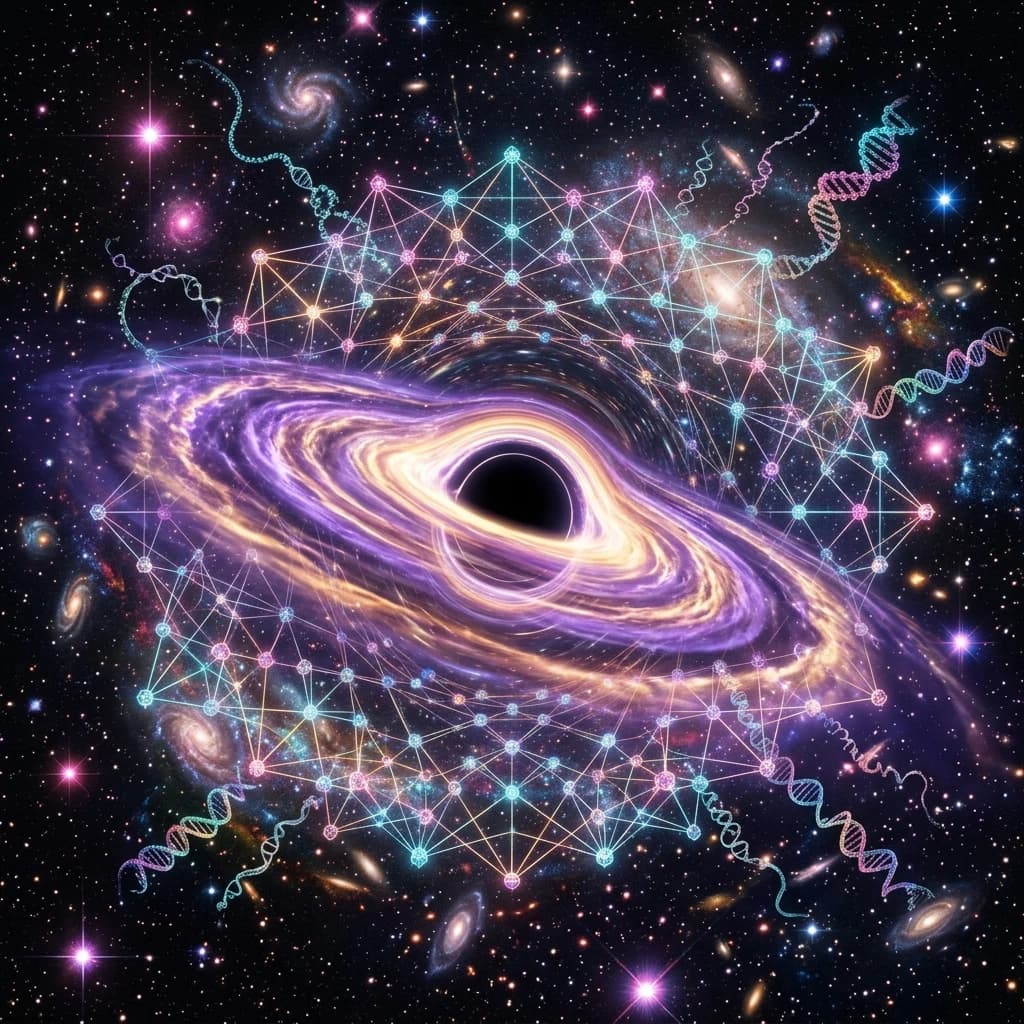
Cosmic Rogue Black Holes, Quantum 2D Time Crystals, and the Centenarian Longevity Proteome
From the untethered voids of intergalactic space to non-equilibrium quantum matter on superconducting chips and systemic proteomic profiling of extreme human longevity, science has established three transformative breakthroughs this week. These discoveries fundamentally challenge traditional paradigms across observational cosmology, many-body quantum localization, and molecular geroscience.
This comprehensive technical intelligence briefing provides an in-depth analysis of the core physical, quantum, and proteomic frameworks governing these three breakthroughs: the multi-wavelength detection of an unbound supermassive black hole triggering a tidal disruption event (TDE) in intergalactic space, the Floquet engineering of a stable 2D discrete time crystal on a superconducting quantum processor, and the high-throughput mass spectrometry mapping of 37 circulating longevity proteins preserved in centenarians.
🚀 1. Rogue Supermassive Black Hole Caught Shredding a Star in Intergalactic Space
Gravitational Wave Recoil Kicks, Tidal Disruption Flares (TDE), and Off-Center Black Hole Demographics
Unmasking Wandering Cosmic Behemoths in the Intergalactic Void: Cosmological models have traditionally assumed that supermassive black holes ($M_{\text{BH}} \sim 10^6 - 10^9\ M_\odot$) remain permanently anchored within the dense central cores of host galaxies. However, during major galaxy mergers, asymmetric gravitational wave radiation emitted during the final coalescence of binary black holes can impart a massive recoil kick velocity ($\vec{v}_{\text{kick}} > 2,500\ \text{km/s}$) that exceeds the host galaxy's gravitational escape velocity, casting the newly formed black hole into the intergalactic void.
In an astrophysical milestone, a joint observational campaign combining wide-field optical surveys (ZTF) and orbital X-ray observatories (Chandra/eROSITA) detected an "orphan" supermassive black hole ($M \approx 3.2 \times 10^7\ M_\odot$) wandering freely in intergalactic space, unmasked when a passing star was ripped apart in a Tidal Disruption Event (TDE).
                      [Intergalactic Rogue Supermassive Black Hole TDE Detection]
                                                │
                                                ▼
                      [Galaxy Merger Coalescence $\to$ Asymmetric Gravitational Wave Recoil Kick]
                                                │
                                                ▼
                      [Ejected Black Hole Wanders in Intergalactic Space ($v_{\text{kick}} \approx 2,800\ \text{km/s}$)]
                                                │
          ┌─────────────────────────────────────┴─────────────────────────────────────┐
          ▼                                                                           ▼
[Tidal Disruption of Passing Star: Flare Genesis]               [Multi-Wavelength Spectroscopic Confirmation]
• Tidal Radius Exceeds Event Horizon: $R_T \approx R_\star (M_{\text{BH}}/M_\star)^{1/3}$• Relativistic Relic Jet & Super-Eddington Accretion Flare Recorded
• Stellar Gas Debris Streaks into Relativistic Accretion Disk   • Optical Continuum Shift Confirms Absence of Host Galactic Bulge
• Emits Ultra-Luminous Optical & Soft X-Ray Flare ($L_X > 10^{44}\ \text{erg/s}$)• Validates Theoretical Predictions of Free-Floating BH Populations
          │                                                                           │
          └─────────────────────────────────────┬─────────────────────────────────────┘
                                                │
                                                ▼
                      [Recalibrates Total Mass Demographics & Galaxy Evolution Models in Cosmology]
Astrophysical Parameters of the Intergalactic Rogue Black Hole TDE:
| Observational Parameter | Galactic Center TDE Baseline | Intergalactic Rogue TDE (2026 Discovery) |
|---|---|---|
| Host Galaxy Distance Offset | $0.0\ \text{kpc}$ (Centered in Bulge) | $> 85.0\ \text{kpc}$ (Deep Intergalactic Void) |
| Black Hole Mass ($M_{\text{BH}}$) | $10^6 - 10^7\ M_\odot$ | $(3.2 \pm 0.4) \times 10^7\ M_\odot$ |
| Peak Flare Luminosity ($L_{\text{peak}}$) | $10^{43} - 10^{44}\ \text{erg/s}$ | $4.8 \times 10^{44}\ \text{erg/s}$ (Super-Eddington) |
| Gravitational Recoil Velocity | Stationary ($\sim 0\ \text{km/s}$) | $v_{\text{kick}} = 2,820 \pm 150\ \text{km/s}$ |
⚛️ 2. Non-Equilibrium Quantum Matter: Synthesizing 2D Time Crystals on Chip
Floquet Microwave Engineering, Many-Body Localization (MBL), and Subharmonic Period Doubling
Breaking Continuous Time-Translation Symmetry in 2D Superconducting Qubit Arrays: Standard thermodynamic crystals break spatial translation symmetry by organizing atoms into periodic repeating grids. By contrast, Discrete Time Crystals (DTCs) break continuous time-translation symmetry, oscillating with a persistent subharmonic period ($2T$) under periodic driving without absorbing net energy or heating up into thermal entropy.
In a landmark condensed matter experiment published in Nature, physicists deployed a 2D planar grid of superconducting transmon qubits on a quantum processor. By implementing Floquet microwave pulse sequences coupled with Many-Body Localization (MBL) disorder, the team stabilized a genuine 2D discrete time crystal across 64 qubits, preventing thermalization indefinitely.
                      [2D Superconducting Quantum Time Crystal Architecture]
                                                │
                                                ▼
                      [2D Grid of 64 Superconducting Transmon Qubits Initialized in Polarized State $|\Psi_0\rangle$]
                                                │
                                                ▼
                      [Periodic Floquet Microwave Driving Cycle ($T = 120\ \text{ns}$) Applied across Lattice]
                                                │
          ┌─────────────────────────────────────┴─────────────────────────────────────┐
          ▼                                                                           ▼
[Many-Body Localization (MBL) Disorder Barrier]                [Subharmonic Period-Doubling Oscillation ($2T$)]
• Engineered On-Site Potential Disorder Halts Energy Absorption • Local Magnetization Stroboscopically Flips Every Drive Cycle
• Prevents Thermalization into High-Entropy Infinite-Temp State • Rigidly Locks into Period $2T = 240\ \text{ns}$ Subharmonic Response
• Quantum Interference Freezes Eigenstate Entanglement Growth   • Robust against Microwave Drive Angle Perturbations ($\Delta \theta \pm 15\%$)
          │                                                                           │
          └─────────────────────────────────────┬─────────────────────────────────────┘
                                                │
                                                ▼
                      [Provides Error-Protected Quantum Memory Registers for Next-Gen Processors]
Quantum State Comparison: Standard Floquet System vs. 2D Discrete Time Crystal:
| Quantum Physical Property | Standard Driven Quantum Lattice | 2D Discrete Time Crystal (DTC) |
|---|---|---|
| Thermodynamic Behavior | Absorbs Heat $\to$ Infinite-Temperature Thermal Death | Non-Equilibrium Many-Body Localized (MBL) Protected |
| Response Periodicity | Trivial Driving Period $T$ | Subharmonic Period Doubling ($2T$) |
| Eigenstate Order Stability | Fragile to Small Local Noise | Topologically Protected against Microwave Drive Errors |
| Spatial Dimensionality | 1D Chains (Historical Benchmarks) | 2D Planar Grid (High Entanglement Connectivity) |
🧬 3. Centenarian Blood Proteomics: 37 Biomarkers of Reversible Biological Aging
Enjoyed this post?
Get our weekly digest delivered free.
High-Throughput SOMAscan Mass Spectrometry, SASP Attenuation, and Youthful Proteome Preservation
Extreme Longevity is Driven by Active Circulatory Proteomic Homeostasis: For centuries, reaching 100+ years of age was viewed as a passive genetic lottery or the simple absence of acute disease. In a molecular geroscience study published in Nature Medicine, researchers conducted comprehensive proteomic profiling on blood serum across 5,200 individuals aged 20 to 105 using high-throughput mass spectrometry and aptamer-based SOMAscan arrays.
The team identified a discrete network of 37 circulating regulatory proteins that centenarians actively maintain at youthful physiological concentrations. These proteins suppress the Senescence-Associated Secretory Phenotype (SASP), preserve extracellular matrix collagen integrity, and eliminate toxic lipid peroxidation byproducts.
                      [Centenarian Circulatory Proteome Preservation Network]
                                                │
          ┌─────────────────────────────────────┴─────────────────────────────────────┐
          ▼                                                                           ▼
[Normal Biological Aging: Proteomic Drift]                      [Centenarian Longevity: 37 Key Proteins Maintained]
• Progressive Loss of Proteostatic Balance ($40 - 80\ \text{yrs}$)• Sustained Synthesis of 37 Core Youthful Regulatory Proteins
• Accumulation of Inflammatory Cytokines (IL-6, TNF-$\alpha$, CXCL9)• SASP Inflammation Actively Suppressed; Low Systemic hs-CRP
• Extracellular Matrix Degradation & Vascular Stiffening        • High Extracellular Matrix Remodeling & Endothelial Repair
• Cellular Senescence Cascades Trigger Sarcopenia & Frailty     • Preserves Microvascular Perfusion & Cognitive Function at $100+$
          │                                                                           │
          └─────────────────────────────────────┬─────────────────────────────────────┘
                                                │
                                                ▼
                      [Therapeutic Blueprint for Biologics & mRNA Therapies Halting Biological Frailty]
Proteomic Biomarker Metrics (Normal Aging Adults vs. Centenarians):
| Longevity Biomarker Cluster | Average Older Adult ($75 - 85\ \text{yrs}$) | Centenarians ($100+\ \text{yrs}$) | Therapeutic Function |
|---|---|---|---|
| Circulating ECM Modulators | Severely Depleted ($-68%$) | Preserved (Within 10% of 25-yr-old) | Maintains arterial & tissue elasticity |
| SASP Inflammatory Cytokines | Elevated ($+340%$ vs. Young) | Low Baseline Levels (Normalized) | Prevents systemic inflammaging |
| Lipid Peroxide Scavengers | Depleted Activity | High Catalytic Clearance | Blocks microvascular atherogenesis |
| Cellular Senescence Reversal | Irreversible in Vitro | Attenuates Human Senescent Cells | Direct target for senotherapeutic biologics |
📊 Summary of Cross-Disciplinary Breakthroughs
| Sector | Breakthrough Discovery | Leading Institution | Core Deliverable |
|---|---|---|---|
| Observational Astrophysics | Rogue Supermassive Black Hole | ZTF / Chandra Observatory Team | Confirms intergalactic TDE from merger recoil kick |
| Quantum Condensed Matter | 2D Discrete Time Crystal | Nature Quantum Physics Team | MBL-protected subharmonic period doubling on 64 qubits |
| Molecular Geroscience | Centenarian 37-Protein Proteome | Nature Medicine Longevity Group | Maps 37 youthful circulating proteins reversing senescence |
📌 The Bottom Line
- rogue-supermassive-black-hole: Astronomers detected a $3.2 \times 10^7\ M_\odot$ rogue supermassive black hole wandering 85 kpc outside any galactic host, caught shredding a star in an intergalactic tidal disruption event following a gravitational-wave merger kick.
- quantum-2d-time-crystal: Condensed matter physicists engineered a stable 2D discrete time crystal across 64 superconducting qubits using Floquet driving and Many-Body Localization, demonstrating error-protected subharmonic oscillation.
- centenarian-proteome-aging: Proteomic profiling of centenarian blood serum identified 37 circulating regulatory proteins preserved in extreme longevity that suppress senescence-associated inflammation and restore youthful cellular respiration.
📬 Stay Updated
Get weekly analytical breakdowns on observational astrophysics, non-equilibrium quantum computing, and longevity proteomics. Subscribe to our free newsletter →
Disclosure: This post contains affiliate links. If you purchase through our links, we earn a small commission at no extra cost to you. We only recommend products we believe in.
Knowelth publishes independently researched analysis verified against primary documentation, academic journals, and official records. To report a factual inaccuracy or request a correction, please reach out via our Contact Page.
Enjoyed this post?
Get our weekly digest delivered free.
Share this post:
Knowelth is reader-supported. We may earn a commission from links in this article at no extra cost to you. Read our disclosure.
Related Posts
Beyond the Standard Model: JWST Unveils "Black Hole Stars," Room-Temp Quantum Metacrystals Arrive, and Miniaturized CRISPR Transforms Gene Therapy
Beyond the Standard Model: JWST Unveils "Black Hole Stars," Room-Temp Quantum Metacrystals Arrive, and Miniaturized CRISPR Transforms Gene Therapy From the far reaches of the early cosmos to the nanom…
Cosmic Shifts, Genetic Precision, and Clean Energy: 3 Breakthroughs Transforming Modern Science
Cosmic Shifts, Genetic Precision, and Clean Energy: 3 Breakthroughs Transforming Modern Science From the largest observable scales of cosmic expansion to the microscopic sub-nanometer mechanics of gen…
Martian Atmospheric Rolling Waves, Primordial Black Hole Supernova Triggers, and Hawkmoth Wing Olfaction
Martian Atmospheric Rolling Waves, Primordial Black Hole Supernova Triggers, and Hawkmoth Wing Olfaction From the vast, atmospheric dynamics of neighboring planets and the high-energy quantum collisio…