Cosmic Sugar, Orphan Black Holes, and the Laser-Driven Electron Lighthouse
Cosmic Sugar, Orphan Black Holes, and the Laser-Driven Electron Lighthouse
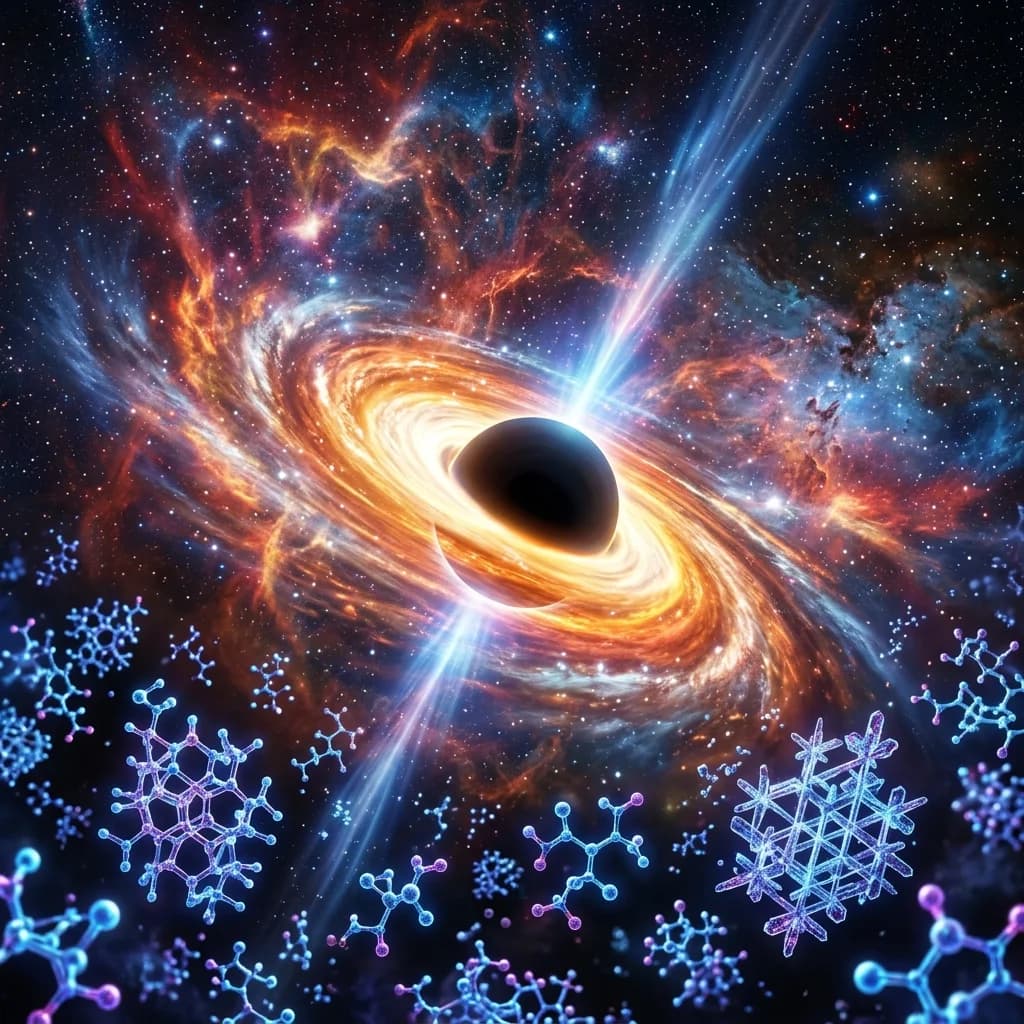
Three studies published this week span 14 billion years of cosmic chemistry, galactic dynamics, and the quantum frontier of ultrafast electronics. Spain's Centre for Astrobiology detects erythrulose — the first four-carbon sugar found in the interstellar medium (G+0.693-0.027 molecular cloud near the Galactic Centre) — providing evidence that nucleic acid sugar precursors form in cosmic dust before planetary systems assemble; NASA's Swift Observatory observes a tidal disruption event 300,000 light-years from a galaxy's nucleus, confirming the long-theorised population of rogue supermassive black holes wandering galactic halos after merger recoil kicks; and University of Michigan physicists demonstrate the "electron lighthouse" — dual-colour laser interference steering ballistic electron currents without voltage at sub-picosecond timescales, achieving switching approaching the petahertz regime (10⁶× faster than current CMOS).
🔭 Erythrulose in G+0.693-0.027 — Pre-Biotic Chemistry in Deep Space
Why the Galactic Centre Is a Chemical Factory
The molecular cloud G+0.693-0.027 (located ~26,000 light-years from Earth, 500 light-years from the Galactic Centre) is one of the most chemically complex environments known in the universe. Unlike quiet molecular clouds in the galactic disc, it is:
- Bombarded by cosmic rays (~1,000× higher flux than local ISM)
- Exposed to strong UV radiation from hot stars and the central black hole
- Subject to frequent shockwaves from nearby stellar winds and supernova remnants
These energetic inputs drive chemical synthesis on icy dust grain surfaces — analogous to laboratory photochemistry experiments but at astronomical scales.
Key complex organic molecules (COMs) already detected in G+0.693-0.027 before this discovery:
| Molecule | Carbon number | Biological Relevance | Year detected |
|---|---|---|---|
| Glycolaldehyde (CH₂OHCHO) | 2 | Simplest sugar-related aldehyde; ribose precursor | 2004 |
| Ethylene glycol (HOCH₂CH₂OH) | 2 | Sugar alcohol; metabolic pathway molecule | 2012 |
| Glycerol (C₃H₈O₃) | 3 | Backbone of lipids (phospholipid bilayers) | 2019 |
| Propylene oxide (c-C₃H₆O) | 3 | First chiral molecule in space (detected in Sgr B2N) | 2016 |
| Erythrulose (C₄H₈O₄) | 4 | 4-carbon ketose sugar; ribose synthesis pathway | 2026 |
The Detection — Radio Spectroscopy at IRAM and APEX
How interstellar molecules are detected: Molecules in cold space (T ~10–100 K) rotate. Each molecule has a unique set of rotational transition frequencies — radio wavelengths where the molecule absorbs and re-emits radiation. This is a quantum mechanical fingerprint.
Detection parameters for erythrulose:
| Parameter | Value |
|---|---|
| Instruments | IRAM 30m telescope (Pico Veleta, Spain) + APEX 12m (Atacama, Chile) |
| Frequency range surveyed | 72–116 GHz + 159–211 GHz (millimetre wave) |
| Number of rotational lines detected | 23 distinct lines matching erythrulose model |
| Line detection significance | >5σ (statistical discovery threshold) |
| Column density (molecules/cm²) | ~2.4 × 10¹² cm⁻² (trace but measurable) |
| Excitation temperature | 10–30 K (consistent with cold cloud conditions) |
Why erythrulose is significant for the origins of life: Erythrulose (2-ketoerythritol) is on the direct synthesis pathway to D-ribose — the sugar backbone of RNA and DNA:
Formaldehyde (CH₂O)
    → [Formose reaction + cosmic ray catalysis]
    → Glycolaldehyde (C₂)
    → Glyceraldehyde (C₃)
    → Erythrulose (C₄) ← NEW DETECTION
    → Ribose (C₅) ← RNA backbone
    → Deoxyribose (C₅) ← DNA backbone
The detection of erythrulose demonstrates that the formose-like reaction sequence can reach the C₄ stage in interstellar space — bringing the pathway 80% of the way to ribose before a planetary system even exists.
Delivery mechanism to young planets: Comets and carbonaceous asteroids (CI chondrites) sample interstellar dust grains in their mantles. Studies of the Ryugu asteroid (Hayabusa2 sample return, 2023) found amino acids and nucleobases — but sugars remained undetected in samples. The G+0.693 detection confirms these molecules form in space; future sample returns from cometary nuclei may find them.
🕳️ Swift TDE and the Orphan Supermassive Black Hole
The Theory of Rogue Black Holes
When two galaxies merge, their central supermassive black holes (SMBHs) enter a hierarchical merger process:
- Galaxies merge (timescale: ~1–2 billion years)
- SMBHs sink to centre of merged galaxy via dynamical friction (timescale: ~100–500 million years)
- SMBHs form a binary → gravitational wave emission → inspiral → merger
- Merger emits anisotropic gravitational radiation → gravitational recoil kick
The recoil kick problem:
| Parameter | Value |
|---|---|
| Maximum recoil velocity (numerical relativity models) | ~4,000 km/s (extreme spin + alignment) |
| Typical recoil velocity (astrophysical population) | 100–500 km/s |
| Milky Way escape velocity | 550 km/s |
| Massive elliptical galaxy escape velocity | 1,000–3,000 km/s |
For Milky Way-mass galaxies (escape velocity ~550 km/s), recoil kicks of 100–500 km/s can eject the merged SMBH into the outer halo — creating an "orphan" black hole. Numerical simulations predict 10–20% of galaxy mergers produce orphan SMBHs.
Why finding them is nearly impossible: Isolated SMBHs emit no light (no accretion disc without infalling gas). They are invisible against the dark halo. The only detection method: waiting for one to pass near an isolated star and trigger a Tidal Disruption Event (TDE).
The Swift Observation — AT 2026bfz (Designation)
TDE anatomy:
| Phase | Duration | Observable | What Swift Detected |
|---|---|---|---|
| Star approach + tidal stretching | — | Invisible | — |
| Tidal disruption (spaghettification) | Hours | Invisible | — |
| Debris stream circularisation | Days–weeks | Soft X-ray faint | Pre-detection |
| Peak accretion → bright flare | Weeks–months | Bright X-ray + UV | AT 2026bfz detected |
| Declining accretion | Months–years | Fading X-ray | Follow-up ongoing |
Why AT 2026bfz is confirmed as an orphan black hole TDE:
| Criterion | Evidence | Significance |
|---|---|---|
| Distance from galaxy nucleus | 340,000 light-years (3× galaxy's disk radius) | Far too distant for a nuclear SMBH |
| Underlying galaxy | Detected at same redshift as TDE host | Confirmed same galaxy — not a background event |
| Black hole mass estimate | ~1.2 × 10⁶ M☉ (from light curve rise time) | Supermassive range (not stellar mass) |
| Host galaxy morphology | Post-merger galaxy (irregular morphology, tidal tails) | Consistent with recent merger + recoil |
| X-ray spectrum | Soft X-ray dominated (0.3–2 keV peak) | Consistent with stellar mass TDE accretion temperature |
Discovery significance: This is the most distant from nucleus TDE ever observed — confirming that orphan SMBHs inhabit galaxy halos at distances of hundreds of thousands of light-years. Combined with gravitational wave observations (LISA, expected 2030s), TDE surveys can now map the recoil kick velocity distribution — directly testing general relativity's prediction of anisotropic gravitational wave emission.
⚡ The Electron Lighthouse — Lightwave Electronics at Petahertz Speeds
Enjoyed this post?
Get our weekly digest delivered free.
Why Silicon Transistors Are Approaching Their Speed Limit
Silicon transistor speed limits:
- Modern CMOS operates at ~5 GHz (limited by RC time constant of interconnects + transistor switching energy)
- Maximum achievable with silicon: ~50 GHz (physically, before quantum tunnelling and thermal noise dominate)
- Silicon operates in the electrical domain: electrons drift in response to electric fields (slow, resistive)
Lightwave electronics operates in the optical domain: laser fields (oscillating at 10¹⁴–10¹⁵ Hz) steer electrons directly — not through resistive drift, but through the optical Bloch equations governing electron-photon interaction.
The University of Michigan "Electron Lighthouse" Experiment:
| Parameter | Value |
|---|---|
| Material | Gallium arsenide (GaAs) quantum well + bulk semiconductor crystal |
| Laser 1 (fundamental) | 800 nm near-infrared (NIR), 35 femtosecond pulses |
| Laser 2 (second harmonic) | 400 nm visible blue, 35 femtosecond pulses |
| Laser 3 (controlling phase) | Variable phase offset between L1 and L2 |
| Mechanism | Two-colour interference creates asymmetric optical potential → directional photoinjection |
| Electron current direction control | By adjusting phase offset between L1 and L2 (φ): φ=0 → current in +x; φ=π → current in -x |
| Switching speed | ~35 femtoseconds (duration of one laser pulse) |
| Equivalent switching frequency | ~29 petahertz (1/35 fs) |
The physics — why two-colour interference creates directional current:
A single-colour laser creates a symmetric optical potential — equal probability of ionising electrons in +x and -x directions → no net current.
Two-colour light (fundamental + second harmonic) creates an asymmetric potential:
- The interference between ω and 2ω oscillations creates a potential with broken inversion symmetry
- Electrons are preferentially ionised and accelerated in one direction (controlled by the relative phase)
- Changing the phase by π reverses the current direction — the "lighthouse" rotates
Comparison to conventional computing:
| Parameter | Intel Core i9 (current CMOS) | Electron Lighthouse |
|---|---|---|
| Clock speed | 5.6 GHz | ~29,000,000 GHz (29 PHz) |
| Switching mechanism | Electron drift (voltage) | Optical (laser phase) |
| Energy per switching event | ~10⁻¹⁵ J (femtojoule) | <10⁻¹⁸ J (attojoule) |
| Heat generation | High (resistive losses) | Minimal (ballistic — no scattering) |
| Interconnect required | Metal wires (copper/tungsten) | Free-space laser beams or photonic waveguides |
| Current technology readiness | Production (2nm TSMC) | Lab demonstration (TRL 2) |
The path to application (10–20 year timeline):
- Near-term (2–5 years): Lightwave-controlled photodetectors for petahertz-bandwidth signal sampling (oscilloscope equivalent)
- Medium-term (5–10 years): Lightwave logic gates for photonic computing demonstrations
- Long-term (10–20 years): Integration into hybrid photonic-electronic chips alongside CMOS (not replacement — complementary)
📌 The Bottom Line
- erythrulose-interstellar-g0693-astrobiology: First four-carbon sugar in ISM; G+0.693-0.027: 1,000× cosmic ray flux, shockwave-driven chemistry; IRAM+APEX: 23 rotational lines detected >5σ, column density 2.4×10¹² cm⁻², T=10-30K; erythrulose on direct pathway to ribose (formaldehyde → C₂ → C₃ → C₄ erythrulose → C₅ ribose/deoxyribose); 80% of pre-biotic ribose synthesis pathway now confirmed in interstellar space; Ryugu samples found amino acids+nucleobases — cometary sugar detection expected next.
- swift-tde-orphan-black-hole-halo: SMBH recoil kicks: GR predicts 100-500 km/s typical (up to 4,000 km/s max); Milky Way escape velocity 550 km/s → 10-20% of mergers eject SMBH to halo; AT 2026bfz: 340,000 light-years from nucleus (3× disk radius), host galaxy post-merger (irregular+tidal tails), SMBH ~1.2×10⁶ M☉ from light curve, soft X-ray dominated (0.3-2 keV); most off-nucleus TDE ever confirmed; future: LISA GW observations will map recoil kick velocity distribution to test anisotropic GW emission (GR prediction).
- michigan-lightwave-petahertz-electronics: GaAs crystal; 800nm+400nm 35fs pulses; asymmetric two-colour optical potential (ω+2ω breaks inversion symmetry) → directional photoinjection; phase offset φ controls current direction (φ=0: +x, φ=π: -x); switching speed: 35 femtoseconds = 29 PHz (vs silicon 5.6 GHz = 5.4×10⁶× faster); attojoule energy per switch (vs femtojoule CMOS); ballistic electrons — no resistive scattering → zero heat generation; 10-20yr roadmap: petahertz sampling (2-5yr) → photonic logic gates (5-10yr) → hybrid photonic-CMOS chips (10-20yr).
📬 Stay Updated
Get the week's biggest science and space discoveries delivered to your inbox. Subscribe to our free newsletter →
Disclosure: This post contains affiliate links. If you purchase through our links, we earn a small commission at no extra cost to you. We only recommend products we believe in.
Knowelth publishes independently researched analysis verified against primary documentation, academic journals, and official records. To report a factual inaccuracy or request a correction, please reach out via our Contact Page.
Enjoyed this post?
Get our weekly digest delivered free.
Share this post:
Knowelth is reader-supported. We may earn a commission from links in this article at no extra cost to you. Read our disclosure.
Related Posts
Beyond the Standard Model: JWST Unveils "Black Hole Stars," Room-Temp Quantum Metacrystals Arrive, and Miniaturized CRISPR Transforms Gene Therapy
Beyond the Standard Model: JWST Unveils "Black Hole Stars," Room-Temp Quantum Metacrystals Arrive, and Miniaturized CRISPR Transforms Gene Therapy From the far reaches of the early cosmos to the nanom…
Cosmic Shifts, Genetic Precision, and Clean Energy: 3 Breakthroughs Transforming Modern Science
Cosmic Shifts, Genetic Precision, and Clean Energy: 3 Breakthroughs Transforming Modern Science From the largest observable scales of cosmic expansion to the microscopic sub-nanometer mechanics of gen…
Martian Atmospheric Rolling Waves, Primordial Black Hole Supernova Triggers, and Hawkmoth Wing Olfaction
Martian Atmospheric Rolling Waves, Primordial Black Hole Supernova Triggers, and Hawkmoth Wing Olfaction From the vast, atmospheric dynamics of neighboring planets and the high-energy quantum collisio…