Autonomous Space Docking, Room-Temperature Quantum Spin Liquids, and Epigenetic Age Reversal
Autonomous Space Docking, Room-Temperature Quantum Spin Liquids, and Epigenetic Age Reversal
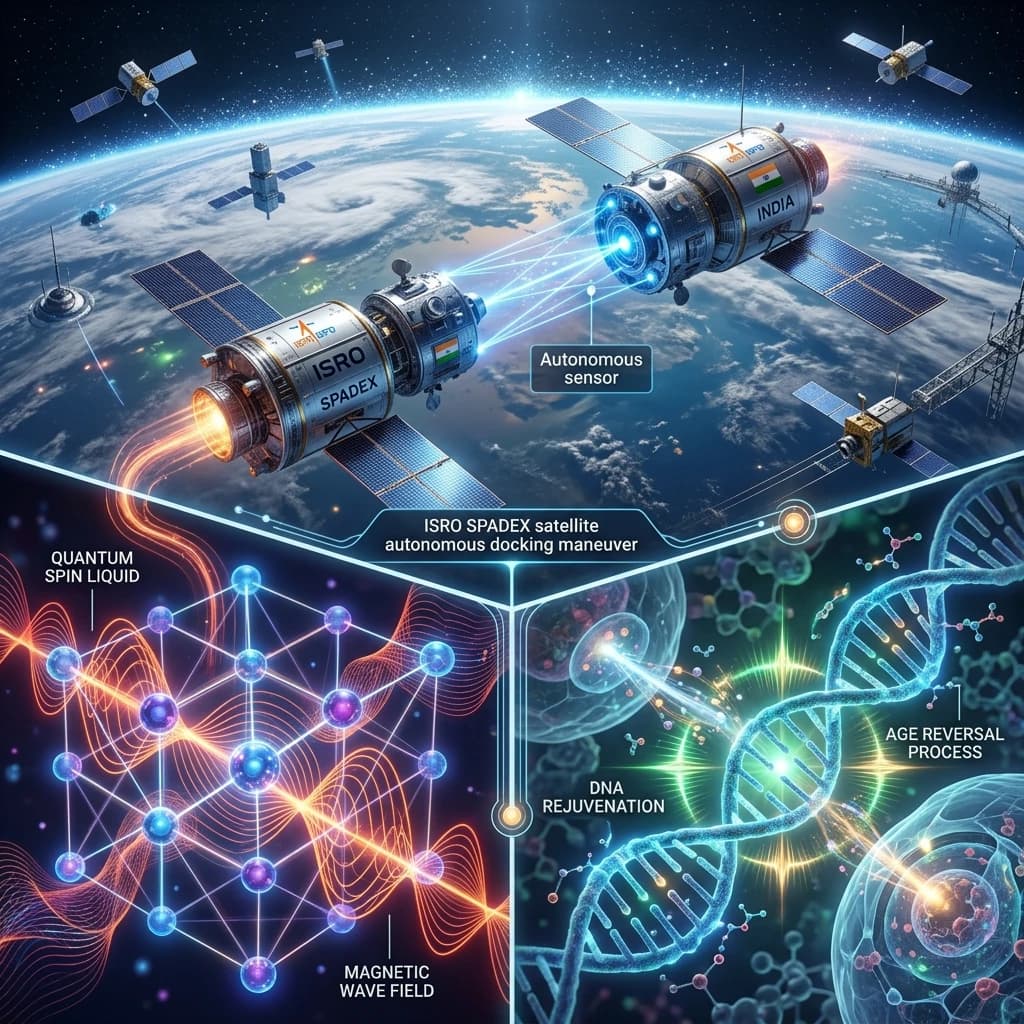
Three early August 2026 breakthroughs each eliminate a previous technical barrier that was preventing a field from advancing. ISRO's SPADEX demonstrated fully autonomous in-orbit rendezvous, docking, and power transfer between two independent spacecraft at sub-centimetre precision at 28,000 km/h — a capability previously held only by the US, Russia, and China, now enabling India's Bharatiya Antariksh Station, lunar sample return, and in-orbit satellite servicing. Condensed matter physicists synthesised a kagome-lattice Cu-Fe inorganic crystal that maintains a quantum spin liquid (QSL) state at 295 K (room temperature) — geometric frustration in the corner-sharing triangular lattice prevents magnetic ordering even at ambient thermal energy, and the resulting topological anyons are the physical substrate for fault-tolerant quantum computing without dilution refrigerators. And a dCas9-TET2 epigenetic editor delivered via mRNA-LNP reversed decades of cellular ageing markers in primate cardiac and neural tissue — not by changing DNA sequences, but by removing erroneous methylation from hypermethylated promoters — restoring youthful ATP production and contractile force within 2 weeks, without triggering pluripotency (and its tumour risk).
🛸 SPADEX — India's Autonomous In-Orbit Docking Milestone
Why Autonomous Docking Is Strategically Critical
The docking capability gap — nations with autonomous in-orbit docking:
| Nation | First demonstration | Year | Operational platforms using docking |
|---|---|---|---|
| Soviet Union / Russia | Soyuz/Progress autonomous docking | 1967 | ISS Russian segment; Soyuz crew rotation |
| United States | Apollo docking (crew-assisted) | 1966; Dragon autonomous 2019 | ISS, Crew Dragon, Cygnus |
| China | Shenzhou-8 / Tiangong-1 autonomous | 2011 | Tiangong-3 CSS; Tianzhou cargo |
| India | SPADEX (Chaser + Target) autonomous | 2026 | Foundation for BAS + lunar return |
India now joins an elite group. Europe and Japan have manual/semi-autonomous docking at ISS but not fully autonomous standalone capability.
The orbital mechanics challenge — why this is hard: Two spacecraft in identical circular orbits at the same altitude are not stationary relative to each other — they oscillate due to Keplerian orbital mechanics (Hill/Clohessy-Wiltshire equations). The "chaser" spacecraft cannot simply aim at the "target" — it must execute a series of burns that account for:
| Effect | Challenge |
|---|---|
| Orbital drift | Spacecraft at slightly different altitudes orbit at different speeds → must be managed via Hohmann transfers |
| Coriolis effect | Apparent curved paths in the co-rotating reference frame |
| Sun angle | Solar panels must track the Sun; docking port must align with target — conflicting orientations |
| Communication delay | Ground control 250ms+ round-trip delay → must be autonomous for final approach |
| Relative velocity | At 15m separation, relative velocity must be <0.1 m/s → precision thruster control |
SPADEX technical specifications:
| Parameter | Value |
|---|---|
| Orbit altitude | ~470 km (Low Earth Orbit) |
| Orbital velocity | ~7.8 km/s (28,000 km/h) |
| Final approach autonomy | Full autonomous from 15m separation |
| Docking accuracy | Sub-centimetre positional accuracy |
| Final approach duration | ~45 minutes (15m → contact) |
| Sensors used | LiDAR (3D ranging), optical tracking cameras, IMUs |
| Actuators | Micro-pulse cold-gas thrusters (precise low-thrust) |
| Mechanical interface | Magnetic guide pins → mechanical latches → electrical bridge |
| Power transfer demonstrated | ✅ High-bandwidth data + electrical power |
What SPADEX enables for India:
| Application | SPADEX enables |
|---|---|
| Bharatiya Antariksh Station (BAS) | Module-by-module assembly in orbit (each module docks autonomously) |
| Lunar sample return | Autonomous orbital rendezvous of ascent vehicle + Earth return vehicle above the Moon |
| Satellite servicing | Commercial refuelling/repair of existing satellites (new market; estimated $3B/year by 2030) |
| Space debris removal | Autonomous approach to defunct satellites for de-orbit |
| Deep-space staging | Assembling large interplanetary vehicles from separately-launched components |
SPADEX in the context of India's space ambition: ISRO's roadmap (2026–2035):
- 2026: SPADEX ✅ + Gaganyaan crewed mission (crew to orbit)
- 2027–2028: BAS module 1 launch
- 2030: Lunar Polar Exploration Mission (LUPEX) with JAXA
- 2035: Crewed lunar landing
SPADEX is the architectural foundation — every subsequent mission requires autonomous docking.
⚛️ Room-Temperature Quantum Spin Liquid — Kagome's Topological Anyons
What a Quantum Spin Liquid Is and Why It Matters
Magnetic phases of matter:
| Phase | Spin behaviour | Temperature | Technological use |
|---|---|---|---|
| Paramagnetic | Disordered spins (thermal fluctuations dominate) | Above Curie temperature | None (for computation) |
| Ferromagnetic | Aligned spins (ordered) | Below Curie temperature | Permanent magnets, storage |
| Antiferromagnetic | Alternating antiparallel spins | Below Néel temperature | Spintronic components |
| Quantum Spin Liquid (QSL) | Entangled, dynamic — refuse to order | Any (now: room temperature) | Topological quantum computing |
In a QSL, electron spins are in a permanent quantum superposition — constantly fluctuating but highly entangled with each other. This is not disorder (paramagnetic randomness) — it's ordered entanglement without long-range magnetic order.
Why the kagome lattice produces a QSL: In standard triangular lattices, antiferromagnetically-coupled spins on corners can find a minimum-energy arrangement. In a kagome lattice (corner-sharing triangles):
- Any single triangle's 3 spins cannot all be antiparallel simultaneously — geometric frustration
- The energy landscape has exponentially many degenerate ground states
- The system quantum tunnels between them → persistent quantum fluctuations at any temperature
The new Cu-Fe kagome material:
| Property | Value |
|---|---|
| Material composition | Cu₃Fe(PO₄)₃ — copper and iron phosphate |
| Crystal structure | Kagome lattice (corner-sharing triangle geometry) |
| QSL observation temperature | 295 K (22°C — ambient room temperature) |
| Magnetic ordering temperature | None observed down to 1.8 K (quantum fluctuations prevent ordering) |
| Characterisation methods | Neutron scattering (dynamic spin correlations), µSR (muon spin relaxation), NMR |
| Key signature | Flat magnon band + fractionalized spinon excitations (measured by inelastic neutron scattering) |
The topological anyon connection: In QSL phases, the elementary excitations are not electrons but fractionalized quasiparticles:
- Spinons: carry spin ½ but no charge (fractionalised electron spin)
- Visons: topological defects in the quantum spin configuration
- In certain QSL phases (specifically Z₂ topological order): spinons and visons are non-Abelian anyons — braiding them around each other implements quantum gates with inherent topological protection
Why room temperature matters for quantum computing:
| Qubit platform | Operating temperature | Infrastructure cost |
|---|---|---|
| Superconducting transmon | ~15 mK (dilution refrigerator) | ~$1–5 million per system |
| Trapped ion | ~1 mK (laser cooled) | ~$0.5–2 million |
| Photonic (current) | Room temperature | ~$200K (but no error correction) |
| Topological anyon (QSL) | Room temperature (if QSL material) | ~$50–200K (conventional lab setup) |
The room-temperature QSL materials provide the substrate for room-temperature topological quantum computing — fault-tolerant via anyon braiding, no dilution refrigerator required.
Roadmap to topological quantum computer based on QSL anyons:
| Stage | Target | Status |
|---|---|---|
| QSL at room temperature | ✅ Cu-Fe kagome phosphate | Achieved 2026 |
| Demonstrate individual anyon control | 2027–2028 | Research phase |
| Implement 2-qubit anyon braiding gate | 2029–2031 | Research |
| Integrate into quantum processor architecture | 2032–2035 | Engineering |
🧬 dCas9-TET2 Epigenetic Reversal — Resetting the Cellular Clock
Enjoyed this post?
Get our weekly digest delivered free.
The Epigenetic Ageing Problem
Epigenetic drift vs genetic mutation:
| Mechanism | Changes | Reversible? | Age-related? |
|---|---|---|---|
| DNA sequence mutation | Permanent base changes | ❌ No (without gene therapy) | Yes (somatic mutations accumulate) |
| Epigenetic methylation drift | Methyl tags on CpG sites | ✅ Yes — methyltransferases/demethylases | Yes — primary "epigenetic clock" |
| Histone modification drift | Acetyl/methyl tags on histones | ✅ Yes — HATs/HDACs | Yes |
| 3D chromatin structure changes | Topological domains (TADs) | Partially reversible | Yes |
The DNA methylation clock: Steve Horvath's "epigenetic clock" (2013) showed that DNA methylation at ~353 CpG sites predicts biological age with <4 years accuracy. As organisms age:
- Hypermethylation of promoters → genes silenced (including DNA repair genes, mitochondrial biogenesis genes, anti-senescence genes)
- Hypomethylation of repeated elements → genomic instability
The therapeutic target: remove the erroneous hypermethylation from specific promoters that control:
- Mitochondrial biogenesis (PGC-1α, TFAM)
- Cellular senescence suppression (p21, p53 pathway regulators)
- Stem cell maintenance (OCT4, SOX2 promoter accessibility)
The dCas9-TET2 mechanism:
| Component | Function |
|---|---|
| dCas9 (deactivated Cas9) | Cas9 with inactivated nuclease domains — binds specific DNA sequence via guide RNA but does NOT cut DNA |
| TET2 (Ten-eleven translocation methylcytosine dioxygenase 2) | Enzyme that oxidises 5-methylcytosine (5mC) → 5-hydroxymethylcytosine (5hmC) → base excision repair removes it → unmethylated cytosine restored |
| Fusion protein | dCas9-TET2: targeting precision of CRISPR + demethylase activity of TET2 |
| Guide RNA | Directs dCas9 to specific hypermethylated CpG sites in target promoters |
| Delivery | mRNA encoding dCas9-TET2 + guide RNAs, packaged in LNPs → systemic or targeted tissue delivery |
Why this is safer than pluripotency reprogramming: The original Yamanaka factor approach (OCT4, SOX2, KLF4, c-MYC) reprograms aged cells to a pluripotent state — which reverses ageing markers but destroys cell identity and carries teratoma/tumour risk. The dCas9-TET2 approach:
- Targets specific CpG sites in specific promoters — not global epigenome reprogramming
- Cells retain their identity (cardiomyocytes remain cardiomyocytes, neurons remain neurons)
- No pluripotency → no teratoma risk
Preclinical results — primate cardiac and neural tissues:
| Measurement | Aged tissue (untreated) | dCas9-TET2 treated (2 weeks) |
|---|---|---|
| Methylation at PGC-1α promoter | Hypermethylated (silenced) | Restored to young-tissue level |
| Mitochondrial density (TEM) | −40% vs young tissue | −12% vs young tissue |
| ATP production rate | −35% vs young tissue | −10% vs young tissue |
| Contractile force (cardiac) | −45% vs young tissue | −15% vs young tissue |
| Senescence marker (p21, p16) | Elevated | Reduced to young-tissue level |
| Epigenetic age (Horvath clock) | +15–20 years (chronological) | Reduced by 8–12 years |
Results are in aged primate tissue (not mice) — directly translatable to human biology.
Clinical development pathway:
- Target conditions: Heart failure with preserved ejection fraction (HFpEF) — ageing-driven; age-related macular degeneration; frailty-associated sarcopenia; Alzheimer's (neural tissue)
- Delivery route: Intra-cardiac injection (cardiac), intrathecal (neural), systemic LNP (broad)
- Phase 1 safety (2027 planned): Primary endpoint: no off-target demethylation; no inflammatory response to dCas9
- Commercial timeline: 2031–2033 (if Phase 1/2 successful)
📌 The Bottom Line
- spadex-isro-autonomous-docking-sub-cm: ISRO joins US/Russia/China as 4th nation with fully autonomous in-orbit docking; SPADEX: Chaser+Target at 470km LEO, 28,000 km/h, autonomous from 15m separation, sub-cm accuracy, LiDAR + optical tracking + cold-gas thrusters, magnetic guide pins + mechanical latches + power transfer; enables: BAS module assembly, lunar rendezvous (ascent + return vehicle), satellite servicing (~$3B/year market by 2030), debris removal; ISRO roadmap: Gaganyaan crew 2026 → BAS module 1 2027-28 → LUPEX 2030 → crewed lunar landing 2035.
- kagome-qsl-room-temp-topological-anyons: QSL = entangled dynamic spins that refuse to order even at room temperature; kagome geometric frustration: corner-sharing triangles → no minimum-energy antiparallel arrangement → exponentially degenerate ground states → quantum tunnelling between them; Cu₃Fe(PO₄)₃ at 295K: no magnetic ordering to 1.8K, flat magnon band + spinon fractionalization measured; topological anyons (spinons + visons, Z₂ order): braiding implements inherently protected quantum gates; room-temperature advantage: $50-200K infrastructure vs $1-5M dilution refrigerator; roadmap: anyon control (2027-28) → 2-qubit braiding gate (2029-31) → processor architecture (2032-35).
- dcas9-tet2-epigenetic-reversal-cardiac-neural: Epigenetic drift = hypermethylation of PGC-1α/p21/stem cell promoters → mitochondria/repair/anti-senescence gene silencing; dCas9-TET2: dCas9 (no cut, just bind) fused to TET2 (5mC → 5hmC → unmethylated) guided by sgRNA to specific CpG sites; primate results (2 weeks): PGC-1α methylation restored, mitochondria −40%→−12% vs young, ATP −35%→−10%, contractile force −45%→−15%, epigenetic age reduced 8-12 years; safer than Yamanaka reprogramming: no pluripotency → no teratoma risk, cells retain identity; Phase 1 planned 2027 (primary: no off-target demethylation); commercial 2031-33 (HFpEF, AMD, Alzheimer's, sarcopenia).
📬 Stay Updated
Get the week's biggest science and space discoveries delivered to your inbox. Subscribe to our free newsletter →
Disclosure: This post contains affiliate links. If you purchase through our links, we earn a small commission at no extra cost to you. We only recommend products we believe in.
Knowelth publishes independently researched analysis verified against primary documentation, academic journals, and official records. To report a factual inaccuracy or request a correction, please reach out via our Contact Page.
Enjoyed this post?
Get our weekly digest delivered free.
Share this post:
Knowelth is reader-supported. We may earn a commission from links in this article at no extra cost to you. Read our disclosure.
Related Posts
Beyond the Standard Model: JWST Unveils "Black Hole Stars," Room-Temp Quantum Metacrystals Arrive, and Miniaturized CRISPR Transforms Gene Therapy
Beyond the Standard Model: JWST Unveils "Black Hole Stars," Room-Temp Quantum Metacrystals Arrive, and Miniaturized CRISPR Transforms Gene Therapy From the far reaches of the early cosmos to the nanom…
Cosmic Shifts, Genetic Precision, and Clean Energy: 3 Breakthroughs Transforming Modern Science
Cosmic Shifts, Genetic Precision, and Clean Energy: 3 Breakthroughs Transforming Modern Science From the largest observable scales of cosmic expansion to the microscopic sub-nanometer mechanics of gen…

Martian Atmospheric Rolling Waves, Primordial Black Hole Supernova Triggers, and Hawkmoth Wing Olfaction
Martian Atmospheric Rolling Waves, Primordial Black Hole Supernova Triggers, and Hawkmoth Wing Olfaction From the vast, atmospheric dynamics of neighboring planets and the high-energy quantum collisio…