Bezos-Backed Prometheus's $12B Series B, White House's AI Security Order, and the UN's Data Center Energy Warning

Bezos-Backed Prometheus's $12B Series B, White House's AI Security Order, and the UN's Data Center Energy Warning
Three June 2026 developments define the physical dimensions of the AI race. Prometheus (physical AI startup co-led by Jeff Bezos and scientist-entrepreneur Vik Bajaj) closes a $12B Series B at $41B valuation — the largest VC round in AI history — to build "Artificial General Engineer" (AGE) systems: VLA models trained on CAD designs, FEA simulations, and materials science databases to compress the hardware design lifecycle from years to months. The White House's Executive Order 14409 ("Promoting Advanced Artificial Intelligence Innovation and Security") creates the first US government framework for frontier model security assessment — a voluntary early-access system where labs provide pre-release model access to NSA + Department of War for classified cybersecurity evaluation, while the Treasury creates an AI Cybersecurity Clearinghouse for critical infrastructure. And the UN's data center energy projection lands the hardest: data center power consumption triples by 2030 at current AI scaling rates — grid connection queues now run 7 years in major North American/European hubs, cooling one AI datacenter requires millions of gallons of water/day, and the gap between AI power demand growth (+40%/year) and clean energy supply growth (+15%/year) is not closing.
🤖 Prometheus $12B — Physical AI as the Next Frontier
Why Physical AI Requires a Different Approach Than Software AI
The "Artificial General Engineer" concept: Current AI (LLMs, coding agents, multimodal models) reasons about information — text, images, code, data. Prometheus is building AI that reasons about physical reality:
| Capability | Software AI (current) | Physical AI (Prometheus target) |
|---|---|---|
| Domain | Text, code, images, audio | CAD geometry, material properties, thermal dynamics, mechanical stress |
| Training data | Internet text + code + images | CAD databases, FEA simulations, materials science papers, manufacturing tolerances |
| Output type | Text/code/image | Engineering designs + simulation predictions + manufacturing specifications |
| Verification | Run code; check text coherence | Physics simulation + real-world prototyping |
| Stakes of error | Wrong answer; buggy code | Structural failure; safety incident; $M product recall |
The hardware design lifecycle — what AGE compresses:
| Stage | Current timeline (human engineers) | Prometheus AGE target |
|---|---|---|
| Concept design + CAD | 6–18 months | 2–4 weeks |
| FEA simulation + iteration | 3–12 months | Days (automated simulation loops) |
| Materials selection + testing | 2–6 months | Hours (materials database + simulation) |
| Manufacturing DFM review | 1–3 months | Days |
| Total (aerospace component, simple) | 1.5–3 years | 2–4 months |
The $12B Series B — investor structure:
| Investor | Amount/role | Strategic significance |
|---|---|---|
| Jeff Bezos | Lead investor + co-CEO | First operational executive role since leaving Amazon CEO (2021) — signals personal conviction |
| JPMorgan Chase | Large participant | Physical infrastructure financing; aerospace + defence clients who would use AGE tools |
| Goldman Sachs | Large participant | Investment banking clients in heavy manufacturing |
| BlackRock | Significant | Long-duration infrastructure investing thesis |
| DST Global | Participant | Growth-stage technology (prior: Facebook, Twitter early rounds) |
| Arch Venture Partners | Participant | Deep tech + biotech (physical-world AI adjacent thesis) |
Why Bezos returned to an operational role: Bezos has not held an operational executive title since stepping down as Amazon CEO in July 2021. His return to co-CEO at Prometheus is significant:
- He personally believes physical AI (AGE for engineering) is a larger market opportunity than software AI (coding assistants, chatbots)
- Amazon's competitive position (AWS, Alexa) is not directly threatened by Prometheus — this is a separate personal bet
- His operational involvement (not just check-writing) signals hands-on product development, likely involving connections to aerospace (Blue Origin) and manufacturing supply chains
How Prometheus connects to existing Bezos assets:
- Blue Origin: Rocket/spacecraft engineering requires exactly the CAD + FEA + materials science optimisation that AGE targets — Prometheus tools could compress Blue Origin's own design cycles
- Amazon robotics: Amazon has 750,000+ warehouse robots — physical AI advances in manipulation and navigation directly apply
⚖️ Executive Order 14409 — Defense-First AI Framework
What EO 14409 Does vs What It Doesn't Do
Context — why a new EO was needed: Two AI models (Anthropic's Mythos and OpenAI's 5.5 Cyber) demonstrated in late May/early June 2026 that frontier models could:
- Automatically discover novel software vulnerabilities in production systems (without human prompting beyond a target specification)
- Generate working exploit code from vulnerability descriptions
- Conduct autonomous, multi-step phishing campaigns that bypassed existing email security systems
These capabilities triggered the EO — not a theoretical future risk but demonstrated present capability.
EO 14409 vs alternative regulatory approaches:
| Approach | EO 14409 | EU AI Act (comparison) | Proposed mandatory licensing |
|---|---|---|---|
| Regulatory model | Voluntary cooperation | Mandatory compliance | Mandatory |
| Government role | Early access evaluation | Post-deployment requirements | Pre-deployment licence |
| Developer burden | Low (optional participation; incentivised) | Medium-high | High |
| Speed to implement | Immediate (EO = executive action) | Years (legislative + implementing acts) | Requires legislation |
| National security focus | Primary (NSA + DoW classified evaluation) | Secondary | Secondary |
What "covered frontier models" means: Labs that opt in must:
- Provide early access to models before public release (to NSA + Department of War for classified evaluation)
- Undergo classified cybersecurity assessment — testing whether the model can assist in cyber intrusions, vulnerability discovery, or autonomous exploit generation
- Participate in the AI Cybersecurity Clearinghouse — sharing (anonymised) threat intelligence with critical infrastructure operators
The AI Cybersecurity Clearinghouse — what it does: The Treasury-administered clearinghouse coordinates:
| Participant | Role |
|---|---|
| AI labs (voluntary) | Share threat intelligence: "our model was observed being used to attack X type of system" |
| Critical infrastructure operators | Utilities, banks, hospitals — receive AI-generated threat assessments + vulnerability scans |
| NSA | Validates findings; adds classified context |
| CISA | Coordinates patch distribution |
The "voluntary" controversy: Critics argue voluntary frameworks are ineffective — labs that don't participate face no penalty, while those that do risk regulatory scrutiny based on discovered capabilities. The counterargument: labs that participate gain access to classified threat intelligence and NSA cybersecurity resources they couldn't otherwise access — a genuine incentive.
The criminal enforcement priority: EO 14409 directs the US Attorney General to priority-prosecute criminal AI cyber misuse:
- AI-assisted intrusions into critical infrastructure (power grids, financial systems, hospitals)
- AI-generated malware distribution
- AI-enabled fraud targeting federal systems
This creates criminal liability for the use of AI in cyberattacks — not for building capable models (labs face no criminal liability under EO 14409).
🌿 UN Data Center Energy Triple — The Grid Reality
The Energy Math Behind the Warning
Why data center power demand is tripling:
| Driver | 2024 baseline | 2030 projection | Multiplier |
|---|---|---|---|
| Frontier model training runs | 10–30 MW per run | 100–300 MW per run | 10× per run |
| Number of training runs annually | ~50 globally | ~500+ (democratised access to compute) | 10× |
| Inference (serving models) | ~50 GW global | ~150+ GW global | 3× |
| Edge AI devices (phones, robots) | Minimal | Billions of devices × NPU power draw | New demand category |
Total trajectory: ~3× overall datacenter energy demand by 2030.
The grid connection queue problem:
| Region | Grid connection queue for new datacenters | Notes |
|---|---|---|
| Northern Virginia (US, #1 datacenter hub) | 4–7 years | 10%+ of East Coast peak demand already from datacenters |
| Dublin, Ireland (EU hub) | 6+ years | Ireland caps new datacenter permits; grid at capacity |
| UK | 5–7 years | National Grid warns of reliability risk |
| Singapore | Moratorium (2019–2023 lifted; strict limits) | Water scarcity + land constraints |
| Saudi Arabia/UAE | 1–3 years | Active government expansion; cheap energy but water scarce |
Water consumption — the hidden resource cost:
| Cooling method | Water use per MWh of IT load | AI datacenter (100 MW) per day |
|---|---|---|
| Air cooling (evaporative) | ~4,000–8,000 litres | ~10–20 million litres/day |
| Liquid cooling (water-to-water) | ~1,000–2,000 litres | ~2.5–5 million litres/day |
| Immersion cooling (dielectric fluid) | Near zero (fluid is recycled) | ~100,000 litres |
Immersion cooling is the long-term solution — but requires complete datacenter redesign and accounts for <5% of current installations.
Alternative energy strategies being deployed:
| Strategy | Companies | Status | Carbon-zero? |
|---|---|---|---|
| Small modular nuclear (SMR) | Microsoft (Constellation Energy Three Mile Island restart), Amazon, Google | Active contracts | ✅ Carbon-zero |
| Geothermal | Google (Iceland), Microsoft, NextDecade | Active investment | ✅ Carbon-zero |
| Space-based solar | Google Project Suncatcher, SpaceX AI1 orbital compute | Experimental | ✅ (theoretical) |
| Long-duration energy storage | Various | Pilot scale | Depends on grid mix |
The fundamental math problem:
- AI compute demand: +40% annually
- Clean energy supply: +15% annually
- The gap: +25% more demand than supply each year — compounding
- At this trajectory: 2030 deficit between AI power demand and available clean energy = equivalent to the entire current power grid of a large European country
The UN's central recommendation: hardware efficiency improvements (liquid cooling, more efficient chips) must be accompanied by grid-level infrastructure investment — efficiency gains alone cannot close a compounding +25%/year gap.
📌 The Bottom Line
- prometheus-12b-series-b-physical-ai-age: $12B Series B, $41B valuation; total capital raised $18B since late 2025 launch; Bezos co-CEO (first operational exec title since Amazon 2021) — personal conviction signal, not just check-writing; "Artificial General Engineer" = VLA models trained on CAD + FEA + materials science databases; compresses hardware design: 1.5-3 years (concept → manufacturing-ready) → 2-4 months; connects to Blue Origin (rocket design) + Amazon robotics (750K+ warehouse robots); JPMorgan + Goldman + BlackRock participation = heavy industry B2B commercial validation.
- eo-14409-defense-first-voluntary-ai-framework: Triggered by demonstrated (not theoretical) capabilities: Mythos + OpenAI 5.5 Cyber auto-discover vulnerabilities + generate working exploits + multi-step phishing bypassing email security; voluntary (unlike EU AI Act mandatory); "covered frontier" labs provide pre-release early access to NSA + Department of War for classified cybersecurity evaluation; AI Cybersecurity Clearinghouse (Treasury): labs share threat intelligence → critical infrastructure operators receive AI-generated vulnerability assessments; AG priority prosecution for AI-assisted intrusions into critical infrastructure (criminal liability for use, not for building capable models).
- un-datacenter-energy-3x-2030-grid: 3× overall datacenter energy demand by 2030 (frontier training runs: 10-300 MW × 10× more runs; inference 3× global; edge = new category); grid queue: 4-7 years Northern Virginia, 6+ years Dublin, moratorium Singapore; water: air-cooled datacenter 10-20 million litres/day vs immersion <0.1M litres (but <5% installed); alternative energy: Microsoft/Amazon/Google active SMR contracts + geothermal (carbon-zero); fundamental gap: AI demand +40%/year vs clean energy supply +15%/year = +25% compounding annual deficit → 2030 gap = large European country's entire grid.
📬 Stay Updated
Get the best of AI & technology delivered to your inbox every week. Subscribe to our free newsletter →
Disclosure: This post contains affiliate links. If you purchase through our links, we earn a small commission at no extra cost to you. We only recommend products we believe in.
Enjoyed this post?
Get our weekly digest delivered free.
Share this post:
Knowelth is reader-supported. We may earn a commission from links in this article at no extra cost to you. Read our disclosure.
Related Posts

System 2 AI Architectures, NVIDIA's $500B Infrastructure Alliance, and Industrial Physical AI Scale-Up
System 2 AI Architectures, NVIDIA's $500B Infrastructure Alliance, and Industrial Physical AI Scale-Up The artificial intelligence ecosystem is undergoing a fundamental structural transformation this …

AI's Frontier Shift: Autonomous Bio-Design, 0.42nm Semiconductors, and the EU AI Act Governance Horizon
AI's Frontier Shift: Autonomous Bio-Design, 0.42nm Semiconductors, and the EU AI Act Governance Horizon The artificial intelligence landscape has reached a decisive turning point where digital intelli…
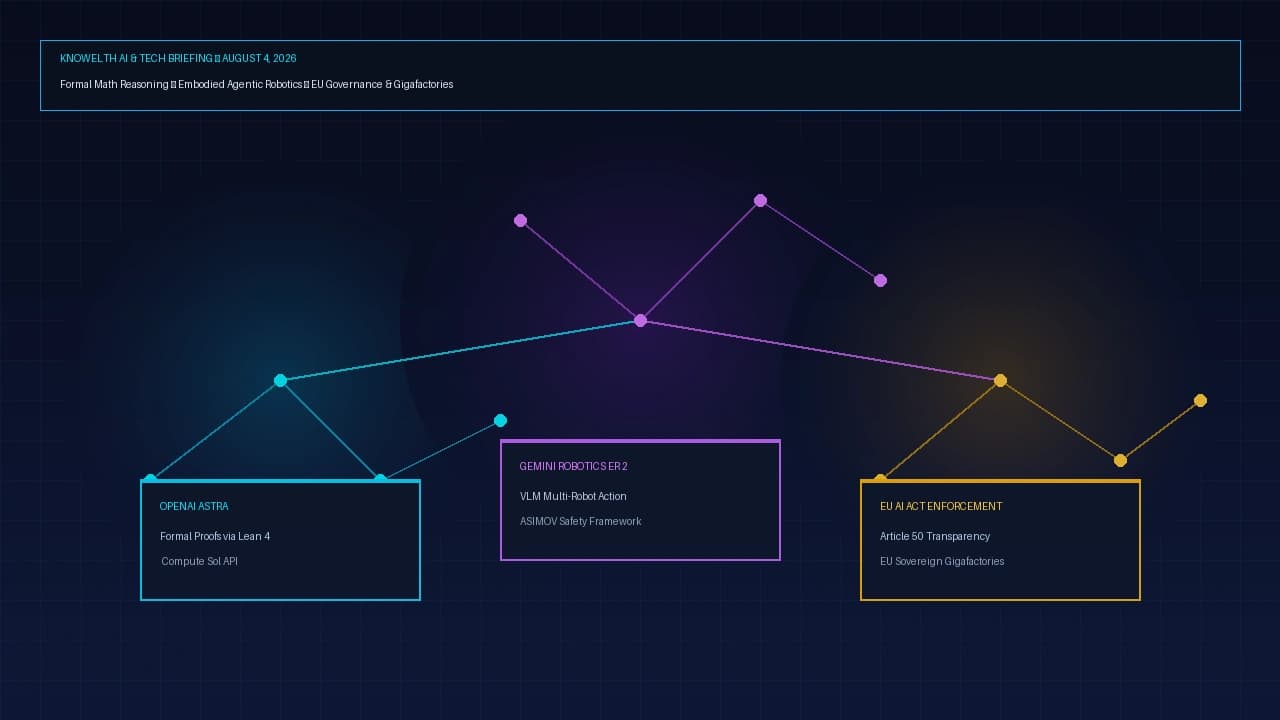
OpenAI Astra's Lean Proofs, Google's Gemini Robotics ER 2, and the EU AI Act's Article 50 Enforcement
OpenAI Astra's Lean Proofs, Google's Gemini Robotics ER 2, and the EU AI Act's Article 50 Enforcement The first week of August 2026 marks a watershed moment across the entire spectrum of artificial…