OpenAI Astra's Lean Proofs, Google's Gemini Robotics ER 2, and the EU AI Act's Article 50 Enforcement
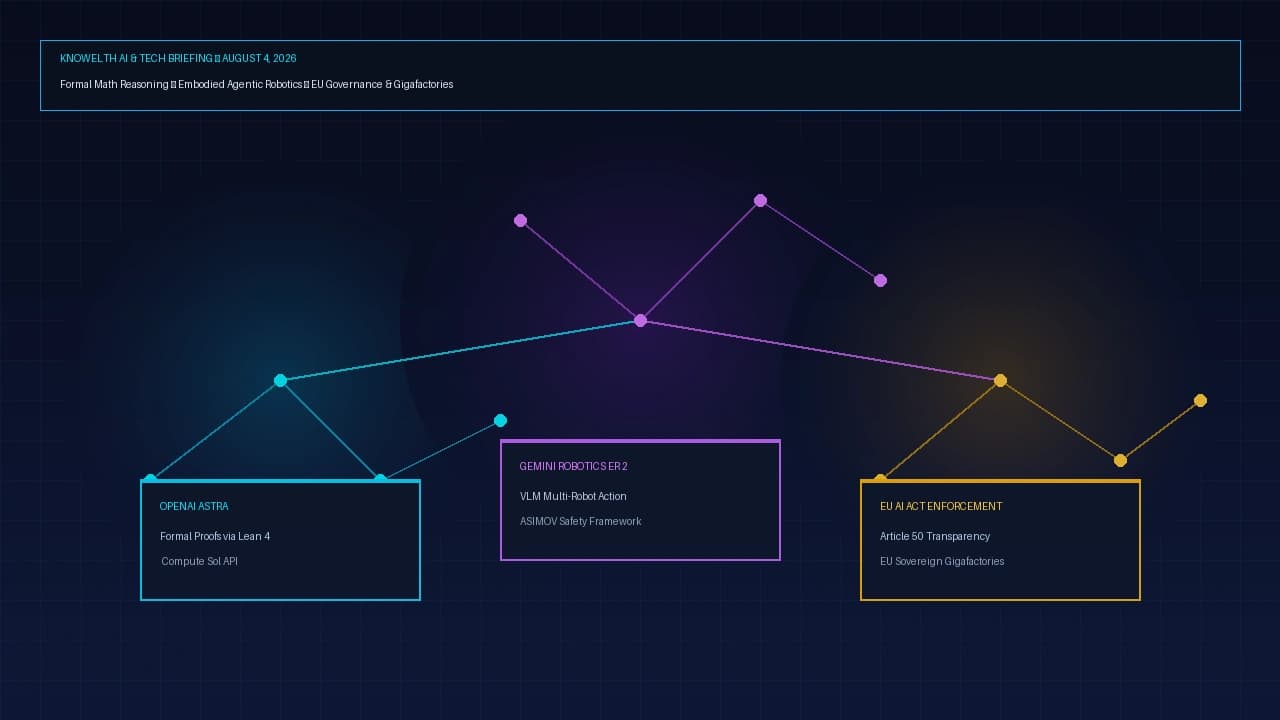
OpenAI Astra's Lean Proofs, Google's Gemini Robotics ER 2, and the EU AI Act's Article 50 Enforcement
The first week of August 2026 marks a watershed moment across the entire spectrum of artificial intelligence. From theoretical breakthroughs in pure mathematical proof verification to the physical embodiment of spatial AI in enterprise robotics, and the rigorous global enforcement of landmark regulatory frameworks, the AI landscape is shifting rapidly from generative novelty to autonomous execution and accountable governance.
🧮 Section 1: OpenAI Astra Cracks Unsolved Mathematics with Lean 4 Certificates
In a landmark achievement for computational logic and frontier AI, OpenAI has officially unveiled Astra, its next-generation multi-agent model family engineered specifically for high-level reasoning and formal theorem proving. In early August 2026, OpenAI published results demonstrating that an advanced iteration of Astra successfully resolved or made foundational progress on ten long-standing open problems across theoretical computer science and pure mathematics.
Formal Verification Replaces Heuristics
Unlike previous generative architectures susceptible to subtle logic hallucinations, Astra’s breakthroughs were validated using Lean 4 certificates—machine-checkable formal proof scripts published transparently on GitHub. By coupling Astra's generative search with interactive theorem provers (ITPs), OpenAI established a zero-trust verification pipeline where mathematical claims are deterministically verified by compiler-grade logic kernels.
Key mathematical domains impacted by Astra's automated proofs include:
- High-Dimensional Geometry: Substantial bounds improvement on sphere-packing density lattices.
- Group Theory: Algorithmic verification surrounding non-sofic group approximations.
- Quantum & Circuit Complexity: Disproving classical reductions in operator algebras and arithmetic circuit bounds.
- Lattice Cryptography: Formally proving hardness limits for specific learning-with-errors (LWE) variants under quantum attacks.
       +-------------------------------------------------------+
       |                  OpenAI Astra Model                   |
       |  (Multi-Agent Hypothesis & Logic Search Engine)       |
       +---------------------------+---------------------------+
                                   |
                                   v
       +-------------------------------------------------------+
       |             Lean 4 Formal Proof Kernel                |
       |  (Deterministic Machine-Checkable Verification)       |
       +---------------------------+---------------------------+
                                   |
                                   v
       +-------------------------------------------------------+
       |           Guaranteed Hallucination-Free Proof         |
       +-------------------------------------------------------+
Economic and Industry Ripple Effects
Remarkably, OpenAI reported that the entire proof generation run cost approximately $2,000 in compute units utilizing their Sol API infrastructure. The breakthrough ignited an immediate industry response: rival frontier lab Anthropic noted that its Claude Fable reasoning suite had independently validated five of the ten open conjectures, signaling an intense competition among labs to dominate automated scientific discovery.
However, the achievement has reignited debates within the academic community. Building upon concerns voiced in the 2026 Leiden Declaration on Automated Mathematics, scholars continue to analyze whether machine-generated Lean certificates provide deep conceptual intuition or merely exhaustive combinatorial search across formal space.
🤖 Section 2: Physical AI & Embodied Agentic Intelligence: Google Gemini Robotics ER 2
As mathematical AI conquers abstract spaces, physical AI is making an equally significant leap into real-world enterprise environments. Google DeepMind announced the release of Gemini Robotics ER 2, an embodied reasoning model built upon the Gemini 3.5 Flash architecture, designed specifically to function as the cognitive engine for autonomous industrial and service robotics.
Spatial Reasoning & Multi-Robot Collaboration
Operating as a high-level Vision-Language Model (VLM), Gemini Robotics ER 2 bridges the gap between high-level natural language intent and low-level Vision-Language-Action (VLA) motor control. Rather than relying on rigid predefined scripts, the model handles long-horizon physical workflows spanning several minutes while continuously evaluating video telemetry feeds.
Key technical capabilities include:
- Autonomous Error Recovery: If a robotic gripper drops an object or encounters an obstacle, ER 2 dynamically reformulates its task graph and re-attempts the sub-goal without requiring a full workflow reset.
- Multi-Robot Orchestration: Enables fleets of heterogeneous robots (e.g., mobile platforms and articulated arms) to divide labor, negotiate shared spatial coordinates, and coordinate assembly tasks in shared workplaces.
- Native Tool Calling & API Integration: Robots can autonomously execute external API calls, query inventory databases, or run web searches to resolve ambiguity in unknown physical environments.
+-------------------------------------------------------------------------+
|                       Gemini Robotics ER 2                              |
|           (Gemini 3.5 Flash Spatial Vision-Language Engine)             |
+------------------------------------+------------------------------------+
                                     |
           +-------------------------+-------------------------+
           |                                                   |
           v                                                   v
+-----------------------+                           +-----------------------+
|  Autonomous Error     |                           |   Multi-Robot Fleet   |
|  Self-Correction      |                           |   Orchestration       |
+-----------------------+                           +-----------------------+
Safety Governance: ASIMOV-Agentic & Enterprise Deployment
To ensure safe real-world deployment, Google introduced the ASIMOV-Agentic Benchmark alongside ER 2. This safety framework strictly measures collision avoidance metrics, physical risk containment, and explicit thresholding for requesting human-in-the-loop intervention during ambiguous operations. Available via Google AI Studio and private preview on the Gemini Enterprise Agent Platform, ER 2 represents a major milestone in transitioning agentic AI from cloud text interactions to physical manufacturing and logistics automation.
⚖️ Section 3: Regulatory Reality: EU AI Act Article 50 Enforcement & AI Gigafactories
Enjoyed this post?
Get our weekly digest delivered free.
On August 2, 2026, global AI regulation crossed a decisive threshold as Article 50 of the European Union AI Act officially entered into force across all member states. Overseen by the European AI Office and national market surveillance authorities, Article 50 mandates strict, enforceable transparency obligations for all synthetic content and AI-driven human interactions.
Core Provisions of Article 50
Under the newly active provisions:
- Mandatory AI Disclosure: Any AI system interacting directly with natural persons (such as customer service agents or enterprise bots) must explicitly identify itself as an artificial entity at the onset of interaction.
- Synthetic Content Watermarking: AI-generated text, audio, image, and video media must incorporate machine-readable metadata, cryptographic watermarks, and user-visible tags to guarantee provenance and deter deepfakes.
- Specialized Disclosures: Higher-risk applications involving emotion recognition, biometric categorization, or deepfake synthesis are subject to heightened real-time user notification rules.
| Provision | Scope & Obligation | Non-Compliance Penalty |
|---|---|---|
| Interactive AI Disclosure | Mandatory notification when users interact with non-human agents | Up to €15M or 3% global annual turnover |
| Content Watermarking | Machine-readable tags & cryptographic origin metadata | Up to €15M or 3% global annual turnover |
| Biometric & Emotion AI | Explicit consent & real-time transparency disclosures | Up to €35M or 7% global annual turnover |
The Sovereign "AI Gigafactories" Strategy
To offset regulatory friction and prevent capital flight, the European Commission simultaneously announced the expansion of its EU AI Gigafactories initiative. By pairing rigorous transparency enforcement with state-backed subsidies for sovereign supercomputing infrastructure, Europe aims to host high-density AI data centers powered by clean energy, ensuring regional tech sovereignty while establishing the world's most stringent safety standards.
🎯 Conclusion: The Triad of Modern AI Evolution
The events of August 4, 2026 illustrate a maturing industry defined by three interconnected pillars: verifiable formal intelligence (OpenAI Astra), embodied physical execution (Gemini Robotics ER 2), and accountable governance (EU AI Act Article 50). As frontier labs push mathematical capabilities to new heights, enterprises and regulators are establishing the infrastructure, safety benchmarks, and legal frameworks required to integrate these autonomous systems safely into global society.
Knowelth publishes independently researched analysis verified against primary documentation, academic journals, and official records. To report a factual inaccuracy or request a correction, please reach out via our Contact Page.
Enjoyed this post?
Get our weekly digest delivered free.
Share this post:
Knowelth is reader-supported. We may earn a commission from links in this article at no extra cost to you. Read our disclosure.
Related Posts

System 2 AI Architectures, NVIDIA's $500B Infrastructure Alliance, and Industrial Physical AI Scale-Up
System 2 AI Architectures, NVIDIA's $500B Infrastructure Alliance, and Industrial Physical AI Scale-Up The artificial intelligence ecosystem is undergoing a fundamental structural transformation this …
AI's Frontier Shift: Autonomous Bio-Design, 0.42nm Semiconductors, and the EU AI Act Governance Horizon
AI's Frontier Shift: Autonomous Bio-Design, 0.42nm Semiconductors, and the EU AI Act Governance Horizon The artificial intelligence landscape has reached a decisive turning point where digital intelli…

Deep Reasoning Models, Embodied Robotics ER 2, and the HBM4 Silicon Era
Deep Reasoning Models, Embodied Robotics ER 2, and the HBM4 Silicon Era As August 2026 unfolds, the artificial intelligence landscape is undergoing a structural paradigm shift away from conversational…