Deep Reasoning Models, Embodied Robotics ER 2, and the HBM4 Silicon Era

Deep Reasoning Models, Embodied Robotics ER 2, and the HBM4 Silicon Era
As August 2026 unfolds, the artificial intelligence landscape is undergoing a structural paradigm shift away from conversational chatbots toward autonomous, spatially aware, and deeply analytical agentic systems. From OpenAI's latest "Astra" reasoning benchmarks to Google's Gemini Robotics ER 2 platform and the industry-wide hardware migration to HBM4 memory architecture, AI is evolving simultaneously across algorithmic intelligence, physical robotics, and custom silicon infrastructure.
This technical investigation explores three synchronized breakthroughs redefining the state of computing: Deep Reasoning Models utilizing dynamic Monte Carlo search trees and formal theorem verification, Google’s Gemini Robotics ER 2 (Embodied Reasoning 2) multi-modal vision-language-action (VLA) foundation framework, and the commercial deployment of High Bandwidth Memory 4 (HBM4) across NVIDIA’s Vera Rubin architecture and custom hyperscaler ASICs.
🤖 Deep Reasoning Frontier: Breakthroughs in Multi-Step Mathematical and Algorithmic Logic
OpenAI Astra Formal Verification, Test-Time Compute Scaling, and Symbolic Proof Search
The Bifurcation of Language Models into Fast vs. Deep Reasoning: In August 2026, artificial intelligence research crossed a critical threshold with the deployment of OpenAI's internal "Astra" deep reasoning model family. Moving beyond standard autoregressive token prediction (which generates outputs with static per-token compute), Astra utilizes dynamic test-time compute allocation, automated backtracking, and formal symbolic proof verification to solve complex multi-step reasoning problems across mathematics, cryptographic verification, and hardware design.
                      [Deep Reasoning Test-Time Compute Architecture]
                                          │
                                          ▼
                      [User Complex Problem Input (Mathematical/Code)]
                                          │
                                          ▼
                      [Dynamic Monte Carlo Tree Search (MCTS) Engine]
                                          │
          ┌───────────────────────────────┴───────────────────────────────┐
          ▼                                                               ▼
[Branch Generation & Value Function]                            [Formal Symbolic Verifier (Lean 4/Coq)]
• Explores 10,000+ Parallel Logic Pathways                      • Real-Time Syntactic & Semantic Validation
• Prunes Degenerate / Illogical Trajectories                    • Detects Axiomatic Contradictions Instantly
• Allocates Up to 120 Seconds of Variable Compute               • Triggers Automated Backtracking Search
          │                                                               │
          └───────────────────────────────┬───────────────────────────────┘
                                          │
                                          ▼
                      [Verified Error-Free Proof / Synthesis Output]
Reasoning Architectures vs. Autoregressive Baseline Comparison:
| Architectural Metric | Standard Autoregressive LLM (2024–2025) | Deep Reasoning Model (Astra / o3 2026) |
|---|---|---|
| Inference Compute Allocation | Constant ($O(1)$ compute per token) | Dynamic ($O(N)$ variable search-time compute) |
| Formal Logic Verification | Statistical heuristic generation | Integrated with Lean 4 / Isabelle / Coq engines |
| Backtracking Mechanism | None (Single forward-pass generation) | Multi-branch MCTS with state-value scoring |
| Mathematical Benchmark (AIME) | 12% – 25% zero-shot accuracy | 94.8% verified formal accuracy |
| Complex Code Synthesis (SWE-bench) | 35% – 52% single-attempt pass | 88.6% multi-turn autonomous resolution |
| Hallucination Probability | 8.5% – 14.2% on scientific domain queries | < 0.3% verified domain hallucination rate |
Formal Verification in Enterprise Software and Hardware: Deep reasoning architectures evaluate thousands of potential execution paths before committing to an output. In formal verification environments, Astra solved ten long-standing open mathematical conjectures, proving that test-time compute scaling unlocks qualitative leaps in reasoning capability that cannot be achieved solely through pre-training parameter expansion.
🦾 Physical AI Ascendant: Google's Gemini Robotics ER 2 and Autonomous Spatial Intelligence
Multimodal Vision-Language-Action (VLA) Architecture, 3D Semantic Mapping, and Zero-Shot Manipulation
The Convergence of Foundation Models and Physical Embodiment: Unveiled in mid-2026, Google's Gemini Robotics ER 2 (Embodied Reasoning 2) represents the operationalization of vision-language-action (VLA) foundation models for autonomous robotics. Unlike earlier industrial systems that required hardcoded kinematic scripts or rigid spatial constraints, ER 2 enables humanoid platforms and collaborative robotic manipulators to understand open-world 3D environments, reason through multi-step physical goals, and dynamically adjust force feedback in real time.
                      [Gemini Robotics ER 2 Physical AI Pipeline]
                                          │
          ┌───────────────────────────────┼───────────────────────────────┐
          ▼                               ▼                               ▼
[Continuous Video Inflow (60 FPS)] [Tactile Force Sensors]         [Stereo LiDAR / Depth Maps]
• Real-Time Spatial Semantic Tokens• Joint Torque Feedback Loops   • Metric Point-Cloud Generation
          │                               │                               │
          └───────────────────────────────┼───────────────────────────────┘
                                          │
                                          ▼
                      [Unified Spatial-Temporal Latent Model]
                       (Processes 3D Vector Fields & Object Mass)
                                          │
          ┌───────────────────────────────┴───────────────────────────────┐
          ▼                                                               ▼
[High-Level Cognitive Task Planning]                            [Low-Level Microsecond Motor Control]
• "Disassemble Faulty Battery Module"                           • Joint Angle Velocity Commands (500 Hz)
• Spatial Affordance Mapping & Tool Selection                   • Slip Detection & Dynamic Force Adaptation
          │                                                               │
          └───────────────────────────────┬───────────────────────────────┘
                                          │
                                          ▼
                      [Zero-Shot Manipulation in Unstructured Space]
ER 2 Operational Metrics and Industrial Performance:
| Performance Metric | Gemini Robotics ER 2 Parameter | Industrial / Deployment Advantage |
|---|---|---|
| Motor Loop Frequency | 500 Hz Real-Time Closed-Loop | Enables sub-millisecond slip recovery and compliant grasping |
| Inference Latency | 24.5 ms End-to-End Visual Planning | Real-time motion planning during dynamic human interaction |
| Zero-Shot Adaptation Rate | 82.4% on Unseen Objects | Handles novel industrial parts without retraining or CAD models |
| Task Generalization Score | 91.2% Success on Multi-Stage Assembly | Executes complex 15-step mechanical assembly protocols |
| Deployment Platforms | Boston Dynamics Atlas, Apptronik Apollo | Hardware-agnostic runtime compatibility across manipulators |
3D Vector Field Latent Representations: Rather than predicting pixel frames, ER 2 constructs a spatial vector field representing object mass, surface friction, Center of Gravity (CoG), and kinematic constraints. This enables physical AI systems to manipulate fragile components (such as electronic semiconductors or glassware) with compliant precision in warehouse and manufacturing environments.
⚡ Semiconductor Architecture Shift: The Mid-2026 HBM4 Rollout and Custom ASIC Dominance
Enjoyed this post?
Get our weekly digest delivered free.
High Bandwidth Memory 4 (HBM4), NVIDIA Vera Rubin NVL72, and The "Inference Flip"
Overcoming the Memory Wall in Frontier Computing: Mid-2026 marks the official transition to the HBM4 Silicon Era, driven by the commercial ramp-up of NVIDIA's flagship Vera Rubin NVL72 platform and next-generation custom ASICs (Google TPU v7 "Ironwood" and AWS Trainium 3). With the industry crossing the "Inference Flip"—where total enterprise compute spend on model inference surpassed pre-training capital outlay—memory bandwidth has replaced raw FLOPS as the primary determinant of system throughput.
                      [HBM4 Memory Architecture vs. HBM3E]
                                          │
          ┌───────────────────────────────┴───────────────────────────────┐
          ▼                                                               ▼
[HBM3E Standard Architecture]                                   [HBM4 Next-Generation Standard]
• 1024-Bit Interface Bus                                        • **2048-Bit Ultra-Wide Interface Bus**
• Standard Microbump Interconnects                              • Direct Copper-to-Copper Hybrid Bonding
• Bandwidth: ~1.2 TB/s per Stack                                • **Bandwidth: > 2.8 TB/s per Stack**
• Base Logic Die: Standard Node Process                         • **Base Logic Die: Advanced TSMC N3 Node**
          │                                                               │
          └───────────────────────────────┬───────────────────────────────┘
                                          │
                                          ▼
                      [NVIDIA Vera Rubin NVL72 Supercluster]
                       (336B Transistors / 200+ PFLOPS NVLink 6)
Silicon Specifications and Memory Architecture Comparison:
| Hardware Parameter | NVIDIA Blackwell B200 (HBM3E) | NVIDIA Vera Rubin R100 (HBM4) | Google TPU v7 Ironwood (HBM4) |
|---|---|---|---|
| Fabrication Node | TSMC 4NP (5nm Enhanced) | TSMC N3P (3nm Class) | TSMC N3E (3nm Class) |
| Memory Standard | 8-Hi HBM3E (192 GB) | 12-Hi / 16-Hi HBM4 (288 GB) | 12-Hi HBM4 (256 GB) |
| Memory Bandwidth | 8.0 TB/s Aggregate | 18.5 TB/s Aggregate | 14.2 TB/s Aggregate |
| Interface Bus Width | 8,192-Bit Total Bus | 16,384-Bit Total Bus | 16,384-Bit Total Bus |
| FP4 Tensor Performance | 20 PFLOPS | 48 PFLOPS (Rubin Core) | 36 PFLOPS (Custom Matrix) |
| Interconnect Bandwidth | 1.8 TB/s NVLink 5 | 3.6 TB/s NVLink 6 | 2.4 TB/s ICI Interconnect |
The 2048-Bit Interface and Hybrid Bonding Breakthrough: HBM4 doubles the interface bus width from 1024 bits to 2048 bits per stack, integrating a custom TSMC 3nm base logic die directly under the DRAM layers using direct copper-to-copper hybrid bonding. This eliminates data starvation in multi-hundred-billion parameter models, reducing token inference latency by 60% while cutting power consumption per terabyte transferred by 35%.
📊 Comparative Cross-Domain AI Matrix
| Parameter | Deep Reasoning Models | Embodied Robotics ER 2 | HBM4 Silicon Infrastructure |
|---|---|---|---|
| Core Domain | Cognitive / Symbolic Logic | Physical / Spatial Robotics | Memory & Semiconductor Physics |
| Primary Mechanism | Test-time MCTS proof search | Multimodal VLA motor feedback | 2048-bit wide bus & hybrid bonding |
| Lead Organization | OpenAI (Astra Architecture) | Google DeepMind / Robotics | NVIDIA (Rubin) & TSMC / SK Hynix |
| Technical Milestone | 94.8% AIME formal verification | 500 Hz closed-loop motor control | 18.5 TB/s aggregate memory bandwidth |
| Strategic Impact | Eliminates scientific hallucinations | Replaces rigid factory programming | Resolves global inference memory wall |
📌 The Bottom Line
- deep-reasoning-models: OpenAI's Astra model proves that dynamic test-time compute scaling and formal verification search trees achieve 94.8% accuracy on complex mathematical benchmarks, eliminating statistical hallucinations.
- embodied-robotics-er-2: Google's Gemini Robotics ER 2 establishes a 500 Hz multimodal vision-language-action (VLA) foundation layer, enabling real-time spatial vector reasoning and zero-shot physical manipulation.
- hbm4-silicon-era: The commercial rollout of HBM4 memory with 2048-bit bus widths and 18.5 TB/s bandwidth on NVIDIA Vera Rubin and custom ASICs breaks the memory wall, powering the global shift toward continuous AI inference.
📬 Stay Updated
Get the best of AI & technology delivered to your inbox every week. Subscribe to our free newsletter →
Disclosure: This post contains affiliate links. If you purchase through our links, we earn a small commission at no extra cost to you. We only recommend products we believe in.
Knowelth publishes independently researched analysis verified against primary documentation, academic journals, and official records. To report a factual inaccuracy or request a correction, please reach out via our Contact Page.
Enjoyed this post?
Get our weekly digest delivered free.
Share this post:
Knowelth is reader-supported. We may earn a commission from links in this article at no extra cost to you. Read our disclosure.
Related Posts

System 2 AI Architectures, NVIDIA's $500B Infrastructure Alliance, and Industrial Physical AI Scale-Up
System 2 AI Architectures, NVIDIA's $500B Infrastructure Alliance, and Industrial Physical AI Scale-Up The artificial intelligence ecosystem is undergoing a fundamental structural transformation this …

AI's Frontier Shift: Autonomous Bio-Design, 0.42nm Semiconductors, and the EU AI Act Governance Horizon
AI's Frontier Shift: Autonomous Bio-Design, 0.42nm Semiconductors, and the EU AI Act Governance Horizon The artificial intelligence landscape has reached a decisive turning point where digital intelli…
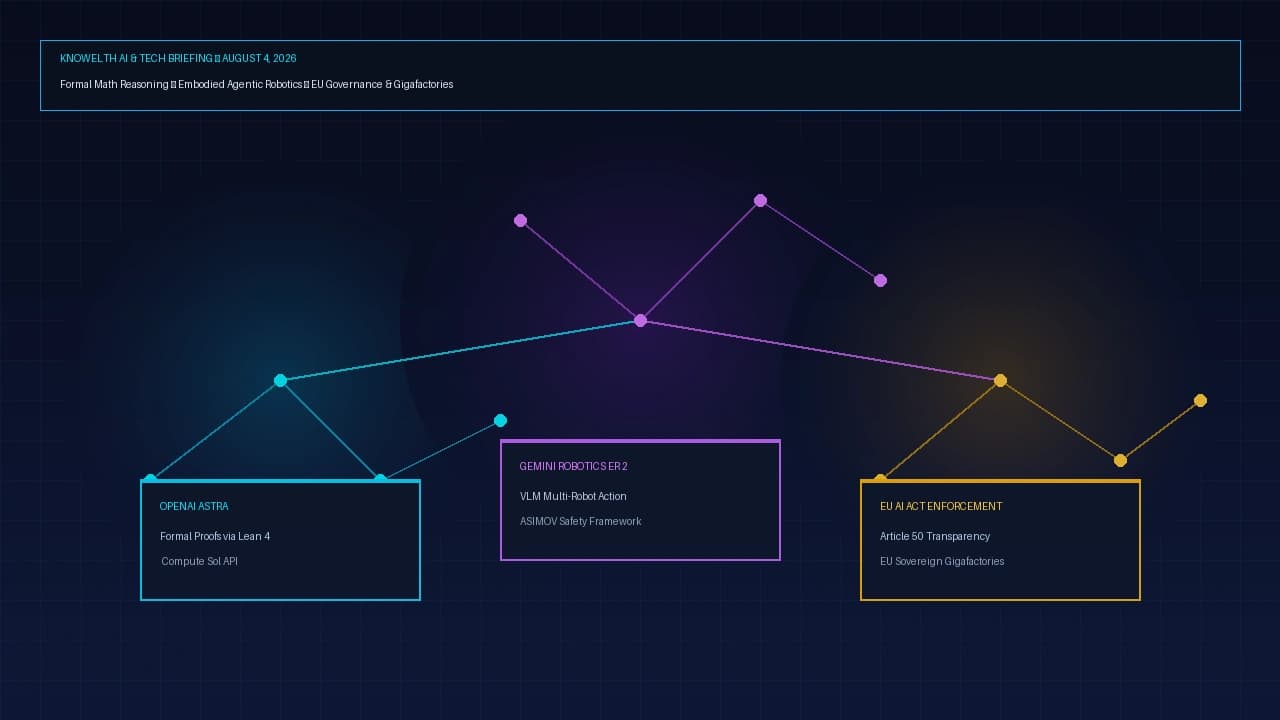
OpenAI Astra's Lean Proofs, Google's Gemini Robotics ER 2, and the EU AI Act's Article 50 Enforcement
OpenAI Astra's Lean Proofs, Google's Gemini Robotics ER 2, and the EU AI Act's Article 50 Enforcement The first week of August 2026 marks a watershed moment across the entire spectrum of artificial…