Reasoning Models, Geopolitical Shifts, and the Local-First AI Revolution
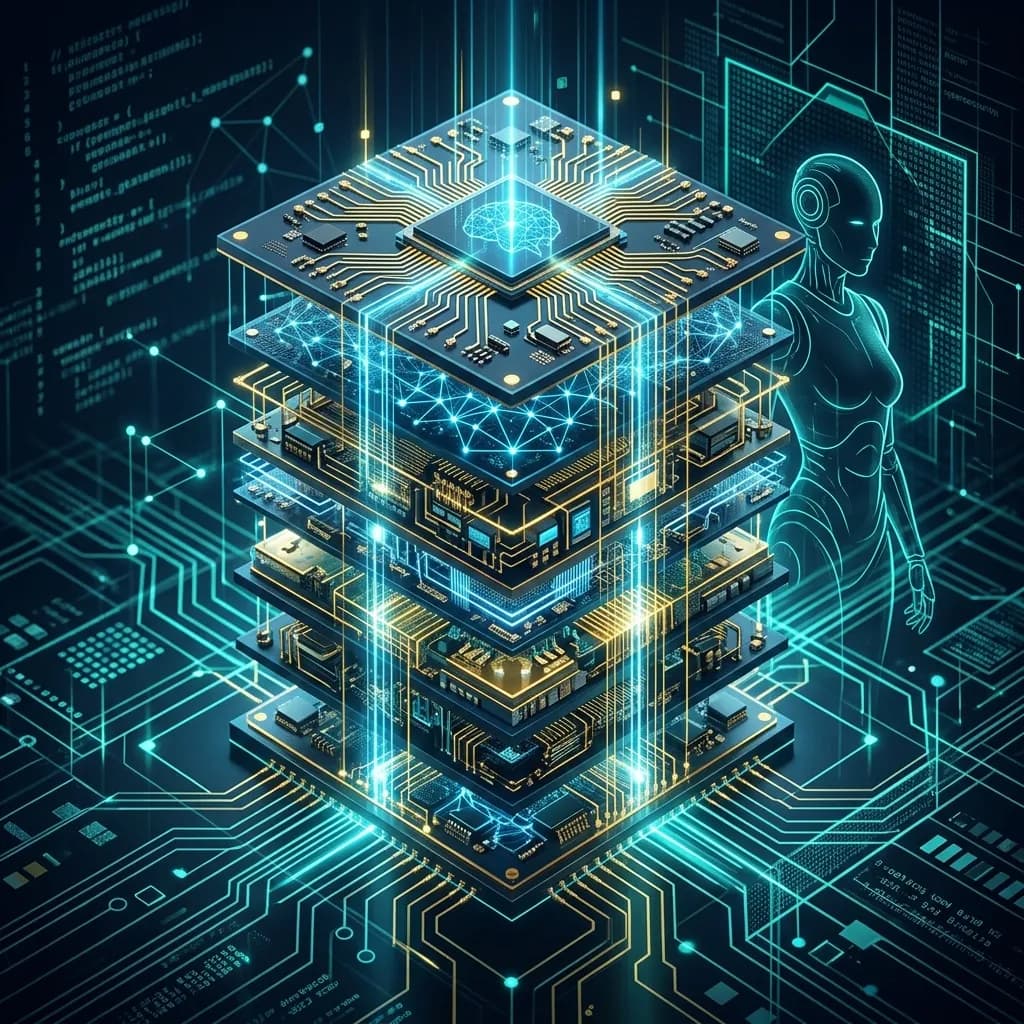
Reasoning Models, Geopolitical Shifts, and the Local-First AI Revolution
The week of June 24, 2026 delivers three interlocking AI trends that are reshaping how developers, enterprises, and governments think about frontier AI. Google's Gemini 2.5 Pro introduces Deep Think — a compute-at-inference-time reasoning mode that rivals human expert deliberation; Anthropic's Fable 5 re-shutdown and restructured comeback reveals the permanent entanglement of frontier AI with export control law; and Google's Gemma 4 spearheads a local-first deployment revolution that is fundamentally decoupling AI capability from cloud dependency.
🤖 Gemini 2.5 Pro Deep Think — Architecture and Benchmarks
What "Reasoning Mode" Actually Means Architecturally
Most LLM responses are generated in a single forward pass — the model processes the input and immediately generates the output token-by-token. "Reasoning mode" breaks this into a structured two-phase process:
Standard generation vs Deep Think:
| Phase | Standard LLM (Pre-2026) | Gemini 2.5 Pro Deep Think |
|---|---|---|
| Phase 1 | None — immediate output generation | Think phase: Extended chain-of-thought scratch pad (not shown to user); model plans, outlines sub-problems, tests hypotheses internally |
| Phase 2 | Output tokens (direct answer) | Respond phase: Model generates final answer conditioned on its internal reasoning chain |
| Compute cost | 1× base cost | 3–8× base cost (varies by problem complexity) |
| Output latency | 0.5–2 seconds | 5–45 seconds |
| Best for | Retrieval, summarisation, translation | Multi-step math, code, legal analysis, scientific reasoning |
Why the 2-million-token context window is significant paired with Deep Think: Previous reasoning models (OpenAI o1, o3) used 8K–32K context windows — meaning they could not load an entire codebase or document corpus into working memory. Gemini 2.5 Pro's 2M token context = approximately:
- ~1,500 pages of text (a full legal contract review set)
- ~100,000 lines of code (a mid-size enterprise codebase)
- ~90 minutes of video (paired with video understanding)
This combination — extended reasoning + massive working memory — enables tasks that were previously impossible for a single model invocation:
| Task Previously Impossible | Now Possible with Gemini 2.5 Pro Deep Think |
|---|---|
| Full codebase security audit | Loads entire codebase, reasons through data flows, identifies vulnerabilities |
| Multi-year contract review | Loads all contracts, cross-references conflicting clauses, outputs structured discrepancy report |
| Scientific paper synthesis | Loads 500+ papers, reasons through methodological contradictions, produces meta-analysis |
| Full-stack debugging | Loads frontend + backend + database schema, traces bug causation across the stack |
Deep Think Benchmark Performance
June 2026 benchmark results (Gemini 2.5 Pro Deep Think vs leading models):
| Benchmark | Gemini 2.5 Pro DT | GPT-4.5 | Claude Fable 5 | Human Expert |
|---|---|---|---|---|
| MMLU-Pro (expert knowledge) | 91.2% | 88.7% | 89.4% | ~89% |
| MATH-500 (competition math) | 97.1% | 93.8% | 95.2% | ~85% |
| SWE-bench Verified (software engineering) | 73.4% | 71.2% | 72.1% | ~72% |
| GPQA Diamond (PhD-level science) | 79.8% | 73.1% | 76.2% | ~69% |
| Codeforces (competitive programming, 2200 Elo) | 2,234 Elo | 2,109 Elo | 2,178 Elo | ~2,200 Elo |
The GPQA Diamond result is the most significant: GPQA Diamond contains questions written by PhD scientists in their own field — questions that non-experts in the field cannot answer even given unlimited time. Gemini 2.5 Pro scoring 79.8% on questions that stump human non-experts in those fields suggests genuine specialised domain competence, not pattern matching.
🌐 Anthropic Fable 5 Export Control Shutdown — What Happened
The Timeline of the June 2026 Fable 5 Incident
| Date | Event |
|---|---|
| June 7 | BIS (Bureau of Industry and Security) issues emergency export control directive targeting specific AI API access |
| June 10 | Anthropic suspends Fable 5 access for all users outside the US (3AM PST) |
| June 10–11 | Enterprises with international operations report API failures; downstream products disrupted |
| June 12 | Anthropic confirms suspension is "regulatory compliance" without specifying BIS directive |
| June 14 | 47 enterprise customers file expedited BIS licence applications for restored access |
| June 20 | BIS grants 30-day temporary licence for covered international users |
| June 23 | Fable 5 returns online — restructured to usage-credit framework for non-US subscribers |
The usage-credit restructuring — what changed: Pre-shutdown, Fable 5 was available to international subscribers on a flat monthly subscription. Post-return:
- International subscribers moved to a usage-credit model — pay per 1M tokens consumed
- Access requires account-level country verification (IP + payment card country + government ID in some regions)
- Restricted regions (under US sanctions or covered by BIS Entity List): China, Iran, Russia, North Korea, Syria, Cuba, Venezuela — complete API block
- "Monitored access" regions (partner countries where BIS is reviewing AI exports): India, UAE, Saudi Arabia, Turkey — access available but usage logs retained for BIS review
The industry-wide lesson: For enterprises, the Fable 5 incident demonstrated that any AI API dependency on a single cloud provider for a frontier model is now an operational risk. The following week, enterprise AI procurement teams across financial services, legal, and healthcare added "export control continuity" clauses to their AI vendor contracts — requiring providers to have geographic redundancy, failover to alternative models, and 72-hour restoration SLAs for regulatory events.
💻 Gemma 4 — The Technical Case for Local-First AI
Why Local-First AI Passed a Critical Threshold in Mid-2026
Hardware capability vs model requirement (mid-2026 consumer hardware):
| Device | RAM | NPU Capability | Gemma 4 Model | Tokens/Second |
|---|---|---|---|---|
| Apple M4 MacBook Pro (16GB) | 16GB | 38 TOPS | Gemma 4-9B (Q4 quant) | ~85 tok/s |
| Apple M4 Max MacBook Pro (64GB) | 64GB | 38 TOPS | Gemma 4-27B (Q4 quant) | ~40 tok/s |
| Windows AI PC (Intel Lunar Lake + NPU) | 32GB | 45 TOPS | Gemma 4-9B (Q4 quant) | ~60 tok/s |
| Nvidia RTX 4090 workstation | 24GB VRAM | 1,321 TOPS | Gemma 4-27B (FP16) | ~180 tok/s |
| Qualcomm Snapdragon X Elite laptop | 32GB | 75 TOPS | Gemma 4-9B (Q4 quant) | ~70 tok/s |
Why 85 tokens/second on an M4 MacBook matters: 85 tokens/second = approximately 63 words per second — faster than a human can read. This means a local model running on an M4 MacBook Pro generates text that a user literally cannot consume faster than the model produces it. The user experience is indistinguishable from a cloud API — but the data never leaves the device.
The Gemma 4 quality vs cloud API comparison:
| Task Category | Gemma 4-27B (local, Q4) | GPT-4o-mini (cloud) | Gemini 1.5 Flash (cloud) |
|---|---|---|---|
| Code completion (HumanEval) | 76.2% | 74.1% | 71.8% |
| Document summarisation | Excellent | Excellent | Excellent |
| Multi-step reasoning (MATH-500) | 68.4% | 70.2% | 65.8% |
| Instruction following (IFEval) | 83.1% | 85.4% | 81.2% |
| Cost per 1M tokens | $0 (local) | $0.60 | $0.30 |
Enterprise economics — the case for local: A software company running GPT-4o-mini for code completion (100 developers, 200K tokens/day each) spends:
- Cloud cost: 100 × 200K × $0.60/1M = $12,000/month = $144,000/year
- Local cost: One-time purchase of M4 Max MacBook Pros for developers = hardware capex only; no ongoing API cost
For enterprises with >50 AI-heavy developers, Gemma 4 local deployment pays back hardware cost in under 6 months compared to cloud API pricing — and eliminates data privacy risk for proprietary codebases.
📌 The Bottom Line
- gemini-25-pro-deep-think: 2-phase architecture: Think (extended chain-of-thought scratch pad, 3-8× compute) + Respond (conditioned on internal reasoning); 2M token context = 1,500 pages or 100K LOC; GPQA Diamond 79.8% (PhD-level questions written by domain experts) = genuine specialised competence signal; MATH-500 97.1%; SWE-bench 73.4%; Codeforces 2,234 Elo (matches 2,200 Elo human competitive programmer).
- anthropic-fable5-export-controls: BIS June 7 emergency directive → June 10 3AM suspension (13 days down) → June 23 return; restructured: international = usage-credit (pay per 1M tokens) + country verification + restricted regions (China/Iran/Russia + 6 others complete block) + monitored access (India/UAE/Saudi Arabia — usage logs retained for BIS); industry response: "export control continuity" clauses added to AI vendor contracts; 72-hour restoration SLA requirement emerging as enterprise procurement standard.
- local-first-gemma4-edge: M4 MacBook Pro (16GB, Q4) = 85 tok/s (faster than human reading speed); Gemma 4-27B code completion 76.2% (beats GPT-4o-mini 74.1%); economics: 100-developer team pays $144K/year cloud API vs $0 local ongoing cost (hardware payback <6 months); data privacy: proprietary codebase never leaves device; Anthropic Fable 5 incident = Exhibit A for single-provider API operational risk → drives local-first procurement.
📬 Stay Updated
Get the best of AI & technology delivered to your inbox every week. Subscribe to our free newsletter →
Disclosure: This post contains affiliate links. If you purchase through our links, we earn a small commission at no extra cost to you. We only recommend products we believe in.
Enjoyed this post?
Get our weekly digest delivered free.
Share this post:
Knowelth is reader-supported. We may earn a commission from links in this article at no extra cost to you. Read our disclosure.
Related Posts
System 2 AI Architectures, NVIDIA's $500B Infrastructure Alliance, and Industrial Physical AI Scale-Up
System 2 AI Architectures, NVIDIA's $500B Infrastructure Alliance, and Industrial Physical AI Scale-Up The artificial intelligence ecosystem is undergoing a fundamental structural transformation this …
AI's Frontier Shift: Autonomous Bio-Design, 0.42nm Semiconductors, and the EU AI Act Governance Horizon
AI's Frontier Shift: Autonomous Bio-Design, 0.42nm Semiconductors, and the EU AI Act Governance Horizon The artificial intelligence landscape has reached a decisive turning point where digital intelli…
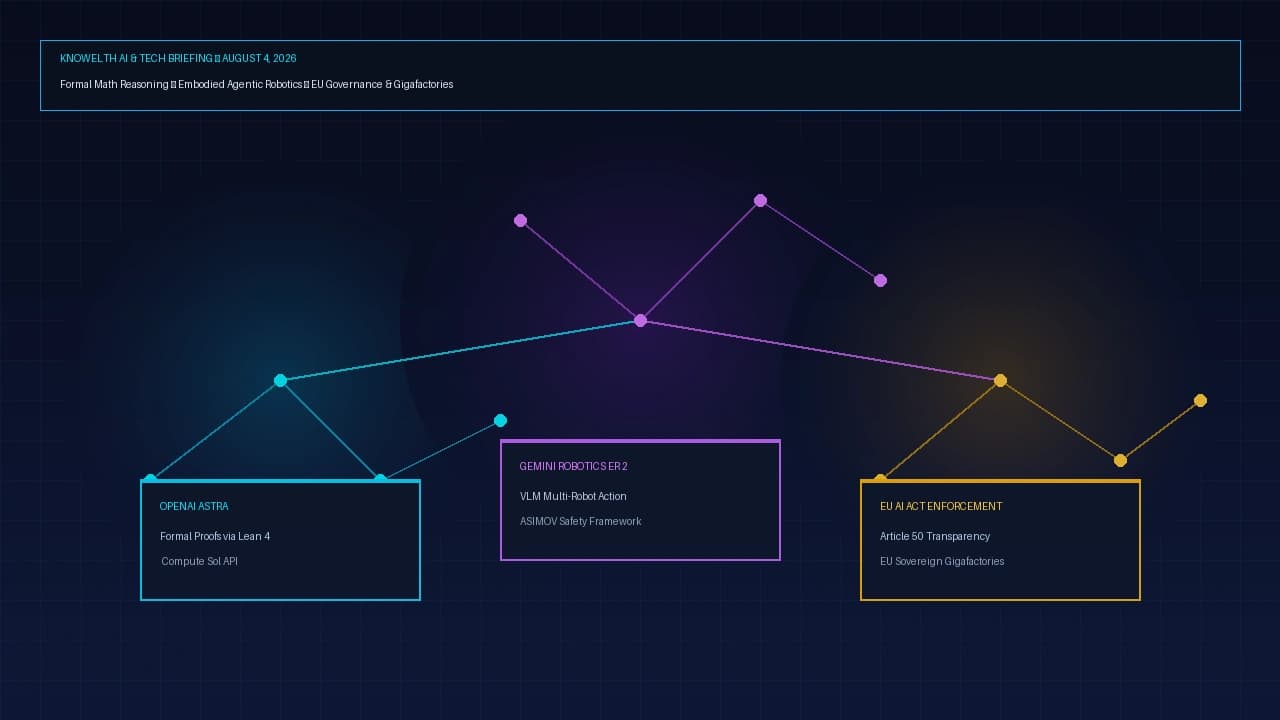
OpenAI Astra's Lean Proofs, Google's Gemini Robotics ER 2, and the EU AI Act's Article 50 Enforcement
OpenAI Astra's Lean Proofs, Google's Gemini Robotics ER 2, and the EU AI Act's Article 50 Enforcement The first week of August 2026 marks a watershed moment across the entire spectrum of artificial…