SambaNova Secures $1B Series F, Mistral AI Releases Robostral Navigate, and India Proposes AI Judicial Regulations

SambaNova Secures $1B Series F, Mistral AI Releases Robostral Navigate, and India Proposes AI Judicial Regulations
Three mid-July 2026 developments define AI's divergence from general-purpose to specialised: SambaNova's $1B Series F ($11B valuation, led by General Atlantic with QIA/BlackRock/Intel Capital) funds the only major inference-specialised silicon alternative to Nvidia for on-premises enterprise deployments — JPMorgan Chase selected SambaNova's SN40/SN50 Reconfigurable Dataflow Architecture for financial workloads. Mistral AI's Robostral Navigate (8B VLA model, July 14) achieves 76.6% on the R2R-CE benchmark for autonomous indoor navigation using only a single RGB camera — no LiDAR, no depth sensors — by training on indoor video tour datasets to construct real-time semantic maps from light alone. And the Supreme Court of India's draft AI judicial regulations close their public consultation with a "human primacy" framework: AI permitted for case management, summarisation, transcription, and translation, but explicitly prohibited from bail decisions, sentencing, or witness credibility assessment — any AI-assisted research must be verified by a human judge before incorporation into a ruling.
🤖 SambaNova $1B Series F — Inference-Specialised Silicon at Enterprise Scale
Why Inference, Not Training, Is the New Investment Thesis
The hardware investment thesis has flipped:
| Year | Investor focus | Why |
|---|---|---|
| 2022–2024 | Training hardware (Nvidia H100 clusters) | Frontier model development = primary AI value creation |
| 2025–2026 | Inference hardware + deployment efficiency | Models already trained; bottleneck is now serving them efficiently at scale |
The cost asymmetry: The $500M spent training GPT-5 is a one-time cost. Serving GPT-5 to users costs $0.01–$15 per million tokens — at 100B+ tokens/day across all OpenAI users = $1M–$150M per day in inference costs. Inference efficiency is now the dominant economic variable.
SambaNova's market position:
| Company | Architecture | Primary use | On-premises? | Nvidia alternative? |
|---|---|---|---|---|
| Nvidia H100/H200 | GPU (CUDA) | Training + inference | ✅ | — (incumbent) |
| Groq | LPU (streaming dataflow) | Ultra-fast inference (1,200+ tok/s) | ✅ | ✅ |
| Cerebras | Wafer-Scale Engine | Large model inference | ✅ | ✅ |
| SambaNova | Reconfigurable Dataflow (RDA) | Production enterprise inference | ✅ | ✅ |
| Cloud (AWS/Azure/GCP) | GPU clusters (rented) | General | ❌ (cloud-only) | N/A |
The $1B Series F — investor structure and significance:
| Investor | Type | Amount/role | Strategic significance |
|---|---|---|---|
| General Atlantic | Lead VC | Largest tranche | Growth equity = commercial scale-out, not R&D bet |
| T. Rowe Price | Institutional fund | Significant | Signals institutional-grade confidence |
| BlackRock | Asset manager | Participant | Long-duration investment = betting on 5-10 year hardware cycle |
| Intel Capital | Strategic VC | Participant | Intel exploring partnership/competitive intelligence |
| Qatar Investment Authority (QIA) | Sovereign wealth fund | Participant | Sovereign AI compute strategy — QIA wants domestic AI infrastructure |
| Capital Group | Institutional | Participant | Signals pre-IPO positioning |
The QIA participation is geopolitically significant: Gulf sovereign wealth funds are investing in sovereign AI chip companies to secure domestic AI compute independence without US cloud dependency.
SambaNova RDA (Reconfigurable Dataflow Architecture) — technical advantage:
| Attribute | Traditional GPU (Nvidia) | SambaNova RDA |
|---|---|---|
| Memory access pattern | Fixed CUDA SIMD | Dynamically reconfigured per model layer |
| Memory bandwidth efficiency | ~40–60% of peak | ~85–95% of peak (dataflow eliminates stalling) |
| Inference latency | High for on-premises scale-out | Low — dataflow avoids memory bottleneck |
| Power consumption at equivalent throughput | 100% (baseline) | ~40–60% of GPU |
| Software ecosystem | CUDA (dominant, mature) | NVIDIA CUDA-compatible layer + proprietary optimisation |
JPMorgan Chase selection — why it matters: JPMorgan Chase selected SambaNova's SN40 + SN50 for on-premises inference (not cloud), citing:
- Data residency: Financial regulations (SEC, OCC, FINRA) require certain AI-processed data to remain on-premises
- Latency: Algorithmic trading and risk models require <10ms inference (cloud round-trip = 50–200ms)
- Cost at scale: At JPMorgan's inference volume (~10B+ tokens/day across banking applications), on-premises RDA hardware is significantly cheaper than cloud API rates
🧭 Mistral Robostral Navigate — RGB-Only Robot Navigation
Why RGB-Only is Commercially Transformative
Current robot navigation sensor landscape:
| Sensor | Cost (retail) | Data output | Limitation |
|---|---|---|---|
| LiDAR (high-end) | $5,000–$15,000 | 3D point cloud (precise distances) | Expensive; heavy; can fail in rain/fog |
| Stereoscopic depth camera | $300–$1,000 | Depth map (less precise than LiDAR) | Poor performance in low texture environments |
| Structured light sensor | $100–$400 | Short-range depth | Very limited range (<3m) |
| Single RGB camera | $20–$80 | Standard 2D image | No inherent depth information |
Replacing a $5,000–$15,000 LiDAR with an $80 RGB camera on a humanoid robot reduces per-unit hardware cost by $4,920–$14,920. For a fleet of 1,000 humanoid robots, this saves $5–15 million in hardware cost alone.
The R2R-CE benchmark — what 76.6% means: R2R-CE (Room-to-Room in Continuous Environments) evaluates an agent's ability to:
- Receive a natural language navigation instruction ("walk down the hallway, turn left past the water cooler, stop near the copy machine")
- Navigate a photorealistic 3D environment it has never seen before
- Arrive at the specified destination without collisions
| Score range | Capability level | Previous best (pre-Robostral) |
|---|---|---|
| 0–30% | Basic direction following; frequent failures | — |
| 30–50% | Simple environments; fails complex instructions | ~42% (2024 state-of-the-art) |
| 50–70% | Most instructions; fails in visually similar corridors | ~65% (early 2026) |
| 70–80% | Commercial viability threshold | Robostral Navigate: 76.6% |
| >85% | Human-equivalent | Not yet achieved |
Robostral Navigate's 76.6% crosses the commercial viability threshold — robots using this model can successfully navigate real office/hospital/warehouse environments in >3 of 4 attempts.
How RGB-only navigation works — the technical mechanism:
| Stage | Process |
|---|---|
| 1. Visual feature extraction | VLA model encodes each RGB frame into spatial feature vectors |
| 2. Semantic scene graph | Model constructs a real-time graph of objects (door, corridor, furniture) + their spatial relationships |
| 3. Monocular depth estimation | Neural network estimates depth from a single image using learned scene statistics + scale priors from training data |
| 4. Natural language grounding | Model maps instruction words ("left", "past the water cooler") to identified objects in the scene graph |
| 5. Trajectory generation | Action space sampling: model outputs velocity commands (forward speed, turn angle) |
| 6. Collision avoidance | Scene graph + estimated depth → "free space" map → trajectory constrained to free space |
Training data — how the model learned depth from video: Robostral Navigate was trained on:
- Millions of indoor video tours (real estate walkthroughs, Google Street View indoor, conference room scans)
- Synthetic 3D environments (Habitat, AI2-THOR) with ground-truth depth for supervision
- Cross-modal training: Match RGB video + LiDAR depth during training → at inference, model predicts what LiDAR would have seen without actually having LiDAR
⚖️ India Supreme Court AI Regulations — "Human Primacy" Framework
The Global Judicial AI Landscape
Why courts worldwide are moving to regulate AI (not ban it):
| Jurisdiction | Status | Approach |
|---|---|---|
| EU | AI Act Article 22 | High-risk AI in justice systems requires human oversight |
| USA | No federal rule | Some state courts (California, New York) have local guidelines |
| UK | Lord Chief Justice guidance (2023) | Judges may use AI for research; not for determination |
| China | Supreme People's Court rules (2023) | AI cannot make final legal decisions |
| India | Draft Regulations (July 2026, public consultation closed) | "Human primacy" — most comprehensive framework to date |
The India draft regulations — permitted vs prohibited:
| AI application | Permitted? | Rationale |
|---|---|---|
| Case docket management + scheduling | ✅ Yes | Administrative; no rights affected |
| Legal document summarisation | ✅ Yes | Tool for judge; not determinative |
| Automated court transcription | ✅ Yes | Factual record; human verification possible |
| Language translation (regional languages) | ✅ Yes | Access to justice; not determinative |
| Legal research assistance | ✅ Yes (with mandatory human verification) | Assistive only; judge must verify before use in ruling |
| Bail decisions | ❌ Prohibited | Liberty at stake; algorithmic bias risk |
| Sentencing guidelines | ❌ Prohibited | Constitutional due process; no AI may determine punishment |
| Witness credibility assessment | ❌ Prohibited | Credibility is inherently human judgment |
| Autonomous legal determination | ❌ Prohibited | Judicial authority is constitutionally vested in human judges |
The "human primacy" principle — legal basis: The Indian draft regulations ground the human primacy principle in:
- Article 21 of the Indian Constitution (Right to Life and Personal Liberty) — algorithmic bail denial without human reasoning = constitutional violation
- Natural justice principles (audi alteram partem — right to be heard; nemo judex in causa sua — no one shall be judge in their own cause) — AI systems lack the capacity to reason about contextual justice
- Judicial accountability: A human judge is personally accountable for a ruling; an algorithm has no legal personhood
The transparency mandate: Any AI usage in court proceedings must be disclosed to all parties:
- Defence counsel must be informed if the prosecution used AI-assisted legal research
- Both parties can challenge the AI-generated analysis
- The judge must explicitly state how AI assistance was used (if at all) in the written ruling
Why this matters for global legal AI: India has the world's largest court caseload by volume — over 40 million pending cases across all courts. If India's AI regulations enable efficient AI-assisted case management while prohibiting autonomous determination, it creates the largest live test of the "AI as assistant, human as decision-maker" model in judicial systems worldwide.
📌 The Bottom Line
- sambanova-1b-series-f-reconfigurable-dataflow: Investment thesis shift: 2022-2024 training (one-time $500M) → 2025-2026 inference (daily cost at scale = $1-150M/day); $1B at $11B valuation; QIA sovereign wealth fund participation = Gulf sovereign AI compute independence strategy; RDA vs GPU: 85-95% memory bandwidth efficiency (vs 40-60% GPU), 40-60% power at equivalent throughput; JPMorgan Chase SN40/SN50 selection: data residency regulations + <10ms latency requirement + on-premises cost at 10B+ tokens/day.
- mistral-robostral-navigate-rgb-76pct-r2r: RGB camera $20-80 vs LiDAR $5,000-15,000 = $4,920-14,920 saved per robot (1,000-robot fleet: $5-15M hardware cost); 76.6% R2R-CE crosses commercial viability threshold (50-70% = too low for deployment; >70% viable; >85% = human-equivalent not yet achieved); RGB-only: VLA encodes frames → semantic scene graph → monocular depth estimation (trained with LiDAR supervision → infers depth at inference without LiDAR) → natural language grounding → trajectory + collision avoidance; trained on millions of indoor video tours + synthetic 3D environments with ground-truth depth.
- india-supreme-court-ai-judicial-regulations: Most comprehensive global judicial AI framework (EU Article 22/UK Lord Chief Justice/China Supreme Court all less detailed); permitted: case management + summarisation + transcription + translation + research (with mandatory human verification); prohibited: bail + sentencing + witness credibility + autonomous legal determination; grounded in Article 21 (Liberty) + natural justice principles (audi alteram partem) + judicial accountability (AI has no legal personhood); transparency mandate: AI use must be disclosed to all parties; 40M+ pending Indian cases = world's largest live test of AI-as-assistant judicial model.
📬 Stay Updated
Get the best of AI & technology delivered to your inbox every week. Subscribe to our free newsletter →
Disclosure: This post contains affiliate links. If you purchase through our links, we earn a small commission at no extra cost to you. We only recommend products we believe in.
Enjoyed this post?
Get our weekly digest delivered free.
Share this post:
Knowelth is reader-supported. We may earn a commission from links in this article at no extra cost to you. Read our disclosure.
Related Posts
System 2 AI Architectures, NVIDIA's $500B Infrastructure Alliance, and Industrial Physical AI Scale-Up
System 2 AI Architectures, NVIDIA's $500B Infrastructure Alliance, and Industrial Physical AI Scale-Up The artificial intelligence ecosystem is undergoing a fundamental structural transformation this …
AI's Frontier Shift: Autonomous Bio-Design, 0.42nm Semiconductors, and the EU AI Act Governance Horizon
AI's Frontier Shift: Autonomous Bio-Design, 0.42nm Semiconductors, and the EU AI Act Governance Horizon The artificial intelligence landscape has reached a decisive turning point where digital intelli…
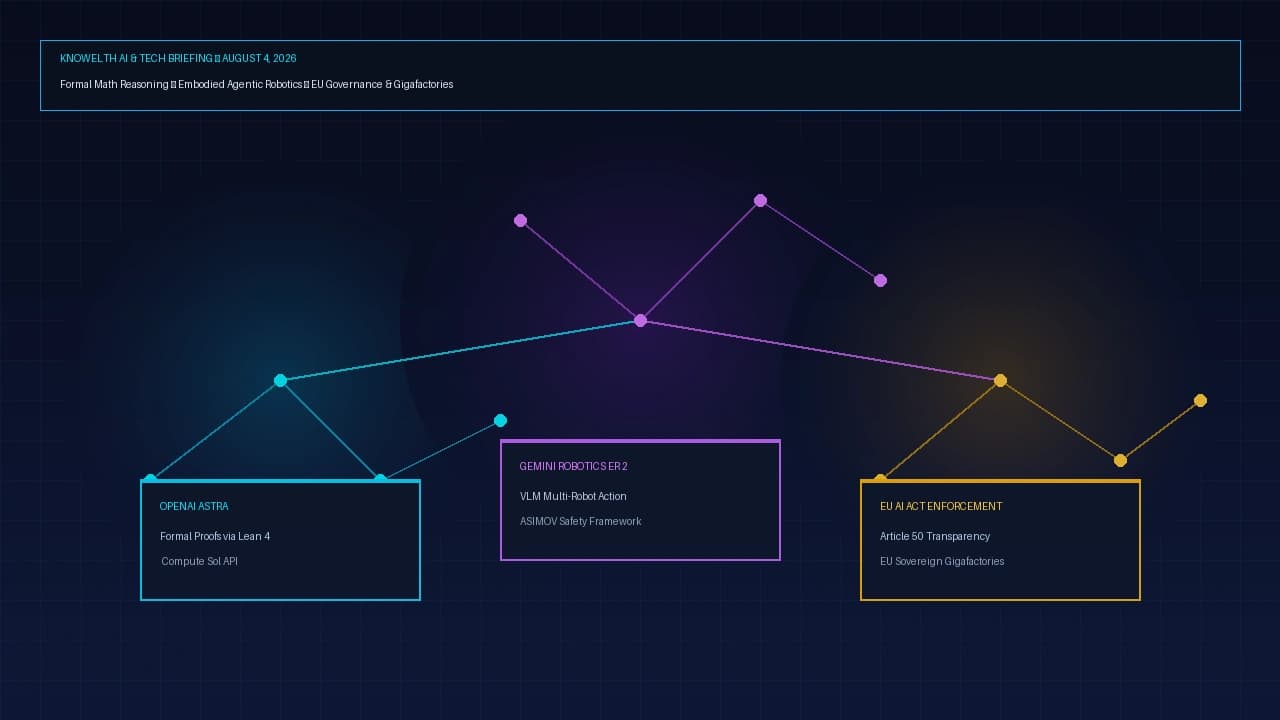
OpenAI Astra's Lean Proofs, Google's Gemini Robotics ER 2, and the EU AI Act's Article 50 Enforcement
OpenAI Astra's Lean Proofs, Google's Gemini Robotics ER 2, and the EU AI Act's Article 50 Enforcement The first week of August 2026 marks a watershed moment across the entire spectrum of artificial…