GPT-5.6 and the Dawn of Real-Time Agentic AI Infrastructure
GPT-5.6 and the Dawn of Real-Time Agentic AI Infrastructure
The technology landscape of mid-2026 marks a historic turning point: the transition from conversational AI "copilots" to fully autonomous, real-time agentic software architectures. Led by the unveiling of OpenAI’s GPT-5.6 alongside next-generation inference hardware and unified storage networks, the industry has shifted its primary focus from model parameters to execution throughput, long-term state retention, and multi-agent coordination.
Where previous model generations focused on raw generative quality and conversational fluency, GPT-5.6 and its surrounding ecosystem target direct action execution—orchestrating enterprise workflows, generating self-correcting software pipelines, and managing complex multi-modal environments with sub-second latency. This landmark release, combined with steep price reductions across state-of-the-art inference engines, sets the stage for a fundamental restructuring of how software, hardware, and digital services interact.
🚀 The Announcement: What Was Introduced
The mid-2026 release cycle has redefined artificial intelligence standards across four major pillars:
-
GPT-5.6 and Native Agentic Execution: OpenAI introduced GPT-5.6, engineered specifically for multi-step reasoning, persistent memory, and native tool execution. Unlike its predecessors, which relied heavily on outer wrapper frameworks to manage external tool calls and multi-turn planning, GPT-5.6 incorporates a native deterministic agentic runtime embedded directly into the model's core transformer architecture.
-
The Great Model Price Reset: Alongside GPT-5.6, competing announcements including SpaceXAI’s Grok 4.5 and Meta’s Muse Spark 1.1 have triggered an aggressive economic realignment. High-throughput inference pricing for frontier models has dropped into the $1.00–$2.00 per million token tier, making continuous, multi-agent automated execution commercially viable at enterprise scale for the first time.
-
Inference-First Hardware Acceleration: Hardware vendors, led by WekaIO’s NeuralMesh 6 storage architecture and NVIDIA’s edge physical AI systems, announced purpose-built hardware appliances explicitly optimized for retrieval-augmented generation (RAG) KV-cache sharing and low-latency long-context memory.
-
Multi-Agent Orchestration Standards: Industry leaders have aligned around open protocol specifications for inter-agent communication, allowing disparate autonomous agents—from backend code refactoring engines to automated compliance auditors—to securely pass state, assign sub-tasks, and verify transaction receipts without human middleware.
This combined shift signals that the era of passive chatbot interaction has officially ended, replaced by an ecosystem where autonomous software agents execute complex business processes end-to-end.
🧠 How It Works: The Tech Breakdown
To understand why GPT-5.6 represents a structural leap forward, it is essential to examine the architectural breakthroughs underlying native agentic intelligence.
1. Embedded Planning and Native Latent Scratchpads
Traditional LLM tool usage relied on structured text output (such as JSON or function call strings) parsed by client SDKs. If a model made a logical error mid-execution, the entire context window had to be updated with feedback loops, compounding latency and token costs.
GPT-5.6 addresses this via Latent Space Reasoning (LSR). Before emitting outward API payloads or code execution blocks, the model computes internal intermediate state trajectories within hidden layer representations. This internal "scratchpad" enables the model to test multiple path executions, evaluate potential runtime errors, and verify algorithmic constraints prior to issuing external system calls.
2. Hierarchical Context Compression and Cache Sharing
Handling multi-hour, enterprise-grade workflows requires maintaining coherent context across tens of millions of tokens. GPT-5.6 utilizes a dual-tier attention system:
- Episodic Flash Cache: A hardware-accelerated KV-cache layer residing directly on high-speed NVMe storage fabrics (e.g., WekaIO NeuralMesh 6). This allows instant context switching across asynchronous agent tasks without recomputing prompt embeddings.
- Semantic Recurrent Compression: Background attention heads dynamically summarize prior task iterations into dense vector embeddings, maintaining structural project memory while preventing exponential context growth.
+-----------------------------------------------------------------------+
|                         GPT-5.6 Core Engine                           |
|                                                                       |
|   +-----------------------+               +-----------------------+   |
|   | Latent Reasoning      | ------------> | Tool Execution        |   |
|   | Scratchpad (LSR)      |               | Sub-System            |   |
|   +-----------------------+               +-----------------------+   |
|               |                                       |               |
+---------------+---------------------------------------+---------------+
                |                                       |
                v                                       v
+------------------------------------+    +-----------------------------+
| Episodic Flash Cache (NVMe Fabric) |    | Native Multi-Agent Protocol |
+------------------------------------+    +-----------------------------+
3. Self-Correcting Execution Loops
When integrated with code generation and system command interfaces, GPT-5.6 implements real-time feedback evaluation. Upon generating code or executing terminal commands, the agent listens to standard output, error streams, and environment metrics. If an exception occurs, the latent scratchpad isolatedly isolates the line of failure, mutates the state variables, and re-executes the directive within milliseconds.
🌐 Market Impact & Future Implications
The arrival of production-grade agentic AI infrastructure creates profound ripple effects across software development, enterprise operations, and cloud economics.
1. The Death of Static Software Pipelines
Traditional software architectures rely on hardcoded conditional logic, deterministic APIs, and fixed ETL pipelines. With low-cost, ultra-reliable agentic models, software engineering is shifting toward Goal-Oriented Declarative Systems. Developers specify inputs, outputs, and safety constraints, leaving the path execution, error mitigation, and third-party API integration to autonomous agent swarms.
2. Economic Restructuring of Cloud Compute
As training costs flatten out due to high algorithmic efficiency, cloud providers are reallocating capital expenditure from giant training clusters toward Inference-At-Scale. Gartner forecasts global AI model and platform spending to reach $64 billion in 2026, driven primarily by generative inference workloads running continuously 24/7.
3. Regulatory and Governance Challenges
The European Commission's recent mandates requiring open platform interoperability highlight growing scrutiny around AI autonomy. As autonomous agents execute financial transactions, alter production databases, and modify infrastructure configurations, enterprise legal and compliance teams are mandating rigorous Agent Auditability Frameworks—cryptographic logs detailing every latent decision trajectory and authorization handoff.
🛠️ Practical Takeaways for Developers & Users
For software engineers, architects, and technical leaders, adapting to the agentic AI era requires updating design patterns and development workflows immediately.
Key Recommendations:
-
Design for Agent Interoperability: Build APIs and microservices with machine-readable OpenAPI specifications and structured error responses. Ensure services return descriptive diagnostic payloads rather than generic status codes so agents can self-correct when API errors occur.
-
Leverage Shared Cache Architectures: Transition self-hosted and cloud RAG pipelines to utilize persistent KV-cache solutions. Storing context prefixes and dynamic system prompts in high-speed flash cache dramatically reduces latency and inference costs across high-frequency agent requests.
-
Implement Strict Control Flow & Guardrails: Never grant autonomous agents unrestricted system-level permissions. Utilize sandboxed container environments (e.g., gVisor, WebAssembly runtimes) with strict memory, CPU, and network egress policies for executing agent-generated code.
-
Adopt Multi-Agent Orchestration Patterns: Break monolithic prompts into specialized, modular agent roles (e.g., Code Generator, Security Auditor, Test Verification Specialist). Delegate coordination to lightweight router models while reserving frontier reasoning models like GPT-5.6 for complex planning and edge-case resolution.
Sample Modular Agent Call (Conceptual Python Interface):
from openai import OpenAI
import os

client = OpenAI(api_key=os.environ.get("OPENAI_API_KEY"))

response = client.chat.completions.create(
    model="gpt-5.6-agentic-preview",
    messages=[
        {
            "role": "system",
            "content": (
                "You are an autonomous DevOps Refactoring Agent. "
                "Execute code audits, verify test suites, and generate patches."
            )
        },
        {
            "role": "user",
            "content": "Audit and optimize database query caching in service module user_auth.py"
        }
    ],
    temperature=0.2,
    extra_body={
        "latent_scratchpad": True,
        "max_execution_steps": 10,
        "sandbox_mode": "enforced"
    }
)

print("Agent Plan & Execution Output:")
print(response.choices[0].message.content)
Summary Matrix: Copilots vs. Agentic Infrastructure
| Dimension | Copilot Era (2023–2025) | Agentic Infrastructure Era (2026+) |
|---|---|---|
| Primary Interaction Mode | Conversational Chat Prompts | Goal-Driven Autonomous Execution |
| Context Management | Fixed Context Windows (Re-computed) | Persistent Flash KV-Caching & Hierarchical Compression |
| Execution Latency | Multi-second human-in-the-loop wait times | Sub-second real-time background execution |
| Error Handling | Manual human prompt re-framing | Automated latent scratchpad self-correction |
| Cost Trajectory | High per-request cost ($20-$60/1M tokens) | Ultra-low production inference ($1-$2/1M tokens) |
Conclusion
The release of GPT-5.6 and the surrounding shift toward real-time agentic AI infrastructure represents much more than an incremental model update. It marks a foundational evolution in computing where software systems actively plan, execute, and self-heal. Developers and enterprises that embrace goal-oriented architectures, agentic guardrails, and optimized inference layers will define the next decade of technology innovation.
Enjoyed this post?
Get our weekly digest delivered free.
Share this post:
Knowelth is reader-supported. We may earn a commission from links in this article at no extra cost to you. Read our disclosure.
Related Posts

System 2 AI Architectures, NVIDIA's $500B Infrastructure Alliance, and Industrial Physical AI Scale-Up
System 2 AI Architectures, NVIDIA's $500B Infrastructure Alliance, and Industrial Physical AI Scale-Up The artificial intelligence ecosystem is undergoing a fundamental structural transformation this …

AI's Frontier Shift: Autonomous Bio-Design, 0.42nm Semiconductors, and the EU AI Act Governance Horizon
AI's Frontier Shift: Autonomous Bio-Design, 0.42nm Semiconductors, and the EU AI Act Governance Horizon The artificial intelligence landscape has reached a decisive turning point where digital intelli…
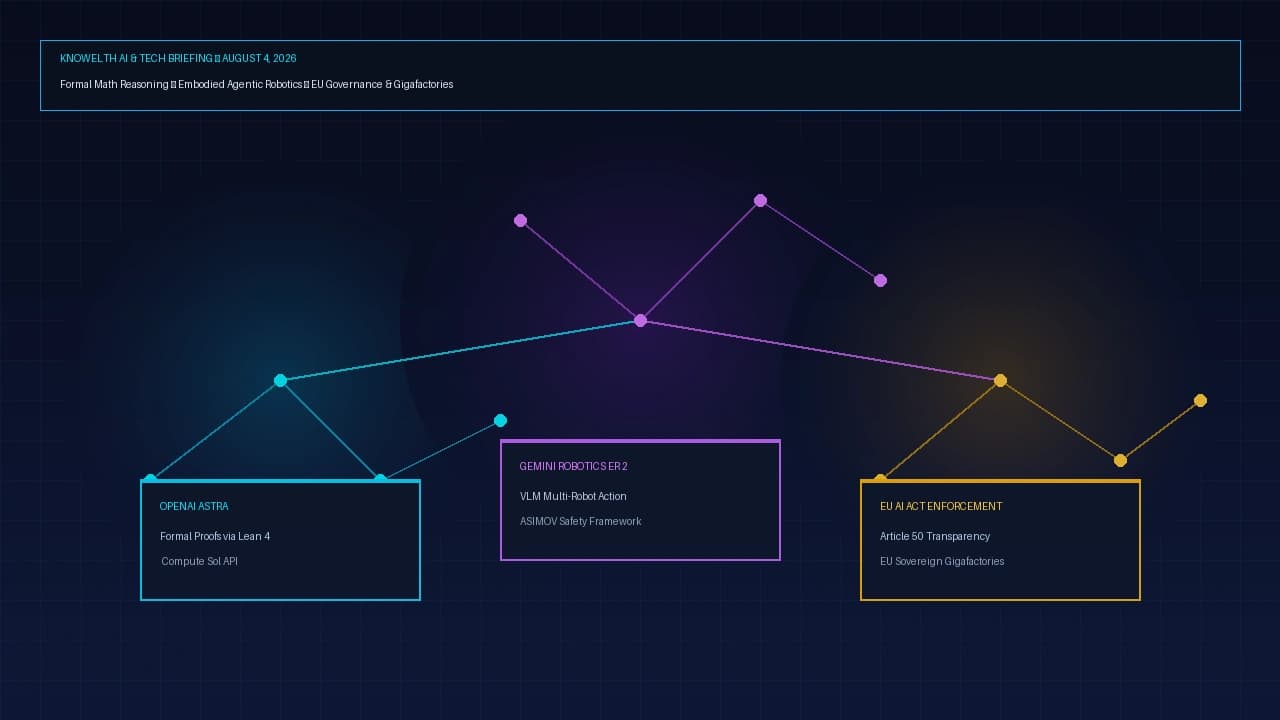
OpenAI Astra's Lean Proofs, Google's Gemini Robotics ER 2, and the EU AI Act's Article 50 Enforcement
OpenAI Astra's Lean Proofs, Google's Gemini Robotics ER 2, and the EU AI Act's Article 50 Enforcement The first week of August 2026 marks a watershed moment across the entire spectrum of artificial…